In 1959, a short memoir about a forgotten queen contained a single sentence that has lingered ever since. It said there was a rumor that she had once been briefly engaged to Philip. No date.
No source. No confirmation from either of them. One line in a book about a man who spent 70 years married to someone else.
The woman in that line was not a stranger to him. She was the cousin who had been there from the beginning. Before the navy, before Britain, before everything.
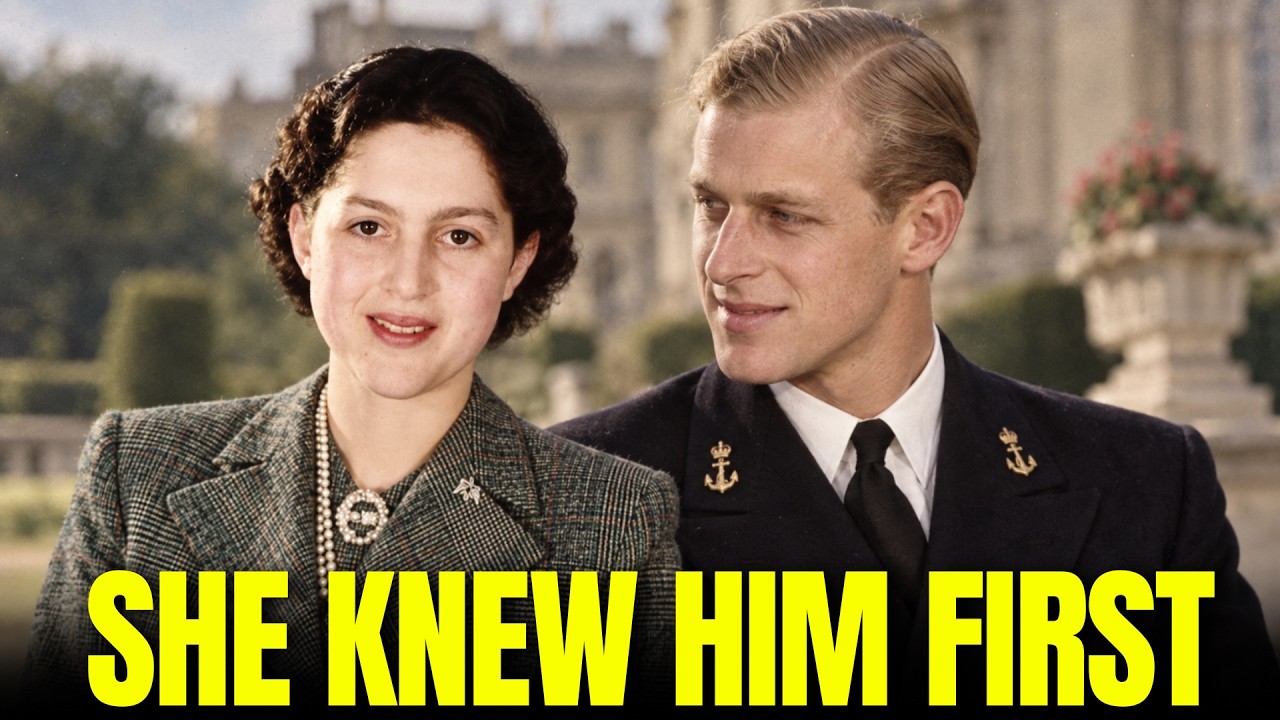
Her name was Alexandra of Greece and Denmark, and she was his first cousin.
Twelve years after Philip’s wedding, she sat down and wrote a book about him. It ran 218 pages and was published under her name with her title on the cover: Queen of Yugoslavia. A queen who held the title for 20 months and never once set foot in the country.
This is the story of the person who knew Philip the longest and ended up with the least.
They were born in the same year, into the same family, and both lost a homeland before they could walk. Alexandra was born in Athens on March 25, 1921. Her father, King Alexander of Greece, had died five months earlier.
He was 27 years old and died of blood poisoning after being bitten by a pet monkey. He had taken the throne in 1917 at age 24 after his father was deposed and his older brother was passed over. He reigned for three years and was not allowed to choose anything, including his wife.
Alexandra’s mother, Aspasia Manos, had married the king secretly. The marriage was unequal, meaning the family did not recognize it. So the child had no title, no status, no place in the royal house she was born into.
In July 1922, a law was passed recognizing such marriages retroactively, and she became Princess Alexandra of Greece and Denmark. The law was issued at the request of her grandmother, the Dowager Queen Sophia, sister of the German Kaiser. At 18 months old, she was already a princess by act of parliament.
Her place in the family was granted by law rather than birth, and laws can change.
The other child was born in June 1921 in Corfu, the son of Prince Andrew of Greece. Andrew and Alexander were brothers. That made the two children first cousins, born just three months apart.
Within 18 months, Andrew was arrested, tried before a revolutionary court, and exiled for life. The family left Greece on a British warship. Greece had just lost a war against Turkey, and six senior figures of the old regime had been executed after similar trials.
Andrew was one of the few who survived. Philip was carried out in a crib made from an orange crate.
Alexandra and her mother followed the family into exile in 1924. Two small children, worthless passports, and a family scattered across Europe. The Greek royal family in those years was a group of people moving between borrowed villas in Italy, France, Switzerland, and England, depending on the generosity of wealthier relatives.
Italy was the first place they settled. From 1924, Alexandra and her mother lived in Florence with her grandmother, the Dowager Queen Sophia. A villa outside the city, shuttered rooms in the afternoon, and a garden full of children with titles and nowhere to go.
The house was crowded with exiled Greek relatives, including two boys her age. One of them was Philip.
The three-month age gap made them natural allies in a house full of adults. He had no parents in that house. His father was in France, his mother was ill, and he moved between relatives for most of that decade.
She had a fiercely protective mother and no father at all. Together, they formed a complete unit. Her mother was a commoner who had barely been accepted by the family.
His mother was in a sanatorium. Neither child fully belonged to the royal house they were born into.
This is the part of the story that no one else could tell. And she told it 35 years later in her writing. The boy in those pages is not the man the world later knew.
He was loud, argumentative, and always moving. He swam, sailed, climbed things, and broke things. He arrived at the house with almost no luggage and left when the adults decided, which made him easy to live with.
She was the little cousin who was always there when he came back. Not a sister, not a school friend, not one of the wealthy English relatives who paid for his education. She was his age and in his situation, someone he never had to explain anything to.
Philip at six drawing sandcastles for her. She was five. It is the earliest description of him ever published by anyone, and it comes from a playmate, not a biographer.
Then the family as seen from the inside. A father tried for treason and exiled forever. A mother with deafness.
Rooms in Paris with no money. None of this was known to the public in 1959. The Duke of Edinburgh was a national figure by then, and she was his cousin describing the years before anyone in Britain knew him.
One detail was so specific it has been repeated ever since. She wrote in her book that he used to sell carpets on the streets of Saint-Cloud. A Greek prince in a Paris suburb selling carpets.
What happened to each of them next is why the friendship lasted. In 1927, Alexandra and her mother moved to England and settled near Ascot, where she was placed in a boarding school. She hated it.
Separated from her mother, she stopped eating and became seriously ill, and her mother had to take her to Switzerland to recover. Then they settled in Venice, which would matter later. Venice between the wars was full of exiled aristocrats living cheaply in borrowed palaces, and that was the point.
Philip’s childhood was falling apart differently at the same time. His father moved to the south of France and lived apart from the family. His mother was committed to a sanatorium and treated for mental illness.
He did not see her for years. He moved between relatives in France, Germany, and England, and was eventually sent to a school in Scotland. Three of his four sisters married German princes in a single year, 1931, and the fourth followed.
By the mid-1930s, his closest family was on the other side of what was coming.
Two cousins, both children of a dynasty that no longer had a throne. Both living out of suitcases in other people’s houses. They kept meeting through the 1930s wherever exiled families gathered.
Weddings, funerals, summers at an aunt’s house, Christmas at whoever had a home. Those gatherings fill her pages, described by someone who was a child in them. Queen Mary telling fairy tales to the children.
A saxophone played in Kensington Palace. The uncles who took him in, Georgie and Dickie.
No other witness to Philip’s childhood ever published an account of it. She is effectively the only one who did. When biographers describe the poverty in Paris, the uncles, or the homeless boy, many of them are drawing on her indirectly.
By the late 1930s, both were old enough to be looked at differently. In 1937, Alexandra was presented in Paris, where she danced with her cousin, the Duke of Windsor. He had abdicated the British throne a few months earlier to marry an American divorcée and was living with her in France.
So a 16-year-old princess with no money danced with the most famous abdicated king in the world, and someone recorded it.
It is at this point in her life that the sentence which began this story appears. A rumor that she was briefly engaged to Philip. One sentence in one account, with no dates attached and no evidence to support it.
That is exactly why such things survive. Hard to verify, hard to abandon. Neither of them ever confirmed it.
Neither of them ever denied it either.
As far as the records show, it was not a ridiculous idea at the time. Marriages between royal cousins were customary. Philip’s own parents were related.
All four of his sisters married German princes. And they were close. That much is not disputed and she never hid it.
The question the rumor raises is different. Was there a point before Dartmouth, before the navy, before the 13-year-old princess at the British naval college, where the obvious thing nearly happened?
If it existed, it left no trace. No letters, no photos of the two of them alone, no family account beyond that single line. Even if it never happened at all, the rumor tells you something.
It tells you that the people who knew them together thought it was plausible.

There is something else in her book that seems strange next to that. She wrote about his first love at age 17 during a summer in Venice. Venice was where she and her mother had settled.
The book does not say the girl was her, and this story will not say that either. But she was there, and she chose to put that summer in the story.
In April 1941, German forces invaded Greece. Alexandra and her mother managed to get out and reached London. The Greek royal family went into exile again, this time to Egypt, South Africa, and England.
Philip’s mother stayed in occupied Athens. So did half the monarchs of Europe, from Norway, Holland, Yugoslavia, and Greece. Kings and queens living in hotels and rented houses with governments in exile and no countries to rule.
London in those years hosted more homeless monarchs than any city in history. Most of them never ruled again.
Philip was in London too, between his duties in the Royal Navy. His future was being arranged around him while he was at sea. His uncle Dickie had decided years earlier where the boy would end up, and the war gave him the opportunity.
A stateless Greek prince was a problem. A decorated British naval officer with a new surname was a solution.
Alexandra watched this happen closely. She attended the same dinner parties in the same houses in the same displaced society, and she knew the boy in question since he was six. By then he was no longer the boy drawing in the sand.
He was an officer in his twenties, and the family was talking about his future differently. So was the British royal family. The princess he met at Dartmouth in 1939 was corresponding with him.
Alexandra knew the price of marrying someone on a throne because she was going through the same experience at the same time, in the same city, against the same kind of opposition. Philip needed the approval of a British king for his marriage. Alexandra needed the approval of a Yugoslav government in exile for hers.
Both received the answer: not now.
In that city, in that strange society of the displaced, Alexandra met the man she would marry. He was King Peter II of Yugoslavia, on the throne since age 11 after his father was assassinated in France. In April 1941, ten days after a pro-British coup put him in power at 17, German forces invaded his country and he fled to London.
Two exiled royals in their early twenties in a city under bombardment. They fell in love quickly and wanted to marry. Everyone around them said no.
His mother, Queen Marie, was against it. So was the Yugoslav government in exile, which was running a war and did not want a wedding. The engagement was delayed for nearly two years.
For most of that time, the couple could only meet at the London home of Marina, Duchess of Kent, who was a cousin to both of them. Marina was also Philip’s first cousin. The same small circle keeps repeating.
They married on March 20, 1944, at the Yugoslav embassy in London. She was 22, he was 20, and he wore RAF uniform. The ceremony was held in two languages by Serbian and Greek Orthodox priests.
White satin, lace veil, incense, and two sets of prayers in two alphabets.
The guest list is worth reading twice. King George VI of Britain, King Haakon of Norway, King George II of Greece, Queen Wilhelmina of the Netherlands, the Duke of Gloucester, and the Duchess of Kent. Four kings and three queens in a diplomatic mission building in wartime London, witnessing the marriage of two young exiles.
Nearly every crown in that room, with one exception, was either under enemy occupation or about to disappear. The one person not present was the groom’s mother. Queen Marie refused to attend her son’s wedding.
Philip’s name does not appear in the attendance records. He was at sea for most of that period, which is the most likely explanation.
Alexandra later wrote about the journalists and photographers lined up outside Claridge’s Hotel that morning and around the mission building. She was queen for about 20 months. On July 17, 1945, her son Alexander was born in their suite at Claridge’s in Mayfair.
The story always told is that King George VI declared the suite Yugoslav territory for one day, so the boy could be born on his own soil. Historians have questioned whether that legally happened. But the story has been told for 80 years because it is a good story.
On November 29, 1945, the Communist assembly in Belgrade abolished the monarchy. Peter was deposed. Alexandra stopped being queen.

Their property and assets were confiscated. Within five years, the thrones of Yugoslavia, Romania, Bulgaria, Albania, and Italy all vanished. Greece kept its monarchy until 1974.
She held the title for 20 months and never visited Yugoslavia. Not once.
The dates are two years apart, and that is where the paths of the two cousins diverge forever. In November 1945, she lost a throne. In November 1947, Philip walked into Westminster Abbey and married the heir to the British throne.
He had renounced his Greek titles and taken a British family name four months earlier, a trade that Alexandra was never able to make. A Greek prince could become British. A Greek princess married to a deposed Yugoslav king remained exactly what she was.
One spent the next 70 years inside a palace. The other spent them in rented apartments across four countries. What happened to her after 1945 is the part no one tells.
They lived in France, then Switzerland, then moved to the United States in 1949. Four countries in four years with a small child and whatever money could be managed. There was no money.
The marriage strained under the constant search for income and her husband’s private life. Eventually, they separated. He settled in America.
She took their son and moved to Venice with her mother.
In the middle of that, she began to write. In 1956, she published a memoir of her own life. It was translated into French the following year.
In 1959, she published “Prince Philip: A Family Portrait.” 218 pages about her cousin, written by a woman with no homeland, no throne, and no income. The book covered the member of the family who had come out of the same wreckage and landed in Buckingham Palace.
What makes the book remarkable rather than bitter is that there is no resentment in it. The sandcastles are there. So is Queen Mary telling fairy tales, the saxophone in Kensington Palace, and the uncles who raised him, Georgie and Dickie.
She wrote about Dartmouth in 1939 and about the love story she and her husband watched closely during the war years. She watched her cousin court the future Queen of England in the same years her own crown was being taken from her. There is no bitterness in the book about that.
If she felt any, she kept it out of the manuscript.
The difference is that she did not stay silent. She wrote it, put her name on it, and allowed it to be sold in bookshops. Much of what the world thinks it knows about Philip’s childhood comes from those pages.
The book had a second life in libraries and used bookstores, and it is still quoted today, usually without her name.
Peter died on November 3, 1970, in Denver, Colorado, after a failed liver transplant. He was 47, a king for 10 years and in exile for 29. He was buried in Illinois, the only European monarch buried in the United States.
A Serbian monastery church in the American Midwest, 4,000 miles from the throne he lost at 22.
Alexandra’s mother, Aspasia, died in 1972. Alexandra spent her final years in a care home in England. She died on January 30, 1993, in Burgess Hill, Sussex.
She was 71. Philip was still alive, still working, and would live for another 28 years.
In 2013, her remains and her husband’s were transferred to Serbia and buried together in the royal mausoleum at Oplenac. She reached her husband’s country 68 years after she stopped being its queen.
So what do you do with that single line about the engagement? You cannot prove it. No one else can either.
It may be just a rumor that attached itself to two cousins who were simply close. What is certain is that she knew him before almost anyone who later wrote about him. Before the navy, before the name change, before the abbey.
And when she lost everything that once made her his equal, she wrote about him kindly and at length for history. She was not settling scores or correcting anyone’s impressions. She was saying, in her own words, that she was there.