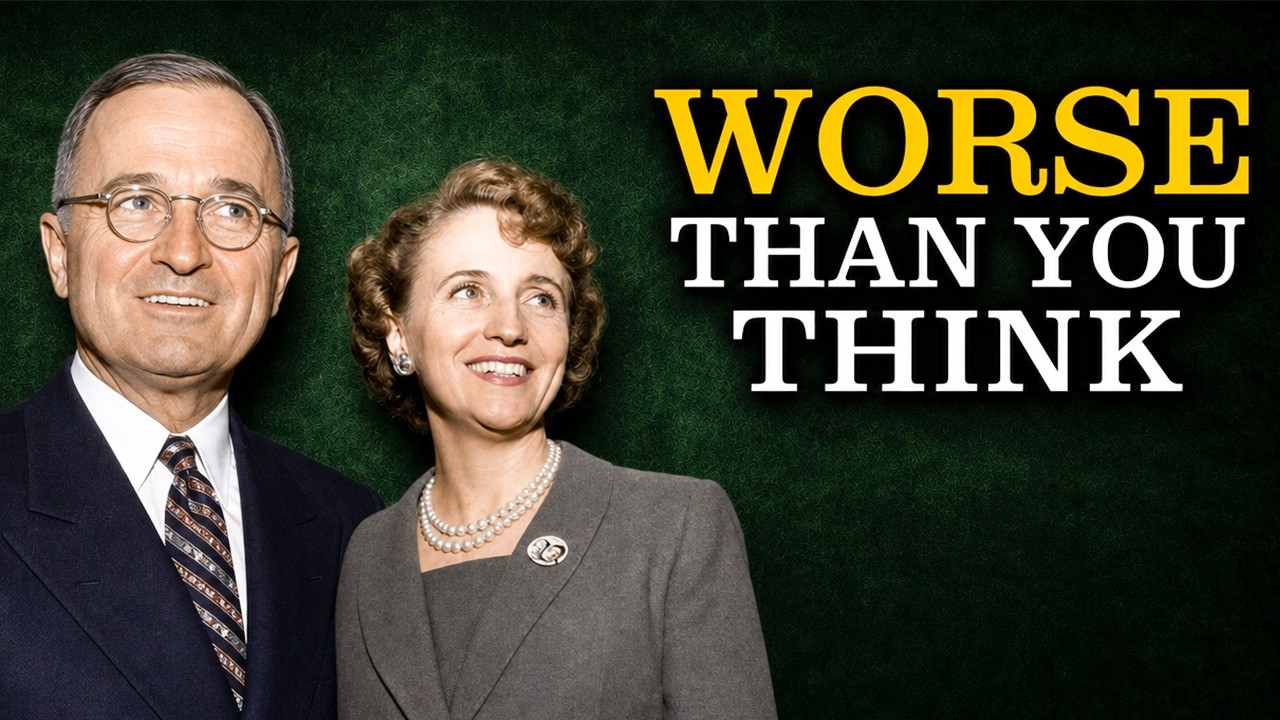
In late December 1955, Bess Truman stood before the fireplace in her Independence, Missouri, home and began feeding bundles of letters into the flames. Her husband, Harry, had just returned to find her destroying what would have been one of the most remarkable personal archives in American political history—nearly 1,300 love letters he had written to her over more than four decades. He urged her to think of history. She replied that she had thought about it, and she continued burning.
The letters she destroyed were his. The ones she kept were her own. Harry Truman saved everything—ticket stubs, receipts, memos, notes scribbled at 3 a. m.
and never sent. The Truman Library holds roughly 1,316 letters he wrote to Bess between 1910 and 1959, letters that captured his wit, his judgment, his grievances, and his unguarded assessments of the people around him. Of the letters Bess wrote in return, only 184 survive. Those survived not because she preserved them, but because they slipped out of her hands.
According to their grandson, Clifton Truman Daniel, the only reason any of her letters exist is that they had been misplaced or lost. The burning was deliberate. Bess admitted it. The exact date is disputed—some accounts place it earlier, and Margaret Truman, their daughter, never gave a year—but there is no doubt about what happened.
Robert Ferrell, the historian who later compiled Harry’s letters into the collection Dear Bess, found the remaining letters scattered throughout the house after her death: stuffed under sofa cushions, tucked inside books, lying in the attic amid pigeons and raccoons. A man’s voice survived by accident and neglect. A woman’s voice was almost erased on purpose. Every story about the Truman marriage—hailed for decades as the last great romance of American political history—has its origins in the version Harry himself created.
He was a devoted husband and a brilliant writer, but he was not an impartial witness. The beginning was her father. David Willock Wallace was handsome, popular, and the kind of man everyone in Independence liked but who never quite succeeded at anything. He held a series of patronage jobs, first as Jackson County treasurer, then as deputy surveyor at the Kansas City customs office—positions that depended entirely on who your friends were in any given election year.
The income was never enough. He drank. The debts piled up. On June 17, 1903, at age forty-three, Wallace shot himself in the family home.
Bess was eighteen. She had graduated from Independence High School two years earlier. A friend later recalled finding her pacing in the yard and walking silently beside her, because there was nothing to say. What mattered for the next seventy-nine years of Bess’s life was what happened next.
The family did not grieve publicly. They left. Her mother, Madge Gates Wallace, took Bess and her three brothers to Colorado Springs for nearly a year—not for the scenery, as the family later claimed, but to live somewhere no one knew what had happened. When they returned, they did not go back to their own house.
They moved into the home of Bess’s grandfather, George Porterfield Gates, a wealthy man who co-owned the mill that produced Queen of the Pantry flour. Wealth on the mother’s side. Shame on the father’s. The family never spoke of David Wallace again.
Bess never told her own daughter how her grandfather had died. Margaret learned the news like an outsider and later wrote about her confusion over the silence. Bess’s nephew, who grew up in that house and published a memoir, stated plainly that his aunt created the silence around the family to protect her mother—and it worked. Two lessons emerged from that summer, and Bess applied both for the rest of her life.
The first was that silence was a technology. Not weakness. Not modesty. A tool that worked.
If you said nothing, the story simply disappeared. The second lesson was uglier, and it explains a decision she made forty-one years later that shocked everyone around her. Politics had killed her father. Not literally—his debts and his drinking did that.
But the world that broke him was the world of county offices and patronage lists and men whose livelihoods depended on the next election. Bess Wallace grew up watching a political career consume a man from the inside, then watching the town whisper over the wreckage. Harry Truman had been in love with her since he was six years old. That part of the legend is true, and he repeated it constantly.
His family moved to Independence in 1890, and he saw her in Sunday school at the First Presbyterian Church. He noticed her blue eyes and golden curls and never stopped noticing. They attended school together and graduated in the same class. Sometimes he carried her books.
That was the extent of their courtship. Then the Trumans left Independence, and Harry went to work—bank jobs in Kansas City, then the family farm in Grandview, where he stayed until he was thirty-three. A plain farmer with no degree and no money. According to family accounts, they were reunited over a cake plate.
His aunt lived across the street from the Gates house, and there was a plate in her kitchen that needed returning. Harry insisted on returning it himself. Bess answered the door. In 1911, he began writing to her every week.
On paper, he was funny, self-deprecating, apologetic for his letters, and relentless. In June of that year, he proposed in writing and confessed he had been crazy about her since Sunday school. She did not answer. He wrote again.
No answer. A third letter finally drew a response: no. Harry took it as gracefully as possible. He said he would try again once he earned more than a farmer’s income.
He kept writing. They remained friends. It took until November 13 for her to change her mind. Why she said no is usually explained simply: she was not in love yet.
But look at what Harry was offering in 1911—a farm in Grandview, a meager income, no certainty of a future. She had seen firsthand what happened to a family when the money stopped. By then, the Gates family’s responsibilities had fallen to her. Her mother never fully recovered and never would, so Bess managed her mother, her three brothers, and the family’s standing.
Any hope of further education or a life of her own had ended in that yard in 1903. Her mother’s opinion of Harry Truman was no secret. The Gates family was wealthy, refined, and staffed with servants. The Trummans were farm people from Lamar, and the town kept strict account of social standing.
Madge Wallace never accepted him—not during the engagement, not during the wedding, not during his presidency. Until the day she died, she called him Mr. Truman. The engagement stretched on.
Then the war took him: France, artillery, Battery D, and a growing exchange of letters. After the war, they married on June 28, 1919, at Trinity Episcopal Church in Independence. He was thirty-five. She was thirty-four.
They returned from their honeymoon and moved in with her mother. The arrangement was supposed to be temporary. It lasted thirty-three years. The house at 219 North Delaware belonged to Bess’s grandfather until his death in 1918, then to her grandmother until 1924, when Bess’s mother bought out the other heirs for $10,000 so she could stay.
From that moment until December 1952, the roof over Harry Truman’s head legally belonged to his mother-in-law. At sixty-eight years old, Harry had never owned a home. The Truman Library’s own records state this plainly—it is not family gossip; it is a title document. Picture the household he married into.
Upstairs, a grandmother. A mother who had never walked freely since 1903. Brothers coming and going, one of them raising two children in that same house. Bess managed all of it, as she had since she was eighteen, and after marriage she simply added a husband to the list.
Margaret later wrote that her grandmother sat at the head of the dining table—not the son-in-law, not the future president, but the grandmother. Margaret also noted that her father must have loved her mother very much, because he endured everything without complaint and never said one unkind word about Madge Wallace—this from a man who freely insulted nearly everyone else, including generals and the entire country. By the early 1920s, money troubles mirrored Bess’s father’s path. Harry opened a men’s haberdashery in Kansas City with his army friend Eddie Jacobson.
It did well for about two years, then collapsed with the postwar agricultural depression. The store failed in 1922. Harry spent most of the next fifteen years paying off its debts without declaring bankruptcy. That decision speaks well of his character and badly of the family budget Bess was managing.
She also suffered two miscarriages in those early years. When she became pregnant again in the fall of 1923, she bought no baby clothes or blankets in advance—she had learned not to expect the worst to pass her by. Margaret was born at home on February 17, 1924, and was laid in a dresser drawer. That is the ledger of Bess Truman’s first five years of marriage: her mother’s house, her husband’s debts, two lost children, one daughter.
In 1922, the year the store closed, Harry entered politics under the sponsorship of the Pendergast organization, the machine that controlled Jackson County and much of Missouri and that would trail him like a smell for his entire career. He won a seat as county judge, which was more administrative than judicial. He lost reelection in 1924, won again in 1926, then again in 1930. Consider what that meant to the woman he had married.
She had watched her father cycle through county offices, watched the income never be enough, watched what it did to him. Now her husband, having failed in business, had joined a county office dependent on a political boss. Britannica dryly notes that she had doubts about politicians. That is putting it mildly.
She did the work anyway, out of sight. Publicly, she said her only role in campaigning was to make sure her hat was on straight—a line quoted for fifty years because it was exactly what reporters wanted from a candidate’s wife. In private, she kept the store’s books, then worked as his assistant during his judgeship, edited his speeches, and read every major address before he gave it. The hat comment was an act.
She had learned in 1903 how much the public should be told. In 1934, Pendergast backed Harry for the U. S. Senate, and he won.
The Trumans moved to Washington, and their life split in two—an apartment in Washington, a house in Independence. Bess traveled constantly between them, spending most of her Washington time with Mary Paxton, her friend from Independence. Her surviving letters from 1936 to 1943 are filled with the strain of running two households: money, schedules, her mother’s health, Independence politics, and whom to trust in Washington. In 1944, the Democratic Party’s leadership decided Franklin Roosevelt needed a new running mate.
Harry Truman did not want the job. His failure to win it became almost an obsession. At the convention in Chicago that summer, observers described Bess as exhausted and looking as though she had been crying. Family accounts say that as she and Harry pushed through the crowds of reporters and Secret Service agents, she asked him whether this was how they would spend the rest of their lives.
On the afternoon of July 19, the decision was taken out of their hands. Truman was summoned to a hotel room where party leaders were on the phone with Roosevelt. The president essentially told him that if he wanted to break the Democratic Party in the middle of a war, the responsibility was his. Truman said yes.
Watch what happened there. Their marriage had an unwritten, unbreakable rule: her father’s death stayed secret. The rule held for four decades because nothing important enough had ever tested it. Then a president on the other end of a telephone made it impossible to keep, and Harry Truman—the man who never disobeyed his mother-in-law, who accepted everything, who wrote 1,300 letters—said yes.
The suicide never came out. That is the strange part. Reporters either did not dig or did not publish, and the secret held through the entire campaign. The day after the nomination, Bess did something nearly unbelievable for her: she held a press conference.
The Washington women’s press corps had been demanding regular access since she arrived, and she had managed to avoid them. She told them she wanted no part of the vice presidency and had never wanted any part of politics. It was the most she would say for years. On April 12, 1945, she was visiting a neighbor in their apartment building when the call came.
Harry asked her and Margaret to come to the White House. On the way, she cried. She spoke first with Eleanor Roosevelt, then stood beside her husband as he took the oath of office. Her later comment about that day was that she could never be Mrs.
Roosevelt and she was not going down any coal mines. She meant it as modesty. It functioned as policy. She canceled the weekly press conferences almost immediately.
When she finally agreed to answer a written questionnaire in 1947, her pencil replies were so brief that two White House secretaries read them in minutes. Yes. No. No comment.
Asked if she wanted her daughter to live in the White House someday, she refused in a single sentence. The public accepted the image: the plain Missouri housewife who never wanted the job. It was not a lie. It was not the whole truth either.
The same introverted woman read her husband’s speeches, argued over his word choices, and told him which members of his cabinet were fools. J. B. West, who worked at the White House and wrote about it later, said she guarded her privacy like a jewel and used it to perform a role almost no one knew.
Harry publicly called her his chief adviser and full partner in everything. But in the summer of 1945, he developed and used an atomic weapon without telling her. She learned about Hiroshima the way the rest of the country did. The Truman Library’s own records state this directly.
She was extremely upset that he had not consulted her before the bombing. Margaret wrote that her mother became a spectator rather than a partner in her husband’s presidency, and that it made her very angry. She did not leave. That was not an option, and they both knew it.
Instead, she reclaimed the only ground she controlled. She went home. Not once—it became a pattern. Her appointment books at the Truman Library are split in two, and the folders marked “personal” are the Independence ones, because she spent months each year in Missouri.
During those absences, the president of the United States wrote to her the way he had in 1911, 1918, and 1937. She answered, and in June 1946 she assured him that no one else opened their family mail. She called the White House “the Great White Jail. ”
When she was lonely, she flew her Independence bridge club members to Washington so she could play cards with people who had known her before.
She drove herself around the capital until the Secret Service complained they could not keep track of her. She paid three dollars a week at the same beauty shop because she saw no reason to change. In 1945, when the Daughters of the American Revolution barred pianist Hazel Scott from performing at Constitution Hall—the same organization, the same hall, that had barred Marian Anderson six years earlier and driven Eleanor Roosevelt to resign in protest—Bess attended the event in Scott’s honor. Adam Clayton Powell Jr.
, Scott’s husband, called her the country’s “last lady. ” Harry Truman refused to allow DAR members into the White House for the rest of his presidency, nursing the insult to his wife for years. Bess herself issued a one-line statement condemning any denial of artistic merit and opportunity based on prejudice, then said nothing more. On December 5, 1952, Madge Gates Wallace died at the White House, six weeks before her son-in-law’s term ended.
She had lived with the Trumans for thirty-three years. The funeral was held in the music room at 219 North Delaware. When the estate was settled, Harry and Bess bought the house. He was sixty-eight.
She was sixty-seven. It was the first home either of them had ever owned—the same house she had moved into in 1904 as a shamed eighteen-year-old. Three years later, she began burning the letters. That is the sequence.
And the sequence is the whole story. She became the legal owner of the house, then she cleaned out the record. She kept every one of his letters—scattered them so carelessly that raccoons ate some—but she kept them. Only hers.
Only her own voice. Harry died in December 1972. Bess lived another ten years in that house, appearing for visitors, refusing interviews, and died in 1982 at ninety-seven, the longest-lived first lady in American history. After her death, Ferrell found Harry’s letters.
They were published in 1983. They are wonderful, and they are why everyone thinks they understand this marriage. In the 1980s, archivists found 184 of Bess’s letters that had escaped her attention. Her grandson published them in 2011.
The woman inside those letters was funny, sharp, and warm—nothing like the silent figure the country remembered. She left us that. Less than one percent of her voice survived, by accident. The rest she burned deliberately, having thought about history more carefully than anyone gave her credit for.
She had spent her whole life knowing that history would not treat her fairly. So she made sure it could not treat her at all.