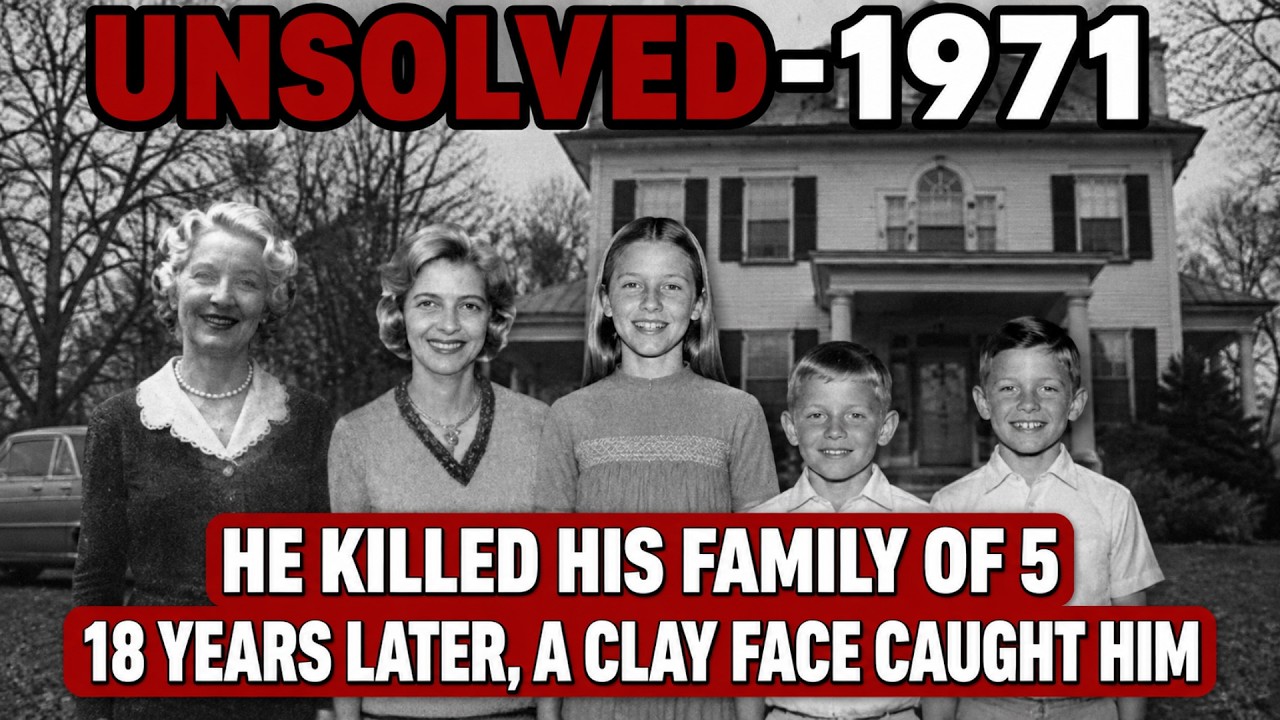
On the morning of November 9, 1971, John List dropped his three children off at school in Westfield, New Jersey. To the outside world, he was a dutiful accountant, a Sunday school teacher, and a devoted father living in a 19-room Victorian mansion called Breeze Knoll. That morning, on his way home, he bought two guns.
By the end of the day, five members of his family were dead. He shot his wife, Helen, in the back of the head in the kitchen. He shot his 84-year-old mother, Alma, in her third-floor apartment.
He watched his 15-year-old son play football, drove him home, and shot him multiple times when the boy tried to fight back. He shot his 16-year-old daughter and his 13-year-old son as they walked through the front door.
He arranged the bodies on sleeping bags in the ballroom, cut his own face out of every family photo, turned on hymn music, and left a five-page confession letter for his pastor. Then he locked the door and vanished. The bodies were not discovered for nearly a month.
It took 18 years to find him.
John Emil List was born in Bay City, Michigan, in 1925. He was the only child of a strict German Lutheran family. His father drilled two values into him: discipline and appearances.
Failure was not an option. Social assistance was shameful. No matter what happened behind closed doors, the outside world had to see perfection.
List served in the U. S. Army during World War II, fighting on the European front before being honorably discharged as a sergeant in 1945.
He used the G. I. Bill to earn degrees in business and accounting from the University of Michigan.
In 1951, he married Helen Morris Taylor, a widow with a daughter named Brenda. They had three children together: Patricia, John Jr. , and Frederick.
Behind the perfect facade, problems were growing. Helen began drinking heavily and showed signs of mental instability. Medical records later revealed she was suffering from late-stage syphilis, which affected her brain and behavior.
List knew about the illness but told no one. Appearances mattered more than getting her help.
In 1965, List took a job as vice president and controller at a bank in Jersey City. That same year, he bought Breeze Knoll, a 19-room Victorian mansion in Westfield, New Jersey. The house had a grand ballroom with a stained-glass ceiling reportedly signed by Tiffany, extensive grounds, and enough space for his mother to live in a private third-floor apartment.
It was far too large for one family, but List did not buy it because he needed the space. He bought it because he wanted the world to see him living there.
In Westfield, List became a respected member of the community. He led a Boy Scout troop and taught Sunday school at Redeemer Lutheran Church. His children were well-behaved and disciplined.
Neighbors saw a model family. No one heard arguments. No one saw Helen drinking.
No one knew that by the end of the 1960s, List was drowning.
He lost his job at the bank in 1970. According to a former colleague, the reason was simple: no one liked him. He applied for other positions but was not hired.
He told no one, not even his wife. Every morning, he put on his suit, took his briefcase, and drove away from Breeze Knoll as if going to work. In reality, he sat at the Westfield train station, read newspapers, watched trains pass, and waited out the day.
He secretly drained his mother's life savings of about $200,000 to pay the mortgage. By 1971, the money was nearly gone. The bank was threatening foreclosure.
For List, the prospect of being seen as a failure was worse than death. He prayed. In his distorted religious logic, he found what he called an answer.
He looked at his family and saw five souls slipping toward damnation. Helen was drinking and deteriorating. Patricia, a bright and lively 16-year-old who loved theater and wore peace symbols, was showing independence he saw as rebellion.
He suspected her of drug use with no evidence. John Jr. , 15, was a quiet teenager who played football.
Frederick, 13, was simply a child who had not yet become anyone. List decided that if he killed them now, while they were still Christians, he could guarantee their salvation.
He did not kill himself because he believed suicide was an unforgivable sin. If he died by suicide, he would go to hell and never see his family again. He had to live, pray for forgiveness, and hope to reunite with them in heaven.
In the days before the murders, List planned meticulously. He canceled the newspaper, milk delivery, and mail. He called the children's school and said the family was traveling to North Carolina to visit a sick relative.
He calculated the house temperature to slow decomposition and prevent neighbors from smelling anything.
On the morning of November 9, he drove his children to school. On the way home, he picked up two guns from the garage: a 9mm Steyr and a . 22 Colt.
He shot Helen once in the back of the head in the kitchen. He dragged her body away, cleaned the floor, and went upstairs. He shot his mother once above her left eye.
He left her body in her third-floor apartment because she was too heavy to carry down the stairs.
He made himself lunch and ate in a house with two corpses. He drove to the bank and closed his accounts. Then he went to his son's football game and watched the entire match, knowing it was the last one his son would ever play.
After the game, he drove John Jr. home and shot him. The boy did not die immediately.
Evidence showed he tried to resist, and List fired multiple times into his chest and face before he stopped breathing.
Patricia came home from school and was killed at the door. Frederick came home and was killed at the door.
List dragged four bodies into the ballroom and laid them on sleeping bags, side by side, as if they were sleeping. Alma remained on the third floor. He went through all 19 rooms and cut his face out of every family photograph.
He lowered the heat, left the lights on, and played hymns through the intercom system so the house would appear occupied. Then he sat down and wrote a five-page letter to his pastor, Reverend Eugene Rehwinkel.
In the letter, he confessed to the murders. He explained his financial failures, his fear for his family's immortal souls, and his belief that Patricia's acting ambitions threatened her Christian faith. He gave funeral instructions and ended with a line that would haunt investigators for decades: "I commit myself to the justice and mercy of God, not the justice of the law, but the justice of God."
He left the letter on his desk with a note for whoever found it. Then he locked the door, drove to Kennedy Airport, left his car in the parking lot, and took a bus and a train to Denver, Colorado. He applied for a new Social Security card under the name Robert Peter Clark.
The house sat silent for nearly a month. The lights stayed on. The music played.
Five bodies lay in the darkness. Because the List family was so isolated, no one noticed their absence. Finally, in early December, Patricia's drama teacher grew concerned.
Neighbors noticed the lights going out one by one. Police entered Breeze Knoll on December 7, 1971.
The hymns were still playing. The air was cold and heavy with the smell of decay. Four bodies were found on sleeping bags in the ballroom.
Alma's body was found on the third floor. The confession letter was on the desk.
The FBI quickly identified List as the prime suspect. They found his car at Kennedy Airport, but the trail ended there. No plane ticket, no bank transactions, no contact with anyone from his old life.
He had vanished.
In Denver, Robert Peter Clark appeared in early 1972. He was a polite, quiet middle-aged man who rented a small trailer and worked as a night cook at a Holiday Inn. He soon returned to accounting, his lifelong profession.
He joined a Lutheran church, the same denomination he had always attended. He lived quietly, soberly, and without close friends. He never spoke about his past.
From 1979 to 1986, he worked as a controller at a paper box factory outside Denver. In 1985, he married Dolores Miller, a kind, religious woman he met at church. She knew nothing about his past.

He never gave her a reason to ask.
In February 1987, a neighbor named Wanda Flannery was reading a magazine article about the List family murders. She looked at the 1971 photo of John List and felt her blood run cold. He looked exactly like her neighbor, Bob Clark.
She told Dolores, who dismissed the idea completely. Her husband went to church every Sunday. He was the most upright man she had ever known.
Flannery let it go, but she did not forget.
In February 1988, the Clarks moved to Midlothian, Virginia. Bob Clark took an accounting job in Richmond. The case remained cold.
In 1988, a new television program called "America's Most Wanted" began airing on Fox. Hosted by John Walsh, the show focused on unsolved cases and asked viewers for help. The List case was proposed, but there was a problem.
The most recent photo of John List was 18 years old. In 1971, he was 46 with dark hair. Now he would be 63.
The old photo was nearly useless.
The producers turned to Frank Bender, a self-taught forensic sculptor in Philadelphia. Bender had begun his career in 1976 when he reconstructed the face of an unidentified corpse and helped solve a murder case. He became one of America's best forensic sculptors, specializing in reconstructing faces of unknown victims and predicting the appearance of fugitives.
The List case was his greatest challenge. He had only old, faded front-facing photos. He worked with forensic psychologist Richard Walter to build a complete psychological profile.
They studied the confession letter, List's daily habits, his obsessive need for control, and his isolated life. Walter concluded that List would never change. He would still go to church, still work as an accountant, still wear suits, and still live according to his old patterns.
Bender translated that profile into a clay bust. He predicted List would be bald, possibly with skin cancer from aging, and wearing old-fashioned round glasses. He went to an antique store and bought a pair of thin-framed round spectacles.
He placed them on the clay head. After three months of work, Bender believed he was looking directly at John List in 1989.
On May 21, 1989, the clay bust appeared on "America's Most Wanted." The show recounted the full story of the List family murders and displayed the bust next to the 1971 photo. John Walsh told viewers: "If you recognize this man, call us."
In Aurora, Colorado, Wanda Flannery was watching with her daughter. When the bust appeared, they both jumped from their seats. It was Bob Clark.
Not a resemblance. It was him. Two years earlier, she had told Dolores Clark that her husband looked like the killer in the magazine.
Dolores had refused to believe it. This time, Flannery did not call Dolores. She called the show directly.
She was not the only one. Within hours, about 20 calls came in from Richmond, Virginia, where Bob Clark now lived and worked. Former neighbors, coworkers, and church members all recognized the same face.
Frank Bender had been right.
Eleven days passed between the broadcast and the arrest. On June 1, 1989, FBI agents arrived at Robert Clark's home in Richmond. Dolores answered the door and said her husband was at work.
Agents went to the accounting office. The man standing before them looked exactly like the clay bust: bald, round glasses, medium build, an ordinary face that no one would look twice at.
An agent asked: "Are you Bob Clark?" He said yes. The agent asked again: "Are you John List?"
He said no. He claimed he did not know who John List was. But fingerprints do not lie.
Agents took his prints and matched them against the records List had left when applying for a gun permit in New Jersey in 1971. All ten fingers matched perfectly.

After 17 years, 6 months, and 23 days, John List was in handcuffs. Dolores Miller Clark collapsed. She had lived with him for four years, gone to church with him every Sunday, eaten dinner with him every night, and slept beside him without ever knowing he had murdered his first wife, his mother, and his three children.
She was the sixth victim, not of a bullet, but of a lie that lasted four years.
List was extradited to New Jersey. He denied his identity for months, even after fingerprints, military records, and crime scene evidence proved who he was. Finally, on February 16, 1990, facing overwhelming evidence, he admitted his true identity.
Robert Clark disappeared for the last time.
The trial began on April 2, 1990. The defense did not deny that List had killed his family. Instead, they argued he suffered from obsessive-compulsive disorder and genuinely believed he was saving his family's souls.
The prosecution countered with the five-page letter. They read it piece by piece: the plan to cancel the newspaper, the plan to call the school, the plan to close the bank accounts, the funeral instructions, the escape route. They asked the jury whether this was the behavior of a man who lost control or a man who calculated every detail, from the temperature of the house to the music playing through the speakers.
A court-appointed psychiatrist testified that List had an obsessive personality but showed no evidence of genuine remorse. The judge described him in six words: "No remorse and no honor."
The trial lasted seven days. The jury deliberated briefly. On April 12, 1990, John List was convicted of five counts of first-degree murder.
The judge imposed five consecutive life sentences, one for each victim. List was 64 years old. He would die in prison.
He appealed, arguing that post-traumatic stress from his World War II service impaired his judgment and that his confession letter was protected by clergy-penitent privilege. Both arguments were rejected. The court noted that his meticulous planning proved he was fully in control of his actions.
The letter was left voluntarily at the crime scene with a note for whoever found it. It was a confession, not a confidential communication.
In prison, List lived the same disciplined, quiet life he had always lived. He attended the prison chapel every Sunday. He prayed.
He read the Bible. He waited for the day he would reunite with his family in heaven.
In 2002, he gave his only major interview to correspondent Connie Chung. He was 76 years old. He said he wished he had not done what he did and that he had prayed for forgiveness.
When asked why he did not kill himself instead of his family, he repeated the same twisted logic from his letter. Suicide would have prevented him from entering heaven. If he did not go to heaven, he would never see his family again.
He had to live to have a chance of reuniting with the people he had murdered.
Then he said something that Chung later described as the most terrifying moment of her career: "When we get to heaven, we won't be interested in these earthly matters. They'll forgive me or they won't realize what happened."
He believed his family would not remember the bullet in Helen's head, or Patricia seeing her father holding a gun when she walked through the door, or John Jr. trying to fight back, or Frederick, who never had the chance to become anyone. If they did not remember, there was nothing to forgive.
John List died on March 21, 2008, in New Jersey State Prison in Trenton, from complications of pneumonia. He was 82 years old. He served 18 years in prison, almost exactly the same amount of time he had lived free as Robert Clark.
He died without ever publicly admitting that what he did was morally wrong. He only said he wished he had chosen a different path.
Helen and the three children were buried in Fairview Cemetery in Westfield. Alma was buried separately. Five graves for five lives ended by the man they trusted most.
The List case left a lasting legacy. Frank Bender's clay bust became a symbol of age-progression technology, now a standard tool in law enforcement. The case was one of the first major successes of "America's Most Wanted," which ran for 25 seasons and helped capture more than 1,000 fugitives.
John List became a classic case study in family annihilation, the outwardly perfect man whose obsessive need for control turned to destruction when control was lost. The case inspired books, documentaries, podcasts, and the Netflix series "The Watcher."
In Westfield, the old mansion was destroyed by arson in August 1972, less than a year after the murders. A new house now stands at 431 Hillside Avenue. But the ground beneath it remains the same ground where Breeze Knoll once stood, where hymns echoed through 19 empty rooms, and where five bodies lay on sleeping bags in the ballroom for nearly a month.
Five people. One bullet each. Eighteen years of hiding and eighteen years in prison.
A clay bust that pulled justice from the darkness. A cold case that took nearly two decades to solve, solved by a sculptor who saw a face, a neighbor who picked up the phone, and a justice system that refused to let the case die.