On a quiet June morning in 1940, Edward Avery McIlhenny walked to the edge of the marsh on his family’s Louisiana estate and released about twenty large South American rodents into the wild. Five years later, he freed the rest of his stock. The animals bred beyond all expectation, spread across the coastal wetlands, and today the state of Louisiana pays hunters a six-dollar bounty per tail to kill roughly four hundred thousand of them every year just to slow the damage they cause. The same man had spent decades protecting birds, had saved the snowy egret from extinction, and had founded one of the most celebrated wildlife reserves in the country.
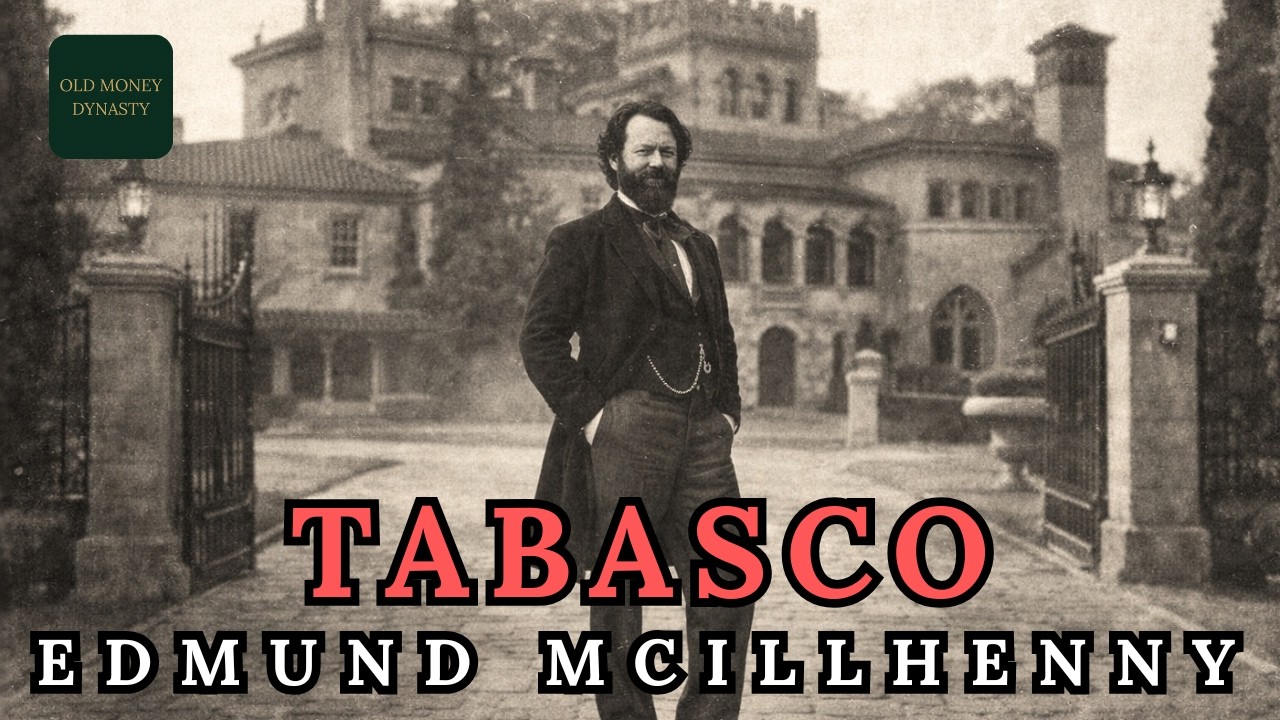
He was also the grandson of the man who created Tabasco sauce. Edmund McIlhenny never imagined any of it. Born in 1815 in Hagerstown, Maryland, he moved south as a young man and built a successful banking career in New Orleans, eventually owning five banks in the city. In 1859 he married Mary Eliza Avery, whose family owned a remote 2,200-acre stretch of elevated land in the Louisiana marsh south of New Iberia.
The property, called Petit Anse Island though it was surrounded by bayou rather than open water, was home to a sugar plantation. Soon after the wedding, Edmund moved onto the island and into the Avery household. He had money, land, and a growing family. The Civil War took all of it.
The Union naval blockade cut off the Confederacy’s supply of imported salt, and by 1862 the South was desperate for a way to preserve meat for its armies. That May, workers on the Avery estate, while deepening a natural spring, struck a deposit of nearly pure rock salt roughly sixteen feet below the surface. It was the first commercially significant salt discovery in the United States. The family placed the operation at the disposal of the Confederate government, and within months ten pits were open across the property, producing over twenty-two million pounds of salt that supplied garrisons at Vicksburg, Port Hudson, and throughout the lower South.
The operation lasted less than a year. In April 1863, Union troops under General Nathaniel Banks reached the estate, burned all eighteen buildings connected to the works, smashed the equipment, and broke apart six hundred barrels of salt waiting for shipment. The family fled to Texas for the duration of the war. Edmund’s banks had already collapsed with Confederate currency.
When he returned in 1865, he was approaching fifty, with a wife, eight children, and nothing that produced income. Before the family had fled, Edmund had planted a small crop of red peppers in the garden, a variety believed to have originated in the Mexican state of Tabasco. The plants had survived the occupation, the neglect, and the years of abandonment. Alone among the wreckage, they were still growing.
Edmund crushed the ripest peppers into a coarse mash, mixed in salt from beneath the property, and let the mixture ferment rather than boiling it as other pepper sauce makers did. When the aging was complete, he stirred in French white wine vinegar, blended it over several days, and strained out the solids. The result was too concentrated to pour, so he acquired small cologne bottles from a New Orleans glassware supplier and fitted each with a narrow sprinkler top. He called the sauce Tabasco.
At the time, the peppers were not commonly known by that name. The pepper would eventually be named after the sauce, not the other way around. In 1868 he grew his first full commercial crop, and the following year he shipped his first batch: 658 bottles at one dollar apiece wholesale. The sauce moved off shelves quickly, and Edmund pushed outward, connecting with a major food distributor that placed the product in New York, Philadelphia, and Boston.
By the late 1870s, he was exporting to Europe. He never considered any of it important. Edmund wrote an autobiographical sketch near the end of his life and left the sauce out entirely. His obituaries in 1890, the year he died at seventy-five, did not mention it.
He had treated the business as a practical solution to a financial problem, something to keep his household afloat. His sons saw something else. John Avery McIlhenny took charge of the operation after his father’s death and modernized manufacturing, expanded advertising, and began building a brand rather than just a product. In 1898, he left the company to volunteer for the Spanish-American War, joining Theodore Roosevelt’s Rough Riders after a letter of introduction from the household.
He fought in Cuba, was promoted twice on the battlefield, and claimed for the rest of his life that he had pushed Roosevelt out of the path of a Spanish sniper. Roosevelt never contradicted him, and the two became lifelong friends. John later served in the Louisiana legislature, on the United States Civil Service Commission, and as a financial adviser to Haiti before retiring to Virginia in 1922. His younger brother Edward, known as Ned, had taken over the company when John left for Cuba.
A naturalist who had explored the Arctic twice before the age of thirty, Ned renamed the operation McIlhenny Company, standardized production, redesigned the label, and replaced the cork and wax seal with a screw-top cap in 1927. He led the company for fifty years. Between them, John and Ned transformed what their father had built. Edmund had created a product.
His sons created an institution. The family then spent three decades defending the name. Bernard Trappey, a blacksmith who had worked on the McIlhenny grounds for years, took pepper seeds with him when he left, started his own crop, and in 1898 founded his own sauce company with the word Tabasco on the label. The legal fight that followed turned on whether the name, which originated as the name of a Mexican state, could belong to a single producer.
An early trademark registration was canceled in 1909 after competitors challenged it. The family regrouped and argued that after decades of exclusive commercial use, consumers associated the word with their sauce alone. The decisive ruling came in 1929, when Trappey was permanently barred from putting the word on the front of his bottles. In 1991, McIlhenny Company quietly purchased Trappey’s bottled sauce division.
The next generation went to war again. Walter Stauffer McIlhenny, John’s son, joined the Marine Corps Reserve in 1935 and was serving in the Pacific when Pearl Harbor was attacked. On Guadalcanal in August 1942, he led a rescue party to evacuate wounded Marines, deliberately drew enemy fire to create cover, silenced a machine gun nest, and was concussed by a mortar round. He received the Navy Cross.
During a night engagement, he stumbled into a Japanese officer who swung a katana at his head. The blade was still in its scabbard. The blow dented his helmet and knocked him down, and before he lost consciousness, Walter shot the man. He kept both the helmet and the sword.
After the war, Walter took over the company in 1949 and ran it until his death in 1985. During the Vietnam War, he created a tongue-in-cheek recipe guide called the Charlie Ration Cookbook, which came wrapped around a two-ounce bottle of sauce. By the 1980s, miniature bottles became standard issue in American military field rations, and the Australian, British, and Canadian armies followed. The product itself never changed.
Three ingredients, peppers, salt, vinegar, fermented in white oak barrels for up to three years, with field workers still using a painted wooden dowel to judge the exact shade of red required for a pepper to be picked. No preservatives, no colorings. The company licensed the name to other food producers, expanded carefully with new pepper varieties, and in 2009 received a royal warrant from Queen Elizabeth II certifying it as a supplier to the British royal household. NASA added the sauce to space shuttle menus, and astronauts on the International Space Station requested it because the human sense of taste dulls in microgravity.
The island itself has become the greatest threat to the operation. The same wetlands that buffer the factory from the Gulf of Mexico are disappearing. Louisiana has lost more than two thousand square miles of coastline since 1932, and the nutria Ned released have accelerated the destruction by devouring marsh grasses and burrowing into the root systems that hold the land together. In 2005, Hurricane Rita drove a storm surge within inches of the factory.
The company responded by building a seventeen-foot earthen levee around the production facility at a cost of five million dollars. Harold Osborn, Edmund’s great-great-grandson, became president and CEO in 2019. He holds a master’s degree in environmental science from Oxford and has described the effort to hold back the Gulf as probably a standoff. The company has never been sold.
Every generation has handed control to another branch of the same family. Seven hundred thousand bottles still roll off the line every day, the same recipe, the same aging process, the same small glass container with the sprinkler top and the diamond label. The man who made the sauce never understood what he had made.
But the family that followed him recognized that a name, properly defended, and a product, never altered, could outlast every bank he ever owned, and they have spent more than a century proving it.