On June 25, 1876, along the Little Bighorn River in Montana Territory, a United States Army expedition collided with the largest concentration of indigenous resistance the northern plains had ever seen. The destruction of Lieutenant Colonel George Armstrong Custer’s immediate command was not a simple battlefield misfortune. It grew out of political pressure, broken intelligence, strained logistics, and a strategic culture that refused to take indigenous military capacity seriously. The campaign that carried the Seventh Cavalry to the Little Bighorn was not designed around a single decisive battle.
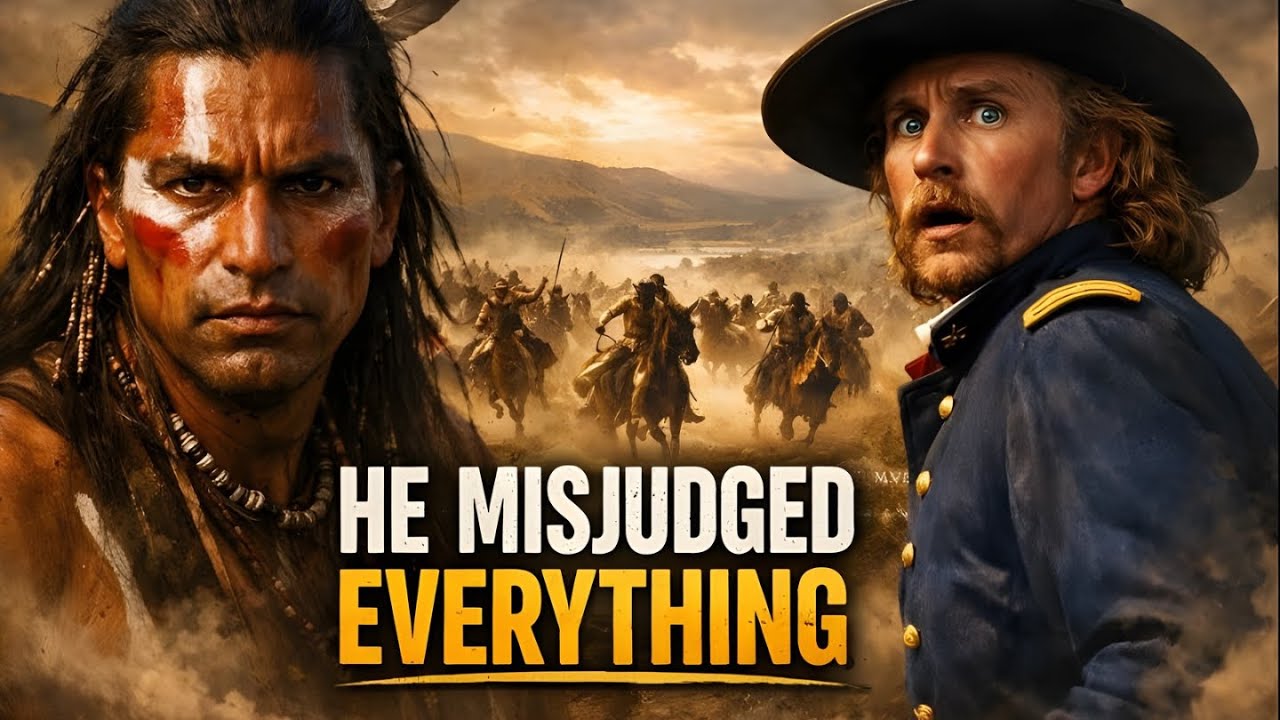
It was part of a coordinated summer offensive ordered by the federal government to force Lakota and northern Cheyenne bands onto reservations established by treaty and later altered by executive action. The discovery of gold in the Black Hills, territory guaranteed to the Lakota under the 1868 Fort Laramie Treaty, had already made those agreements politically expendable. By early 1876, bands that refused to comply were officially reclassified as hostile, providing the legal cover for military enforcement. The massive encampment along the Little Bighorn River was a direct response to that pressure.
Thousands of Lakota, northern Cheyenne, and smaller numbers of Arapaho families gathered there not to start a war but to consolidate safety, resources, and political autonomy. It was the largest intertribal gathering on the northern plains in the nineteenth century. Estimates placed the population between seven and eight thousand people, including a fighting force of more than fifteen hundred. Nothing in the army’s prior frontier experience matched that scale.
Leadership inside the encampment was decentralized but coordinated. Sitting Bull held spiritual and political influence rather than tactical command; his visions and authority helped hold together bands that usually operated independently. Military leadership during the fighting rested with experienced commanders such as Crazy Horse, Gall, and Lame White Man, each leading warriors accustomed to mobile warfare and rapid coordination without rigid command structures. Opposing them was the Seventh Cavalry, roughly six hundred officers and enlisted men.
The regiment was well equipped by the standards of the day, armed with single-shot Springfield carbines and supported by pack trains carrying reserve ammunition. But it suffered from chronic logistical weaknesses. Ammunition distribution was uneven. The horses were exhausted from extended movement.
The regiment had no heavy fire support; artillery had been deliberately left behind to preserve speed, a decision consistent with Custer’s operational preferences but consequential in its effects. The terrain compounded those disadvantages. The country along the Little Bighorn consisted of rolling bluffs, narrow ravines, and broken ridgelines that blocked visibility and fragmented movement. For cavalry trained in linear maneuver and visual signaling, the landscape shattered command cohesion.
For indigenous fighters who knew the region through hunting and seasonal movement, the same terrain offered concealment, interior lines, and rapid routes of approach. Custer’s understanding of the situation rested on incomplete reconnaissance and an overly optimistic reading of scout reports. Indigenous scouts attached to the Seventh Cavalry repeatedly warned that the village was unusually large. Those warnings contradicted Custer’s prior experience, in which speed and surprise had scattered smaller encampments before organized resistance could form.
He concluded that delay would allow the village to disperse, and that waiting would forfeit the chance to strike. That assumption governed everything that followed. Instead of concentrating his force, Custer divided the regiment into multiple battalions operating beyond mutual support. Major Marcus Reno was directed to advance into the valley from the south.
Captain Frederick Benteen was sent westward to scout and prevent flight. Custer himself retained direct command of five companies and moved north along the bluffs, intending to hit what he believed was the village’s rear. The maneuver reflected standard cavalry doctrine, but it ignored a critical variable: numbers. By fragmenting his force, Custer converted a regiment capable of sustained defense into isolated units vulnerable to encirclement.
Communication between elements depended on couriers moving through difficult terrain under uncertain conditions, and no plan existed for rapid concentration if resistance proved stronger than expected. Reno’s engagement unfolded first. As he entered the valley, his command met scattered resistance that appeared to withdraw. This response matched indigenous tactical practice, which often used delay and deception to draw opponents into disadvantageous positions.
Within minutes the situation reversed. Large numbers of fighters converged on Reno’s exposed flanks, overwhelming his skirmish line with no natural cover to protect it. His withdrawal across the river was disorderly and costly. Men fell during the retreat to the bluffs, where the survivors established a defensive perimeter.
The position was defensible, but it removed Reno from any further offensive action. His decision to halt rather than attempt re-engagement would later become a matter of controversy, though at the time it reflected the exhaustion and disorganization of his command. Benteen’s battalion, delayed by terrain and vague orders, did not reach Reno until after the initial collapse. Once united, the combined force stayed fixed on the bluffs, repelling repeated probes but unable to move toward Custer’s position.
Smoke and distant gunfire showed fighting continuing to the north, but no reliable word reached them about Custer’s fate. Custer’s battalion walked into the full weight of indigenous resistance. As word spread through the encampment, warriors disengaged from Reno and redirected northward. The numerical balance shifted decisively; estimates suggest Custer faced opposition at a ratio of more than ten to one.
His companies tried to hold defensible ridgelines, but those positions lacked depth and access to water. Ammunition ran out quickly, and resupply was impossible under constant pressure. Archaeological evidence recovered from the battlefield indicates fragmented movement rather than a single cohesive stand. The distribution of cartridge cases suggests a series of successive withdrawal attempts along the ridges, with resistance breaking into smaller clusters as pressure intensified.
The engagement ended quickly. From first contact to the last organized resistance, the fight likely lasted under an hour. No soldier from Custer’s immediate command survived to report what happened. The absence of eyewitness testimony meant the battle’s interpretation would depend on indigenous accounts, physical evidence, and later reconstruction.
Several factors converged to produce the outcome. Intelligence failure prevented an accurate assessment of enemy strength. Tactical dispersion eliminated the possibility of mutual support. Logistical limitations undermined sustained defense.
And above all, strategic overconfidence discounted the adaptability and coordination of indigenous forces fighting on familiar ground. A frequently overlooked element of the battle was the role of the pack train under Captain Thomas McDougall, delayed far to the rear. It carried the critical ammunition reserves that never reached Custer. Even a partial resupply might have prolonged resistance long enough to alter the sequence of events.
That logistical separation shows how operational tempo, not just combat action, shaped the battle’s conclusion. The aftermath of the Little Bighorn reached far beyond the battlefield. In the short term, the engagement stood as a significant strategic success and a demonstration of effective intertribal cooperation. In the longer term, it provoked an intensified federal response.
Public reaction in the United States reframed the conflict as a national humiliation requiring resolution. Subsequent campaigns deployed larger forces, extended supply networks, and harsher enforcement measures. Within five years, most of the Plains resistance had been neutralized. Crazy Horse lost his life.
Sitting Bull fled briefly into Canada before eventually surrendering. The autonomy defended along the Little Bighorn was systematically dismantled through military pressure, confinement, and policy enforcement. The Battle of the Little Bighorn occupies a dual position in American history. It represents both the tactical failure of an overextended command and the strategic turning point that accelerated the loss of indigenous independence on the northern plains.
Its legacy endures not because of mythic heroism but because it exposes the consequences of misjudgment, cultural misunderstanding, and the limits of force when applied without accurate knowledge. The engagement remains a case study in how military decisions intersect with political objectives, and how short-term outcomes can generate long-term transformations far beyond their immediate context.