She won a trip to Moscow at twenty-one, starred opposite Cary Grant at twenty-three, and by the age of thirty was being carried out of a courtroom without her shoes, kicking so hard the matrons had to remove them to protect themselves. The newspapers called it a breakdown. Hollywood called it madness. Her own mother called it grounds for guardianship.
The judge sentenced her to one hundred eighty days. The industry said nothing. The woman Howard Hawks had publicly called the best actress he had ever worked with was transferred, signed away, and locked inside Western State Hospital in Washington, where she would remain for the better part of six years, subjected to insulin shock therapy, stripped of every legal right she had ever held, and erased so completely that when she finally walked out, the world had simply moved on. Frances Elena Farmer was born on September 19, 1913, in Seattle, Washington, the youngest of three children.
Her father, Ernest, was a lawyer. Her mother, Lillian Van Ornum Farmer, was a domineering, intensely controlling woman whose relationship with her youngest daughter would shape and ultimately destroy the arc of Frances’s life. From the beginning, Frances was different. She thought too hard, questioned too readily, and refused the easy comfort of accepting what she was told.
At sixteen, while a student at West Seattle High School, she wrote an essay for a national contest titled “God Dies. ” It was a sophisticated, philosophical argument against the existence of God, written by a teenager in deeply religious 1930s America. She won. The fallout was immediate.
Her school, her community, and her mother were horrified. Local newspapers ran the story. Hate mail arrived at the family home. Frances was unrepentant.
In her later recollection, the response was simply evidence of how stupid people could be. She enrolled at the University of Washington, studying journalism and drama. She was brilliant academically and ferocious in her passion for theater. She did not want to be famous.
She wanted to be good, to understand performance from the inside out, its mechanics, its psychology, its capacity to tell true stories about human beings. In 1935, she entered a contest sponsored by a leftist publication called Voice of Action, the prize being a trip to the Soviet Union to observe the Moscow Art Theater. She won and went. In an America already growing paranoid about communism, a young actress traveling voluntarily to the Soviet Union was not a neutral act.
When she returned, her willingness to discuss her political views openly, without apology, made her a target. The talent, however, was undeniable. After New York and a handful of modeling jobs, a screen test for Paramount followed. The New York talent chief predicted she had the potential to become a very big star.
By October 1935, she was on the Paramount lot, signed to a seven-year contract. She was twenty-two, extraordinarily beautiful, impossibly talented, and she hated almost everything about Hollywood from the moment she arrived. Her years in Hollywood, from 1935 through the early 1940s, were a collision between an extraordinary woman and an industry that had no idea what to do with her. She was assigned films that did not interest her.
She was told how to dress, how to speak in interviews, how to present herself. Studio head Adolph Zukor called her personally and told her that as a rising star, she would have to start acting like one. Frances ignored him. She wanted to act seriously, the way she had been taught to think about theater.
The studio wanted a product. Frances was a person. The studio wanted compliance wrapped in beauty. Frances was an intellect wrapped in the same beauty, and she had no intention of pretending otherwise.
Every time she pushed back, refused a role, questioned a director, or spoke her mind in an interview, she accumulated enemies in a town with a long institutional memory. Despite this, she was exceptional on screen. Her 1936 film Come and Get It, directed by Howard Hawks and William Wyler, earned some of the best reviews of any actress that year. She played a dual role, a saloon singer and her own daughter, with a complexity that astonished critics.
It was this film that prompted Hawks to say she was the best actress he had ever directed. In 1937, she confounded Paramount by leaving Hollywood to join the Group Theatre in New York, the most serious and politically engaged theatrical company in America. She landed the role of Lorna Moon in Clifford Odets’s Golden Boy, which opened at the Belasco Theatre on November 4, 1937, and became one of the biggest hits in the Group Theatre’s history. During this period, she began a relationship with Odets.
He was married. The affair was passionate, volatile, and conducted in the full glare of New York’s theatrical world. It ended badly and left Frances more emotionally exposed than she had ever allowed herself to be. In June 1942, her marriage to actor Leif Erickson, widely described as a marriage of convenience, was formally dissolved.
Around the same time, Paramount suspended her contract after she refused a role in Take a Letter, Darling. She was thirty, without a studio contract for the first time in seven years, increasingly dependent on alcohol and, by her own later account, Benzedrine, an amphetamine widely prescribed as an appetite suppressant, the dangers of which were almost entirely unknown. She was in trouble, and the machinery of Hollywood and the tabloid press was watching. On October 19, 1942, Frances was pulled over in Santa Monica.
She was driving with her headlights on during a wartime blackout. She had been drinking. The arresting officer described her as verbally combative. She was charged with drunk driving.
The judge gave her a suspended sentence and a fine of five hundred dollars. She paid half and did not pay the rest. On January 14, 1943, a warrant was issued for her arrest. Police found her at the Knickerbocker Hotel in Hollywood.
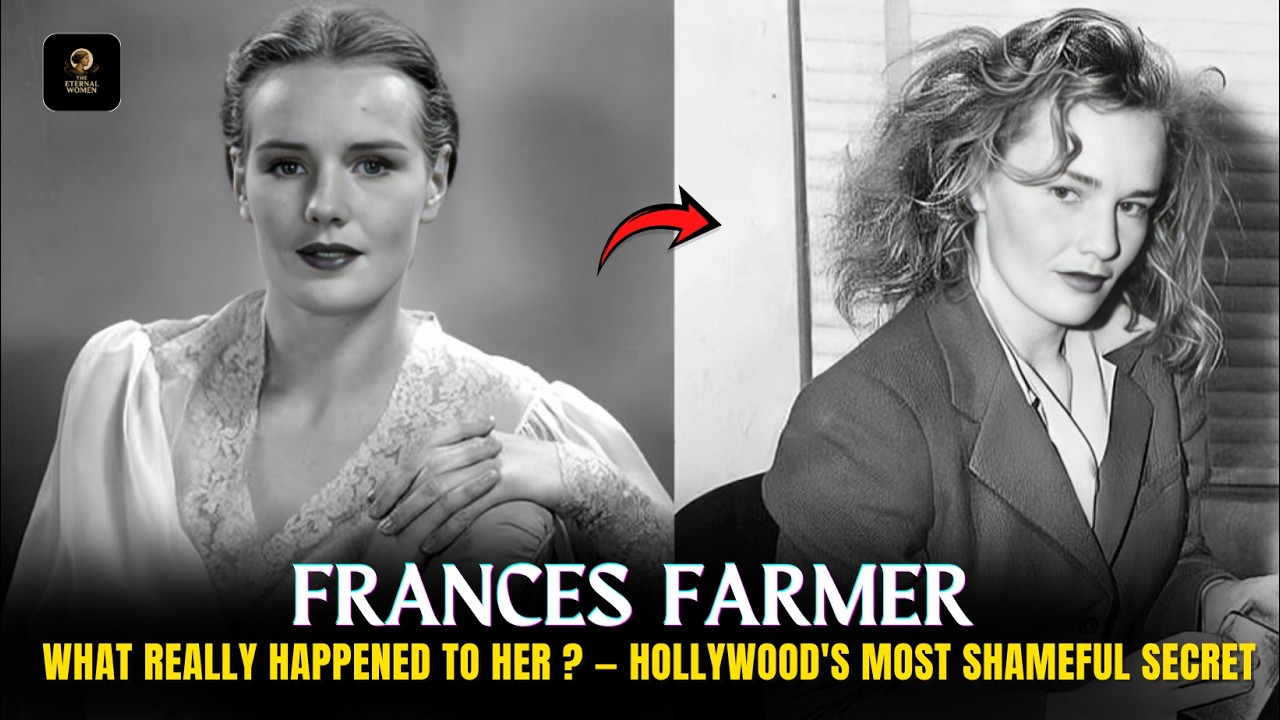
When they approached, she resisted. By her own later account, she told them she had been drinking everything she could get her hands on, including Benzedrine. The scene, Frances disheveled and furious being physically removed from the hotel, was printed in newspapers across the country. The courtroom appearance that followed became one of Hollywood’s most infamous moments.
When the judge asked what she did for a living, she told him she was an actress. When he asked if she had a drinking problem, she told him the truth. When he sentenced her to one hundred eighty days in jail, she erupted. Matrons carried her out, removing her shoes so she could not kick them.
The newspapers had a field day. Every outlet framed what they saw as proof of madness. Her sister-in-law, present at the sentencing, decided that committing Frances to a psychiatric hospital would be preferable to jail. Frances was transferred to the psychiatric ward of Los Angeles General Hospital, where she was diagnosed with manic depressive psychosis.
From there she was sent to the Kimball Sanitarium in La Crescenta, where she spent nine months. While she was there, her mother traveled to Los Angeles and fought in court for legal guardianship of her thirty-year-old daughter. Lillian won. She brought her daughter back to Seattle.
It did not go well. Frances and her mother fought constantly and violently. Within months, Frances physically attacked Lillian during one of their confrontations. On March 24, 1944, Lillian Farmer had her daughter committed to Western State Hospital in Fort Steilacoom, Washington.
Frances was thirty years old. She had no legal rights, and she was not released for years. Western State was a place of containment, not healing. In the 1940s, American psychiatric institutions operated before meaningful patient rights, before informed consent, before accountability.
What happened to Frances inside Western State remains a matter of historical dispute. The most sensational account came from a 1978 biography, Shadowland by William Arnold, which claimed she had been subjected to a transorbital lobotomy in 1948, allegedly performed by Dr. Walter Freeman, and that she had been chained, straitjacketed, raped, gnawed by rats, and used for experimental drugs. Arnold later retracted significant portions of his claims.
No verified medical record confirms a lobotomy. Medical historians and members of Frances’s own family disputed it. What is verified is this. Frances Farmer was subjected to insulin shock therapy, a procedure that involved injecting patients with large doses of insulin to induce a hypoglycemic coma, then reviving them.
It was dangerous, deeply traumatizing, and is now entirely discredited. She underwent it repeatedly. She was housed in overcrowded wards in conditions that by any modern standard would be considered abusive. She had no legal advocate and no meaningful right of appeal.
She was paroled briefly in 1946, returned shortly afterward, and remained institutionalized until 1950, the better part of six years. She was released in 1950 at age thirty-six, into a world that had largely moved on without her. The studio contract system was cracking. The Group Theatre had dissolved.
The people who had praised her were a decade ahead of where she had been frozen. She was quieter now, more careful. She worked odd jobs, as a hotel desk clerk, in a laundry, in food service. The people around her had no idea who she was.
Then she went home. She cared for her parents, including her mother, the woman who had crossed the country to sign her daughter into an institution. Her father died in 1952, and Frances was there. When Lillian’s time came, Frances was there too.
In 1954 she married Alfred Lobley. It did not last. In 1958 she married Leland Mike Sell, which also ended in divorce in 1963. But before those marriages ended, she came back.
In 1957, a Modern Screen interview led to appearances on the Ed Sullivan Show and This Is Your Life. Beginning in 1958 and running for six years, she hosted her own television program in Indianapolis, Frances Farmer Presents, on which she introduced and discussed classic films. She was warm, articulate, deeply knowledgeable. The audience loved her.
It was not the career she had deserved, but it was hers, built from the wreckage of everything that had been taken from her. She made a handful of final film appearances in the 1960s, including Ride the Wild Surf in 1964, but her screen career never recovered. The industry that had called her the best actress of her generation had moved on too completely for her return to be more than a footnote. Her memoir, Will There Really Be a Morning?
, was published posthumously in 1972. Frances Elena Farmer died on August 1, 1970, in Indianapolis, Indiana, at fifty-six, of esophageal cancer. She was buried at Oaklawn Memorial Gardens Cemetery in Fishers, Indiana. She had outlived the studio system that tried to destroy her, the mother who committed her, the tabloids that mocked her, and the industry that looked away when she needed it most.
In the years since her death, recognition came slowly and incompletely. A 1982 film, a Nirvana song, biographies and retrospectives, all arriving long after the person who deserved them was gone. Frances Farmer was not destroyed by madness. She was destroyed by a specific set of people and institutions who found her inconvenient and had the power to remove her from the world when she became too much trouble to manage.
The system that destroyed her career was not a system of individual villains. It was the collective tolerance of an industry and a culture for the erasure of women who did not comply, the willingness of powerful people to look away while someone inconvenient was removed, and the readiness of the press to frame a woman’s breakdown as spectacle rather than emergency. The people who had the power to help Frances Farmer in 1942 and 1943, the studio executives, the fellow actors, the directors who had praised her talent, did nothing. Not one of them stepped forward.
The people who had legal power over her used that power not to protect her but to contain her. That is Hollywood’s most shameful secret, not a lobotomy, not a single dramatic act of cruelty, but the slow, systematic, institutional abandonment of a woman who did not fit the shape the industry had made for her. Howard Hawks said she was the best actress he had ever worked with. He said that in 1936, when she was twenty-three.
Frances Farmer paid a price for being herself that no amount of talent, beauty, or intelligence could protect her from. She never got her revenge, but she never stopped being right.