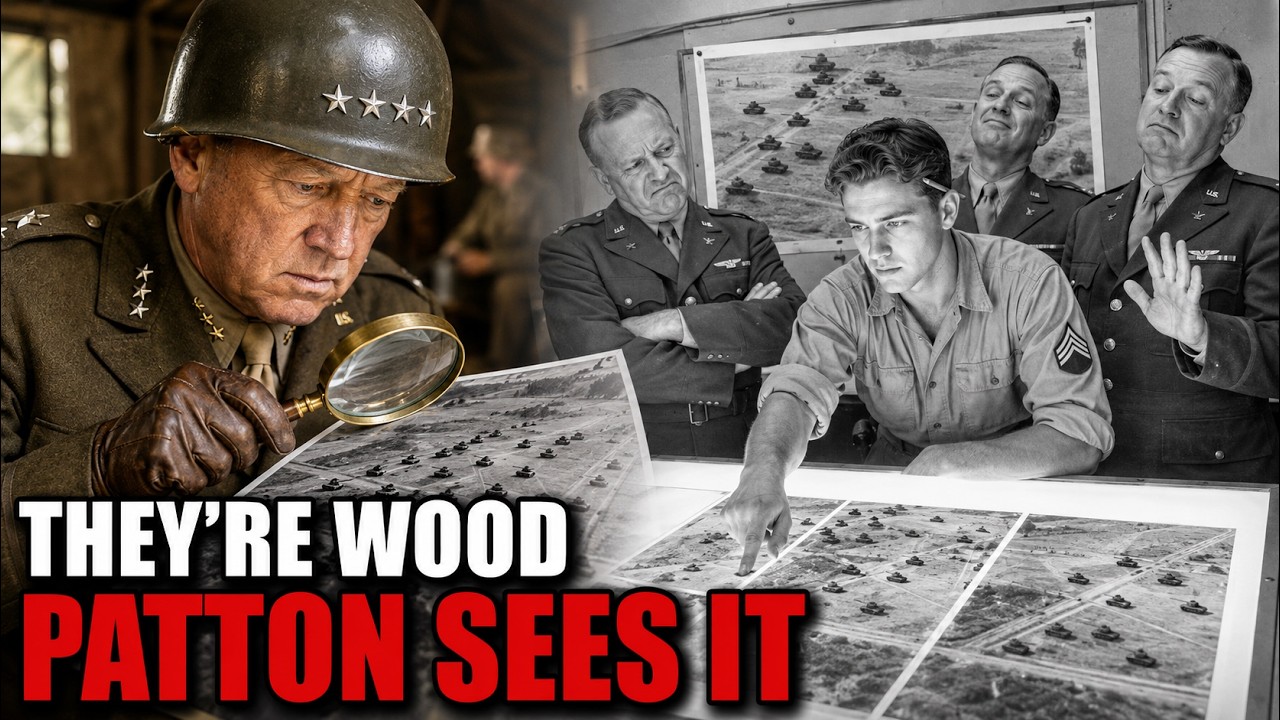
The aerial photographs arrived before dawn, still damp from the developing baths, and were placed on the intelligence table like playing cards. They had been taken from a night reconnaissance flight at 15,000 feet, showing a field position somewhere along the German defensive lines. Every colonel in the room agreed on what they saw: a concentration of German armor.
Roughly thirty Panzer tanks, positioned in what appeared to be an assembly area for an attack or a reinforced defensive line.
Thirty tanks was a significant number. It changed the operational picture, and plans began forming around how to respond. Then the 21-year-old photo analyst looked at the images and said, “Those aren’t tanks.
They’re wooden decoys.”
The room fell into the kind of silence that occurs when someone says something the assembled colonels consider absurd. Then they disagreed with him, all of them. The matter was eventually brought to General Patton.
He looked at the photos, looked at the analyst, asked a single question, and then acted in a way that ignored the unanimous opinion of the colonels. He proceeded based on the young man’s assessment.
What the troops found when they entered the field confirmed what Private First Class Arthur Mea had said.
To understand what Mea saw in those photographs and what the colonels missed, it helps to understand what aerial photo interpretation was in 1944. It was a specialty that sat at the intersection of science and art, and that intersection was uncomfortable because neither side fully accounted for the other.
The scientific part was methodical. Trained interpreters worked from specific standards, using stereoscopes to create three-dimensional images from overlapping photos. They measured shadows to determine object heights, examined track marks in the soil to identify vehicle types and directions of travel, and compared what they saw against comprehensive reference libraries compiled by Allied intelligence.
These libraries contained the exact dimensions of every German tank model, the shadow angles they cast at specific times of day and latitude, and the track widths and tread patterns left by different Panzer types in various soil conditions.
The artistic part was harder to describe. It was a specific kind of spatial intelligence that some people possess and others do not. The ability to hold a two-dimensional image in the mind and reconstruct the three-dimensional reality it represents.
To feel that something is wrong with a photograph, much as one feels a misplaced word in a sentence. Not through systematic analysis, but through a perception that precedes analysis and drives it.
The best photo interpreters had both. Those with only science were competent. Those with only art were unreliable.
Those with both were the people intelligence sections needed at critical moments. Mea had both.
Arthur Mea was 21 years old, from Columbus, Ohio, the second son in a family where his father managed a warehouse district and his mother taught piano to other people’s children. He had grown up with an unusual talent for solving visual puzzles, the kind of spatial reasoning that appears early and does not change much with age. The ability to see what other eyes overlook, because his brain processed the visual field differently than most.
He had been identified during his army induction as a potential photo analyst and trained at the Air Force photo interpretation school, where he distinguished himself with speed and accuracy in identifying vehicles and equipment, as recorded in his files by his instructors. He had spent seven months in the intelligence section by the time the night reconnaissance photos arrived. He looked at them for about four minutes before he said what he said.
What Mea saw was not immediately obvious. The photos showed objects with the correct side profile of Panzer tanks: the right length, the right width, and the general silhouette that German armor of that type produced in aerial photography. The colonels looked at them and saw what the silhouette told them to see.
Their training and experience said that this shape in this location meant tanks.
But Mea saw two things the silhouette did not explain.
The first was the shadows. In aerial photography, the shadow cast by an object is a function of its height above the ground, the angle of the sun, and the density of the object casting it. A real Panzer tank, a solid steel vehicle weighing dozens of tons, casts a shadow of a specific quality: dark, with hard edges, consistent density from end to end, with sharp boundaries where the steel surface ends and the ground begins.
The shadows under the objects in these photos were different. They were slightly lighter than they should have been. The edges were softer.
There was a transparency to them that real armor did not produce. This indicated that the objects casting these shadows were not solid steel but thinner and less dense than their external shape suggested. Painted wooden frames designed to mimic the shape of a Panzer tank would cast a shadow very similar to what he was looking at.
Not identical, but close enough for a skilled observer who looked carefully to notice the difference. He noticed it.
The second issue was the ground around the objects. Real tanks in a positioned formation leave evidence of their presence in the soil. The distinctive double track marks of tank treads appear in aerial photography as parallel lines approaching and leaving the site.
Tanks that entered the position left their tracks behind.
What the photos showed around these objects was different. There was human foot traffic, appearing as softer, less organized marks left by groups of people in the same ground where tanks would have left clear mechanical evidence. The people who placed the decoys had walked in and walked out.
The decoys themselves had not been driven into the position. Wooden decoy models placed by infantry personnel. That is what he saw.
That is what he said.
Imagine the scene. The briefing room, the photos on the table, the colonel looking at the same images and seeing a formation of German armor representing a significant tactical threat requiring a major operational response. And Mea saying clearly, without hesitation, that those objects were not tanks.
The shadows were wrong. There were no tank tracks. What they were looking at was a fabricated deception designed to draw their attention to a position that did not contain the threat it appeared to contain.
The colonels had more experience. They had been in combat longer. They had seen reconnaissance photos before.
They had been trained in the same specialty. They had a systematic understanding of what Panzer formations should look like in aerial photography. When Mea explained what he saw, the shadow quality, the ground evidence, they debated his argument the way experienced officers debate the argument of someone of much lower rank: with a mix of professional assessment and the institutional impatience that rank generates when challenged by a subordinate.
Some looked more carefully at what he was pointing to. Some acknowledged the points but weighed them against the overall picture, which still showed objects of appropriate appearance in an appropriate location. Others simply held to the prevailing consensus.
They all disagreed with him.
The matter was brought to Patton. What happened when Patton looked at the photos was not a demonstration of military rank. He did not look at a junior officer and decide that the accumulated military experience in the room outweighed the spatial analysis of a 21-year-old.
Patton looked at the photos. He looked at what Mea was pointing to. He asked the analyst a single question, which according to accounts of the incident was approximately: “How sure are you?”
Mea answered: “Very.”
Patton had a particular kind of attention to this matter, the ability to evaluate an argument based on evidence on its own logic rather than judging it based on who was presenting it. He had spent enough time in intelligence briefings to know that a photograph is not the thing it represents. A photograph is a translation of physical reality through a process with specific limitations and failure patterns.
The person who understands those limitations and failure patterns in the fine detail that a trained photo analyst knows deserves to be heard, even when the colonels disagree.
He proceeded based on Mea’s assessment.
The site was approached with the caution required by a defensive position containing 30 tanks, with appropriate support organized and expectations of engaging real German armor. What the advancing soldiers found was not German armor. They found wooden structures.
About 30 of them, made from available lumber and painted in the dark green and brown camouflage colors of German vehicles, positioned to present the appearance that aerial photography captured from 15,000 feet. They had been placed by German infantry who had walked in and out the same way, leaving the footprints Mea had seen and the colonels had not.
The position was a deception. The real German armor was elsewhere, in a location that attracted no attention, while the intelligence section treated it as a secondary concern because the apparent presence of 30 tanks at the first location was consuming planning resources.
Consider that for a moment. Every colonel in that room saw a formation of enemy armor requiring a response. That response would have been directed toward phantom targets, leaving the real threat unaddressed while Allied forces occupied themselves with painted wood.
The 21-year-old who looked at the shadows and the ground evidence uncovered a German deception sophisticated enough to fool everyone in the intelligence section.
Arthur Mea, 21 years old, from Columbus, Ohio. He grew up in a family where the father managed a warehouse district and the mother gave piano lessons. Somewhere in that specific upbringing, he developed a way of seeing things that differs from how most people see them.
Not better in every context, but specifically suited to the task of looking at a photograph of a field and knowing whether the objects in it are really what they appear to be.
He had been in the intelligence section for seven months. He had looked at photographs every day for seven months. He had been right about many things during those seven months, in the quiet, specific way that a low-ranking specialist is right, without anyone noticing in the operational background of the war.
But this time, it was noticed.
The nature of the colonels’ error is worth understanding. They did not overlook the shadow quality or the ground evidence through negligence. They processed the same visual information he processed, but they weighted it differently.
The general profile of the objects, with its correct length, width, and overall shape, carried more weight than the specific anomalies he identified, because the general profile matched a known threat while the specific anomalies fell within a range of things that could be explained away.
Translation quality could account for shadow variation. Specific soil conditions in that area could account for the absence of track marks. The colonels had an answer for everything he pointed to.
The answers were not individually wrong. What was wrong was the overall weighting, the willingness to explain each anomaly separately rather than asking what it meant that multiple anomalies pointed in the same direction.
Mea’s spatial intelligence told him that a single anomaly is not the result. The result was in the pattern itself. The shadows and the ground evidence were two independent indicators from two different physical phenomena, both leading to the same conclusion.
These things were not what the profile said they were. When two independent indicators point away from the expected answer, the appropriate response is not to justify each one separately. It is to take the convergence seriously.
Patton took it seriously. The colonels did not. He asked the right question, which was not “What does everyone in the room think?”
but “How sure are you?” The answer to that question came from someone who had looked at two independent indicators and followed them to the same conclusion.
Was Patton right to proceed based on the assessment of a 21-year-old against the consensus of every colonel in the room? Some might say no, that operational decisions of this magnitude require the best institutional judgment available, and that the consensus of experienced officers is not merely the sum of their individual opinions but the product of their collective experience. A commanding general who ignores this consensus based on the spatial intuition of a single analyst replaces institutional judgment with individual judgment, which is what those processes exist to prevent.
Others might say the opposite. That expertise is specialized, and the specific expertise required to distinguish a wooden model from 15,000 feet was concentrated in a 21-year-old from Columbus who had spent his time looking at nothing but photographs for seven months. Rank tells you who has more experience, but it does not tell you who has the specific, relevant experience.
The thirty painted wooden frames the troops found when they advanced told the story more clearly than any argument in the briefing room could have.