In 1982, Bette Davis sat for an interview at seventy-four and corrected a question that got the number wrong. No, she said, not one abortion. Two. Her first husband had begged her to do it, and she did what he wanted.
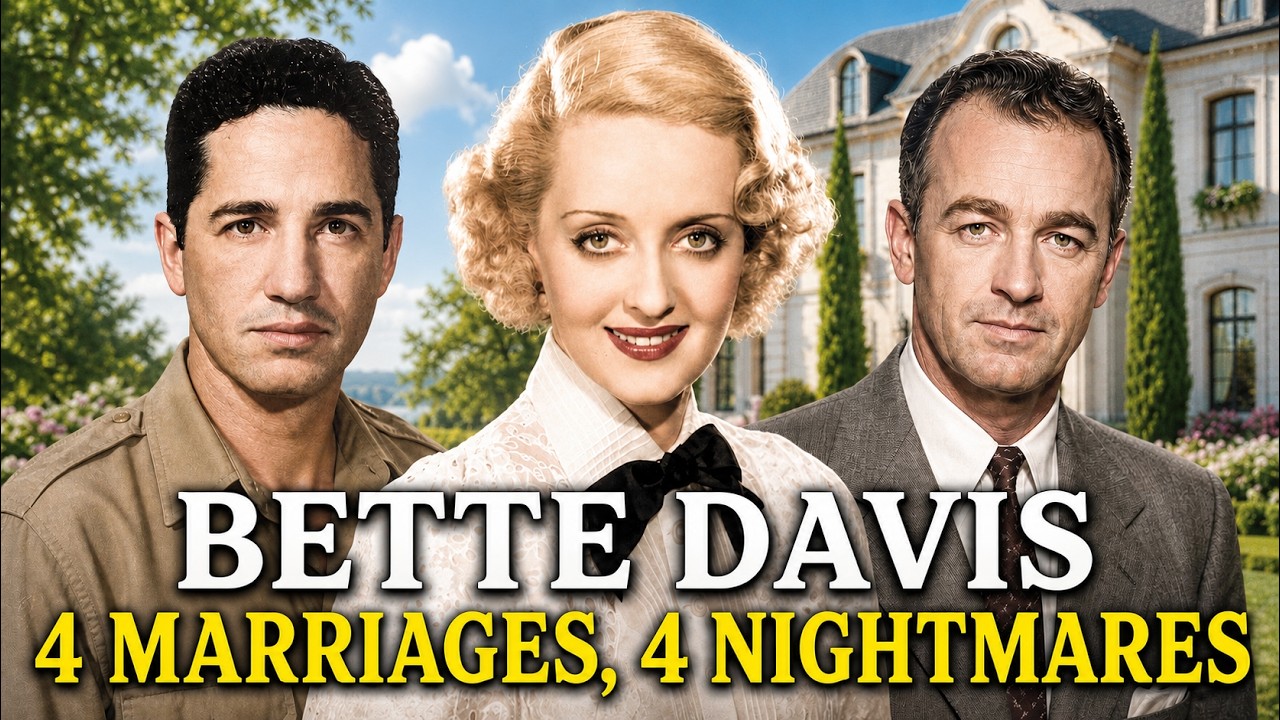
That was Harmon Nelson, her first husband. She described herself as a dutiful wife who made the choice her husband wanted made. The woman who would win two Oscars, sue her own studio, and lose the case in court while winning the argument everywhere else had also, by her own account, quietly surrendered one of the most private decisions a person can make. Ruth Elizabeth Davis was born on April 5, 1908, in Lowell, Massachusetts, the elder of two daughters.
Her father, Harlow Morrell Davis, was a patent attorney, professionally accomplished but personally remote. Her mother, Ruth Augusta Favor Davis, possessed a determination that shaped her daughters more than anything else in their childhood. When Bette was seven, Harlow simply left the family. No gradual withdrawal, no softening warning.
He was gone, and Ruth Davis was left alone to raise two girls on whatever combination of work and nerve she could assemble. She worked as a housekeeper, then as a photographer, then at whatever job the next season required. The family moved through one small New England town after another, a different rented room most years, a different school, always with the same insistence that none of it was permanent. She succeeded by refusing to be defeated by circumstance.
Bette absorbed that refusal completely. It was the same quality that made her extraordinary to watch on screen and, by most accounts, difficult to live with off it. Ruthie, as everyone called her, became her daughter’s closest companion. She went with Bette to New York, attended film premieres with her, and weathered the chaos of her early career from the seat beside her.
They were close in the way mothers and daughters become close after surviving something hard together. Bette had wanted to act since her early teens. She trained at John Murray Anderson’s drama school in New York and with private teachers, made her professional stage debut with a stock company in 1928, and reached Broadway the following year in a play called Broken Dishes. In 1930 she went to Hollywood.
Not because Hollywood was what she most wanted, but because that was where the work was and she needed it. Universal signed her first, decided she had nothing that made a star, and dropped her. Warner Brothers picked her up instead, and four years later loaned her to RKO to play Mildred Rogers, the manipulative waitress in Of Human Bondage, opposite Leslie Howard. That 1934 performance was what made the industry take her seriously, and it was the performance the Academy did not nominate.
The snub was so glaring that the Academy changed its rules the following year to allow write-in votes. She was formally nominated the next year for Dangerous and won. She won again in 1939 for Jezebel. Two Academy Awards before she turned thirty-one, and a body of work critics already described as tragic, brutal, pitiful, and magnificent, with six more decades ahead of her, none of them ordinary.
By the time of her second Oscar, she was already married to the first of four men who would try, in four very different ways, to live with what she was becoming. Harmon Oscar Nelson Jr. , known to everyone as Ham, had been Bette’s high school sweetheart in Newton, Massachusetts. He played music.
He had an easy, likable temperament and belonged to that category of high school sweethearts whose appeal forms before either person becomes what they will later be. They dated as teenagers, drifted apart, and found each other again once he moved to California, where she was already established at Warner Brothers. On August 18, 1932, they married in a small, quiet ceremony. She was twenty-four.
Ham was familiar, safe, and devoted to her, which meant a great deal in the early years of a career like hers. He turned out not to be equipped for what she became. It began with money. By the mid-1930s, Warner Brothers was paying Bette Davis ten thousand dollars a week, making her the highest-paid woman in the country.
The industry that had rewritten its award rules because of her was now paying her more than anyone else in America, male or female. Ham was a working musician and earned nowhere near that. By itself, that is not an unusual arrangement within a marriage. What it requires is a husband confident enough to live in that situation without comparing himself.
Ham did not have that kind of confidence. So he found the one place where he could still exercise control. He refused to let Bette buy a house with her own money until he could pay for it himself. It was not negotiable and was never presented as such.
She had more than enough to purchase and maintain a significant property. She was not allowed to, because of what it would have meant for him if she did. The marriage strained as her career accelerated with Of Human Bondage, the Oscar nominations, and her fights with Warner Brothers over scripts and contract terms that showed how ambitious and principled she was at once. She had become the most important actress in American cinema.
At home, Ham read the newspapers that talked about his wife. He went to the same parties she attended, where people crossed the room to reach her and gave him a polite word as they passed. By 1937, she was involved with George Brent, her co-star in The Great Lie, who reportedly proposed marriage. She refused.
The following year she filmed Jezebel, William Wyler’s melodrama about a stubborn Southern woman who pays a heavy price for her pride, shot while her own marriage was collapsing entirely. People who knew what was happening in her life did not stop noticing the correspondence. She was playing a woman destroyed by her refusal to bend, in the middle of a marriage to a man who needed her to bend, and discovering she could not. In 1938, Ham filed for divorce.
The reasons he listed became the details that have attached themselves to this marriage ever since: that Bette cared more about her career than about him, that she read film scripts when he had guests in the house, and that each had lost what he called the close bond between husband and wife. The divorce file also included documented evidence of her affair with Howard Hughes. Bette did not contest any of it. She said later that other factors also played a part, a phrase that reads, in context, as an admission of the affairs and of something deeper.
The marriage had never been able to hold. What the divorce file left out entirely, until that 1982 interview, was the abortions. By her own later account, she had not been a woman who put ambition above everything. In at least one intensely private matter, she had given her husband the kind of authority a traditional marriage grants the husband.
It saved nothing. The problem was not one decision. The problem was a wife who kept winning Oscars, kept getting richer, and kept entering rooms where everyone turned to her first. No personal concession could change that reality.
She was thirty, twice an Oscar winner, and free of a marriage that had never fit. For the first time since her fame, she was alone without anyone else. That changed in 1939 when she checked into the Sugar Hill inn in Franconia, New Hampshire, looking for rest that required genuine distance from the industry, the city, and the whole machine her life was built inside of. Arthur Farnsworth was the inn’s assistant manager, the son of a New England dentist, light-hearted and unassuming, a former commercial pilot who had moved into hospitality.
He was not awed by her identity and did not seek any advantage her fame might bring. He was a man in New Hampshire who found this particular woman interesting and told her so. She fell under his spell almost immediately. Visits became correspondence, and correspondence became something larger.
He wanted nothing from her status. He wanted her. In her later interviews and memoirs, she described a man entirely at peace with his own life and therefore comfortable with hers, proud of her without needing to process the gap between her fame and his relative obscurity, enjoying her, interested in her as a person rather than a phenomenon. They eloped in December 1940 and married on the thirtieth at the Home Ranch in Rimrock, Arizona, in a ceremony small enough to avoid becoming the spectacle Hollywood weddings usually were.
By the testimony of everyone who knew them, these were the happiest domestic years of Bette Davis’s adult life. Farnsworth felt no threat from her success and did not compete with her career. He supported it plainly and without resentment, which had exhausted her first marriage. The word people kept using for him was anchor.
On August 23, 1943, Arthur Farnsworth collapsed on the sidewalk at the corner of Hollywood Boulevard and Cahuenga in the middle of the afternoon, in front of whoever happened to be passing. He struck his head on the pavement as he fell. He never regained consciousness and died two days later on August 25. He was thirty-five.
Bette rented the room next to his to stay close, and sat with his body after death. The official finding was a fractured skull from an earlier fall no one had noticed or treated. A clot formed, and the pressure was blamed for the dizziness that threw him onto the sidewalk that evening. The Los Angeles County coroner ordered an official inquiry.
According to a Los Angeles Times report from the time, Davis told investigators that Arthur had fallen from a staircase in their New Hampshire home about two months earlier while running to answer the phone. The inquiry concluded accidental death. The question was never whether Arthur Farnsworth had been killed, because no evidence ever supported that. What remained unresolved was a small, stubborn gap in the timeline of an injury.
No one around him seems to have noticed it until it killed him. That gap was enough, over the decades that followed, to grow darker legends. Some later biographies and documentaries raised the possibility that Bette might have caused the earlier injury, and one recurring account suggested she pushed him toward a wall in a train compartment. None of it rises to the level of an accusation based on real evidence.
It is speculation built by people writing decades later, added to a genuine but limited medical uncertainty, and it never succeeded in overturning the conclusion the inquiry actually reached. What is hard to ignore is the effect the ending had on her. With Ham, there had been an incompatibility that could be identified. With the husband who came later, there would be violence.
With Arthur, there was nothing to blame. No betrayal, no enemy, just a thirty-five-year-old man who was there and then gone. She tried to withdraw from her next film, Mr. Skeffington.
Jack Warner halted production for a time and persuaded her to return to the set. Accounts of that production describe behavior unusual even for her. Confrontations, demands for rewrites, flat refusals, and temper tantrums her colleagues had never seen before. She described her own pattern in one blunt sentence looking back: in the worst pain of her life, she attacked rather than broke.
Two years later, she married again. The warnings about that marriage arrived before the wedding date. One came from the mother of the man she was marrying. In 1945, two years after Farnsworth’s death, she met William Grant Sherry, a painter six years her junior, handsome, and as far from the Hollywood machine as Farnsworth had once been.
That resemblance seems to have mattered to her. After losing the only husband who never felt the need to shrink her career, here was another man entirely outside that world. On the surface, it had worked before. According to biographical accounts, Sherry’s mother warned Bette about him before the wedding and described her son as cruel.
Bette’s sister, known as Bobby, reportedly hired an investigator, whose report carried its own warnings. Bette chose not to read it. She married William Grant Sherry on November 29, 1945, about a month after they met. Davis later said the violence began that very night, when Sherry threw a suitcase at her.
Their daughter, Barbara Davis Sherry, known to everyone as B. D. , was born in 1947. Bette threw herself into motherhood with the same intensity she devoted to everything else.
She later wrote about nearly leaving acting entirely, stunned by the feeling of having a child and genuinely unsure how to balance it with a career that had never been built to stop. The marriage deteriorated quickly after that. Sherry’s rages got worse instead of better. He appeared uninvited at her film locations and displayed his displeasure in front of crews and fellow actors.
Bette began to fear for B. D. ‘s safety as well as her own. She also learned that Sherry was having an affair with the woman she had hired to care for their daughter.
A detail that sounds like a bad novel, except that it is part of the documented record. She filed for divorce and agreed to a settlement that says as much about her fear as anything else in this story. She offered to pay Sherry alimony on the condition that he stay away from her and from B. D.
This was not a woman negotiating for more money, the usual form of Hollywood divorce settlements. This was a woman who had more money than almost anyone and offered to give up a portion of it permanently in exchange for distance and the safety of her daughter. The divorce was finalized on July 3, 1950. Once it was final, Sherry married the nanny, Marion Richards.
They remained married until his death in 2003. B. D. later wrote that Sherry effectively disappeared from his daughter’s life after the divorce, with the relationship reduced to Christmas cards for years.
That left a void in B. D. ‘s childhood that should have been filled by a father. And Bette, without much hesitation, was about to fill that void with a new husband.
By 1950, she was alone again, and her career was faltering for the first time since she had become a star. Her Warner Brothers years were ending. Offers were drying up, and the industry was saying the things it tends to say about a woman past a certain point in her career: that she had become difficult, too expensive, tied to an era Hollywood was preparing to move past. She was forty-two, divorced from a violent man, raising a three-year-old daughter largely by herself, facing professional uncertainty she had not known in nearly twenty years.
In 1950, Claudette Colbert injured her back and had to withdraw from Joseph L. Mankiewicz’s production at Twentieth Century Fox called All About Eve. Darryl Zanuck needed a replacement quickly. The script was one of the most admired in recent Hollywood memory, a brilliant and devastating study of ambition and of the particular cruelty the entertainment industry reserves for women who are no longer young.
It required an actress who could embody immense intelligence and genuine fear in the same performance. Bette Davis read it and called it the best script she had ever read, significant from a woman who had read thousands by then. She accepted within days and joined the production in San Francisco. Mankiewicz later said she was absolutely perfect, that she arrived with the character fully built, and that directing her mostly meant staying out of her way while she did the work herself.
All About Eve received fourteen Academy Award nominations, a number no film has matched since, and won six, including Bette Davis’s eighth nomination. During filming, she fell in love with her co-star. Gary Merrill was an actor, not a star of her level, but he was talented and had the kind of presence the camera loves. He played Bill Simpson, the fiancé Eve plans to steal from Margo Channing, and he was faithful on screen and off, falling in love with the very woman he was playing at being faithful to.
Merrill’s divorce from his first wife was finalized on July 28, 1950. Bette’s divorce from Sherry had been finalized twenty-five days earlier. On the same day Merrill’s divorce became final, the two married. The speed was not accidental.
Bette Davis was never a woman who waited once she knew what she wanted. The marriage seemed like an extraordinary foundation: two actors who had just made one of the greatest films of the decade together, both people of strong opinions and large appetites for life. They had three children together: B. D.
, and Margo and Michael, whom they adopted. They had a home on the coast of Maine, beautiful and remote, far enough from Hollywood to feel like a real life and close enough to reach when work called. Mankiewicz, who directed them both, observed that Davis and Merrill seemed to have confused themselves with the characters they played. Bette became Margo Channing in a permanent way, and Merrill became Bill Simpson, the devoted younger partner.
The screen versions worked better than the real ones. The early years with small children, the Maine coast, and a film industry a train ride away were good, by most accounts, in ways the later years were not. Bette later wrote about finding something in motherhood that surprised her with its completeness: the simple physical reality of small children who needed her in the moment and gave her their attention without calculation, which the film industry had never done once. She stepped back a significant portion of her career in the early 1950s to be present for that.
Compared with her first marriage, it almost amounts to a controlled experiment. Ham’s complaint had been that her career mattered more than he did. With Gary, a decade later, she tried the opposite. Less Bette Davis, more wife and mother.
What made the choice costly rather than merely symbolic was the timing. She made it in 1950 and 1951, at the moment the logic of her career was screaming in the opposite direction, at the height of the greatest comeback of her professional life. But she did something else instead. This was the only one of her four marriages in which she deliberately and at great cost tried to shrink herself to preserve the marriage.
And that fact matters later. Merrill adopted B. D. with Sherry’s consent.
In January 1951, they adopted a daughter and named her Margo after the character who had brought her parents together. In 1952, they adopted a son named Michael. The family moved to a seaside property in Cape Elizabeth, Maine. What the marriage revealed over the next decade was that two people capable of great passion and similar volatility do not achieve stability by combining those qualities.
They produce heat and turbulence, creating a vivid story and real damage in nearly equal measure. Merrill’s drinking worsened over the years, and he became physically volatile in a way that made the household frightening and chaotic on a regular basis, though not matching Sherry’s violence. Bette provoked him, and Merrill escalated. Their careers were not running on the same track either.
His star was fading while hers stayed bright, and a decade of that disparity wore them both down in ways neither fully recovered from. The family also carried a weight this story has not yet mentioned. Margo, adopted as an infant, was finally diagnosed with a serious developmental disability and spent most of her adult life in institutional care. There is no basis for saying this diagnosis ended the marriage.
But this was not only a story of professional disparity, drinking, and fighting. There was also a crisis of parenting no one had chosen, sitting beneath the surface of the marriage the whole time. Merrill later wrote a memoir titled Bette, Rita, and the Rest of My Life, naming Davis and Rita Hayworth as the romantic relationships that defined him. He admitted he lacked her burning ambition and described himself as a man content to live and enjoy himself.
It is an honest piece of self-knowledge. Bette filed for divorce in 1960, citing his drinking and the resulting behavior over a decade. She said later that during the first three years of the marriage, she put her career aside to be a wife and mother, and that Gary stopped loving her during those years. It is a striking admission from a woman not known for public vulnerability.
The only sacrifice she ever made of her career, which had always defined her, was not enough. What actually happened inside that decade depends on which account one believes. Bette’s own version centers on his alcoholism, his cruelty, and a marriage that exhausted itself. B.
D. Hyman’s later memoir describes something far more violent. Gary Merrill’s own record is neither of those exactly. When Hyman published that memoir in 1985, it was Merrill, not Davis, who stood outside a bookstore in Maine with a sign urging people not to buy it, calling his former stepdaughter’s motives cruel and greedy.
Bette wrote to thank him. The marriage failed. Whatever affection had existed had clearly faded into areas neither enjoyed discussing. The damage described in B.
D. ‘s memoir was real enough that Merrill himself did not deny all of it. Even twenty-five years after the divorce, he still refused to let his stepdaughter’s book be the last word about the woman he had once been married to. Merrill died five months later, in March 1990.
In 1985, B. D. Hyman published a memoir titled My Mother’s Keeper, describing Bette as demanding, difficult, and at times destructive as a mother over decades of her daughter’s life. Davis was devastated.
People who knew the family said much of what B. D. described was misleading or stripped of context. When Mike Wallace later rebroadcast an old 60 Minutes interview in which B.
D. herself praised her mother’s parenting and said she had adopted Bette’s own principles in raising her children, the contradiction between that interview and the memoir became hard to ignore. Critics of B. D.
‘s account also noted that Bette had supported the Hyman family financially for years, including help that prevented them from losing their home shortly before the book appeared, which sits uneasily against the picture of a mother who had given her daughter only harm. Margo, whose diagnosis was described in this story as a real burden within the marriage rather than merely a footnote, spent most of her adult life in institutional care and died in 2022 at seventy-one. Michael Merrill became a film producer, remained the closest son to Bette in her final years, and eventually cut off contact with B. D.
over the way she treated their mother. Of the three children raised across four marriages, Michael was the closest to her. Bette kept working. That refusal to accept defeat, learned by watching her mother survive abandonment and poverty, was now directed at a career the industry had tried to write off more than once.
She made What Ever Happened to Baby Jane in 1962 opposite Joan Crawford, a film that is itself a study of what extraordinary difficult women look like once the industry stops knowing what to do with them. She continued working in film and television into the 1980s, far outlasting what most people had predicted. She suffered a stroke in 1983 that left partial paralysis on one side of her face and required intensive rehabilitation, which she undertook with the same discipline she applied to everything else in her life. She was also diagnosed with breast cancer and underwent a mastectomy in roughly the same period.
Two serious health crises in succession, faced by a woman in her seventies who had buried a husband, survived a violent one, and outlasted a fourth marriage that had deliberately tried to diminish her. She kept appearing in public, kept taking roles, kept giving interviews that were, by everyone’s testimony, just as sharp and distinctive as they had been at the height of her career. In 1977, she received the American Film Institute’s Lifetime Achievement Award, the first woman ever to receive it. Nearly every major figure in American cinema attended, and reports of that night describe an atmosphere approaching reverence.
She was not entirely comfortable receiving that kind of veneration. She was far more comfortable giving her opinions. In her plain manner, learned from her mother, she said she refused to be helpless or to allow illness to write the final chapters of her life instead of her. She died on October 6, 1989, in Neuilly-sur-Seine, France, while returning from a film festival in San Sebastian, Spain, where she had just received an award for her achievements and delivered remarks those present described as entirely her: direct, humorous, uninterested in sentiment, fully aware of what she had accomplished, and not inclined to pretend otherwise.
She was eighty-one. She was buried in Forest Lawn Memorial Park in the Hollywood Hills under a headstone she chose herself. It reads: She did it the hard way. Five words she selected to sum up eighty-one years.
Two Oscars. A mother who never allowed hardship to look permanent. And four marriages, each of which tried, in its own way, to convince her there was an easier path available if she wanted it. It would be easy to end this the way stories usually end: four men drawn to her strength and intelligence, none of whom could live inside a marriage with the woman who actually possessed those qualities.
There is truth in that version. But it also ignores what she actually tried to do. With Ham, she was not simply choosing her career over her marriage. By her later account, she gave him authority over one of the most private decisions a person can make, and it still was not enough to keep their marriage together.
With Arthur, she found the only man who never felt the need for her to be less, and the marriage seemed as if it might work for exactly that reason. Then death took him before the marriage had a chance to face the years, which pose the real question of whether two people can grow old side by side in the same house. With Sherry, she reached for the same type of man again, another outsider to Hollywood, mistaking his distance from the film world for the safety Arthur had provided. That was a mistake.
A man who never had to build his own life outside Hollywood is not the same as one who already had. And with Gary, at the moment her career was giving her everything, she tried the one thing her other marriages had not asked of her. She deliberately made herself smaller for the sake of the marriage. It ended anyway.
Put the four side by side, and a different pattern emerges than the one this story began with. A woman of that size could not simply be contained. She tried to be contained four separate times, in four different ways: through private deference, through finding a man who needed her to change nothing, through seeking the same safety twice, and through deliberately shrinking her career. Every version of the experiment returned the same result.
Four attempts to make marriage survive an association with Bette Davis, and four different ways of failing. Perhaps the question is not why none of these men could handle her. Perhaps the question is which of them actually came closest, and whether she was more than could be handled was the right lesson to draw from a woman who sincerely tried, at least once, to be less. She never married a fifth time.
When asked about it in later interviews, her answers were as direct and complicated as ever, naming what each man had given her and what each had cost her, without blaming herself and without pretending the damage had not been real. By her own repeated admission, she was not an easy woman to live with, and she was right about that. She was also never willing to shrink herself to fit a marriage designed for someone smaller, except once. When she tried it, she discovered it did not save her either.
Four marriages are the record of everything that produced: the damage, the grief, the children, and the remarkable life that continued anyway.