The most visible reminder of what Sardinia once held stands in a small museum in Cabras, on the island’s western coast. There, rows of carved stone figures rise two meters and more from glass cases: warriors, boxers, archers, their faces cut with a precision that has defied full explanation. According to the accepted timeline, the Bronze Age culture that produced them should not have possessed the skill required to make them. They were found by accident.
In 1974, a farmer plowing a field near the village of Monte Prama struck stone. What came up was a shattered arm, then a torso, then a head of unusual dimensions. Preliminary excavation recovered fragments belonging to dozens of figures. Reassembled, several stood taller than any living adult on the island today.
The eye sockets were carved in deep concentric rings, a style with no documented precedent in earlier Sardinian art and no successor in any later tradition. The limestone work required tools and organizational capacity that the Nuragic culture was not supposed to have mastered. Researchers dated the statues to somewhere between 900 and 700 BCE. Then the figures were locked in storage for thirty years.
The full scientific excavation of Monte Prama was not undertaken until 2014—forty years after a plow first struck stone. Monte Prama is not where the story begins. It is the part that survived long enough to be told in public. What happened in Sardinia before that, and specifically what was documented and quietly removed in 1903, is a different kind of record, defined not by what was found but by the gap between what excavation field notes described and what was published for other scholars to read.
Sardinia sits in the western Mediterranean, roughly between Italy and North Africa. The island has been continuously inhabited longer than most places in Europe with a connected historical record, with human presence dating back roughly 500,000 years. By the Bronze Age, between 1800 and 700 BCE, it had developed the civilization archaeologists now call Nuragic, named for the nuraghi: massive stone tower fortresses built in numbers that still surprise researchers. Approximately 7,000 stand today, some reaching forty feet, constructed from basalt and limestone without binding mortar, using interlocked stones held under compression in a technique modern structural engineers describe as sophisticated.
The peak Nuragic population is estimated at 300,000 to 500,000 people, meaning roughly one tower for every forty to seventy residents. These were not simple watchtowers. The engineering required—the precision stonework, the multi-story internal chambers, the corbelled ceilings that have survived four millennia of Mediterranean seismic activity—is not the scale of a chieftain’s household. It is the scale of a civilization with institutional memory, organized labor, and a relationship to permanence that does not fit what is expected from a Bronze Age culture on an island this size.
The mainstream explanation treats the nuraghi as residences or communal centers, but their distribution does not follow expected patterns. They are not clustered around the most productive land or concentrated at water sources. The surface record alone is more complex than the standard narrative comfortably accommodates. In 1903, an excavation team operating under the authority of the newly unified Italian state, working in coordination with a Jesuit-affiliated academic institution that appears in the original correspondence but is absent from later published reports, opened a series of sites in the Oristano province of west-central Sardinia.
The sites were near the village of Arbini and in the valley approaching the ancient settlement now known as the archaeological site of Tharros. Documentation from those excavations survives in two forms, and the two forms do not describe the same findings. The first form is the field notes. They were written by Antonio Taramelli, then one of Italy’s most respected classical archaeologists, a man whose documentation practices were considered a model of professional care.
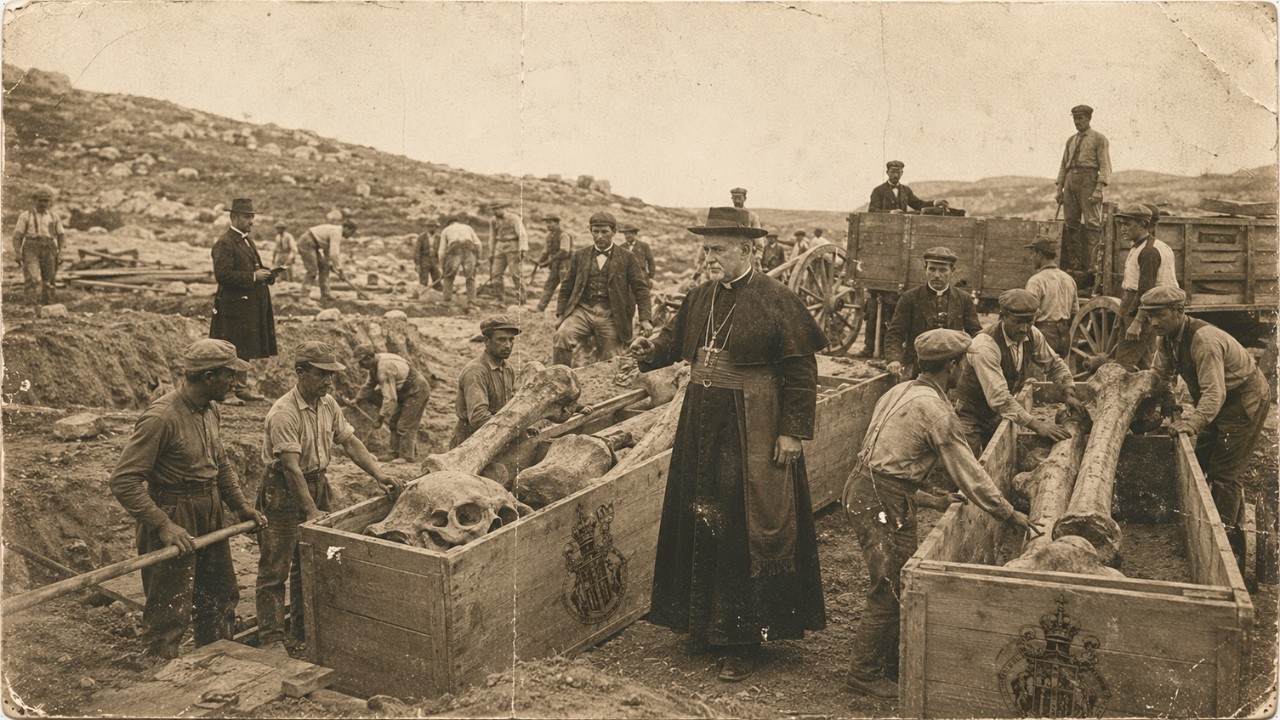
The notes from the 1903 Oristano excavations, portions held today at the National Archaeological Museum in Cagliari, record the discovery of skeletal remains at multiple locations. Taramelli describes what he calls individuals of exceptional physical stature, using the Italian phrase straordinaria statura—extraordinary stature—in two separate entries written weeks apart. He recorded measurements. In at least three documented instances, the long-bone measurements correspond to individuals whose height in life would have been seven feet or above, based on standard forensic anthropological calculations.
The second form is the published report. It appeared in 1904 in the Notizie degli Scavi di Antichità, then the primary venue for Italian archaeological publication. The report describes the recovery of bronze figurines, ceramic vessels, and decorative metalwork. It categorizes the skeletal remains as ordinary, consistent with standard Nuragic burial practices, and provides no individual measurements.
The phrase straordinaria statura does not appear. The specific measurements do not appear. The objects Taramelli’s notes describe as set aside for separate evaluation and transport do not appear either, and their absence is neither explained nor acknowledged. Four lines near the close of the report state that certain artifacts and organic materials of exceptional interest had been transferred to Rome pending further classification by specialist scholars.
The notation was written in 1904. The classification was never completed. The transferred materials were never listed in any publicly accessible catalog. They entered an institutional space in Rome and did not emerge from it.
The Vatican’s holdings of pre-classical Mediterranean artifacts are substantial, housed across several collections. The catalog formally initiated in 1908, revised in 1937 and again in 1963, covers roughly sixty percent of the institution’s documented pre-classical holdings. The remaining forty percent is listed only in internal inventories inaccessible to outside researchers. Formal requests for access have been met, in documented exchanges stretching back to the 1960s, with the same response: the materials are either being prepared for cataloging or are under active scholarly review.
Sixty years of being prepared for cataloging. The fully cataloged portions contain what a major classical institution would be expected to hold: Greek ceramics, Roman bronze work, Etruscan funerary goods, pre-classical material normalized within an interpretive framework that confirms the accepted chronology of Western civilization. The uncataloged forty percent, to the extent its contents can be inferred from partial internal inventories examined by independent scholars, is disproportionately concentrated in two categories: pre-classical Sardinian artifacts and skeletal remains. The pattern is structural.
The field notes say one thing. The published report says something smaller. The transfer notation points somewhere. The destination shows a gap precisely where the transferred material should appear.
The gap has been there for over a century. The physical evidence that remains in Sardinia makes the gap hard to dismiss. The Nuragic bronze figurines, publicly visible and studied by serious researchers, number in the thousands. Produced between roughly 900 and 600 BCE, they depict warriors in detailed armor, shamanic figures, and boats of a design some maritime historians note is not consistent with known Bronze Age Sardinian shipbuilding traditions.
The warrior figures are depicted with proportions noticeably different from contemporary Mediterranean figurative traditions: elongated limbs, narrow torsos relative to height. Extrapolated to human scale, they represent individuals substantially taller than what the accepted model of ancient Sardinian populations predicts. Artistic stylizations in ancient figurative traditions are grounded in something real; the question of what physical reality the convention was responding to is a legitimate research question. Giovanni Lilliu, the Sardinian archaeologist universally regarded as the most important scholar of Nuragic culture in the twentieth century, wrote in a 1969 letter to a colleague in Rome that the complete picture of what Sardinia had been in the Bronze Age could not be reconstructed until the archaeological record was made whole again.
He meant specifically that objects removed from Sardinian contexts to mainland Italian collections would need to be brought back into active scholarly circulation. That concern has not been addressed. The reunification Lilliu identified has not happened. The deeper levels at Tharros and other Nuragic sites show the same inversion the statues do: standard archaeological models predict development from simple to complex, but the Sardinian record reverses that sequence at site after site.
The oldest layers are the most architecturally ambitious. The people who built the towers left physical evidence in stone that outlasted every empire that subsequently ruled the territory. They were gone, and the towers were still standing across the Sardinian hillsides and coastal plains, one every few miles, four thousand years old, mortar-free, architecturally precise, distributed in a pattern that looks less like habitation and more like the deliberate infrastructure of a civilization that understood the island as a managed territorial system. And somewhere in Rome, in storage that has been pending classification for 120 years, something measured in 1903 by a careful archaeologist who wrote straordinaria statura may still be waiting to be described with the accuracy and completeness the historical record deserves.
The Monte Prama statues, once finally studied, produced a substantially revised understanding of what Bronze Age Sardinians could do. A proper examination of what was transferred in 1904 might produce findings fully integrable into a revised model of Nuragic civilization. That is the point. The process works when the evidence is allowed to be examined.
The question is why the Monte Prama evidence took forty years, and why the 1903 materials have been waiting for 120.