Roy Rogers was four years old when his father first appeared on screen, though he would not remember it that way. Leonard Franklin Sly, born in Cincinnati in 1911, grew up in rural poverty and moved to California during the Great Depression, where he worked as a migrant fruit picker in the San Joaquin Valley. In the evenings, he played guitar around the campfire, and he discovered that music lifted people in a way nothing else could. That discovery carried him into the Pioneer Trio, later the Sons of the Pioneers, whose early recordings caught Hollywood’s attention.
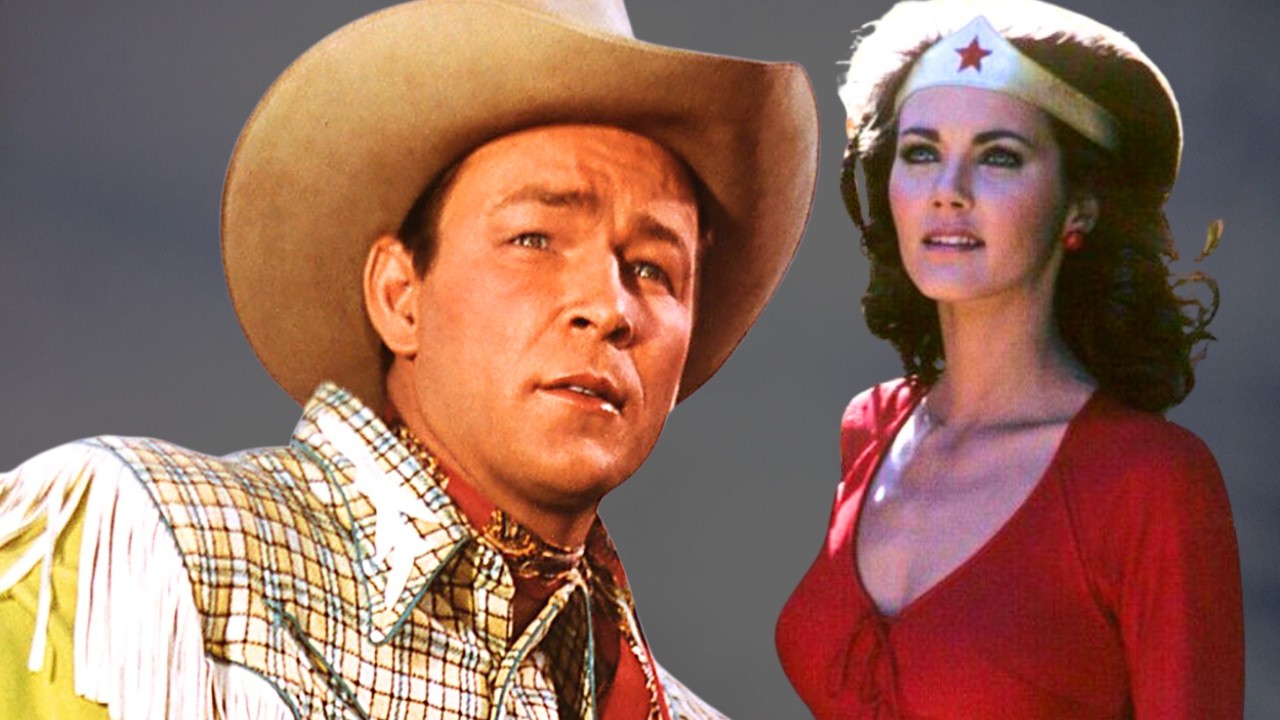
Republic Pictures signed him in 1937 and renamed him Roy Rogers, borrowing the surname from the recently deceased Will Rogers. The association resonated far beyond anyone’s expectations. From 1943 onward, the Motion Picture Herald named him the number one money-making Western star for twelve consecutive years. With Dale Evans, he made 88 movies that were seen by 80 million people every year during the 1940s.
His horse, Trigger. His dog, Bullet. His Jeep, Nelly Belle. The Roy Rogers Show ran from 1951 to 1957, and his theme song, Happy Trails, written by Dale Evans, became one of the most recognized pieces of music in American popular culture.
The public figure was a man of honesty and warmth, the king of the cowboys, the man in the white hat. The private man carried burdens that the audience never saw. Roy and Dale Evans had married on New Year’s Eve, 1947, after the sudden death of Roy’s first wife, Arlene, who died in 1946 following the birth of their son Roy Jr. , known as Dusty.
Roy and Dale’s marriage lasted more than fifty years, until his death in 1996, and their Christian faith was central to everything they did. They appeared with Billy Graham at crusades across the country and spoke openly about their beliefs in an era when that was not fashionable in Hollywood. That faith would be tested repeatedly by the tragedies that marked their family life. In 1950, Dale Evans gave birth to their only biological child together, a daughter named Robin Elizabeth Rogers.
Robin was born with Down syndrome. At that time, doctors routinely advised parents to institutionalize children born with the condition, and the prevailing medical wisdom held that these children were best hidden from public life. Roy and Dale refused. They insisted that every family publicity photo include Robin, even though the studio was convinced that fans would be repulsed by pictures of a child with disabilities.
In 1950, at the peak of their fame, they made that choice quietly and unwaveringly. Robin lived for just under two years. She died in August 1952, shortly before her second birthday, from complications related to mumps. Dale Evans transformed that grief into something that changed lives beyond her own.
She wrote a book narrated from Robin’s perspective, as if her daughter were telling her short life story from heaven. She called it Angel Unaware. Published in 1953, it became a best-seller and served as a lifeline for countless parents raising children with disabilities in an era when they were told to be ashamed. The book influenced public perceptions of children with developmental disabilities, and the Oklahoma Council for Mentally Retarded Children adopted the name the Dale Rogers Training Center in her honor.
The loss of Robin reshaped the Rogers family in ways that almost nobody knew for decades. In 1954, a thirteen-year-old girl named Marion Mimi Rogers, born in Scotland during World War II and raised largely in an orphanage, was adopted by Roy and Dale. Mimi has spoken in interviews about the culture shock of suddenly becoming the daughter of the most famous cowboy in America. But what she remembers most is not the fame or the glamour.
Inside the house, Roy and Dale were not celebrities. They were just mom and dad. The warmth was real, and Mimi, who had spent years without any of it, recognized its value in a way that perhaps only someone who had been without it could. Mimi also confirmed something that gets to the heart of why the family story matters.
She believes, and has said so directly, that the reason Roy and Dale adopted her was connected to Robin. The loss of their biological daughter created a space in their family and in their hearts that they chose to fill by opening their home to children who had no family of their own. She has said that she probably owes her entire life in America to Robin, a little girl who lived less than two years and never knew the ripple her existence would send across an ocean into a Scottish orphanage. Roy and Dale did not stop with Mimi.
Together, they opened their home to several more children, including Dodi, a Native American infant adopted at seven months old, as well as Sandy and Debbie. Roy was already the father of children from his first marriage, and the family ultimately included nine children. The Rogers household became a blended, multiracial family in an era when such things were genuinely unusual, built by two people who, even after suffering profound loss, continued to make room for children who needed love and stability. The family was not done being tested.
In 1964, their adopted daughter Debbie, twelve years old, was killed in a bus accident. The next year, their adopted son Sandy, eighteen, died after a night of heavy drinking while serving in the military in Germany. Two children in two years. To lose three children, Robin, Debbie, and Sandy, across the span of a life while maintaining a public career and presenting an image of warmth and hope to millions of fans is a weight that defies description.
Roy and Dale kept going. They did not collapse publicly. They did not retreat into bitterness. Their Christian faith was what held them together, and they were open about it.
Dale continued to write about Robin, about Debbie, about Sandy. She turned private grief into public witness, giving language and comfort to other parents carrying similar losses in silence. Roy Rogers died on July 6, 1998, at the age of eighty-six, of congestive heart failure. President Clinton expressed his condolences publicly.
Dale Evans survived him and passed away in 2001. The surviving children continued their lives largely out of the spotlight. For decades, the story of how Mimi came to be adopted, and its connection to Robin’s death, was not part of the public record. Roy and Dale never broadcast it.
It was simply the private truth of how their family came together. When Mimi finally spoke, she reframed what millions of people thought they understood. The king of the cowboys, the man in the white hat, that image was not wrong. It was incomplete.
The fuller picture is of a man and a woman who responded to private suffering by expanding their capacity to love rather than contracting it. They lost Robin. They could have closed. Instead, they opened to Mimi, to Dodi, to Sandy, to Debbie.
Mimi’s words, that inside the house they were just mom and dad, reveal who Roy Rogers really was. Not the star. The father who showed up for a thirteen-year-old girl from a Scottish orphanage and gave her a home. Robin lived less than two years.
She never knew Mimi. But the love Roy and Dale poured into her short life, and the grief they carried after losing her, shaped a family that extended far beyond what biology or geography would have predicted.