In 1851, in St. James Parish, Louisiana, a man enslaved on a sugar plantation was told that the woman he had loved, lived beside, and buried was never his wife. The law agreed. His owner, Lucius Harrou, expected grief to be a temporary memory, expecting obedience and that marriage would serve the plantation’s control.
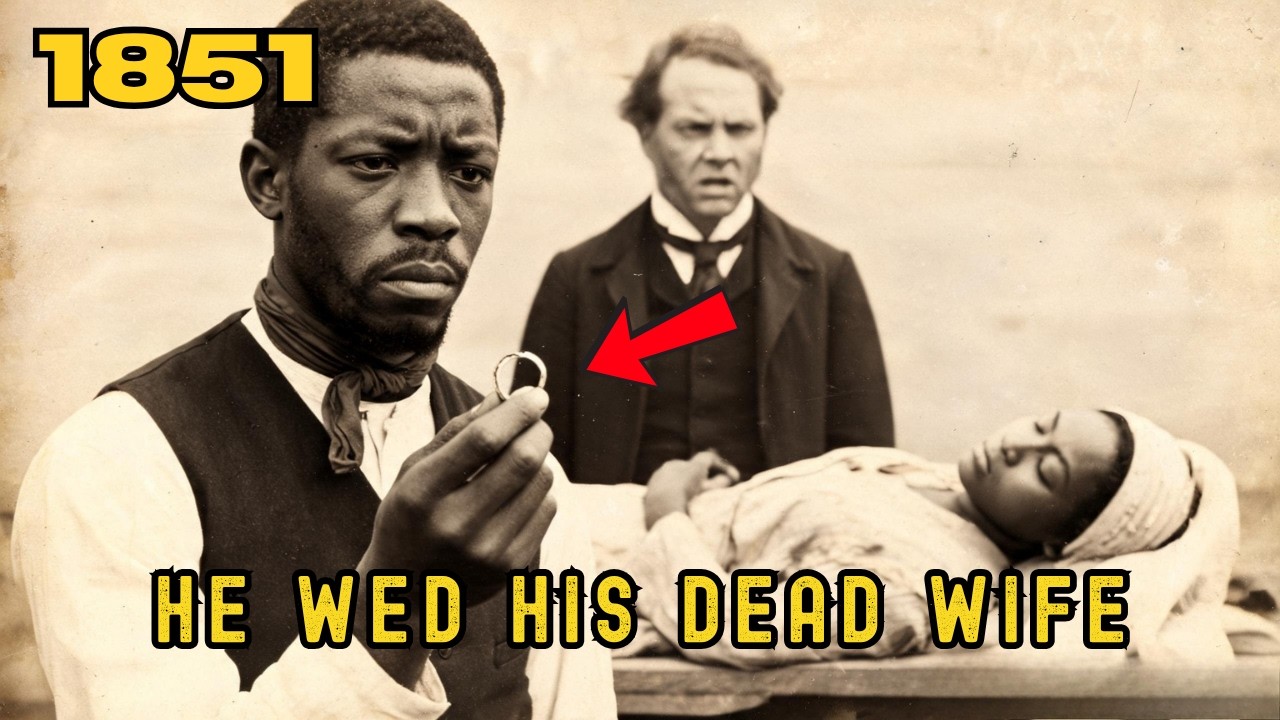
But Bram Kile refused to give up the one thing Harrou believed he could redefine as he saw fit. When Harrou ordered him to take another woman, Bram chose a form of defiance that was public and deliberate—so disruptive to the plantation’s authority that death itself became a line his master could not cross. Before sunrise, Bram Kile was already awake, kneeling beside Serafine Dorsey. The room was small, built for workers whose lives were not meant to require privacy.
A narrow bed stood against one wall. A wooden chair had been pulled near it. On the bed lay Serafine, motionless under a simple covering. She had died during the night.
Bram did not cry out. He placed two fingers on her wrist, waited, then moved his hand to her face. There was no response. For months, her strength had been fading.
She kept working until she could no longer stand a full shift. Even then, rest was not freely given. On the slave plantation, illness was measured against productivity before it was measured against suffering. By the time Serafine was allowed to stay inside, her body had little left to recover.
Now Bram sat beside her and adjusted the cloth around her hands. He did it carefully, not because anyone ordered him to, but because those were the hands he knew. She had shared food with him, mended his torn shirts, held his wrist through the worst nights, and pressed her hand to his chest when neither could voice what they feared. They had lived as husband and wife.
The plantation never cared. People who knew them had witnessed their commitment. Their home had been built over the years. Their loyalty was never in doubt among the enslaved community.
But the system that controlled them did not need to question their marriage. It could simply deny the marriage existed at all. That legal void was not accidental. Slavery depended on the ability to sell husbands away from wives.
It separated partners without consulting them and imposed new arrangements when owners believed those arrangements served labor discipline or reproduction. Recognition would have created boundaries. The institution was designed to avoid those boundaries. Bram understood this reality before Serafine died.
He had lived under its shadow his entire adult life. But understanding the system did not make its cruelty theoretical. That morning, cruelty entered the room in the form of Lucius Harrou. Harrou owned the plantation and legally claimed ownership of Bram.
He was in his fifties, sober in manner, rarely theatrical. Men like him did not need constant violence to prove their authority. The surrounding system did most of that work. He stopped near the entrance.
His eyes moved once toward Serafine, then toward Bram. Harrou glanced toward the window. There was no consolation, no acknowledgment of the years Bram and Serafine had lived together. His first concern was practical.
She must be buried before dusk. Bram looked at him. I will take care of my wife. The silence that followed was brief, but it changed the atmosphere of the room.
Harrou’s expression stiffened slightly. You will return to the wheel shed when this is over. Bram said nothing. He was a wheelwright and wagon repairer, a skilled role that made him useful beyond the fields.
Cane wagons, broken axles, wheels cracking under heavy loads, twisted wooden frames—Bram could repair them quickly. That skill gave him responsibilities. It did not give him rights. Harrou stepped further inside.
Bram remained beside the bed. I said I will take care of my wife. Harrou answered without raising his voice. You never had a wife.
The statement was not an insult improvised in a moment of anger. It was the plantation’s official position. That made it worse. Under Harrou’s authority, Serafine could work beside Bram, sleep beside him, and become the core of his survival.
Yet she could be erased with a single sentence. Bram’s eyes stayed fixed on Harrou. He did not rush at him. He did not shout.
There was no dramatic confrontation. That would have been easier for Harrou to understand. Anger could be punished. A threat could be isolated.
Bram did none of that. He turned back toward Serafine. Harrou watched him for another moment, then left. The door remained open behind him.
Bram reached over and closed it. That small movement mattered. For the next few hours, he treated Serafine as Harrou had just denied she was—as his wife. He washed her face.
He folded the covering carefully. He found the clean cloth she kept for Sundays and placed it near her shoulders. Other enslaved adults came quietly from the quarters. No formal authority recognized their families.
But the community did. A woman came with water. Another came with thread. A man from a nearby cabin stood outside to give Bram some time alone before the preparations began.
No one asked whether Serafine was his wife. They knew. That contrast revealed the brutality of Harrou’s claim. The people who held the least legal power understood the relationship immediately.
The man who held absolute legal power insisted it had never existed. By afternoon, Bram briefly returned to the wheel shed. Not because he accepted Harrou’s order, but because unfinished work could be used against others. A damaged cane wagon was leaning on one of its supports.
Bram removed the wheel, examined the axle, and found the crack. Saw, chisel, hammer, wooden pin. He completed the repair with almost no conversation. But something had changed.
A nearby worker asked whether Serafine would be buried that evening. Bram shook his head. Tomorrow. The man nodded.
Bram continued working. Then he asked a question. Has Harrou been here? Yes.
What did he want? The answer came reluctantly. He was talking about your cabin. Bram stopped.
The hammer stayed in his hand. What about it? The man looked away. He said it would not stay empty.
Bram did not respond immediately. The meaning was clear. Not one day had passed since Serafine’s death, and Harrou was already thinking of a replacement. Not mourning.
Not partnership. Replacement. Later, Bram saw Minty Akel crossing near the washing area. She was an enslaved woman in her early thirties, known for her reserve, speaking only when she had something worth saying.
She looked at Bram, then looked away. That was enough. He realized she had heard something too. The arrangement had not been announced yet, but the plantation was already moving toward it.
Serafine’s body was not yet buried. Harrou was already deciding who would take her place. That evening, Bram returned to the cabin. The light had almost faded.
Serafine remained where he had left her, prepared as carefully as circumstances allowed. He sat beside her again. For a long time, he said nothing. Harrou thought it was simple.
A woman died. A worker lost a companion. Another woman could be assigned. Life would go on.
Production would continue. The plantation would absorb the loss and reorganize the survivors. That is how slavery protects itself. It tried to make every human bond temporary.
Every attachment replaceable. Every grief subject to orders. Bram leaned toward Serafine. He did not promise revenge.
He did not promise escape. He said only her name. Serafine. Then again.
Serafine. That was refusal in its simplest form. If Harrou planned to erase who she was, Bram would begin by speaking her name again. Her name.
Her place. Her meaning. By the next morning, Harrou had stopped treating Bram’s grief as a personal problem. Bram was summoned from the wheel shed before the first damaged wagon arrived.
He was ordered to the back office of the plantation house, a narrow room Harrou used when he wanted obedience without witnesses. Minty Kils was already there. She stood near the wall, hands still, face composed. She did not look at Bram when he entered.
That was enough for him. Harrou remained behind a small desk, but there were no papers to sign and nothing to negotiate. The arrangement had already been decided. Minty will move into your cabin after the burial.
Bram looked at her. For the first time, Minty looked at him. There was no invitation in her expression, no expectation—only the same suppressed anger Bram felt inside himself. Harrou continued.
You need someone in the house. She needs a permanent place. This solves both. He wrapped the order in polite words.
Nothing was being solved. He was assigning two enslaved people to each other. Harrou believed ownership extended beyond labor to include domestic life. Bram’s grief had become an administrative problem.
Minty’s consent was irrelevant. Serafine’s death had left a vacancy, and Harrou intended to fill it. Bram answered with one word. No.
Harrou waited. Bram did not correct himself. Harrou told Minty to leave. She exited without a word.
The door closed. Harrou stood. You are useful because you understand instructions. Bram remained in place.
You asked me to repair wheels. I repair wheels. I did not ask you. No.
That distinction was dangerous. Harrou stepped closer. This is not a request either. Bram’s refusal did not come from confusion.
He was fully aware of what Harrou could do to him. Skilled labor offered no protection when an owner decided obedience mattered more than competence. Yet Bram repeated it again. No.
Harrou did not strike him. He did something more cunning. He sent Bram back to work. The punishment began there.
By noon, Bram was removed from the covered wheel shed. He was ordered to unload timber beside the cane road. The task required less skill and more exertion. Another worker was placed in charge of the repairs Bram usually handled himself.
The message was simple. Skill could be taken. Status could be taken. Whatever small measure of control Bram had built through competence existed only as long as Harrou allowed it.
Bram lifted the wood. He carried it. He did not change his answer. The next day, his evening food ration was reduced.
Then he was told he could no longer leave the work area without permission. When he asked to visit Serafine’s grave after sunset, the request was denied. Harrou was testing a theory. He believed grief had a price.
Make the price high enough, and Bram would abandon it. That assumption revealed more than cruelty. It revealed how plantation authority understood human attachment. They treated love as behavior that could be corrected through deprivation.
Bram kept working. He stopped asking permission to visit the grave because he realized the answer would always be no. He did not stop calling Serafine his wife. That was the one thing Harrou could not break.
The funeral itself was brief. Bram was allowed to attend because refusing entirely might have caused more disruption than Harrou wanted. But the time was controlled. The place was controlled.
Even mourning was expected to fit the plantation schedule. Serafine’s body was lowered into the ground. Bram stood without a word. Minty remained a few steps away.
She did not approach him. Not then. Harrou watched long enough to confirm the burial ended when he wanted. Then everyone was ordered back.
Within hours, the cane wagons were moving again. The plantation resumed its rhythm. Bram did not. Three nights later, he returned from work and found a folded blanket outside his cabin.
Beside it sat a small wooden box containing Minty’s belongings. She stood a few yards away. Harrou had decided to enforce the arrangement before Bram could resist further. Bram looked at the box, then at Minty.
She walked toward him slowly. I did not bring it. I know. He made them put it here.
Bram nodded. Neither moved toward the door. Minty glanced at the cabin. This was hers.
It still is. Minty studied it. There was no insult on her face, only recognition. Harrou had tried to create conflict between them.
He expected Bram to resent Minty for taking Serafine’s place, or Minty to resent Bram for rejecting her. That conflict never formed. Both realized who had made the decision. Minty lifted the wooden box.
I will return this. Bram reached for one end. I will carry it. No.
She held it firmly. Then she lowered her voice. I am not asking you to forget her. Bram looked at her directly.
Neither is he. Minty waited. He is ordering it. That sentence changed something between them.
Until that moment, their resistance had been separate. Bram was refusing to replace Serafine. Minty was refusing to be used as a replacement. Now they realized it was the same struggle.
Minty picked up the blanket and walked away with her belongings. Bram entered the cabin alone. The next morning, Harrou noticed immediately. He sent for Minty first.
Bram did not hear what was said inside the plantation house. He only saw the result. Minty was moved from light domestic work to harsh outdoor labor near the washing area and storage yard. Harrou had detected her refusal.
He punished her for it. By evening, Bram was summoned again. This time, Harrou did not care about privacy. The confrontation happened beside the work yard, where enslaved adults returning from different tasks could see them.
That was deliberate. Harrou no longer wanted simple compliance. He wanted everyone to witness Bram’s submission. Minty will move into your cabin.
Bram kept his hands at his sides. No. Harrou glanced toward the people nearby, then back at Bram. Are you going to turn this into a theatrical display?
Bram answered quietly. You are the one who brought them here. The reply landed harder because Bram did not raise his voice. Harrou stepped closer.
Do you think refusal changes what she was? Bram knew exactly who he meant. Serafine. He said nothing.
Harrou continued. She is dead. Your work is here. Your life is here.
What happened before is over. For Harrou, this was not philosophy. It was ownership, stated plainly. He believed that authority over Bram’s present gave him authority over Bram’s past.
That was the line Bram would no longer accept. Harrou turned his back. Tomorrow, you return to timber. Then he addressed Minty, who had stopped nearby.
You will move your things tonight. Minty did not answer. Harrou walked away. Neither Bram nor Minty moved until he was gone.
The plantation had forced them to make a decision. If Minty entered Bram’s cabin, Harrou would present their compliance as proof that his authority had prevailed. If they continued to refuse, the punishments would intensify. Escape was not a realistic option.
They were watched. The roads were known. Harrou could call on neighboring slaveholders and local authorities. Violence would give him the pretext to isolate Bram immediately.
Their resistance needed another form. Minty spoke first. Will he keep doing this? Yes.
Until one of us gives him what he wants. Bram looked toward the cabin. What Harrou wanted was not companionship between two people. He wanted acknowledgment.
He wanted Bram and Minty to stand where he placed them. He wanted them to confirm through their behavior that Serafine’s relationship to Bram had ended on Harrou’s schedule. That realization made the conflict clearer. Harrou did not simply want Bram to live with another woman.
He wanted to prove that he could define what a wife was. Several days passed. Bram remained on timber duty. Minty remained outside.
Harrou intensified his surveillance of them, but he could not stop them from exchanging brief words as they moved between tasks. They did not discuss escape. They did not plan revenge. They watched.
Then Harrou made his mistake. He decided private coercion was no longer enough. One afternoon, after the work pace had slowed, he gathered the enslaved adults nearest the quarters. He announced that Bram and Minty would be formally married before the plantation community.
The order was designed as humiliation disguised as order. Harrou wanted witnesses. He wanted to turn Bram’s refusal into surrender. He wanted it before the same people who had recognized Serafine as Bram’s wife.
He set the day. He told Minty where she would stand. Then he turned to Bram. You will be there.
Silence filled the yard. Minty stared at Bram. She expected another refusal. Harrou expected it too.
Instead, Bram waited a few seconds. Then he said, I will be there. Minty’s expression changed. Harrou’s did not.
He believed the pressure had finally worked. He nodded slightly and dismissed everyone. Bram walked away before anyone could question him. Minty followed at a distance until they reached the side of the wheel shed, out of Harrou’s direct sight.
What did you just agree to? Bram stopped. For the first time since Serafine’s death, his answer carried no sorrow. It sounded like a decision.
I agreed to stand in a wedding ceremony. Minty watched him warily. Bram looked back toward the plantation house. Harrou had demanded a public ceremony because he wanted public submission.
Bram had just realized that the same public could witness something else. Something Harrou had not chosen. Something he could not easily erase once it happened before everyone. Bram looked at Minty.
But he does not get to choose what I say when I stand there. Minty did not answer immediately. The wheel shed was empty behind them. The afternoon work had moved to the cane road, and Harrou’s announcement still hung over the quarters.
Bram had accepted the ceremony. But Minty knew the truth. She studied his face closely. Are you thinking of something?
Not yet. That is not what I said. No. I only agreed to attend.
I did not agree to obey. That distinction was the only space Harrou had left him. For the next few days, Bram said almost nothing about the ceremony. He returned to timber work.
Minty remained under harsher duties. Harrou watched them closely. But he relaxed in one important way. He thought the conflict was over.
That error gave Bram time. The answer came to him through Serafine. Not as a vision. Not as a ghost.
But as a memory he had not fully understood while she was alive. In the last weeks before her death, Serafine had become too weak for regular work. She spent longer periods inside the cabin. Lying down made breathing harder, so she often sat upright.
Bram would return after dark and find her waiting, saving her energy until he passed through the door. She rarely complained. Not because her suffering was small, but because suffering was already everywhere. Naming each part of it would not change the conditions that produced it.
One evening, Bram brought her water and set it beside the bed. Serafine pushed it away with her hand. Sit. He sat.
She looked at his hands. His knuckles were cracked from repair work. A thin cut ran across one thumb. You keep repairing what breaks it.
Bram knew who she meant. I repair wagons. You know what I mean. He did.
For years, Bram had survived by learning where resistance was possible and where it would be crushed immediately. He repaired what Harrou ordered. He lowered his head when confrontation was useless. He protected Serafine whenever he could.
But it was never enough. The institution was designed so that private protection could always be overridden by ownership. Serafine knew that too. Her next question came without warning.
What will happen when I am gone? Bram looked at her. You are not gone yet. I asked you what will happen.
He did not answer. She kept watching his responses until he did. I will bury you. That is not what I mean.
Bram’s jaw tightened. Serafine leaned her back against the wall. For several seconds, she gathered enough breath to continue. He will say it is over.
Bram understood. Harrou would not need to destroy their marriage. He had never recognized it. Serafine continued.
He will tell you what I was. Bram shook his head. No. He will tell you.
He can speak. And he can do more than speak. That was the truth Bram did not want to voice. Harrou controlled tasks, housing, movement, separation.
He could force Bram to move to another cabin. He could order another woman to go there. He could punish refusal until Bram’s actual life contradicted the truth he carried privately. Serafine reached out to take his hand.
Her grip was weak. The sentence came slowly. Do not let him decide what I was to you. At the time, Bram thought she was asking him not to forget her.
He promised. He meant it. But he only now realized Serafine had been warning him of something more subtle. Memory could be controlled too.
Not inside his mind, but outside it. In the way the plantation arranged bodies, households, public behavior. Harrou did not need Bram to forget Serafine emotionally. He only needed Bram to act as though she had never been his wife.
That was why the ceremony mattered. It was not about Minty. It was about forcing Bram to perform Harrou’s version of the past. Once Bram understood that, the structure of his resistance changed.
He stopped thinking about how to avoid the ceremony. He began thinking about how to use it. That evening, he approached Minty near the water barrels. They could not talk long.
Surveillance had increased around them. Bram lowered his voice. He wants witnesses. Minty continued washing a piece of cloth.
Yes. He wants them to see me accept it. She looked at him. Is that why you said yes, as part of the order?
Minty stopped working. What is the other part? Bram looked toward the plantation house. Harrou had chosen a public ritual because he wanted public authority.
That gave the ritual its value. It could carry another meaning if Bram changed just one part. The most important part. I said I would stand for a wedding.
Minty waited. Bram turned toward her. I never said whose. She stared at him.
For several seconds, she did not understand. Then she did. Her expression hardened. No.
Bram said nothing. You cannot mean that. I do. She is buried.
Yes. Minty looked around quickly to make sure no one was approaching. Then she lowered her voice. You were talking about bringing her back.
Bram did not soften his answer. Yes. Minty stepped back from him. The idea was harsh.
Not because Bram lacked love for Serafine, but because that love was exactly what made the act dangerous. Exhuming her body would expose Bram to punishment before the ceremony even began. It required help. It required precise timing.
If Harrou discovered it early, the entire plan would collapse. Minty stared at him silently. What do you think that will change? Bram answered without hesitation.
What he said. Minty knew the phrase. You never had a wife. Bram continued.
He wants me to stand beside you. For everyone to see him replace her with you. Minty grimaced. I am not replacing anyone.
I know. Then do not use me to prove something to him. I am not. He stepped closer.
I need you to step aside. That was the first moment Minty understood her place in the plan. Not a bride. Not a replacement.
A witness. She looked at the wet cloth in her hands, then said, I will stand beside Serafine. Do you think Harrou will let you finish? No.
Then what is the point? The point is that he will have to stop it in front of everyone. That was Bram’s calculation. If Harrou interrupted immediately, he would reveal the true nature of the ceremony.
It was not a union between two people. It was a mechanism for enforcing control. And if Harrou allowed Bram to continue even briefly, Bram would publicly declare that Serafine was his wife before the very assembly Harrou had gathered to witness her replacement. Either way, Harrou would lose control of the meaning.
Minty understood the logic. She also understood the consequences. They will punish you. Yes.
They will punish me. Yes. Have you planned for that? No.
That answer surprised her. Bram did not claim to control what would happen after. He controlled only that single act. That made the plan more dangerous, but also more honest.
It was not an escape. It was not a survival strategy. It was refusal. Minty folded the cloth once, then again.
What do you need? Bram looked at her. That was the moment their alliance began. Not sympathy.
Shared purpose. They started with the practical problem. Serafine could not simply be lifted from the grave at the last moment. The earth had barely settled.
Digging would take time. They would need darkness, tools, and a way to cover the body. They also needed clothing. Serafine had been buried in whatever could be found quickly after her death.
Bram wanted something else. Not luxury—honor. He remembered a dark dress Serafine folded for Sundays and rare gatherings. It had been left behind because Harrou wanted the burial finished quickly.
Minty knew where it was. The next night, she retrieved it from the cabin before Harrou could issue orders about moving her belongings again. She carried it under a cloth meant for work. Bram did not touch it immediately.
He looked at the worn fabric. There was a tear along one seam. Minty noticed it too. I can fix that.
Bram nodded. Neither of them called it a wedding dress. Not yet. Harrou continued preparing for the ceremony he believed he controlled.
He gave instructions about where Bram would stand. He gave instructions about where Minty would stand. He told others when they were expected to gather. He even allowed Bram to return to lighter manual work for part of the day, believing the restored privilege would reinforce obedience.
Bram accepted the task. He repaired a wheel. He spoke little. Harrou passed the shed once and saw him working.
Bram did not lift his eyes. To Harrou, the silence looked like defeat. In reality, Bram was measuring a strip of soft metal left over from a repair. Thin enough to bend, strong enough to hold its shape.
He cut a short piece and put it in his pocket before anyone noticed. That night, he found Minty behind the cabins. She had finished repairing Serafine’s dress. Bram showed her the metal.
Minty understood without asking. You are making a ring. Yes. For a dead woman.
For my wife. The language mattered. Every time Bram said it, he refused Harrou’s definition. Minty looked toward the darkness behind the quarters.
What will happen if we do this? Bram closed his hand around the metal. I do not know. That answer remained true.
There was no clear end ahead of them. Only a ceremony Harrou expected to use as proof of ownership. And a dead woman he had already tried to reduce to nothing. Bram had finally understood Serafine’s last warning.
Harrou could decide where she worked. He could decide how quickly she was buried. He could decide whether Bram was allowed to mourn. But there was one thing Bram had not surrendered.
The right to name what Serafine had been to him. Harrou wanted a public wedding. Bram would give him one. But not the one he ordered.
The plan became dangerous the moment it required movement. Until then, Bram’s resistance had lain mostly in refusal. He had said no. He had endured punishment.
He had accepted Harrou’s ceremony only because he intended to corrupt its purpose. Now Minty and Bram had to move. The night before the ceremony, Bram waited until the cabins had settled and the last movement from the plantation house had stopped. He did not head directly toward Serafine’s grave.
That would have been too obvious. He carried a broken-edged shovel as though returning it from work. He crossed behind the grain stores and disappeared along the darker side of the cane road. Minty joined him later.
She carried Serafine’s mended dress wrapped inside a work cloth. Neither spoke as they approached the burial ground. Finding the grave was not difficult. Bram had memorized its location.
Harrou had refused any marker, but Bram did not need one. He had stood there when the earth was poured over the coffin. He knew exactly where she was. For several moments, he stayed still.
Minty watched him. This was the moment the plan stopped being an idea. Bram drove the shovel into the ground. The work was slow.
They could not use a lamp. He had to control the force of every strike. Every pause was a test of hearing. A horse moving near the stable.
A door shifted by the wind. Footsteps somewhere behind the cabins. Then silence again. Bram kept working.
Minty helped clear the loosened earth with another tool. Neither considered what they were doing a violation of the dead. The violation had already happened. Serafine had been denied honor in life.
Her place beside Bram had been treated as if it could be filled by administrative order. What Bram was doing now was not an attempt to deny her death. He knew it fully. He was bringing evidence of Harrou’s cruelty to the ceremony Harrou believed he controlled.
When they finally reached the burial covering, Bram stopped. His breathing had changed. Minty noticed. Do you want me to do it?
No. Bram knelt. He opened the covering carefully. Serafine was there.
He did not speak to her as though she were alive. He did not ask permission from the dead. He simply worked. That distinction mattered.
Bram was grieving, but he had not lost his grip on reality. The strength of his plan depended on that clarity. Serafine was dead. Harrou’s authority over Bram still stood.
The ceremony would force those two truths into the same space. Minty unfolded the dress. It had been repaired along the side seam. The fabric was worn but clean.
They changed Serafine’s clothing with the same calm used to prepare her for burial. No display. No unnecessary exposure. Minty adjusted the collar.
Bram closed the sleeves. The work was practical and quiet. When they finished, Bram looked at Serafine for several seconds. She wore this when we first ate together outside the quarters.
Minty looked at him. You remember that? Yes. What did you eat?
Bram almost smiled. Bad corn porridge. That moment passed. It was enough.
Minty reached into the cloth bundle and brought out a narrow strip of clean fabric. What is that? For her hands. Bram nodded.
They wrapped them carefully. Then Bram reached into his pocket. The metal he had taken from the wheel shed was no longer just a strip. He had shaped it during stolen moments of work.
A small, uneven ring. Simple. Made by his hands. Minty looked at it.
Did you finish it? Yes. You have not put it on her yet. Tomorrow.
Minty understood. The ring was not meant for the burial ground. It was meant for the witnesses. They prepared a wooden support that could be moved without drawing attention.
It had originally been part of a broken chair left behind one of the cabins. Bram repaired it enough to bear weight. Minty covered it with a simple white cloth. There was nothing in the arrangement resembling wealth or elaborate ceremony.
That was not the point. The essential elements were enough. Serafine. The dress.
The ring. The witnesses. Bram’s words. Before dawn, they moved Serafine to an unused storage space behind the quarters.
This was the most dangerous stage so far. If anyone loyal to Harrou entered, the plan would end immediately. Minty placed sacks and broken items near the entrance to make the room look unremarkable. Then she and Bram separated.
They could not be seen together that morning. The ceremony was still hours away. Harrou believed he had won. He demonstrated it by returning Bram to the wheel shed.
A damaged wagon was waiting. Bram examined the axle and began work. Harrou appeared before noon. You will finish early.
Bram kept his eyes on the wheel. Yes. You will wash. Bram continued working.
Yes. And you will stand where you are asked. That was the sentence Bram had been waiting for. He raised his head.
I will stand. Harrou watched him. The answer satisfied him. He left.
Bram returned to the axle. For the first time, Harrou’s confidence was part of the plan. He no longer expected resistance. He had stopped guarding against it.
Minty faced the same assumption. A woman from the plantation house brought her a cleaner dress to wear for the ceremony. Minty accepted it. She did not argue.
She carried it back toward the quarters. Then she placed it on a bed inside another cabin and left it untouched. It would look clean enough to satisfy Harrou. But she would not wear the bride’s dress he had chosen.
That distinction was hers alone. Late in the afternoon, Bram and Minty met briefly behind the storage shed. There was no time for emotion. They reviewed the sequence.
You go first, Bram said. Minty nodded. He expects me to stand beside you. Stand there.
For how long? Until he begins. And then? Move.
Minty looked toward the open yard where Harrou intended to hold the ceremony. What about Serafine? Two other people will bring her. Minty frowned.
Bram had made one adjustment. He had asked two trusted adults to help carry the covered support at the right moment. He had told them only what they needed to know. Both knew Serafine.
Neither refused. That mattered. The resistance was no longer Bram’s alone. It had become collective—not through numbers, but through recognition.
Harrou had denied that Serafine was Bram’s wife. The people around Bram had never denied it. Now some of them were willing to risk punishment to help him show that truth publicly. Minty lowered her voice.
What if Harrou stops them before they reach us? Then uncover her where they stand. And if he orders everyone away? He will still have seen her.
Is that enough? Bram looked at her directly. It is more than he wants. Minty studied him.
What he really wants is for the vows to be completed. Yes. Do you think he will allow you? No.
That answer had not changed. The plan did not rely on Harrou’s tolerance. It relied on speed and surprise. Once Serafine was revealed, Bram needed only seconds.
A name. A declaration. A vow. Enough to force Harrou to act openly.
Enough to expose what the ceremony actually was. Minty reached into her pocket and brought out a small piece of thread left from repairing Serafine’s dress. She tied it around her finger once. Bram noticed.
What is that? A reminder. Of what? That I am not his bride either.
Bram said nothing. The gesture was small, but its meaning was precise. Harrou had tried to turn Minty into a replacement. She had refused the role before even stepping into the ceremony.
By late afternoon, the enslaved adults began gathering near the open yard. Harrou had chosen the location deliberately. It was visible from the quarters. Visible from the work areas.
Visible enough for Bram’s submission to become a lesson. A chair was placed near the center. Harrou stood close to it, speaking quietly with one of his white overseers. He looked calm.
There was no reason from his perspective not to be. Bram arrived wearing a clean shirt. He had washed his hands. The small metal ring was hidden inside his palm.
Harrou studied him. Do you understand what is about to happen? Bram closed his fingers around the ring. Yes.
Minty entered from the opposite side. She was wearing a simple dark dress, not the one Harrou had sent. He noticed. His brow furrowed, but he let it pass.
The clothing was not the victory he wanted. Bram’s compliance meant Minty standing beside him. For a moment, the scene looked exactly as Harrou had planned. A man.
A woman. An owner imposing order. Witnesses watching. Harrou began to speak.
Minty looked at Bram. Bram gave no visible signal. He did not need to. She knew when the time came.
Minty stepped away. Harrou stopped. At the far end of the yard, white cloth appeared. Two adults were carrying something beneath it.
Harrou turned. His face changed before the covering was removed. He realized the ceremony was no longer under his control. Minty kept moving until there was empty space beside Bram.
Bram opened his hand. The metal ring rested on his palm. The covered form approached. Harrou stepped forward once.
What is this? No one answered. The support was set in place. Minty stood beside it.
She reached toward the white cloth. Bram looked directly at Harrou. For the first time since Serafine’s death, Harrou was not the one giving the next order. He was waiting to learn what Bram had already decided.
Minty pulled the cloth away. The bride Harrou had tried to erase was finally brought into his ceremony. Serafine was revealed before Harrou could stop it. For one second, no one moved.
The effect was not horror. It was recognition. The people gathered in the yard knew her face. They knew the dress.
They knew where she had been buried. And most importantly, they knew what Harrou had said after her death. You never had a wife. Now the woman he had tried to reduce to a completed burial sat in the middle of the ceremony he had arranged for her replacement.
Harrou was the first to react. Cover her. Minty did not move. The two people who had helped carry Serafine stayed in place.
Harrou turned toward the overseer. Remove that. Bram stepped forward. Not quickly.
Not violently. He stood between Harrou and Serafine. The overseer stopped. That hesitation lasted only a moment.
But it mattered. The entire purpose of Harrou’s ceremony had been to make control visible. He had chosen a public place to be seen commanding Bram’s submission. Now every order Harrou gave revealed the opposite.
He had summoned witnesses to display his authority. Instead, they were watching him lose control of the scene he had created. Bram opened his hand. The small metal ring rested in his palm.
Harrou saw it. His face tightened. You will put that back. Bram looked at Serafine.
Then he stepped toward her. Harrou moved again. Bram. There was no response.
The threat lay in the name. Bram understood that. He also understood there was no longer any safe outcome. He had known that before opening the grave.
This was not an attempt to escape consequences. It was an attempt to fix one truth in the public memory before Harrou could bury it again. Bram reached Serafine. He knelt.
The yard stayed silent. Minty stood a few steps away. She had done what Harrou never thought possible. She had refused to be the replacement.
That refusal was now visible to everyone. Harrou had tried to arrange the lives of two enslaved people according to his needs. They had refused the roles he assigned them. Bram took Serafine’s hand.
He did not speak to her as though death had retreated. He placed the ring carefully on one of her fingers. Then he said the word Harrou had tried to erase. My wife.
Harrou stepped closer. This ends now. Bram continued. You stood with me when there was no safe place to stand.
His voice was controlled. No long speeches. No appeal to Harrou. The words were for Serafine and for those listening.
You worked beside me. You ate beside me. You slept beside me. You were my wife before he denied it.
Harrou looked toward the overseer again. This time, the overseer moved. Minty stood directly in his path. She did not raise her hands.
She simply occupied the space. The overseer stopped again. Harrou understood what was happening. The ceremony had grown larger than Bram.
Not because the crowd had suddenly rebelled, but because everyone present could now see exactly what the plantation was trying to control. Marriage. Grief. Memory.
Identity. Harrou’s authority had always depended on these things remaining private. Once Bram made them public, Harrou was forced to reveal the machinery that managed them. He could no longer claim the ceremony was for order.
He could no longer forcibly pull a dead woman from the man who called her his wife. He could no longer claim Minty had entered voluntarily. She had been ordered back to her position. He could no longer pretend Serafine meant nothing while he reacted with such urgency to her presence.
Bram kept his eyes on Serafine. I promised you I would not let him dictate who you were to me. Harrou interrupted. She is dead.
Bram looked at him. Yes. That answer stopped him. Bram was not denying death.
That was the point Harrou failed to grasp. Serafine’s death did not make their relationship false. It made Harrou’s attempt to replace her more visible. Bram turned back.
You are dead. But you are still my wife. The sentence was simple. It carried more force than any declaration Harrou had prepared.
Harrou reached toward Bram’s shoulder. Bram rose before the hand could grasp him. For a moment, they faced each other at close range. Harrou was no longer calm.
Do you think this makes you free? Bram answered immediately. No. That answer was more dangerous than fantasy-laced defiance.
Bram knew exactly where he stood. He knew Harrou still controlled his work, his movement, his housing, his punishment. He knew the ceremony would not end slavery. He was not claiming victory over the institution.
He was drawing a line. Harrou could control what Bram did. But he could not force Bram to consider Serafine anything less than his wife. Bram looked at the ring.
This makes her mine in my memory. Harrou’s expression changed. The statement was not legal. It was not a claim of ownership.
It was a refusal of Harrou’s control over meaning. Minty stepped closer to Serafine. Harrou gestured at her. You will stand where I placed you.
Minty did not move. No. It was the first time she had refused his orders publicly. Harrou stared at her.
She continued. I am not his wife. That sentence cut through the fiction Harrou had tried to create. Minty was not rejecting Bram.
She was rejecting Harrou. That distinction was now impossible to hide. Bram looked toward her. No words of gratitude were spoken.
There was no need. Minty had accepted the risk without becoming part of Bram’s marriage. She had protected Serafine’s place without surrendering her own will. Harrou had treated her as something to be moved into an empty space.
She had now denied that the space existed. Bram turned back to Serafine. He spoke the final words quickly. I stood with you while you lived.
I stand with you while you are dead. What he calls nothing, I call my marriage. Then he placed the ring fully in her hand. Harrou ordered the overseer forward.
This time, Bram did not block him. The vow was complete. That changed everything. The physical ceremony could be dismantled.
The declaration could not. The overseer pulled the white cloth over Serafine. Bram did not resist. Minty did not resist.
The adults who had helped carry her stepped away. Harrou believed restoring the physical order would restore authority. It did not. Everyone had heard Bram.
Everyone had seen Minty step aside. Everyone had watched Harrou try to prevent a marriage after insisting the first marriage had never existed. The contradiction was now public. Harrou turned to Bram.
You will go to the wheel shed. Bram remained in place. Now. Bram looked once at Serafine under the covering.
Then he walked. Not toward the wheel shed. Toward the open side of the yard. Harrou moved behind him.
Where are you going? To finish what you interrupted. Harrou stopped. Bram gestured toward the burial ground.
Serafine had been lifted from the earth for the ceremony. She had to be returned. That statement forced another decision. If Harrou refused the burial, he prolonged the public desecration of a woman he claimed had no importance.
If he allowed it, Bram would once again participate as her husband. Harrou chose control through silence. He gestured firmly. Return her to her place.
The words were directed at the overseer. Bram turned. No. Harrou stared at him.
Bram walked toward the covered support. I brought out my wife. He took one end. I will return my wife.
For a few seconds, Harrou said nothing. Then he stepped back. Not because Bram had defeated him, but because stopping him again would only deepen the scene. Minty took the other end.
Together, they carried Serafine toward the burial ground. No formal procession followed. No one needed it. The witnesses remained behind, silent.
The meaning had already travelled with them. At the grave, Bram lowered Serafine carefully. He removed the ring before the earth was replaced. Minty noticed.
You are keeping it. Yes. Why? Bram looked at the small piece of metal in his hand.
For the time he will say this never happened. That was the first time the ceremony became evidence. Not written evidence. Not legal evidence.
But memory supported by witnesses and by something Harrou had failed to control. By dusk, Serafine was buried again. Bram returned to the quarters. Minty went elsewhere.
Neither spoke to Harrou. The plantation kept working, but the relationship between them had changed. Harrou had ordered a ceremony so he could replace Serafine. Instead, he had been forced to watch Bram publicly name her his wife.
He had tried to prove ownership. He had revealed its limits. That night, behind the closed doors of the plantation house, Lucius Harrou began deciding which punishment would make everyone forget what they had just witnessed. Harrou did not punish Bram immediately.
That would have made the ceremony seem like the cause. Instead, he waited until the next morning and began dismantling Bram’s life piece by piece. The wheel shed was the first thing taken from him. Bram arrived before sunrise expecting broken axles and cracked wheel hubs.
The tools had disappeared from his table. Another man had been assigned in his place. The overseer pointed toward the distant timber yard. You do not work here anymore.
Bram looked once at the empty table. He had spent years becoming valuable there. That had given Harrou efficiency. It had never given Bram safety.
By midday, he was carrying cut timber again. No repair work. No access to scrap metal. No job granting even the narrow independence of skilled labor.
Harrou was making the lesson tangible. Skill has value only when it enforces obedience. Minty was punished separately. She was moved away from the quarters near Bram and assigned to another work area under closer supervision.
Their paths no longer crossed naturally. When they did, the overseer was close enough to hear. Harrou had realized something he had underestimated before. Bram and Minty were dangerous together.
Not because they were planning an escape, but because they had refused the roles he had drawn for them. Bram refused to accept a replacement wife. Minty refused to be one. That kind of resistance was hard to isolate because it relied on agreement.
Harrou responded by separating them. For several days, Bram was not allowed near Serafine’s grave. The order came without explanation. There was no need.
Harrou had seen what happened when the grave became part of the conflict. He intended to make Serafine disappear again. The burial ground was left almost empty. No permanent marker was allowed.
No carved board. No stone. Nothing publicly identifying the grave as belonging to Bram’s wife. The plantation’s method was consistent.
First, deny the relationship. Then remove the visible signs that contradicted the denial. But Harrou had another problem. The ceremony had already been seen.
He could control the ground. He could not control what had been witnessed. Bram carried the metal ring hidden in his trouser belt. He never showed it.
He did not need to. The object had already served its purpose. What mattered now was that Harrou knew Bram still kept it. Two days after the ceremony, Harrou searched Bram’s cabin.
Bram returned from timber work to find the mattress lifted, the clothes disturbed, the wooden items overturned. Nothing of value had been lost. Harrou was looking for something. Bram stood at the entrance.
He understood immediately. The ring. He reached discreetly toward his waist. It was still there.
That night, he did not keep it in the cabin. He wrapped it in a cloth. He tucked it into a narrow crack inside a wagon support near the timber yard. The next morning, he retrieved it before work began.
He moved it again the following night. This was not juggling. It was protection. Harrou could destroy the object.
But he could not destroy the ritual itself. Bram refused to make destruction easy. The retaliation continued. His food ration was reduced again.
His movement was restricted. He was ordered to sleep in a different cabin, farther from the cemetery, closer to the overseer’s path. Harrou was not improvising. He was removing every trace of Bram’s former life that could connect to Serafine.
The cabin they had shared was reassigned. Bram watched another person carry belongings through the entrance. He did not object. The room is not the marriage.
That distinction had become central to his resistance. Harrou could move bodies. He could change beds. He could empty a place and fill it with someone else.
But those acts no longer proved what he wanted them to prove. The ceremony had exposed that. Several nights later, Minty managed to speak to Bram near the back well. The conversation lasted less than a minute.
He intends to move you, she said. Bram looked at her. Where? I do not know.
Did he tell you? No. Then how do you know? He asked who could do your work.
Bram understood. Harrou was replacing him before removing him. The same logic repeated. First Serafine.
Now Bram. The plantation was turning loss into replacement. If a worker disappeared, another was assigned. If a relationship ended, another was imposed.
If a skilled man resisted, another was trained. Bram looked toward the work yard. Do you think he intends to sell me? Minty did not answer.
She did not need to. The possibility had already become the most likely outcome. Harrou could punish Bram indefinitely. But that had a cost.
Working a skilled man at heavy labor was inefficient. And a man witnessed refusing openly could become a lasting symbol of resistance. Selling Bram solved both problems. It recovered value.
It removed the example. And it permanently separated Bram from Serafine’s grave. That last part mattered to Harrou. Distance might accomplish what coercion had failed to do.
The decision came the following afternoon. Bram was pulled from timber work and taken to the side yard near the plantation house. Harrou was waiting. No audience this time.
The public lesson had failed once. Harrou had no reason to repeat the mistake. You are leaving. Bram said nothing.
Within days. Where? That is no longer your concern. Bram looked at him.
The answer was deliberate. Harrou wanted uncertainty to do what punishment could not. A river journey might take Bram farther west or to another part of the state. He could be separated from everyone who knew Serafine.
The threat was not just removal. It was erasure through distance. Harrou continued. You had a place here.
You lost it. Bram almost answered. Then he stopped. The claim was false.
Bram had never owned a place. He had occupied a space on terms. Harrou’s authority had always reserved the right to reclaim it. That was not stability.
It was permission. Harrou stepped closer. This can still end differently. Bram looked at him.
You can stop this foolishness. What foolishness? Harrou’s jaw tightened. You know what I mean.
Bram waited. Harrou was forced to say it. That woman is dead. Bram’s face did not change.
You will stop calling her your wife. There it was. After the punishment, after the separation, after the reassignment, after the threat of sale, Harrou still needed one thing Bram refused to give. Language.
He wanted Bram to help erase Serafine. Bram answered quietly. No. Harrou’s features hardened.
You are being sold because of this. No. You think this is not because of her? Bram looked directly at him.
This is because of you. The words were disciplined. Harrou stepped forward. You think death protects her?
Bram did not answer immediately. He understood the question. Harrou was trying to make death look like weakness. Bram saw the opposite.
Serafine could no longer be assigned anywhere. She could not be moved to another cabin. He could not be threatened with punishment to control her through her. Harrou could desecrate her memory.
He could refuse to mark her grave. He could sell Bram away. But Serafine herself was beyond his orders. Bram said clearly.
Then she is the only one here you cannot threaten. Harrou froze. The sentence revealed the boundary more clearly than the ceremony had. For the first time, death had placed someone beyond Harrou’s reach.
Not Bram. Not Minty. Not anyone still living under the plantation’s authority. Serafine.
Harrou could punish the living for remembering her. But he could not compel the dead. That was the boundary Bram had found. Harrou turned away.
The conversation was over. The sale would proceed. That evening, they moved Bram under close guard. He was not allowed back to his former cabin.
He was not allowed near the burial ground. Minty did not see him again that night. By morning, preparations for his transfer had already begun. The plantation had failed to force Bram into a new marriage.
Now it would solve the problem the way slavery solved many others. Separation. Bram stood near the timber yard looking toward the distant tree line where Serafine lay. He could not see the grave.
But he knew its exact place. Harrou believed removing Bram would end his defiance. But by then, the essential truth could not be changed. Bram had declared Serafine his wife before witnesses.
Minty had refused to replace her. Harrou had responded by destroying Bram’s position, his housing, and finally his presence at the plantation. And still, he had not forced the surrender he wanted. Bram had lost almost everything Harrou was capable of taking.
That was precisely why the one thing Harrou could not take had become more important than ever. Bram was taken from the timber yard before sunrise. There was no ceremony this time. Harrou had learned what could happen when witnesses were allowed to gather.
Bram was given only enough time to collect the few things remaining with him. Most of his former possessions had already been scattered when his cabin was reassigned. He took a shirt, a cloth, and the small metal ring he had made for Serafine. There was nothing else worth carrying.
He was led toward the road while the plantation was still asleep. Minty saw him from the far side of the worker quarters. She had expected his transfer, but expectation did not soften the finality. This was how slavery dealt with those it could not break.
It separated them. Husband from wife. Worker from community. A person from the place where his memories had formed.
There was no need for argument. No consent was requested. Distance itself became the punishment. Bram looked once toward the wheel shed.
He had spent years there repairing the machines that moved Harrou’s plantation. Wheels, axles, wagon frames, broken supports. When something failed, Bram was expected to fix it quickly. Now Harrou was treating Bram the way he treated damaged equipment.
Remove the problem. Replace it. Continue production. That was the plantation’s own logic.
Everything was supposed to be replaceable. In the last weeks, Bram had proven that Serafine was not replaceable. He was led toward the main plantation road. Then something unexpected happened.
Not rescue. Not freedom. Nothing that clear. The road passed close enough to the burial ground that Bram could see the line of earth where Serafine lay.
He stopped walking. The overseer behind him ordered him forward. Bram did not move. It was only a few seconds.
But after everything Harrou had taken from him, even those seconds were contested. Bram looked toward the grave. There was still no marker on it. Harrou had seen to that.
From a distance, Serafine’s final resting place looked almost indistinguishable from the surrounding ground. That was deliberate. No name. No title.
No public declaration. Harrou had tried to reduce her to a location that could disappear. But Bram knew exactly where she was. He had helped lower her into that ground.
He had opened the earth again. He had lifted her out. He had stood before witnesses and called her his wife. Then he had returned her to the earth himself.
No marker could make those events more real. No absence of a marker could make them less real. Bram reached into his clothing and closed his hand around the metal ring. He did not remove it.
He did not raise it. The gesture was private. Minty had moved closer along the edge of the quarters. She was not allowed to approach him publicly, but she had come far enough for them to see each other.
Bram noticed her. Neither spoke at first. There was nothing left to plan. No ceremony to disrupt.
No body to move. No secret to protect. Their alliance had served its purpose. Harrou had tried to make Minty take Serafine’s place.
She had refused. That preserved Minty’s own identity. She had never been a replacement. She had never been an obstacle between Bram and Serafine.
She was another person trapped inside the same system of orders. And when Harrou tried to use her against another enslaved person, she chose not to cooperate. Bram looked at her. Minty nodded slightly.
That was all. There was no promise that they would meet again. The system around them made such promises worthless. Bram turned back toward the grave.
Harrou appeared from further along the road. He had come to witness the transfer. That too was intentional. He wanted to see the final result carried out.
Bram had refused him. Now Bram would disappear from the plantation. Harrou approached without hurry. You have had enough time.
Bram looked at him. For weeks, Harrou had tried to force one admission from him—that Serafine had never truly been his wife. The punishments had changed. The goal had not.
Bram said nothing. Harrou glanced briefly at the burial ground. Then back at Bram. You are leaving her here.
The statement was meant to wound. It did. Bram had no power to prevent this separation. That was the tragedy Harrou still controlled.
Serafine was buried in St. James Parish. Bram was being led somewhere else. Perhaps he would never return.
Harrou expected that fact to prove the failure of the marriage. Instead, Bram finally recognized the weakness in Harrou’s logic. The plantation had not created the marriage. So it could not formally end it.
Bram looked toward Serafine’s grave one last time. Then he said quietly. He never married us. Minty heard it.
Harrou heard it. Bram continued. So he cannot end our marriage. Harrou’s face tightened.
There was nothing to say in response. That was the final limit Bram had reached. Harrou could send him away. He could erase the cabin Bram and Serafine had shared.
He could prevent a grave marker. He could punish Minty. He could transfer Bram’s work to another man. He could even make the plantation operate as though Serafine had meant nothing.
What he could not do was force Bram to agree. That was the difference between power and absolute possession. Slavery tried to erase that difference. It claimed control not only over labor and movement, but over family relations, memory, grief, and identity.
The system worked hard to make that control seem ordinary. A husband sold away. A wife reassigned. A relationship denied.
A dead woman replaced. Each of these acts could be described as plantation management. Taken together, they revealed something crueler. The institution was not satisfied with owning labor.
It tried to control the meaning of human relationships. Bram’s resistance did not destroy that institution. It did not free him. It did not bring Serafine back to life.
It did not save Minty from slavery. Those facts cannot be softened without weakening the story. The end was still separation. Bram was led along the road.
Serafine remained in the earth. Minty remained under Harrou’s authority. The plantation kept working. But Harrou’s victory was incomplete.
He had tried to make Bram accept another woman as proof that Serafine could be replaced. Minty refused to participate. He had tried to erase Serafine by denying the marriage. Bram responded by speaking her name publicly.
He had tried to make the ceremony a display of his control. Instead, it revealed how deeply that control reached into lives that should never have belonged to him. And when punishment failed to produce submission, Harrou used slavery’s oldest available weapon. Separation.
Bram was led away along the road until the burial ground disappeared behind the trees. He did not look back. The ring stayed hidden on his body. It had no legal value.
No court recognized it. No formal ceremony had sanctioned it. That was exactly the point. Bram and Serafine had lived in a system that refused them the protection of marriage while claiming the authority to regulate their relationship.
Bram’s final act exposed that contradiction. The law could declare that Serafine had never been his wife. Harrou could repeat it. But neither could make Bram accept it.
Perhaps that was the most uncomfortable truth in this entire story. The cruelty of slavery was not limited to controlling bodies. It sought to control what people were allowed to mean to each other. Bram lost Serafine.
Then he lost the grave where she was buried. He refused to let Harrou take the last thing. The plantation demanded the right to define her identity.
Bram denied it that right.