A twenty-seven-ton steel needle hung suspended above Manhattan, eight hundred and sixty feet above the street. The architect William Van Alen stood on the sidewalk watching, his stomach churning. If the cable snapped, fifty-four thousand pounds of metal would tear through seventy floors and crash onto Lexington Avenue. Rumors had circulated for weeks that workers were hoisting nothing more than a flagpole.
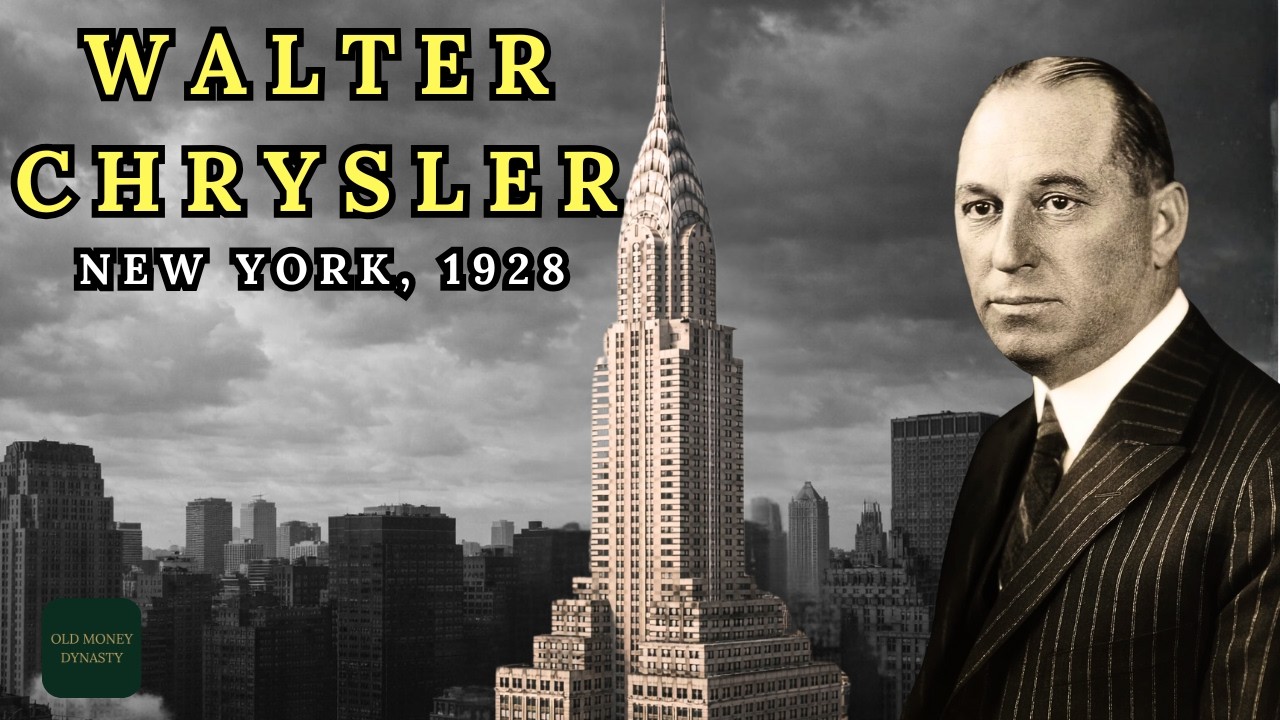
This was no flagpole. The workers began pulling. The first section rose through an opening in the building’s dome and descended into the sixty-sixth floor. Then the second piece, then the third.
Within ninety minutes, all four sections had been riveted together. A one-hundred-eighty-five-foot spire now pierced the sky. The Chrysler Building had just become the tallest structure ever built by human hands—taller than the Great Pyramid, taller than the Eiffel Tower. One thousand and forty-six feet of steel, brick, and one man’s obsession.
Twenty-four hours later, the stock market collapsed. The man behind the tower began in Kansas, as a railroad mechanic’s son who refused his father’s wish that he attend college. At fifteen, Walter Chrysler dropped out of school and spent a year delivering groceries sixteen hours a day for ten dollars a month. At seventeen, he talked his way into an apprenticeship at the Union Pacific Railroad shops for ten cents an hour.
For two decades he roamed the American West, building a reputation as a mechanic who could solve problems that stumped supervisors. By his early thirties he had reached the top of the railroad industry as works manager at the American Locomotive Company in Pittsburgh. In 1908, at the Chicago Auto Show, Chrysler saw a cream-colored Locomobile and bought it on the spot, even though he had never driven a car. The price was five thousand dollars against an annual salary of eight thousand.
When the car arrived at his home in Iowa, he did something peculiar. He did not learn to drive. He pushed it into his barn and took it apart piece by piece, studying the engine, the transmission, the brakes. He reassembled it, then took it apart again.
By some accounts he disassembled that automobile dozens of times before ever turning the ignition key. He wanted to understand every gear, every valve, every connection. Three years later, a banker arranged a meeting with the president of Buick Motor Company, who needed a production chief who understood machines. The position paid six thousand dollars a year, half of what Chrysler was earning at the locomotive works.
He accepted without hesitation. Within five years he transformed Buick into the most profitable division of General Motors. By 1919, after years of clashing with Billy Durant over spending and control, Chrysler sold his stock and walked away with ten million dollars. He was forty-four and one of the wealthiest men in America.
He could have retired. Instead he took over failing companies. His final project was Maxwell Motor Company, which had fallen from fourth place in American automobile sales to tenth, carrying thirty-two million dollars in debt with twenty-six thousand unsold cars rusting in lots. Friends warned him he was destroying his reputation, but Chrysler saw the factories and distribution networks beneath the ruin.
He hired three brilliant engineers who had been developing an advanced six-cylinder engine. The result debuted at the New York Automobile Show in January 1924. The Chrysler 6 featured hydraulic brakes on all four wheels and engineering that rivaled cars costing twice as much, yet sold for under two thousand dollars. Dealers sold thirty-two thousand units in the first year, and on June 6, 1925, the company was reorganized into Chrysler Corporation.
By 1928 Chrysler had purchased Dodge Brothers for one hundred seventy million dollars and watched Time magazine name him Man of the Year. Factories rust and sales figures fade. Walter Chrysler wanted something permanent. In October 1928, he bought a plot of Manhattan land at Lexington Avenue and Forty-Second Street from a Brooklyn developer named William Reynolds, who had run out of money mid-construction.
Reynolds had planned a tower with architect William Van Alen, but his ambition had exceeded his financing. Chrysler paid over two and a half million dollars for the lease, the plans, and the architect, then tore down what little construction had begun. He intended to start over, taller and bolder. Chrysler treated the project as a simple investment for his children, who had no interest in the automobile business.
But when he saw the architectural model, he ordered Van Alen to redesign the lobby completely. After that, the industrialist involved himself in every decision. The original design called for sixty-seven stories. Chrysler wanted taller, then reconsidered and asked to remove ten stories to cut costs, then reversed himself when he realized additional height meant additional publicity.
No corporate funds financed the tower. Chrysler wrote personal checks. The final construction cost reached approximately fourteen million dollars. Every brick, every rivet, every pane of glass belonged to Walter Chrysler alone.
The plans kept growing because another tower was rising downtown, designed by Van Alen’s former partner, H. Craig Severance. The two architects had shared an office for thirteen years until a magazine article credited Van Alen alone for a building they designed together. Lawsuits followed and the partnership dissolved.
Now they faced each other across the Manhattan skyline. Severance’s building at 40 Wall Street reached 840 feet, so Van Alen revised his plans to reach 925. Severance countered by adding a steel cap, putting his building two feet taller. The newspapers called it the race into the sky.
Van Alen had a secret. The announced height of the Chrysler Building was a lie. Inside the fire shaft at the center of the building, workers were assembling a spire in sections—one hundred eighty-five feet of steel hidden from view. The scaffolding shrouding the dome was explained as work on the stainless steel cladding.
In reality, it concealed the true purpose. Even the riveters did not fully understand what they were building inside the shaft. They followed blueprints that showed dimensions but not purpose. Only when the sections came together did the shape become clear.
On November 13, 1929, 40 Wall Street topped out at 927 feet. Severance invited the downtown elite to celebrate their victory. They were three weeks too late. Workers at the Chrysler Building had already hoisted the hidden spire through an opening in the dome.
Van Alen later compared the moment to watching a butterfly leave its cocoon. The Chrysler Building now stood 1,046 feet tall, 119 feet higher than 40 Wall Street, taller than the Eiffel Tower. Severance tried arguing that the spire should not count because it contained no usable space. No one listened.
The two men never spoke again. The building itself became a reflection of the machine age its owner had mastered. Walter Chrysler had spent decades in factories, and he understood that injuries slowed production. He required safety measures that other developers considered excessive: scaffolding with guardrails around every work area, tarpaulins overhead to catch falling tools, wire netting between toe boards, a hospital on site with a physician on every shift.
The expected casualty rate for a project this size was one death per floor above fifteen. More than sixty men should have fallen. None did. Three thousand men built the tower—20,961 tons of steel, 391,881 rivets, nearly four million bricks laid by hand.
Not one of them died. The crown emerged from its scaffolding in the spring of 1930, and New York had never seen anything like it. Seven radiating arches rose in terraced layers, pierced by triangular windows arranged like the rays of a rising sun. The cladding was Nirosta steel, an alloy of chromium and nickel that had never been used on an American building at this scale.
It would gleam as brightly in fifty years as the day it was installed. Below the crown, stainless steel eagles crouched on the corners of the sixty-first floor, enlargements of the Chrysler hood ornament. At the thirty-first floor, replicas of Chrysler radiator caps decorated the facade. The building was a monument to industry, to commerce, to the belief that machines could be beautiful.
Le Corbusier visited and called it hot jazz in stone and steel. In January 1931, Van Alen attended a costume ball dressed as his own building, complete with a headpiece shaped like the sunburst crown. It was the last triumph of his career. He had made a catastrophic mistake when he accepted the commission: he never signed a contract.
When the building was complete, he submitted an invoice for eight hundred forty thousand dollars. Chrysler refused to pay, claiming Van Alen had received bribes from suppliers without offering evidence. Van Alen sued and won his full fee, but the lawsuit destroyed his career. Architecture was a profession built on relationships, and clients did not hire architects who took patrons to court.
He never received another major commission. He died in 1954 to brief obituaries. The Empire State Building opened on May 1, 1931, and the Chrysler Building was no longer the tallest structure on Earth. Its reign had lasted eleven months.
Walter Chrysler died in August 1940. His children sold the tower in 1953. Successive owners cut maintenance costs. The observation deck closed.
The Cloud Club, the exclusive dining room sixty-six floors above the street where the city’s business elite had made deals over lunch, closed forever in 1979. By the early 1970s, with New York City careening toward bankruptcy, the Chrysler Building’s occupancy fell to seventeen percent. Then the revival began. Jack Kent Cook purchased the building in 1979 and completed the lighting system that had been part of the original design but never installed.
In September 1981, fluorescent tubes illuminated the triangular windows of the crown for the first time. The Chrysler Building glowed against the night sky as Van Alen had always intended. Later owners restored the lobby and the mural. By 2005 the building was ninety-five percent occupied.
The critical consensus shifted entirely. Lewis Mumford had called the building a series of restless mistakes. A new generation called it a masterpiece. The taller Empire State Building won the measurement contest, but the Chrysler Building won something else.
It remains the tallest brick building in the world supported by a steel frame. More importantly, it remains the building New Yorkers point to when asked which tower they love most. Walter Chrysler wanted a monument that would outlast his company and his century. William Van Alen gave him one.
Nearly a century later, it still gleams above Lexington Avenue, dissolving into the sky exactly as its architect intended.