On June 25, 1876, a thirteen-year-old Lakota boy named Black Elk knelt in the dust beside a dying soldier. The soldier’s legs were still kicking. Black Elk’s knife was dull and would not cut cleanly, so he pressed the barrel of a gun to the man’s forehead, pulled the trigger, and finished what he had started. He was an Oglala Lakota, a second cousin of Crazy Horse, and he was witnessing a version of the Battle of the Little Bighorn that America would spend more than a century trying to bury.
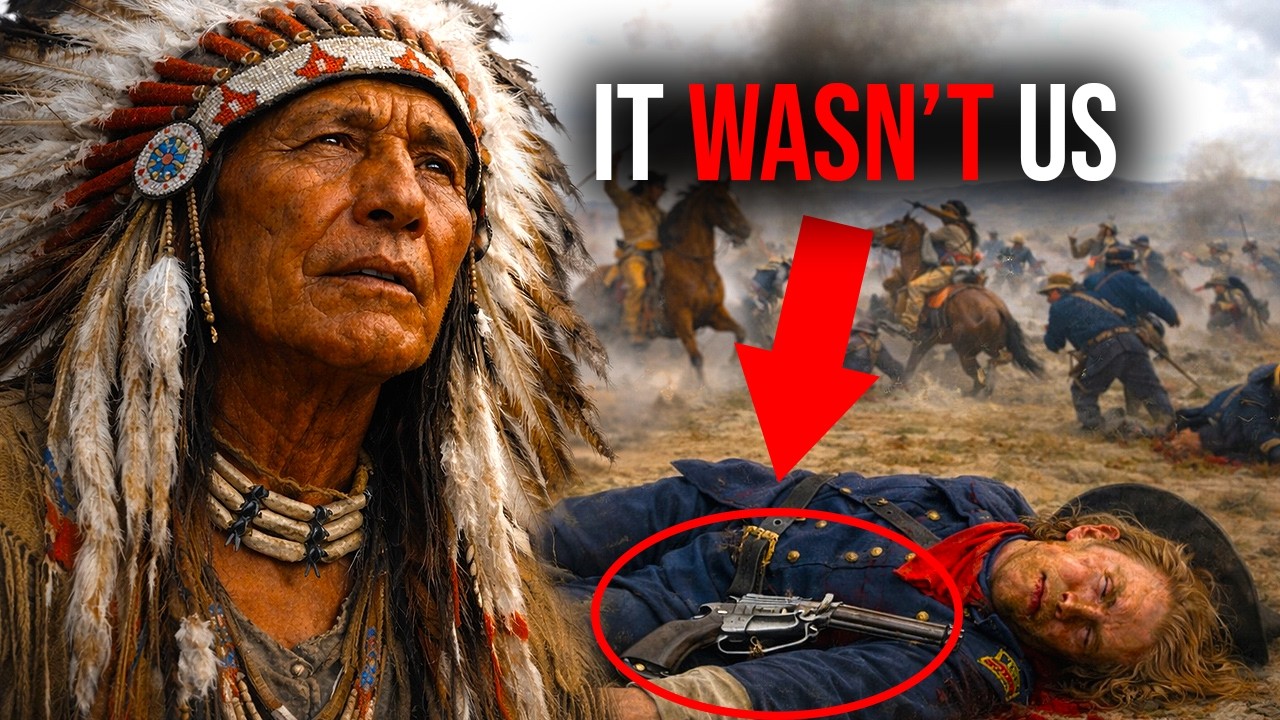
The fight is remembered as Custer’s Last Stand, the most famous military disaster in American frontier history. For generations, its story was told almost entirely from one side—the losing side. The Lakota, Northern Cheyenne, and Arapaho told their own accounts, but those voices were ignored or dismissed. Black Elk’s testimony, recorded decades later, is among the most vivid and human of them all.
It does not describe a noble last stand. It describes chaos, dust, and the brutal work of survival. To understand what brought two civilizations into collision in that remote Montana valley, one has to start with gold. In 1868, the United States government signed the Treaty of Fort Laramie, guaranteeing the Lakota Sioux ownership of the Black Hills of South Dakota, land they considered sacred.
The treaty was clear. The land belonged to the Lakota. Then in 1874, an expedition led by George Armstrong Custer confirmed the presence of gold in the Black Hills. Prospectors flooded in by the thousands.
Instead of honoring its own treaty, the government demanded that the Lakota sell or cede the land. When they refused, Washington issued an ultimatum: report to designated reservations by January 31, 1876, or be declared hostile. Many bands refused. Sitting Bull’s Hunkpapa Lakota, Crazy Horse’s Oglala Lakota, the Northern Cheyenne, and the Arapaho gathered as they always had for their annual summer encampment, this time in the valley of the Little Bighorn River.
The valley they called the Greasy Grass, for the lush vegetation along its banks, was not a staging ground for war. It was where families, elders, and children gathered for the summer. They were living their lives. The United States Army launched a three-pronged campaign to force them onto reservations.
Three columns of soldiers marched into Lakota territory from different directions, intending to converge and crush resistance. It did not go well for the army. In March 1876, Crazy Horse helped repel a cavalry attack on the Powder River. On June 17, just eight days before the Little Bighorn, he met General George Crook’s column of thirteen hundred soldiers at the Battle of the Rosebud and stopped him cold.
Crook retreated and played no further role in the campaign. In three months, Crazy Horse had humiliated two American military expeditions. A third was on its way. Its commander was George Armstrong Custer.
He had graduated dead last in his West Point class of 1861, yet rose to brevet major general during the Civil War by the age of twenty-five through sheer audacity. By 1876, he desperately needed a victory to salvage a career tarnished by political scandal and a public dispute with President Grant. He did not ride toward the Greasy Grass with caution. He rode with hunger.
The encampment along the Little Bighorn stretched for nearly three miles. It was the largest gathering of Plains Indians in living memory, perhaps fifteen hundred to twenty-five hundred warriors among thousands of families. Many warriors carried repeating rifles, Winchesters and Henrys captured or traded in earlier engagements, alongside bows, lances, and war clubs. Some carried weapons taken from Crook’s men at the Rosebud just days before.
They were not disorganized raiders. They had tasted American defeat, and they were confident. Sitting Bull, the Hunkpapa spiritual leader, had recently performed a Sun Dance, one of the most sacred ceremonies in Lakota life. During the ritual, he offered pieces of his own flesh and fell into a trance.
In that trance, he saw soldiers falling upside down into the Lakota camp, tumbling headfirst from the sky like leaves. The people interpreted this as prophecy. The soldiers will come, and they will die. Custer commanded roughly six hundred men of the Seventh Cavalry.
His immediate strike force, the column he personally led toward the village, numbered around two hundred ten. They were armed with single-shot Springfield carbines, powerful but requiring a manual reload after every shot. Custer had refused Gatling guns because they would slow his march. He had refused additional reinforcements because he wanted the glory for the Seventh alone.
His Crow and Arikara scouts warned him the village was enormous. He dismissed the warnings. He was not worried about the size of the village. He was worried the Indians would scatter before he could attack.
On the morning of June 25, Custer split his regiment into three groups. Captain Frederick Benteen took one hundred twenty-five men on a wide reconnaissance that removed them from the coming fight. Major Marcus Reno took approximately one hundred forty men with orders to cross the river and charge the village from the southern end. Custer himself took roughly two hundred ten men and rode north along the bluffs east of the river, planning to strike the village from the opposite end in a classic pincer movement.
The plan required coordination, speed, and a small disorganized enemy. None of those conditions existed. In the early afternoon, women were digging wild turnips near the river and children played in the shallows when a cloud of dust rose to the south. Reno’s troopers came charging across the flats toward the Hunkpapa circle.
For a terrible moment, there was panic. Women grabbed children and ran north through the circles. Men scrambled for weapons and horses, some still pulling on war shirts as they mounted. Chief Gall, the Hunkpapa war leader, rallied the defense with ferocious speed.
Some accounts indicate his wives and children were among the first casualties of Reno’s charge. His grief became a weapon. He organized a counterattack that closed on Reno’s men from three sides. Within minutes, Reno ordered a retreat, first into a stand of timber along the river, then a chaotic scramble across the water and up the steep bluffs to the east.
Men were cut down as they fled. Horses stumbled in the mud and threw their riders. Reno’s survivors dug in on the blufftops, bleeding, disorganized, and effectively out of the fight. They would stay pinned there for the next day and a half.
With Reno neutralized, hundreds, then more than a thousand warriors began streaming north along the river and through the ravines toward the sound of new gunfire. Custer’s column had been spotted on the bluffs to the east. Crazy Horse moved through the ravines to the north and east of Custer’s position, sealing the last route of retreat. From the west and south, more warriors surged up from the river valley.
The movement was fast, fluid, and overwhelming. Kuster’s men were a thin line on an exposed ridge, and a tide of warriors was closing around them like a fist. The first moments of contact were devastating. Soldiers dismounted, some shooting their own horses and dragging the carcasses into rough circles to serve as barricades.
The Springfield carbines barked, one shot at a time. The warriors fired repeating rifles from every direction. Dust rose in columns so thick it was visible for miles. Black Elk moved with the mass of warriors toward the ridge.
He carried a borrowed weapon. Men he had known his entire life were riding into the smoke. From every ravine and fold in the earth, warriors appeared. The ridge was surrounded.
There was no line of retreat. No relief column was coming. Then Black Elk saw a soldier on the ground, still alive, still kicking. The man had short hair.
Young, wounded, dying. Black Elk approached. He later told the poet John Neihardt what happened. The soldier ground his teeth.
The knife was not sharp. The dull blade caught on skin and hair. Black Elk shot the man in the forehead and took his scalp. He was thirteen years old.
He was becoming a warrior in real time, in the middle of the most violent hour of his life. On the ridge, the soldiers who remained alive pulled into a shrinking perimeter at the top of the hill. Dead horses formed crude barricades. Warriors fired arrows in high arcs that dropped behind the barricades.
Others charged on horseback, firing at close range, then wheeling away. The soldiers’ return fire grew thinner. Ammunition was running low. Some Springfields jammed as copper cartridge casings expanded in overheated barrels.
The weapons that were supposed to be their lifeline were failing in their hands. Warriors spotted a soldier hiding in thick brush on the slope below the ridge. They shot arrows into the brush to flush him out. When that failed, they set the brush on fire.
The soldier emerged, stumbling, coughing. They hunted him the way they hunted game. The end came fast. The perimeter collapsed inward as warriors surged over the barricades.
The fighting became close quarters, war clubs, knives, pistols fired at arm’s length. Some soldiers turned their weapons on themselves rather than face what was coming. Whether Custer himself died this way remains debated. Lakota accounts vary, and Black Elk did not claim to have witnessed his final moment.
The firing sputtered, thinned, then stopped. The entire fight on the ridge had lasted perhaps an hour or two. Dust still hung in the air like fog. Approximately two hundred ten soldiers of Custer’s immediate command lay dead.
Not one survived. Across the entire engagement, total United States casualties reached about two hundred sixty-eight killed and fifty-five wounded. It was the worst defeat the army would suffer in the entirety of the Indian Wars. Lakota, Cheyenne, and Arapaho losses are harder to pin down, with estimates ranging from thirty to over one hundred killed.
Kuster’s body was found with two wounds and was relatively untouched, according to several accounts. His famous golden curls were already gone. He had cut his hair short before the campaign. The myth of the long-haired hero dying in a blaze of glory was false before the body was even cold.
Dusk settled over the valley. Black Elk walked back to camp in the fading light. He was thirteen years old. He had killed.
He had taken a scalp. He did not yet know that America would spend the next century pretending he did not exist. The Lakota had won the most decisive Native American victory in the history of the Indian Wars. Within four years, it would be used to justify their complete destruction.
The news reached eastern newspapers within weeks, and the narrative was fixed: Custer was a hero martyred by savages. Paintings depicted a noble Custer standing tall with pistol raised, surrounded by feathered warriors. None of these images resembled the dust-choked reality Black Elk described—the confusion, the soldiers shooting their own horses, the jammed carbines, the friendly fire. Full-scale military campaigns crushed the remaining free bands within two years.
Crazy Horse surrendered in 1877 and was killed under suspicious circumstances at Fort Robinson. Sitting Bull fled to Canada, eventually returned, and was shot dead by reservation police in 1890. The great buffalo herds were systematically slaughtered in a deliberate campaign to starve the people into submission. Then came Wounded Knee.
On December 29, 1890, the Seventh Cavalry, Custer’s own regiment, surrounded a band of Lakota at Wounded Knee Creek in South Dakota and opened fire. More than two hundred fifty Lakota were killed, most of them women and children. Lakota voices, including Black Elk’s, were dismissed as unreliable. His account did not reach a broad public until 1932, when Neihardt published Black Elk Speaks, and even then it was largely ignored for decades.
It was not until late twentieth-century archaeology at the battlefield site that his testimony was fully recognized. Modern excavations confirmed what the Lakota had been saying all along. The locations of bodies matched their oral history. Patterns of spent cartridge casings confirmed the positions of warriors and soldiers.
Evidence of close combat aligned precisely with the accounts historians had dismissed for a century. Black Elk grew into a holy man who spent his life trying to preserve the spiritual traditions of a people the United States tried to erase. He watched the buffalo vanish. He watched the reservations close in.
He stood at Wounded Knee when the Seventh Cavalry took its revenge fourteen years after the Greasy Grass. And through all of it, he remembered. He remembered the valley and the day his people won. America told the story of the Little Bighorn for over a century without ever asking the people who won it what happened.
When it finally did, the answer was the same one Black Elk had given all along. The age of the free Lakota ended not in the valley of the Greasy Grass, but in the decades that followed, slowly, deliberately, and with the full weight of a nation that could not forgive them for winning.