At twenty-three, Pamela Turnure became Jacqueline Kennedy’s press secretary, tasked with protecting the image of the First Lady. But history does not remember her for the statements she wrote. It remembers her for a rumor that refused to die. Whispers suggested she was not only the First Lady’s aide but also a special companion to the President himself.
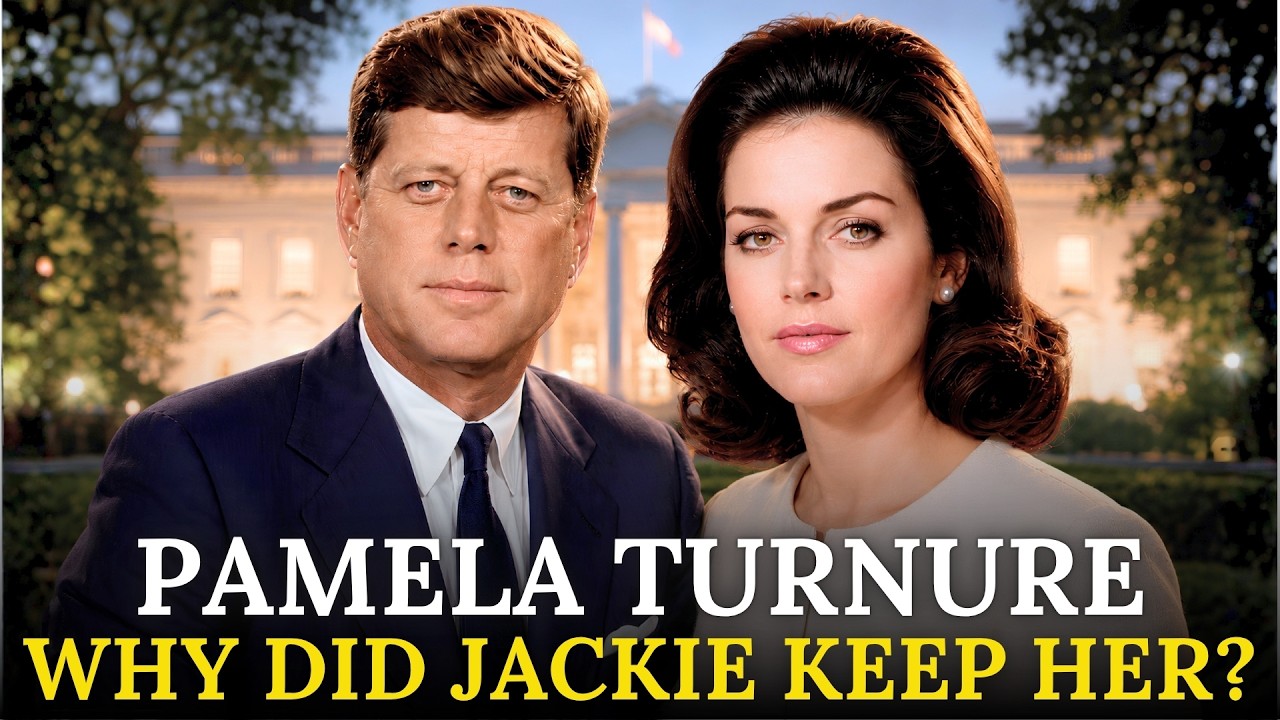
A woman so close to a national scandal would later vanish almost entirely from the records, her name surfacing only when someone wanted to retell the rumor. How did she disappear so completely? And why did she refuse her entire life to tell her side of the story? Born into the upper reaches of New York society, Pamela was raised to handle precisely this kind of pressure.
When she took her job in the East Wing, she stepped directly into an unprecedented media storm. Late-1950s America lived under the weight of Cold War anxiety, the national mood tense and hungry for something new. John and Jacqueline Kennedy answered that mood. Young, magnetic on camera, they projected an almost flawless elegance the world could not stop watching.
Pamela stood on the line between that image and the people who wanted to see behind it. Her task every day was to preserve the public face of the administration exactly as the public wanted to see it. For a new press secretary, the stakes were extraordinarily high. She was guarding a national symbol from any tarnish.
Every photograph was carefully chosen, every statement weighed word by word. The whole country was watching, and Pamela decided what those millions would see. The East Wing was never a place for enjoying the spotlight. It operated like a tightly controlled machine.
Jacqueline turned the White House into a theater of soft power, and the international press demanded every small detail of the new administration. If the First Lady wore a new dress, its design made the front page. If she hosted a formal dinner, foreign journalists analyzed the printed menu. Pamela worked without pause to satisfy that hunger, making her a primary target for Washington’s most aggressive correspondents.
Her office phone rang from early morning until late at night. Reporters pressed her constantly for information about the President’s family, where they went, whom they met, how they spent an ordinary evening. She faced the flood of calls alone, one after another, never once appearing to be a woman hiding something. Standing between the press room and private spaces, she had no room for error.
She could not show exhaustion publicly and had to maintain composure no matter how long the day ran. There was no one to carry the burden when she needed a break. The job carried a sharp contradiction. Jacqueline was the focus of the world’s gaze and, at the same time, an intensely private woman who refused to compromise her personal life.
Her instructions to her staff were strict. Pamela had to give waiting journalists enough to satisfy them, while ensuring they never came near the family’s real life. Too little made them suspicious and sent them digging. Too much risked handing over exactly what Jacqueline ordered her to protect.
It was a delicate balance she had to maintain day after day. In a building full of people, she worked as a lone gatekeeper. She became expert at polite evasion, at answering at length while saying almost nothing. When reporters pressed, she turned them back gently, sending them off with pleasant replies that, when written down and read later, contained no substance at all.
The answer to how a twenty-three-year-old girl handled such pressure lies in the strict upper-class training she absorbed from birth. Raised in the rigid social hierarchy of New York City, she watched her stepfather, a vice president at a major media company, manage how public narratives were built. Educated at private girls’ schools, she ended up at Miss Porter’s in Connecticut. Such schools served a clear purpose for wealthy daughters.
They trained girls in exactly the public behaviors their class expected. Pamela learned how much to say in formal conversation, how to smile only as much as decency required. The real lesson beneath the etiquette was how to avoid drawing attention. Proper upbringing meant knowing how to recede into the background of any gathering while remaining present in the room.
In that world, visibility was a danger, something to be managed rather than sought. Her family was closely tied to East Coast high society. Her mother eventually married into the Cassini family, giving Pamela a direct link to a prominent cultural figure. Oleg Cassini was Jacqueline Kennedy’s personal fashion designer, and his work helped shape the administration’s visual identity.
That connection was more than a convenient introduction. It placed Pamela in the First Lady’s orbit. The two women belonged to the same cultural world and understood its rules without being told. They spoke the same unspoken language of the American elite, both knowing which questions to ask and which to avoid.
That shared understanding created nearly instant trust. Jacqueline never had to explain the basic rules. The younger woman already knew how to operate safely behind closed doors. That instinct opened her first real career door and led her to a Senate office in 1958.
The office was busy and demanding, phones ringing above the clatter of typewriters. Young staffers worked long hours with no fixed schedule, convinced they were shaping the country’s future. Pamela entered as a low-level employee, starting at the reception desk where she organized the daily schedule and managed the flow of visiting politicians and journalists. The job demanded constant attention to detail, where a small lapse could ruin an entire afternoon.
The office functioned as a machine built for one purpose: moving upward. Pamela sat at the front, controlling who entered the inner office. She learned to handle difficult callers without losing her calm. Endurance was required, and she soon adapted to the pace of Capitol Hill.
Keeping composure under pressure became her main asset. Senator John F. Kennedy was the center of everything. Naturally charismatic and energetic, he commanded any room the moment he entered.
He knew how to speak to his staff and make every junior employee feel important to the mission. Working close to a man of his stature had its rewards, a front-row seat to national decisions and strong relationships. But it also carried risks no one acknowledged. The line between professional duty and personal loyalty blurred, and the loyalty he inspired made things complicated for those around him.
Staff members adjusted their days to his schedule. His mood set the office atmosphere, and a word of praise from him was a prize. The culture demanded total dedication to his rise, leaving little room for life outside work. Soon, other staff members noticed something.
Pamela resembled the Senator’s wife. She wore her dark hair the same way, had the same wide eyes and strong features. The resemblance was too obvious to ignore. It went beyond hair and clothes.
Pamela had the same soft, low voice as Jacqueline Kennedy, the same tone. When she answered the phone, callers sometimes confused her for the future First Lady. Unintentionally, she became a living echo of the woman at the top. The resemblance made her a figure impossible to ignore.
A young receptionist reflecting the image of the woman above her. She never asked for the comparison and could not escape its shadow. It caught the attention of journalists and politicians alike, and people began to talk. Among those crowded corridors of power, a rumor began to spread, one that would never leave her for the rest of her career.
Biographers later recorded speculation about the true nature of her role. Records suggest the relationship may have crossed professional boundaries. According to those accounts, the rumor began with one person. A Georgetown property owner named Florence Kater began watching the building closely and was said to have photographed the Senator leaving late at night.
Some accounts say Kater went further, even attempting to plant listening devices to capture their conversations. The evidence never settled exactly what happened during those nighttime visits. But the allegations alone were enough to build a silent story that moved slowly through Washington’s closed world, passed along at dinners and behind closed doors. Whether true or not, the rumor changed how people saw Pamela.
A junior employee without protection or a notable title could have her career ended by such a scandal before it began. Kater’s efforts eventually drew the attention of federal authorities. The FBI opened a file, more concerned about possible illegal wiretapping in the capital and protecting the Senator from surveillance than about the rumor itself. Through the presidential campaign, the immediate threat stayed under control.
The public reckoning came decades later. In 1997, journalist Seymour Hersh published a widely covered book that carried the old rumors to a global audience. What had been private whispers became public knowledge. Pamela issued no statement of her own.
Her family denied the accusations on her behalf, and her silence itself became material for analysts to dissect. People argued about what it meant, whether her refusal to speak was an implicit admission of guilt or a final display of dignity. The media cast her as the hidden woman of the administration. What she actually did at her desk no longer mattered, because the public preferred the version involving scandal.
After the assassination, her work shifted. She organized the response to an enormous wave of national grief. The country responded with a flood of letters addressed to the family, breaking all executive branch records. Pamela managed the crisis with the same discipline and calm, shifting from press room pressure to the weight of national mourning.
In Georgetown, the small team processed up to forty-five thousand letters a day. The total eventually exceeded one million pieces. Pamela built an operation from scratch, relying heavily on civilian volunteers. She gathered three thousand volunteers to sort through the mountain of mail, working in shifts, opening envelopes, sorting letters, and drafting replies.
Pamela oversaw it all closely, ensuring no message went ignored and reviewing outgoing responses herself. The days were long and demanded relentless focus, all in the midst of national mourning. She protected the widow’s privacy by gathering what needed Jacqueline’s review each morning and sending it to her in plain yellow folders. The former First Lady read in silence, wrote instructions in the margins, and sent the folders back down.
The arrangement allowed the office to function without intruding on her grief. It was a quiet, elegant solution born of years working together. That steady support stood far from the rumors of earlier years. In the end, her loyalty said more than any old scandal.
She proved it through months of hard, unglamorous work. Once all obligations were fulfilled, Pamela made a decision aimed at reclaiming her name forever. In 1966, she married and quietly left politics. Over the following fifty years, the public read an endless stream of political memoirs.
Former staffers sold their memories for good money, writing detailed accounts to prove how close they had been to power. Pamela refused those offers. She said no to every major interview and every offer that came with it. She never wrote a book to defend herself, never issued a statement to correct the record, never spoke a word of ill against anyone she had served, not for money, not for vindication.
Her silence stood in sharp contrast to the constant noise of the political establishment around her. People kept expecting her to exploit her notable past sooner or later. They waited for a late confession that never came. She remained entirely absent from historical debates, choosing a private life over selling her history.
In the end, that refusal became the thing that defined her. There was one exception in all those years. In 1982, she agreed to participate in an official oral history project. Even then, she controlled the terms, requiring a legal agreement to seal the tapes before she would speak.
The tapes remained locked in the National Archives for decades. The files were finally opened in 2023. Historians rushed to the transcripts hoping to find hidden political secrets. What they found instead was an example of absolute restraint.
On the tapes, she was still protecting her former employer. When the interviewer pressed her about Jacqueline’s personal troubles, Pamela intervened. She told the historian to stop recording at that moment. She would not allow the hardest moments of the First Lady’s life to be recorded for anyone to read.
Decades after the administration ended, she still stood guard at the door. Time had not weakened her class training, and her loyalty remained a form of defense until the end. Her silence was not submission or retreat. It was a statement of independence.
By refusing to speak, she denied the public their assumed right to judge her and robbed the media of the chance to sell her life as a scandal. The tabloids could publish their rumors, but they could never force her to respond. Pamela Turnure was assigned to manage the Camelot story carefully. She spent her youth shaping the image of a famous family.
Her own story she kept out of reach, drawing a line no journalist could cross. Her name belonged to the administration. Her thoughts belonged only to her. No one was ever given the right to the last chapter of her life.
Washington’s press corps could not break her, and the Kennedys did not own her legacy. Even history could not force her to speak. In the velvet corridors, real power is not always what you show publicly.
Sometimes it lies in choosing to walk away and take the truth with you.