At Pharsalus in 48 BC, Julius Caesar counted his dead and wrote the figure into his own account of the civil war against Pompey. He lost around 200 common legionaries. A hard price, but the kind a commander pays and moves on from. Then he gave the second number.
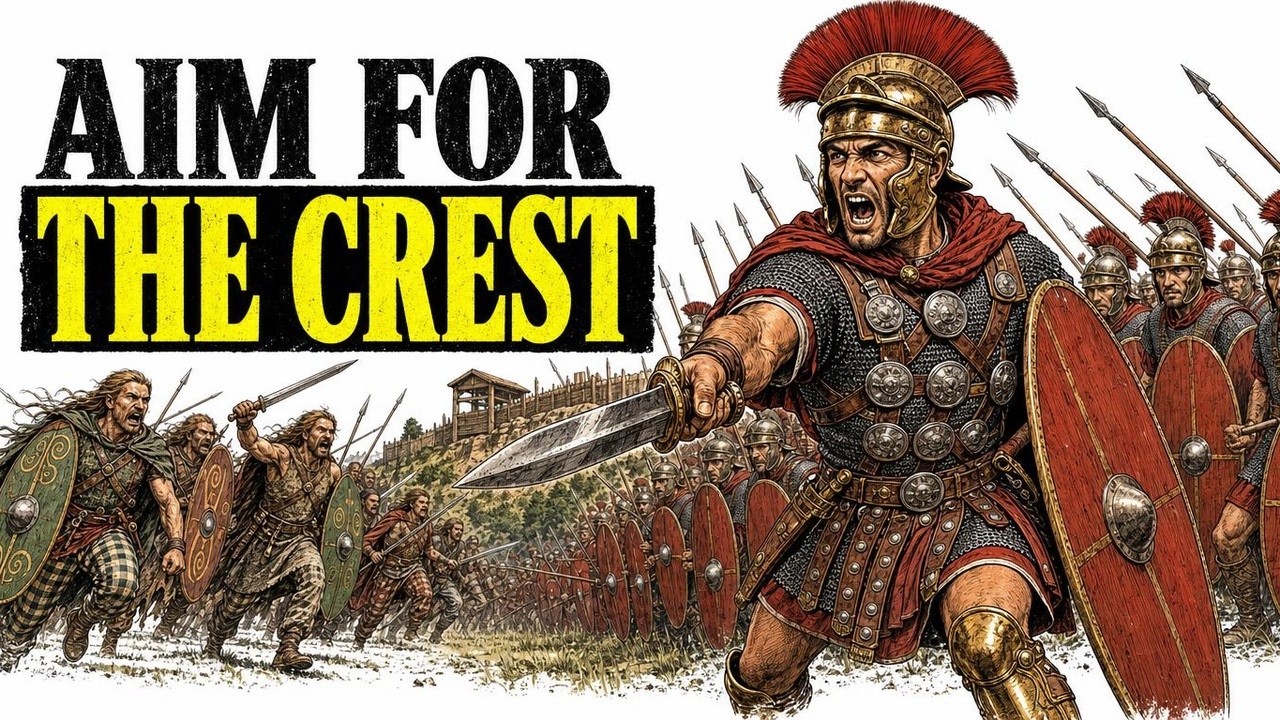
In that same battle, he lost thirty centurions. A legion at full strength carried fifty-nine centurions to command nearly five thousand men. The officers, the most experienced hands on the field, were dying at a rate that dwarfed the recruits they led. This was not a bad day for the centurion.
This was the centurion working exactly as designed. The job was never to lead men and come home. The job was to lead men and fall. To understand how Rome built such men, and why it spent them so freely, you have to begin at the recruiting office.
A new soldier was a munifex, a raw recruit who swore the sacramentum, the military oath, handing his body to the Roman state for twenty years. Under Augustus, who fixed that term in AD 6 and set aside a treasury to pay the men, the oath became a career and a cage at once. Recruiters took sunburnt farm boys over the soft-handed city dwellers, because a man who had swung a scythe all summer already knew how to suffer. He was branded with ink or iron so he could not slip away.
Then came the unmaking. He marched twenty Roman miles in five hours under the summer sun, then thirty at the faster step with sixty pounds strapped to his back. He dug ditches into frozen earth. He drilled against a wooden post with a practice sword and wicker shield that both weighed twice what the real ones did.
He stabbed at that post ten thousand times, aiming for the throat, the groin, the gap under the arm. The writer Vegetius, copying out the old manuals, recorded the cold reasoning: a slash cuts muscle and skin and looks fearsome, but a man can live through it. A thrust, sunk just a couple of inches, kills. So the centurion was trained never to swing.
He stabbed, a piston driving in and out, shield forward to crack an opening, blade low into the belly, twisting as it went in. He also learned something fast. The thing most likely to kill him stood at his elbow wearing his own colors. The Greek historian Polybius, who marched with the legions in the second century BC, wrote down the punishment called the fustuarium.
A condemned man was dragged before the whole legion. The tribune touched him with a cudgel, barely a tap, and that touch was the sentence. Then the man’s own comrades came at him with clubs and stones and beat him until he was dead. Even if he crawled out alive, his own town would never take back a soldier the legion had condemned.
When a whole unit failed, Rome had decimation. The cohort drew lots, one man in ten was pulled out and clubbed to death by the other nine. Crassus revived it in 71 BC against the men who had fled Spartacus, killing hundreds of his own soldiers in front of the rest. The message was the same everywhere: the legion is a single living body, and it will tear out any part of itself that threatens the whole.
Survival depended on being a flawless component, never breaking rank, never drawing the eye. Out of this crowd of frightened, obedient men, a handful were pulled forward. The first rung was the rank of optio, and it was a curse dressed as a reward. The optio stood at the very back of the century, facing his own men, gripping a long pole capped with a metal knob.
When the line started to bend, when every nerve in a soldier’s body shrieked at him to turn and run, the optio was there, driving the wavering man back into the grinder. He was the reason the wall of shields held when everything said it should break. If the optio survived, he might be handed the final promotion. They did not give him a medal.
They gave him a stick, a length of vinewood about three feet long called the vitis. It was his badge of office and an instrument of terror. With it he could beat any man under his command for any offense, real or invented. Cassius Dio records where that power could lead.
In AD 14, the year Augustus died, the legions on the Rhine and along the Danube broke into mutiny. There was a centurion among them named Lucilius, whose soldiers had nicknamed him “Sedo Alteram,” give me another. He broke his vine staff so often across their backs and skulls that when the wood splintered, he would bellow for a fresh one so the beating could go on. When the mutiny broke, the men hunted him down and killed him.
Tacitus describes soldiers dragging their centurions out at night, sixty lashes each, one for every centurion in the legion, then flinging the broken bodies over the rampart or into the river. The mutiny nearly took the empire with it. Augustus was barely cold. His stepson Tiberius held the throne by a thread.
The road to that vine staff was a pyramid built from corpses. For every man who pinned the sideways crest onto his helmet, dozens of his equals were already dead. We know some of their names. Marcus Caelius, senior centurion of the 18th Legion, died in the Teutoburg Forest in AD 9 when Arminius and his Germans destroyed three legions in the rain and mud over three days.
His brother could not recover the body, so he raised an empty stone in Germania, a cenotaph carved with the words that Marcus had fallen in the war of Varus. The stone survives, showing a hard-faced man of fifty-three, still in the front rank, still swallowed by the trees. Six years later, Germanicus led his legions back into that forest to bury what was left. Tacitus describes the scene: whitened bones scattered across the open ground, skulls nailed to tree trunks, altars where the Germans had cut down the captured officers.
The soldiers could not tell which bones were kin and which were stranger, so they buried them all as their own. The centurion’s gear was never meant to keep him alive. It was meant to mark him. The ordinary legionary wore a crest running front to back, if he wore one at all.
The centurion’s crest ran crossways over the skull, the crista transversa, dyed crimson or bleached white, cut from horsehair or feathers. It made him the tallest shape on the field, a landmark every slinger and archer could see. His polished breastplate was molded into the shape of a bare torso, pinned with the phalerae, broad silver discs handed out for valor, which threw back every scrap of light. His greaves gleamed.
He was a knot of light and color standing in a field of dull iron, built to be seen. He was the cape the bull charges, a swirl of glory pulling the horns away from everyone else. His shield was not a wall to hide behind. The scutum was a weapon that hit first, curved to hug the body, rimmed in bronze, with a heavy iron dome at its heart called the umbo.
The manuals were blunt about how the fight opened, not with the sword, with the shield. The centurion drove forward and the first thing to land was that iron boss punched straight into a man’s face. Teeth shattered, the bridge of the nose caved, and for one blinded second the enemy could not see for the blood in his eyes. That second was when the sword did its work.
The Romans wrote down the proof. At Dyrrhachium in 48 BC, a centurion named Cassius Scaeva held a redoubt on the Adriatic coast under a rain of missiles. Pompey’s men poured fire into his position for hours. When the fighting broke off, Scaeva was still on his feet.
His helmet was punched through. One eye was gone, a javelin through the socket. His shield, when they carried it to Caesar, held 120 holes. Caesar promoted him to primus pilus, the first spear of the legion, and paid him 200,000 sesterces from his own purse.
The numbers tell the truth of the job. You were expected to become the thing arrows stick into, to take a weight of fire that would kill a dozen men, and not give ground. The centurion stood on the far right of the line, where he had no one to his own right. Nobody’s shield covered his sword arm.
His life rode entirely on his own speed and on the men locked to his left. He was not allowed to turn his head. He had to wear a calm he could not feel, because fear was contagious down a battle line. One flicker of it in his face could run man to man like fire through dry grass.
If he gave half a step, the man beside him might give a full one, a gap would open, the wall would fold, and eighty men would dissolve into a screaming crowd to be cut down at leisure. At Gergovia, Caesar names the centurion Marcus Petronius, who forced the gate, got trapped inside, and cut his way through a crowd until his shield was hacked to splinters and his feet were pinned by wounds. He turned to the men behind him, told them to save themselves, that he had drawn the enemy onto himself and they should not die for him. Then he threw himself back into the fight and was killed.
To make that bargain go down, the state offered something more solid than glory. Silver. Under Augustus, a common legionary drew 225 denarii a year. A centurion drew at least fifteen times that.
A primus pilus could clear far more, enough on retirement to qualify for the equestrian order and rise into the ranks of the empire’s administrators. But this was not a wage. It was hazard pay, a bribe from the Senate and the emperor, cash handed over in exchange for a man’s willingness to stand where death fell thickest. The price was simple.
He had to die. The tombstones tell the story over and over. The name, the legion, the rank, the campaigns listed one after another, and then the record of triumphs ends on a single flat phrase: killed in action. Many of the stones were carved while the man still breathed, the last lines left empty, waiting for word to arrive from a frontier a thousand miles away.
One prize kept the whole machine driving forward: the rank of primus pilus, the first spear. He was the senior centurion of the whole legion, commander of the first century of the first cohort. He alone among the centurions sat in the general’s war council. He held charge of the eagle standard, the aquila.
On honorable discharge, he was lifted into the equestrian order, the second rank of the Roman aristocracy. That was the lottery ticket. But for every Scaeva there were thousands whose names no one wrote down. The first spear was not the aim of the system.
He was the bait in it, the single winner whose story got told loud enough to drown out the silence of the ten thousand who lost. In AD 9, three whole legions, the 17th, the 18th, and the 19th, marched into the Teutoburg Forest in Germania under Publius Quinctilius Varus. Varus trusted a German chieftain named Arminius, who had served in the Roman army, held Roman citizenship, and knew exactly how a legion moved and how it broke. Arminius fed him false reports of a small revolt and led the column off the roads into the trackless woods.
Rain fell for three days. The forest floor turned to sucking mud that swallowed a man to the knee. The wagons bogged and had to be hauled by hand. The column stretched for miles, tangled with baggage carts, and the neat Roman lines could not form among the trunks.
Germans threw spears from the cover of the trees and vanished before the Romans could close. The centurions did what centurions did. They stood at the front of the collapse trying to pull shattered units back together, and they were cut down where they stood. Near 20,000 Romans died in that forest.
Among them fell close to 600 centurions, 600 of the empire’s finest officers gone in one stroke. When the news reached Rome, Suetonius says Augustus tore his robe, let his beard and hair grow for months, and beat his head against the doorposts, crying out for Varus to give him back his legions. The numbers 17, 18, and 19 were never carried again by any Roman legion. The eagles were lost in the trees, and the last was not returned in Augustus’ lifetime at all.
Germanicus led the men who came back to that place in AD 15. Tacitus set down what they saw, and it is one of the coldest passages the Romans ever left us. Whitened bones lay scattered where men had fled and where they had made their stand, thicker in the spots where the fighting had held longest. Broken weapons and the bones of horses lay among them.
Skulls were nailed to the tree trunks. In the sacred groves stood the altars where the Germans had cut the throats of the captured tribunes and senior centurions.