In the year 787, three ships of Northmen arrived on the coast of England, and the Anglo-Saxon Chronicle recorded their arrival with chilling understatement. These were the first Danish vessels to seek the land of the English nation, and the region they struck was ruled by a king whose name would become synonymous with power, yet whose story is now largely forgotten: Offa of Mercia. Offa is regarded as one of the most powerful Anglo-Saxon kings to ever live, styling himself as the first king of the English. Through a series of battles and political masterstrokes, he became the most powerful man in Britain, yet historians often overlook him due to a frustrating lack of source material from his reign.
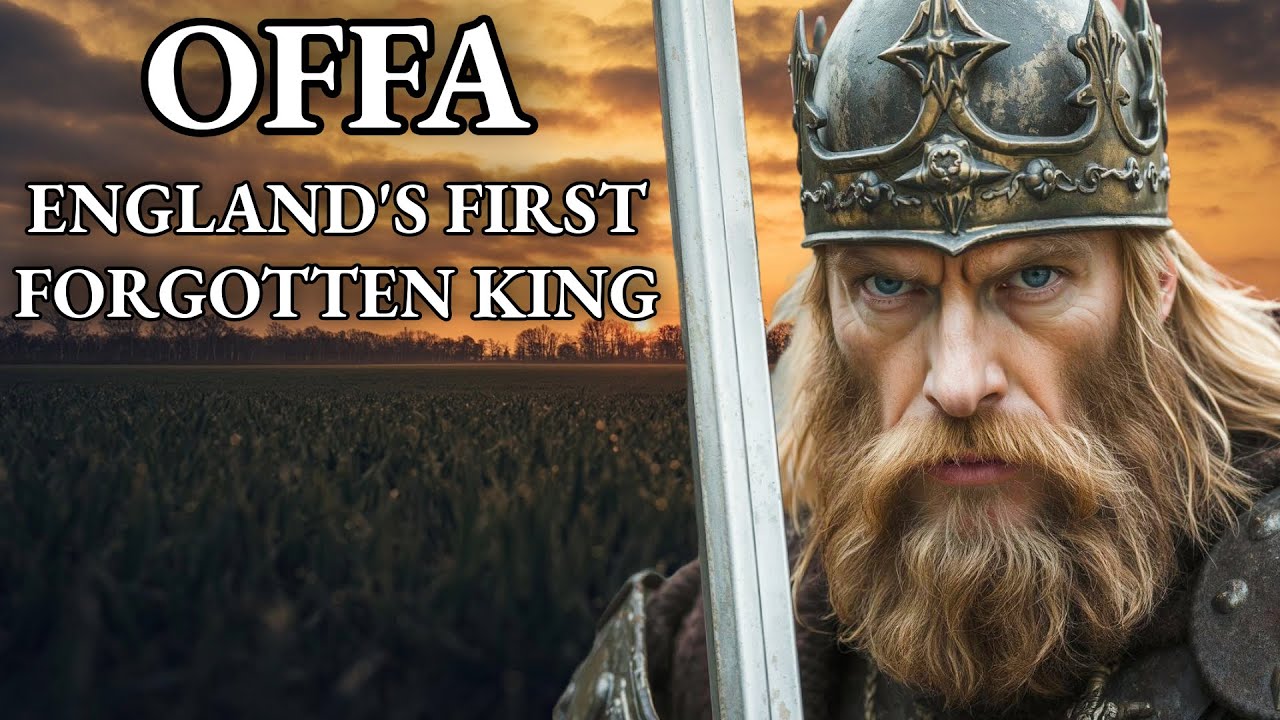
A key source for the period, the Anglo-Saxon Chronicle, may not fully convey the extent of his power, but his actions on the world stage speak to a ruler of extraordinary ambition and capability. He was the son of Thingfrith, a lesser noble and distant kinsman of the then-reigning Mercian king, Æthelbald. The circumstances of his rise to power were steeped in blood. According to Bede’s history, the previous king, Æthelbald, was treacherously murdered at night by his own bodyguards, their motives remaining unknown.
The rule that followed was brief and tyrannical, ending when Offa challenged the usurper, routed his forces in battle, and forced him into exile. Once crowned, Offa faced the daunting task of consolidating a kingdom and legitimizing his authority. He immediately set about shaping a kingdom by the sword, determined to unite and command with both force and foresight. His power grew to such an extent that he extended his influence across England, conquering Kent and East Anglia and even forcing the King of Wessex to acknowledge his overlordship.
The relationship between Mercia and the neighboring Welsh kingdoms was defined by constant tension, border skirmishes, and recurring warfare. The Welsh launched frequent raids into Mercian lands, threatening settlements and disrupting agriculture and trade. These constant incursions demanded a strong and lasting response. In response, Offa ordered the construction of one of the most ambitious defensive works in early medieval Britain: Offa’s Dyke.
This vast earthwork, stretching along the border between Mercia and the Welsh kingdoms, required thousands of men to build and stands as a testament to his authority and resources. It is widely regarded as the most significant construction undertaken by pre-iterate peoples of Britain. Yet Offa’s power was not built solely on conflict. In the first 13 years of his reign, he confirmed charters across Western and Central Sussex, and his royal charters testified to a sovereign who styled himself as the king of the English and the king of Mercia.
He was never given the title Bretwalda, an Old English term meaning the ruler of Britain that was later granted to Egbert of Wessex, whose power paled in comparison. This has led historians to speculate that Offa was, in his own way, the first true king of England, long before Æthelstan of Wessex officially claimed the title. He was also a reformer. He undertook major reforms of the currency, becoming the first Mercian king to issue coins bearing his own name, a clear assertion of royal power and economic control.
One of the most intriguing artifacts of his reign is a coin bearing his name on one side and a backward rendering of the Arabic phrase “there is no god but Allah alone” on the other. This inclusion of Islamic text, clearly misunderstood by the moneyer who copied it, likely reflects an attempt to facilitate trade with the Islamic world, particularly Islamic Spain, demonstrating the reach of his economic influence. His personal life was also used as a tool of political strategy. He married his daughters to powerful rulers, including his daughter Eadburg, who married King Beorhtric of Wessex.
In contrast to the often-fractious relationships between royal families, she remains the only Anglo-Saxon woman recorded as having been honored in such a way during her husband’s rule, a reflection of her prominence and Offa’s exceptional regard for her. He also married another daughter, Æthelburh, to the King of the East Angles, though this union would end in tragedy, with the king being assassinated by a group of Northumbrian nobles. While there is no direct evidence, the marriage of his son, Ecgfrith, to the daughter of King Offa of the East Angles suggests a bond of alliance, if not subjugation. Notably, upon Offa’s death, Ecgfrith was assassinated by a group of Northumbrian nobles, hinting at his reliance on his father’s protection and the fragility of his rule without it.
Through war, diplomacy, and strategic marriages, Offa extended his influence across the entirety of England from Kent and East Anglia to Wessex and possibly even Northumbria. Tragically, the final years of Offa’s reign were marred by a succession crisis. His passing marked the end of an extraordinary reign, one carved in blood, crowned in glory, and destined to shape the course of English history. Though he was succeeded by his son Ecgfrith, the young king’s rule was fleeting, lasting a mere 141 days before his untimely death.
Offa had not hesitated to eliminate rivals to ensure his legacy, a legacy he sought to pass on at all costs. The obscure origins of Offa, the murder of his predecessor, his military conquests, his grand defenses, and his eventual succession crisis all paint a picture of a ruler whose legacy was deliberately obscured. Their silence speaks not to his insignificance, but to the deliberate erasure of a Mercian king whose power once eclipsed all rivals. Offa was not merely a regional ruler.
His story, dimmed by rival chroniclers, deserves to be remembered not as a footnote, but as the prelude to England’s monarchy. He built a lasting monument that can still be seen today, and though his name may now be overlooked in favor of more famous rulers, his impact on the landscape and history of Britain is undeniable.