Prison is meant to be the end of the line. The system takes a person’s name, replaces it with a number, and controls every minute of every day. But for some men, incarceration did not end their power—it concentrated it. From maximum-security cells and solitary-confinement units across the United States, the ten men on this list continued to command organizations, order violence, negotiate with foreign governments, and shape movements from behind bars.
In some cases, prison became not a cage but an office, a platform, or a university. The facilities built to contain them—including ADX Florence, the most secure prison in the country—proved unable to cut off their reach. Ranked from ten to one, these are the men who refused to lose power when the state locked them away. The list begins with Mutulu Shakur, known to the public primarily as Tupac’s stepfather.
Before that, though, Shakur was a leader of the Black Liberation Army and a target of the FBI’s Most Wanted list. In 1979, he was connected to the prison escape of Assata Shakur, Tupac’s godmother, who was broken out of a New Jersey women’s facility and smuggled to Cuba, where she remains today. In 1981, he helped orchestrate the Brinks armored car robbery in Nyack, New York—a heist that left two police officers and a Brinks guard dead. Shakur evaded capture for years before his arrest in 1986, when he received a 60-year federal sentence.
From prison, he continued to organize and educate, becoming a symbol of resistance for political prisoners across the country. Terminally ill, he was released on compassionate grounds in 2022 and died the following year. His influence did not end when the cell door closed; it continued to shape a generation of activists while he was inside. Next is Peter Rollack, known as Pistol Pete, who built a violent drug organization out of the Soundview Houses in the South Bronx.
By his early twenties, his crew had left a trail of bodies across New York. When the federal government caught him, he was sent to a prison in Lewisburg, hundreds of miles from the Bronx. From there, Rollack sent a coded letter to his girlfriend. The instructions in that letter led to two men being shot and killed during a Thanksgiving Day football game between rival housing projects.
One of the victims was a cooperating witness, killed in front of families. The feds traced the order back to Rollack’s letter. He received life plus 105 years and was transferred to ADX Florence, where he has remained in permanent solitary confinement since 2000. For a quarter century, he has had no phone calls and no visitors, because the last time he communicated with the outside world, someone died.
Demetrius Flenory, better known as Big Meech, co-founded the Black Mafia Family, a drug trafficking organization that moved cocaine across the country. Federal prosecutors admitted that in 15 years of investigation, the DEA never saw Meech with product, never heard him discuss it on a phone, and never witnessed a transaction. That did not prevent his influence from following him into prison. After a fight at a federal facility in Atlanta, Meech was sent to the Special Management Unit at Lewisburg, the most restrictive program in the Bureau of Prisons.
The SMU was designed for the most violent and disruptive inmates; in practice, Meech said it was code for the most influential. He spent two years there, in 23-hour lockdown, with limited showers and no freedom of movement. The system was not afraid of his violence—it was afraid of his influence. Guards could not control the energy he brought to a yard, so they tried to lock that energy in a box.
Even that, by his own account, did not stop his impact on other inmates. Stanley Tookie Williams co-founded the Crips in Los Angeles in 1971. The gang grew into one of the largest and most violent organizations in the country before Williams was convicted of four murders in 1981 and sentenced to death. He was sent to San Quentin’s death row, where he spent the next 24 years.
What set Williams apart was not that he maintained power from behind bars, but that he transformed it. From his cell, he wrote children’s books aimed at steering young people away from gang life. He was nominated for the Nobel Peace Prize and the Nobel Prize in Literature. He brokered truces between the Crips and the Bloods from inside death row.
He became the most prominent anti-gang voice in the country while the state of California planned to execute him. Governor Arnold Schwarzenegger denied clemency, and Williams was executed by lethal injection on December 13, 2005, at the age of 61. The system wanted to silence him; instead, it made his voice louder. Rayful Edmond controlled 60% of Washington, D.
C. ‘s cocaine supply before his arrest at age 24. His operation employed more than 150 soldiers and generated an estimated $300 million a year. Washington, D.
C. , became the murder capital of America during his reign. When he was locked up at the maximum-security penitentiary in Lewisburg, most assumed the story was over. It was not.
Edmond had regular access to phones on B cell block and spent hours every day on calls, sometimes using two lines at once. Inside the prison, he connected with a Colombian inmate, the son of the infamous Griselda Blanco, and brokered deals between D. C. drug dealers on the street and Colombian connections abroad.
He set up 20 to 25 separate trafficking operations from his cell, using Pig Latin—a children’s language game—to avoid detection on the phone. When federal authorities caught on, Edmond received an additional 30 years on top of the life sentence he was already serving. The Attorney General publicly criticized the Bureau of Prisons for allowing a convicted drug lord to run a trafficking operation from behind bars. Edmond did not just survive prison; he used it as his office, and he almost got away with it.
Jeff Fort, also known as Abdul Malik, founded the Black P Stone Nation, later renamed El Rukn, which controlled large sections of Chicago’s South Side. Fort was already serving an 80-year sentence when he decided that running a street gang from prison was not ambitious enough. In 1986, federal agents intercepted communications revealing that Fort had been negotiating with Muammar Gaddafi’s regime in Libya for $2. 5 million.
The deal: Libya would pay El Rukn to commit acts of domestic terrorism on American soil. Fort brokered the entire arrangement from inside a federal prison cell. The plot was intercepted before any attacks occurred. Fort was convicted of conspiracy and received an additional 75 years.
He is now housed at ADX Florence. Most prison leaders run drug operations from behind bars. Fort tried to broker an international terrorism deal with a foreign government from a phone inside a federal penitentiary—an act of ambition that forced the Department of Justice to rethink what a prisoner was capable of. Bumpy Johnson, known as the Godfather of Harlem, was sent to Alcatraz in the early 1950s on a drug conspiracy conviction.
The government believed that putting him on an island in the Pacific would end his reign. They were wrong. While other inmates deteriorated, Johnson used Alcatraz as a university. He read philosophy, studied history, and played chess at a level that impressed both guards and inmates.
He maintained his discipline in an environment designed to destroy it. When Johnson was released in 1963, Harlem gave him an impromptu parade, with streets lined to welcome him home. After ten years on the most brutal island in the federal system, he came out sharper, more disciplined, and more respected than when he went in. He returned to running Harlem until the day he died, at his favorite restaurant in the early hours of the morning, a free man.
Hugo Pinell, known as Yogi Bear, was a founding member of the Black Guerrilla Family. In August 1971, he participated in a failed escape attempt at San Quentin alongside BGF founder George Jackson. During the chaos, Pinell helped slit the throats of two prison guards. Six people died that day, including Jackson, who was shot by tower guards.
Pinell survived and was sentenced to life. Then California put him in the Security Housing Unit at Pelican Bay—a windowless box with 23 hours a day in isolation, no human contact, no phone calls, no touch. Pinell spent 45 years in solitary, from 1971 to 2015, longer than most inmates in the state. In 2015, as part of a legal settlement over the use of solitary confinement in California, he was released to general population at a Sacramento-area prison.
He was 71 years old. Within days, the Aryan Brotherhood stabbed him to death. Forty-five years of solitary could not kill Hugo Pinell; four days in general population did. The state kept him alive in a box for nearly half a century, and the moment they let him out, the yard finished what the system never could.
George Jackson entered prison at 18, sentenced to one year to life for stealing $70 from a gas station. He never walked free again. Inside, Jackson transformed himself into one of the most influential revolutionary thinkers of the 20th century. He co-founded the Black Guerrilla Family, a prison gang built on Marxist-Leninist ideology and armed resistance.
Unlike other prison gangs built around profit, the BGF was built around revolution. Jackson wrote two books from prison—Soledad Brother and Blood in My Eye—both of which became bestsellers studied by revolutionaries around the world. Angela Davis championed his case and was placed on the FBI’s Most Wanted list for her involvement. On August 21, 1971, Jackson was shot and killed during an escape attempt at San Quentin.
He was 29. The official account says he smuggled a gun into the prison; his supporters say he was assassinated. His death triggered riots in prisons across the country and sparked a national conversation about prison conditions and racial injustice. The BGF he founded is still active more than 50 years later.
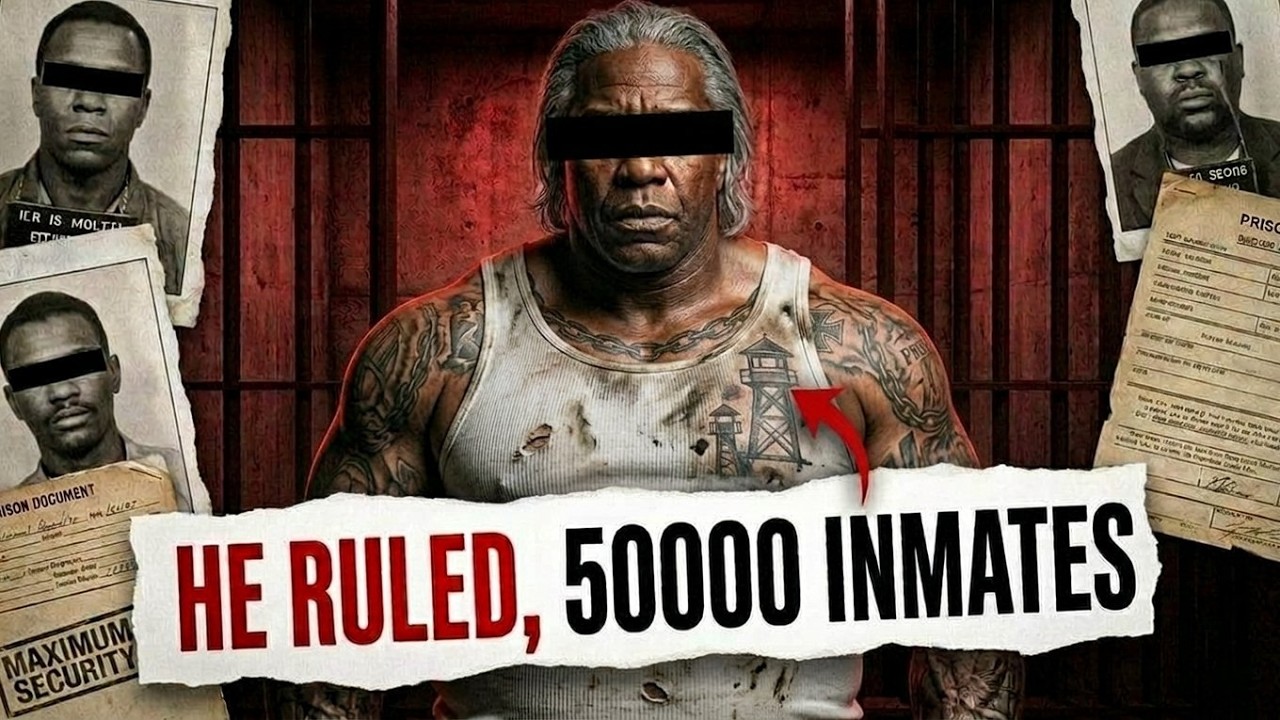
Jackson went to prison for $70. He came out as a symbol. The organization he built and the words he wrote from a cell are still shaking the system. At number one is Larry Hoover, chairman of the Gangster Disciples, an organization with an estimated 50,000 members across 35 states.
Hoover has been in prison since 1973, during the Nixon administration. He has been at ADX Florence, the most secure prison in the United States, since 1997. None of that has stopped him from running the organization. From behind bars, Hoover restructured the Gangster Disciples into what federal prosecutors called a corporate criminal enterprise, with a hierarchical command structure of governors, regents, coordinators, and enforcers.
He established rules, settled disputes, and directed operations across state lines. Federal authorities moved him from Illinois State Prison specifically because they could not stop his influence at the state level. When that failed, they moved him to ADX Florence, the facility holding terrorists, spies, and the worst of the worst. At ADX, Hoover is in solitary confinement with no contact visits, no unmonitored calls, and every piece of mail screened.
Every conversation is recorded. Still, according to federal prosecutors, his orders reach the streets. Fifty thousand soldiers, 35 states, billions in drug revenue over decades—an organization so structured it operates like a government within a government. And the man who built it has been in a cell for more than 50 years.
The world has changed completely since the last time Larry Hoover breathed free air, and his organization is still standing. That is why he is number one—not because of what he did on the streets, but because of what he did from a place designed to make him powerless. The most secure prison in America, with total isolation and 24-hour surveillance, and his words still reach every corner of the country. The system was built to contain men like Larry Hoover.
It has spent 50 years trying. And 50 years later, the chairman is still giving orders.