American field kitchens were delivering hot, freshly cooked meals to infantrymen pinned down in foxholes under enemy fire — a logistical achievement so far beyond the reach of the German Wehrmacht that its officers recorded it in combat diaries with open disbelief, according to wartime reports and military historians.
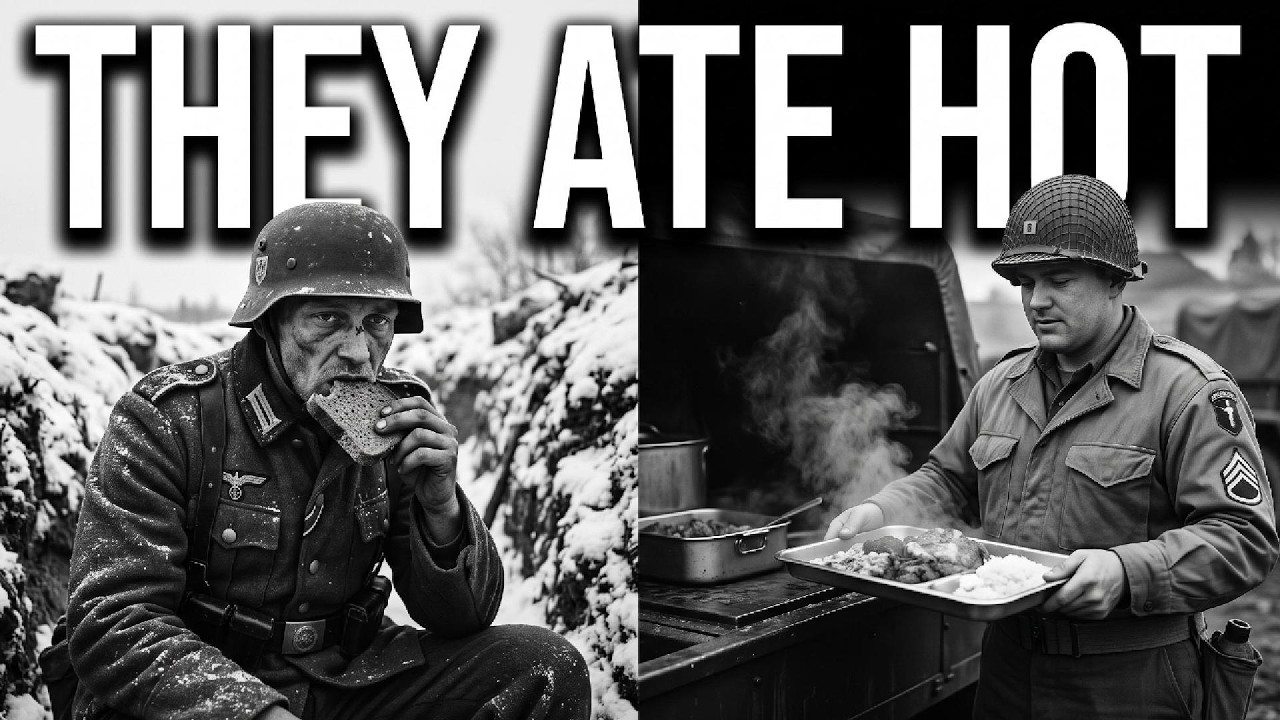
The revelation, drawn from Wehrmacht internal documents and prisoner interrogations from the fall of 1944 through the winter of the Ardennes offensive, exposes a dimension of World War II that historians say has been vastly underappreciated: the war was not only won with tanks, planes and ammunition, but with gasoline stoves, motorized company kitchens and a doctrine that treated hot calories as a weapon of war.
By late 1944, the German army that had once conquered most of Europe was a hollowed-out, exhausted shadow of its former self. Retreating across France and into the frozen forests of the Ardennes, German soldiers were cold, chronically under-supplied and, in the words of one field report, “more often than not, completely starving.”
Their food system had barely evolved since the First World War. At its center stood the Gulaschkanone — the “Goulash Cannon” — a heavy, horse-drawn wagon built around a wood-fired boiler designed to cook a thick stew for an entire company. In theory, it fed the troops.
In practice, it was a slow, vulnerable and antiquated logistical nightmare.
Because it burned wood, it required a constant, heavy supply of fuel. Because it was horse-drawn, it was painfully slow and utterly unsuited to the rapid motorized warfare Germany itself had pioneered. Most critically, it had to stop moving to cook — and by 1944, with American fighter-bombers dominating the skies over Europe, any field kitchen that halted and began emitting telltale smoke was instantly spotted and destroyed.
The result was a brutal choice for German frontline troops: eat lukewarm, hours-old stew hauled forward in insulated containers by exhausted porters, or don’t eat at all. As German lines collapsed under relentless Allied pressure, the answer was increasingly the latter.
 American soldiers, by contrast, were eating fresh meat, potatoes, vegetables and sometimes even ice cream — served hot, on the front lines, during combat. To German troops who captured American positions or interrogated U. S.
prisoners, the sight was almost incomprehensible. Wehrmacht officers noted with a mixture of disbelief and envy that the U. S.
Army appeared capable of delivering full, fresh, cooked meals directly to infantry squads dug into foxholes under fire.
The Germans were not merely being outfought. They were being outfed.
At the heart of the American system was a piece of equipment the Germans never truly understood: the M-1937 field range. Unlike the wood-fired German boiler, the M-1937 was powered by gasoline — the same 60- or 80-octane fuel that ran U. S.
jeeps and trucks. Every American supply column was already drowning in fuel, so there was no need to scout for wood or haul heavy coal.
The stove was a self-contained, air-pressurized unit that could be set up anywhere in minutes, functioning either as a baking oven or a surface burner. It provided consistent, high-intensity heat and, perhaps most importantly, it was entirely smokeless. An American field kitchen could set up a mile behind the combat zone, cook a full meal for hundreds of men, and never emit the column of smoke that would have invited a German artillery strike.
But the stove was only half the revolution. The U. S.
Army reorganized its entire food service around the company level, equipping each infantry company with its own motorized field kitchen, typically mounted on a two-and-a-half-ton “deuce and a half” truck. This created a kitchen on wheels that could move at motorized speeds, keeping pace with rapidly shifting front lines.

American cooks were trained not just as chefs but as mobile mechanics capable of repairing their stoves in the field. During intense combat, they did not wait for a lull in the fighting. They cooked meals five miles back in relative safety, then used unit jeeps to shuttle the hot food forward.
Using double-walled insulated containers, a meal could travel from truck kitchen to foxhole in under an hour.
The contrast with the German experience could hardly have been starker. By 1944, the Wehrmacht had virtually no motorized transport for logistics, relying almost entirely on horses that were dying by the thousands. For Americans to deliver hot stew, they needed a jeep and a gasoline stove.
For Germans to deliver hot stew, they needed wood, a specialized horse cart and a horse that had not already been eaten by starving troops.
Historians and Quartermaster Corps records describe the strategic impact of this disparity as profound. Food service was not merely about survival. It was a potent psychological weapon.
The Quartermaster Corps recognized that a hot, fresh meal was the single most effective way to restore the morale of an exhausted, terrified infantryman.
The U. S. Army went to extraordinary lengths to deliver comfort food to the front.
Fresh meat, white bread and especially hot coffee were prioritized over almost any other cargo except ammunition. American GIs often remarked that a hot meal was the closest thing to home they could experience in a war zone — a reminder of what they were fighting for.
 This became especially critical during the brutal conditions of the Battle of the Bulge, when American troops were surrounded, freezing and running low on supplies. The occasional delivery of a hot meal via a risky jeep run provided the psychological boost they needed to hold the line.
German morale, meanwhile, was systematically eroded by chronic starvation. Combat diaries from Wehrmacht soldiers are filled with passages detailing desperation, with men hallucinating about bread and obsessively discussing food rather than military strategy. When German soldiers finally surrendered, they were frequently in a state of physical and psychological collapse from lack of nutrition.
To them, the sight of well-fed American soldiers casually eating hot food was more demoralizing than any propaganda leaflet or artillery barrage. It proved that the American industrial system was superior — and that Germany could not win against an enemy with such an overwhelming logistical advantage.
Military analysts say the deeper explanation is that the Germans could not understand the American food system because they could not understand how America fought the war itself. The U. S.
system of food logistics was not just a collection of stoves and trucks. It was the final victory of industrial logic over antiquated military tradition.
The U. S. Army treated the delivery of hot calories exactly like the delivery of artillery shells or gasoline — as a technical, engineering and manufacturing challenge that required a high-performance, standardized solution.
By combining the gasoline technology of the M-1937 stove with a decentralized, motorized distribution network, the American Quartermaster Corps achieved what had long been considered impossible: the first truly well-fed fighting force in history.
The German Wehrmacht, built on tactical brilliance but logistical obsolescence, starved in the mud while trying to fight with the horse-drawn tools of the past. The final verdict of World War II logistics, historians say, is clear: Germany may have designed the V-2 rocket, but America built the field stove that fed the men who won the war.