
LONDON — Six children. One father determined to be feared. And not a single life that escaped intact.
The British royal family has long traded in silence, but the private record of King George V’s household reads less like a dynasty and more like a slow-motion casualty list, a story of emotional warfare waged from the head of the dinner table.
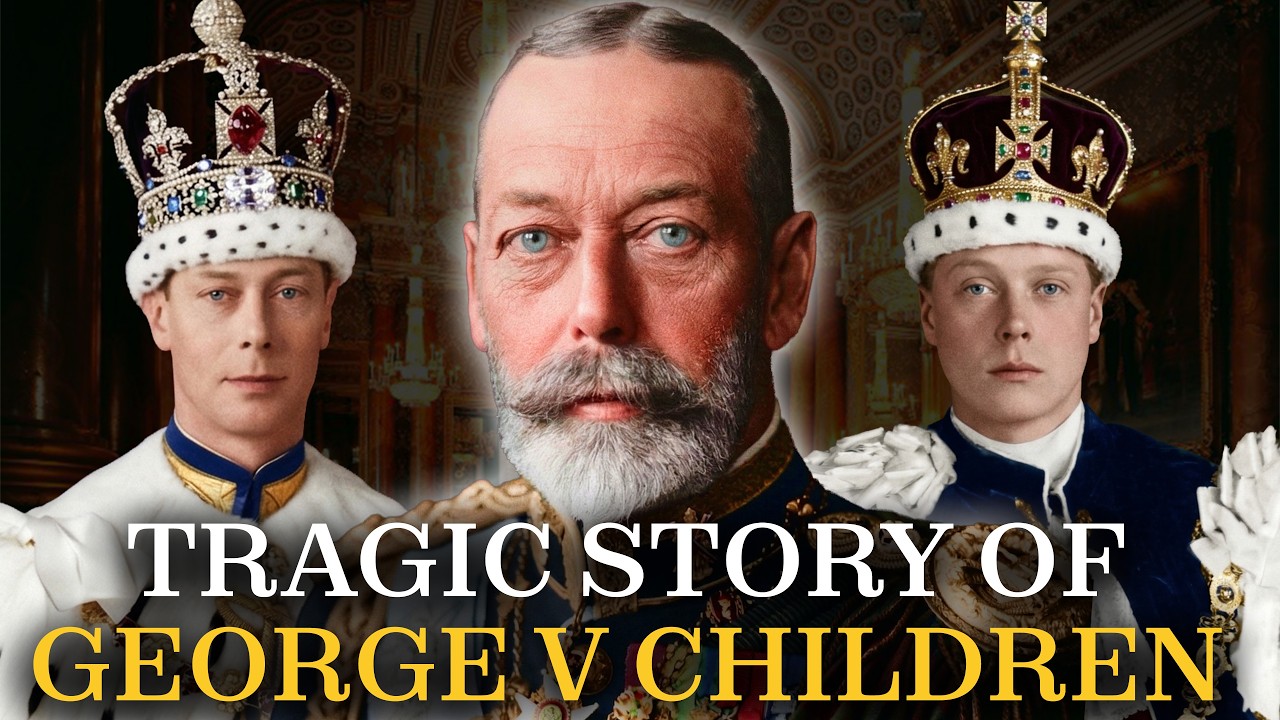 George V, who reigned from 1910 until his death in 1936, governed his family the way he had once commanded a Royal Navy ship: rigid, hierarchical, and intolerant of anything resembling weakness. The results, documented across a century of letters, diaries, and medical records, followed all six of his children to their graves.
His parenting philosophy was not a secret. He reportedly told Edward Stanley, the 17th Earl of Derby, “My father was frightened of his mother. I was frightened of my father, and I am damned well going to see to it that my children are frightened of me.”
Whether polished by retelling or not, the sentiment defined every meal, every greeting, every stiff handshake inside Buckingham Palace.
George never expected to be king. Born a second son, he was groomed for a respectable naval career while his older brother, Prince Albert Victor, known as Eddy, held the golden ticket to the throne. Then pneumonia killed Eddy in January 1892, and George’s entire existence rearranged itself overnight.
He inherited the crown trajectory, the tutors, the scrutiny — and, in a move that made total dynastic sense at the time, his dead brother’s fiancée. George married Princess Victoria Mary of Teck in 1893. Against the odds, the union worked, at least between the two of them.
They became devoted partners, bonded by duty and routine.
The trouble began when they had children. George thrived in the Navy because it rewarded everything he already was: rigid, allergic to ambiguity, and convinced that obedience outranked emotion in every circumstance. When he took the throne in 1910, he governed Britain the same way he had run a ship — quietly, conservatively, and without tolerance for dissent.
In 1917, with anti-German hatred running so hot that people were stoning dachshunds in the streets, George ditched the family name Saxe-Coburg and Gotha and replaced it with the thoroughly English “Windsor.” The Kaiser reportedly joked he planned to see a performance of “The Merry Wives of Saxe-Coburg and Gotha.” George did not laugh.
George rarely laughed at anything.
As a king, he earned grudging institutional respect — not for brilliance, but for showing up. As a father, he earned something closer to post-traumatic stress. Queen Mary did not help.
She deferred to George on every question of discipline, rarely stepping between her husband’s volcanic temper and her children’s fragile nerves. In the hierarchy of her loyalties, the crown outranked the cradle every time.
George’s health crumbled in his final years, ground down by a lifetime of heavy smoking. He died on January 20, 1936, at Sandringham — and the circumstances of that death remain genuinely wild. In 1986, fifty years later, the private diaries of Lord Dawson of Penn, the king’s physician, were unsealed.
They revealed that Dawson deliberately hastened George’s death with lethal injections of morphine and cocaine. His primary concern, documented in his own handwriting, was timing. He wanted the announcement to appear in the dignified morning edition of The Times rather than the less appropriate evening papers.
A king’s final heartbeat, calibrated to a newspaper deadline.
George left behind six children. Every single one carried scars. Edward, the firstborn, arrived in 1894 — blond, charismatic, and, behind palace doors, emotionally stunted and desperate to escape.
 George watched his eldest son’s parade of married mistresses with mounting horror. By 1935, his assessment had calcified into prophecy.
Speaking to Prime Minister Stanley Baldwin, George predicted with eerie precision, “After I am dead, the boy will ruin himself in 12 months.” George died in January 1936. Edward abdicated 11 months later, choosing Wallis Simpson over the crown.
The old man nailed it almost to the week.
The romantic version — a king sacrificing everything for love — is the story Edward sold for decades. The fuller picture is messier. In 1937, less than a year after handing the crown to his terrified brother, Edward and Wallis toured Nazi Germany, met Adolf Hitler, and were photographed giving Nazi salutes.
The Marburg files later confirmed Nazi agents viewed him as a sympathizer.
If Edward was the golden boy, Prince Albert — Bertie — was the shadow. Born in 1895, he was shy, knock-kneed, forced to write right-handed, and afflicted with a stammer so severe that every public sentence became an ordeal. George’s response might be the cruelest detail in the entire story.
When Bertie struggled to push words out, his jaw locking, his face flushing, the king would bark across the dinner table, “Get it out!” As if volume could rewire a child’s neurology. It did not.
It made everything catastrophically worse, wiring the impediment into his nervous system for life.
Then Edward abdicated, and the crown dropped onto Bertie’s head like an anvil. The night of December 1936, he went to his mother and broke down completely, sobbing on her shoulder — not from ambition, but from pure dread. He took the name George VI and hired speech therapist Lionel Logue, clawing his way toward functional speech.
Three years into his reign, World War II erupted. George VI refused to evacuate London during the Blitz. When the palace took a direct hit from a Luftwaffe bomb, Queen Elizabeth reportedly said she was glad she could now look the East End in the face.
His Christmas broadcasts, each a battle against the stammer, connected him to the public as Edward’s charm never could.
The job consumed him from the inside out. A lifelong heavy smoker, he developed arteriosclerosis, then Buerger’s disease, then lung cancer. Surgeons removed his entire left lung in September 1951.
On February 6, 1952, a valet found him dead in his bed at Sandringham. He was 56, worked to death for a job his brother discarded over a romance.
Princess Mary, born in 1897, was the only daughter — and the one child George actually liked. She shared his passion for stamp collecting, which gave her a rapport with her father none of her brothers experienced. During World War I, she trained as a VAD nurse and launched the Princess Mary Christmas Gift Fund, distributing brass gift boxes to every service member overseas.
 In 1922, she married Viscount Lascelles. For generations, the narrative painted this as a cold, loveless match. Modern evidence complicates that story.
Her eldest son wrote that his parents shared a genuinely happy, affectionate marriage. Mary lived the quietest life of any George V child, dying of a heart attack in 1965 at 67.
Prince Henry, Duke of Gloucester, arrived in 1900 as the fourth child. By most accounts the least intellectually gifted, he found his calling in the army — the physical rigor, the camaraderie, the clarity of hierarchy. He might have stayed in uniform for life if his brothers hadn’t systematically removed themselves from the royal roster.
Edward exiled himself. George died in a plane crash. Bertie was on the throne, slowly killing himself with stress.
That left Henry as the last reliable brother standing. The palace pulled him from the military career he loved and reassigned him to full-time royal duty. There was no complaint.
He simply did what he was told.
From 1945 to 1947, he served as governor-general of Australia. Then came the collapse. In 1965, he suffered the first of several devastating strokes.
By 1968, he could not walk, speak, or feed himself. He died in 1974, the last surviving child of George V — though the man his family remembered had disappeared years before.
Prince George, Duke of Kent, born in 1902, might have been the most naturally gifted of the entire family — intelligent, artistic, fluent in multiple languages, and strikingly handsome. He also radiated chaos. Through the 1920s, he tore through bohemian London, conducting affairs with both men and women, including playwright Noel Coward.
He developed serious addictions to morphine and cocaine. The intervention involved Edward literally locking George in a room at York House and forcing him through withdrawal cold turkey. He cleaned up, married Princess Marina of Greece in 1934, and became half of the royal family’s golden couple.
Three children followed.
World War II gave him purpose. He threw himself into RAF service, conducting morale-boosting inspections. On August 25, 1942, his Short Sunderland flying boat took off from Invergordon bound for Iceland.
Thirty minutes later, it slammed into a hillside near Dunbeath, Caithness, in dense fog. Fourteen of the fifteen men aboard died on impact.
George was 39 — the first child of a reigning British sovereign killed on active military duty in centuries. Conspiracy theories arrived almost before the smoke cleared, fueled by the fact that the aircraft flew significantly off course. Serious historians attribute the crash to pilot navigation error compounded by appalling weather.
 No conspiracy required.
And then there was Johnnie. Prince John, born July 12, 1905, was the sixth and final child — cheerful, mischievous, fond of animals. Around age four, he experienced his first epileptic seizure.
More followed, growing more frequent and severe. He also displayed developmental patterns that modern medicine would likely categorize as autism spectrum disorder.
By 1917, the family transferred his household permanently to Wood Farm, a modest house on the Sandringham estate, removed almost entirely from public view. His nanny, Lala Bill, accompanied him, becoming his surrogate mother in every meaningful sense. The popular narrative frames this as abandonment — a defective child hidden away.
According to modern medical historians, that framing is substantially misleading. In 1917, effective anti-epileptic medication barely existed. Standard medical advice centered on removing patients from overstimulating environments.
Wood Farm offered quiet, routine, and the low-stimulus calm that leading neurological thinking of the era believed gave epileptic patients their best chance.
John died in his sleep on January 18, 1919, following a severe seizure. He was 13. Queen Mary wrote afterward with unmistakable tenderness, “For him it is a great release, as his malady was becoming worse as he grew older.
But we shall miss the dear child.” He was buried quietly at Sandringham.
So what do you do with a story like this? Six children raised by a terrifying father and an emotionally absent mother, and not a single happy ending among them. Edward died in Parisian exile in 1972, the stain of Nazi sympathies never washed off.
Bertie let the crown crush the life out of him by 56.
Mary disappeared into Yorkshire and a quiet marriage history barely registered. Henry lost his career, then his body, to a decade of strokes. George burned the brightest and died the youngest, at 39, on a fog-covered Scottish hillside.
And John never grew up at all, buried at 13 in a farmhouse his family had tucked him out of sight.
George V and Queen Mary produced six human beings and raised them inside a system designed from its foundations to manufacture monarchs rather than functional people. The discipline, the emotional withholding, the absolute prioritization of duty over tenderness — every element accomplished exactly what George intended. And it broke every single one of them in different ways.
The Windsors survived. The monarchy endured. Elizabeth II sat on the throne for 70 years and became the most admired British monarch since Victoria.
The machine worked exactly as designed, grinding up one generation and producing the next. But six children paid the bill for that machine’s operation. And not one of them chose to.