On the night of March 22, 1945, a telephone rang in a Luxembourg command post. George S. Patton picked it up and delivered a report with the calm of a man describing routine business.
"Ike, quick update. We crossed the Rhine tonight. Assault boats, minimal casualties. Thought you'd want to know."
On the other end, Dwight Eisenhower went silent. What Patton had just done in the dark — with no air support, no massive artillery preparation, and no weeks of planning — was supposed to be impossible.
The Rhine was Hitler's last natural fortress. It stretched 820 miles through Western Europe, with fast currents, steep banks, and every bridge demolished by retreating German engineers. Any army wanting to reach Berlin from the west had to solve the Rhine problem first.
The Germans had stopped Napoleon at the Rhine. They had stopped armies there for centuries. In the winter of 1945, they were betting everything that they could hold the Allies long enough to buy time.
Field Marshal Gerd von Rundstedt had positioned his remaining forces to punish any crossing attempt. Artillery was zeroed in on every viable crossing point. Demolition teams stood ready on every bridge.
For the Allies, crossing the Rhine was not just a military objective. It was the objective. Every supply line and strategic argument in early 1945 came back to the same question: who crosses, when, and how?
As of January 1945, the answer had been decided at the highest levels. Bernard Law Montgomery would cross the Rhine. His Operation Plunder would be the centerpiece of Allied victory in Europe.
It would be the largest river crossing since Normandy, involving British, Canadian, and American forces with full air support, massive artillery preparation, and an airborne operation of staggering scale.
Churchill had personally assured Montgomery of this. At a private meeting on January 12, 1945, he told his favorite general that Operation Plunder would be remembered as the defining moment of the European campaign. Not American improvisation, but British precision, British planning, British glory.
Montgomery took Churchill at his word. He spent 63 days preparing. Smoke screens, artillery barrages, airborne drops, supply stockpiles positioned with mathematical precision. War correspondents were invited. Photographers were arranged. Churchill planned to be present to witness the moment British forces broke through Hitler's last barrier.
Churchill had even written the celebratory communique in advance. It was sitting in his briefcase on the morning of March 23rd when his radio crackled with four words that stopped his heart.
"Patton crossed last night."
To understand the man who caused this crisis, you have to go back much further than March 1945. George Smith Patton Jr. was born on November 11, 1885, in San Gabriel, California, into a family with a military tradition stretching back to the American Revolution.
His grandfather had been a Confederate colonel killed in the Civil War. His great uncle had served under Stonewall Jackson. Military blood ran so deep that young George grew up believing war was not just a profession but a calling.
He was dyslexic at a time when no one knew what dyslexia was. School was agony. Reading was a physical struggle. But put Patton on a horse, give him a saber, let him move, and something entirely different emerged — an almost instinctive understanding of terrain and movement that no classroom could teach.
He attended West Point, struggled academically, had to repeat a year, and graduated in 1909. He immediately began building a reputation as the most aggressive, most unconventional, most infuriating officer the American army had ever attempted to manage.
He competed in the modern pentathlon at the 1912 Stockholm Olympics. He redesigned the army's cavalry saber. He served under Pershing hunting Pancho Villa in Mexico.
When World War I arrived, Patton was among the first Americans to embrace the tank as a weapon, training the first American tank crews and leading them into battle at Saint Mihiel in 1918.
The lesson he took from that war never left him. Speed kills the enemy's ability to think. An army moving fast enough doesn't give the enemy time to react, dig in, regroup, or plan. Speed was not just a tactical advantage. Speed was the strategy.
By 1944, commanding the Third Army in France, Patton had turned this philosophy into something approaching military art. While other commanders consolidated gains and waited for supply lines, Patton drove forward.
His armored columns moved so fast that German commanders repeatedly reported American forces in positions that seemed physically impossible given the time elapsed.
General Alfred Jodl, Hitler's Chief of Operations Staff, reportedly told colleagues that fighting Patton was like fighting a different war than fighting other American generals. "The others we understand," Jodl said. "Patton, we cannot predict."
In December 1944, when the German offensive in the Ardennes threatened to shatter the Allied line, it was Patton who performed the military miracle that stabilized the front. He pivoted the entire Third Army 90 degrees north in 72 hours during the worst winter in European living memory and drove through to Bastogne before the 101st Airborne collapsed.
Military historians still argue about whether that maneuver was even theoretically possible. Patton did it anyway.
Churchill recorded his reaction in his diary that December with four words that said everything: "Patton does in days what takes us weeks."
By March 1945, Patton's Third Army had fought across France, through the Ardennes, through the Siegfried Line, and into Germany itself. They had reached the Rhine at Oppenheim, a town south of Mainz, downstream from where Montgomery was preparing his massive assault.
Patton looked at the river and asked one question. Not "How do we plan this?" Not "When does Montgomery cross?" Not "What does Eisenhower authorize?" He asked, "Where are the boats?"
His engineers had assault boats. Not many. Not the armada Montgomery had assembled. Just enough small craft to move infantry across in waves. No elaborate preparation. No smoke screens. No airborne drops. No weeks of planning.
At 11:00 p.m. on March 22, 1945, in complete darkness with German forces on the opposite bank, Patton's infantry began climbing into boats.
The crossing was not elegant. It had no air support, no massive artillery preparation, no photographers, no journalists, no welcoming committee from Supreme Headquarters. What it had was silence, darkness, and soldiers paddling quietly across Hitler's last natural barrier.
The Germans on the eastern bank were not expecting a crossing at Oppenheim. All their calculations pointed to Montgomery's sector. All their reinforcements, all their concentrated artillery, all their attention was focused north, where the massive British preparations were impossible to miss.
Oppenheim was quiet, secondary, ignored. By the time German commanders understood what was happening, Patton's infantry had established a bridgehead on the eastern bank. By midnight, engineers were constructing a pontoon bridge. By 3:00 a.m., American tanks were crossing into Germany.
Casualties were under 30 men. In one night, without permission, without coordination, with nothing except infantry, boats, and an absolute refusal to wait, George Patton had solved the Rhine.
He called Eisenhower at 10:37 p.m. as the operation was still unfolding, with the casual confidence of a man reporting something entirely routine.
Eisenhower's response was captured in the SHAEF telephone log. "George, please tell me you coordinated this with Montgomery."
Patton's reply was pure Patton. "Monty's got his own crossing tomorrow. Didn't want to bother him with details."
Eisenhower hung up and immediately called his chief of staff. "Get me Churchill. George just created the biggest diplomatic crisis of the war."
He was not wrong.
At 6:18 a.m. on March 23, 1945, Montgomery received confirmation that American forces had crossed the Rhine 12 hours before Operation Plunder was scheduled to begin.
Staff officers present that morning later reported that Montgomery did not shout. He did not rage. He went cold — the kind of cold that is more alarming than fury because it suggests a man processing something that has shaken him to his foundations.
Montgomery told his assembled staff, referring to Patton in the third person, as though direct acknowledgement was beneath him: "This is insubordination at the strategic level. I want him relieved, court-martialed, and sent home today."
His chief of staff attempted to moderate the response. "Sir, the crossing was successful. Third Army is expanding the bridgehead."
Montgomery's reply became immediately famous among British staff officers who witnessed it. "Success is irrelevant. Discipline is paramount. If Patton is allowed to ignore command authority, we have chaos, not coalition."
He sat down and drafted an immediate message to Churchill, requesting that Eisenhower relieve Patton immediately.
Churchill received Montgomery's message at 9:15 a.m., minutes before his aircraft was scheduled to land on a German airfield to witness Operation Plunder's triumphant beginning.
His military secretary watched Churchill read the message three times. Then Churchill looked out the aircraft window at Germany passing beneath them and asked a single question. "Ismay, what are the facts?"
The facts were simple. Patton crossed at Oppenheim last night. Casualties under 30. Bridgehead secured. He did it without elaborate preparation, without Montgomery's permission, without anyone's permission.
Montgomery was waiting on the tarmac when Churchill's aircraft landed at 10:52. Ramrod straight, face rigid — the expression of a man who has been wronged and intends to ensure everyone in authority understands exactly how wronged he has been.
Churchill descended the stairs. Montgomery saluted. "Prime Minister, thank you for coming to witness Operation Plunder."
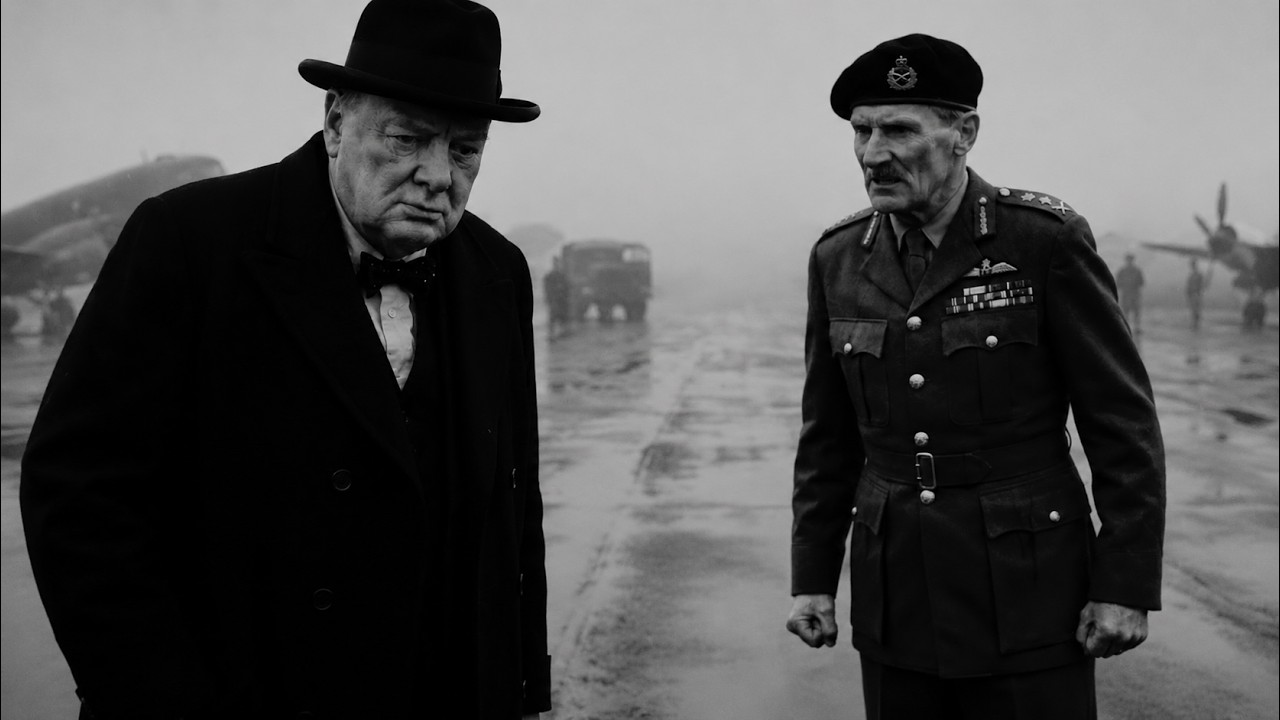
Churchill's reply was carefully, precisely neutral. "Field Marshal, I received your message. Walk with me."
They moved away from the assembled staff officers, away from the photographers, away from the journalists who had been invited to record British glory.
Montgomery began the moment they were clear of the crowd. "Prime Minister, I must insist Patton be relieved. His insubordination cannot stand."
Churchill raised one hand, deliberately. "Montgomery, I need you to answer one question with complete honesty. If Patton had asked permission to cross at Oppenheim last night, what would you have said?"
Montgomery did not hesitate. "I would have denied it. His crossing diverts attention from the main effort."
"Your main effort," Churchill said quietly. "The Allied main effort as agreed upon by planners. As agreed upon by planners who gave you two months and gave Patton nothing."
He continued. "Bernard, is this about strategy or pride?"
Montgomery's face flushed. "Prime Minister, it is about maintaining command discipline. If one general can simply ignore the strategic framework whenever he judges the moment convenient, we no longer have a coalition. We have anarchy."
Churchill looked at him for a long moment. The sound of artillery was already beginning in the distance. Operation Plunder had started. Montgomery's thousand guns were firing. His airborne troops were dropping. His million men were beginning the meticulously prepared crossing that was supposed to define this campaign.
"But it was no longer the first crossing, Bernard," Churchill said. "I've defended your methods for three years. Careful preparation, overwhelming force, minimal casualties. It's the British way, and it has saved thousands of lives. But watching Patton cross the Rhine with boats while you needed two months to plan the same operation forces me to ask uncomfortable questions."
"If you are suggesting that American methods are superior—"
"I am suggesting that American speed achieves results we can no longer match."
The words landed like artillery. Montgomery said nothing.
Churchill turned to face him directly. "The war is ending, Bernard. Germany is collapsing. Every day we spend in careful preparation is a day the Soviets advance further west. Patton understands this. He crossed not because he was reckless. He crossed because he calculated that the cost of waiting was higher than the cost of moving, and he was right."
"So you are choosing him over me?"
Churchill shook his head slowly. "I am choosing to win this war before the Soviets claim all of Europe. That requires speed we no longer possess."
Churchill returned to his aircraft. He did not watch Operation Plunder's crossing. He sat in complete silence for 20 minutes while his military secretary waited. Then he asked for dictation.
The message went to Eisenhower directly. Churchill read it aloud in a voice his secretary later described as completely flat, emptied of emotion — the voice of a man who has made a decision he knows is correct and finds it painful anyway.
"General, I have received Field Marshal Montgomery's request that General Patton be relieved for unauthorized Rhine crossing. After careful consideration, I must decline to support this request. General Patton's operation, while uncoordinated, was successful and contributes to Allied objectives. I recommend no action be taken."
He paused for almost 30 seconds. Then he added a handwritten postscript that was not part of the official dictation. His secretary copied it anyway. "Ike, keep Patton moving. We cannot afford to match his speed, but we cannot afford to lose it either."
Eisenhower received that message at 2:15 p.m. on March 23rd. He read it twice, put it in his briefcase, and immediately called his chief of staff. The answer to Montgomery's demand was now official Allied policy.
Patton would face no consequences. The crossing stood. The bridgehead stood. Third Army would continue advancing.
Montgomery was informed through official channels. He sent no reply. Their relationship, professionally tense for years but never personally broken, crossed a line that afternoon from which it never returned.
British military leadership was furious. The Chiefs of Staff sent a formal protest to Churchill, noting that failure to discipline Patton undermined all command authority throughout the coalition.
Churchill's response was characteristically blunt. "Would you prefer I demand his relief and watch the Americans ignore me? That outcome would undermine British authority far more effectively than this quiet acceptance."
No further formal protest was submitted, but the damage was real. Three senior British generals requested transfers away from Montgomery's command within the following week. Staff officers who had spent months preparing Operation Plunder now found themselves processing the humiliation of being the second crossing, not the first.
Military historians would later note that Operation Plunder was by every objective measure a brilliant success. 130,000 men crossed the Rhine in the first 24 hours. Casualties were remarkably low given the scale. The planning was genuinely masterful.
None of that mattered in March 1945 because Patton had crossed first with boats in one night.
That evening, Churchill met privately with Lord Moran, his personal physician. Moran's diary entry from March 23, 1945, is one of the most remarkable documents to emerge from the war's personal archives — not because of its military analysis, but because of its raw honesty.
Churchill poured himself a whiskey. Moran recorded that the Prime Minister looked exhausted in a way that went beyond physical tiredness. Something else was present — something Moran, who had known Churchill since 1940 and had watched him through the worst days of the Blitz, had rarely seen before.
"I've just chosen American results over British pride," Churchill said. "Montgomery will never forgive me. The military establishment will be furious. But watching Patton cross that river while we prepared our elaborate show made me realize something terrible."
He paused. "We are no longer the leading military power in this alliance. We haven't been for quite some time. I've just been too proud to admit it."
Moran asked if Churchill regretted the decision.
"Not for a second," Churchill said immediately. "Pride doesn't win wars, speed does. Patton understands that. Montgomery doesn't. And if I have to choose between a general who protects British prestige and a general who ends this war faster, I choose the one who brings our boys home."
He refilled his glass. "Bernard demanded Patton be fired for insubordination. And he is right. Patton ignored command structure. He violated protocol. In any properly run military, he would face consequences. But here is what Bernard does not understand. We are not running a properly run military. We are running a coalition of competing national interests where the side with the most resources makes the rules."
Moran wrote the next sentence verbatim in his diary, underlining it twice: "And that side is no longer Britain."
Churchill stared at his glass for a long moment before continuing. "I spent this entire war pretending we were equal partners with the Americans. Today, I admitted the truth. They are the senior partner now. They provide the majority of men, material, and leadership. Patton crossed first because American military doctrine has surpassed ours. Not in training, not in bravery, but in the willingness to move faster than caution recommends. That is the future of warfare, and we are no longer leading it."
Moran closed his diary that night and wrote one final observation of his own, separate from Churchill's words. The Prime Minister did not seem broken by this admission. He seemed in some strange way relieved, as though he had been carrying the weight of a pretense for years and had finally been permitted to set it down.
Patton learned that Churchill had declined Montgomery's request through Eisenhower's staff. He recorded his reaction in his personal diary on March 24, 1945. The entry was brief, three sentences: "The British finally understand this is our war now. We will finish it our way, moving at dawn."
He was across the Rhine by daylight.
In volume six of his war memoirs, Churchill devoted an entire chapter to the Rhine crossings. He wrote that Patton's assault at Oppenheim demonstrated that modern warfare rewards speed over preparation, and that the contrast between Montgomery's operation and Patton's improvised assault was instructive. He chose the word "instructive" carefully. It was honest without being cruel.
In a private letter to Eisenhower in 1953, Churchill was more direct. "You asked me once if I regretted not supporting Montgomery's demand to fire Patton. The answer is no. Patton won the race to the Rhine. He helped end the war faster. He saved lives by moving so quickly the Germans could not organize coherent defense. Was he insubordinate? Absolutely. Was he necessary? More than I wanted to admit."
The Rhine crossing of March 1945 is remembered in military history primarily as two events: Montgomery's Operation Plunder, massive and triumphant, and Patton's improvised assault at Oppenheim first. History has a way of remembering firsts.
But the story that rarely gets told in full is the conversation on a German airfield between two men who had defined British military strategy for three years, and the moment when one of them told the truth neither of them wanted to hear.
Britain had been the greatest military power on Earth. It had built the largest empire in human history. Its military doctrine, its officers, its traditions had shaped warfare for centuries. And on March 23, 1945, standing on an airfield in Germany, listening to artillery begin in the distance, Winston Churchill looked at his finest general and acknowledged what both of them already knew. They were no longer setting the standard. They were trying to keep pace.
What Patton did after crossing the Rhine would force decisions at the highest levels of Allied command that shaped not just the end of the war, but the entire post-war order of Europe.
On March 25, 1945, two days after Patton crossed the Rhine, Soviet forces stood 38 miles from Berlin. American forces stood 285 miles away. The mathematics of that gap seemed to answer the question before anyone asked it. But Patton looked at those numbers and saw a race that could still be won.
The German High Command received confirmation of Patton's Rhine crossing at approximately 4:00 a.m. on March 23rd. General Alfred Jodl convened an emergency staff meeting at 6:15 that morning. The meeting lasted 40 minutes.
The minutes from that session, captured after Germany's surrender, revealed the precise moment German strategic planning collapsed under the weight of a single question none of them could answer: How was Patton already across?
They had calculated that the Rhine would hold for weeks. Their defensive resources, their remaining armor, their artillery concentrations, had all been positioned with one assumption baked into every plan — that Montgomery's crossing at Wesel would be the main effort, massive and slow, giving German forces time to respond and contest the eastern bank.

Patton had invalidated that assumption in one night.
Jodl ordered an immediate counter-thrust against the Oppenheim bridgehead before it could be reinforced. He had three divisions available within striking distance. Those three divisions never arrived in coordinated form.
Patton's armored columns were already moving faster than German staff officers could process information and issue orders. By the time Jodl's counter-thrust was supposed to hit the Oppenheim bridgehead, Third Army had expanded that bridgehead to a depth of 12 miles, and Patton had two armored divisions fully across the river.
German Seventh Army reported to OKW on March 24th that American armored forces were advancing at a rate that made defensive positioning impossible. Every time a defensive line was established, American tanks were already behind it.
Seventh Army's casualty rate in the 48 hours following Patton's crossing was 340 percent higher than its average rate for the preceding two weeks. Prisoners taken during this period were not being captured because their units were overrun. They were surrendering because their units had ceased to function as military organizations.
Jodl told Hitler on the evening of March 24th that Third Army represented a different category of problem than any other Allied force they faced. "The others advance and we adjust," he reportedly said. "Against Patton, we adjust and he is already moved again."
But the Germans were not the only ones creating complications. Back at Supreme Headquarters, Allied Expeditionary Force, a different kind of crisis was developing, and it had nothing to do with the enemy.
Eisenhower had a decision to make that he had been avoiding since January: Berlin.
The Soviet Union was driving toward the German capital from the east. The Western Allies were now across the Rhine and driving from the west. The question of who would reach Berlin first — and whether the Western Allies should even attempt it — had become the defining strategic argument of the final phase of the European war.
Churchill wanted Berlin. His reasoning was not military. It was political. Whoever took Berlin would shape the post-war order in Europe. Whoever reached the German capital first would negotiate from a position of strength in every subsequent conversation about the continent's future.
Churchill had written to Roosevelt in early 1945 arguing that racing the Soviets to Berlin was not just strategically desirable. It was essential.
Roosevelt disagreed — or rather, Roosevelt was dying, increasingly unable to engage with the strategic complexity of the argument, and his advisers disagreed on his behalf.
American military planners at SHAEF, led by Eisenhower's chief of staff Walter Bedell Smith, argued that Berlin had no military value worth the estimated 100,000 American casualties that taking the city would cost. The war was already won. Why spend American lives on a political symbol when the Soviets were willing to bleed for it themselves?
Eisenhower sided with his planners. On March 28, 1945, he sent a message directly to Soviet Marshal Georgy Zhukov, bypassing both Churchill and the Combined Chiefs of Staff, informing the Soviets that Allied forces would halt their eastward advance along the Elbe River and leave Berlin to the Red Army.
Patton received word of this decision on March 29th. His reaction was recorded by his aide-de-camp, Major Alexander Stiller, who was present when Patton read Eisenhower's directive.
Patton read it twice, set it down on the map table, looked at the position markers showing his armored columns advancing at rates that were breaking every previous record for armored warfare in the European theater. Then he looked up at Stiller.
"We're being stopped," he said. "Not by the Germans, by Ike."
He was not wrong, but the directive was not immediate. Third Army still had objectives. There was still fighting to be done. And the fighting that happened in the first two weeks of April 1945 produced some of the most remarkable military statistics of the entire European campaign.
On April 4, 1945, Third Army's 4th Armored Division overran a forced labor camp attached to the Buchenwald concentration camp complex at Ohrdruf, Germany. It was the first Nazi concentration camp liberated by American forces.
The lead elements entered the camp without knowing what they would find. What they found stopped the advance for four hours while commanders tried to process what they were looking at and determine what medical and logistical response was even possible.
Patton was called forward. He arrived at Ohrdruf on April 12th, the same day Franklin Roosevelt died in Warm Springs, Georgia. He walked through the camp with Eisenhower and Omar Bradley. He was physically sick outside one of the buildings. He ordered every American soldier in the vicinity to be brought through the camp, insisting that they understand what they were fighting against and what their speed had helped end.
But it was one week earlier, April 6th through April 8th, that Patton's forces produced the single most militarily significant achievement of Third Army's final campaign: the Kassel Pocket.
German Army Group B, retreating before Montgomery's forces in the north and caught between multiple Allied advances, attempted to establish a defensive perimeter around the city of Kassel in central Germany. The German commander, General Walter Model, believed Kassel could be held long enough to allow organized withdrawal of his remaining forces eastward.
Patton saw the Kassel position on his maps and understood it differently. He did not see a defensive strongpoint. He saw a closing trap.
Third Army's 12th Corps, commanded by General Manton Eddy, executed a double envelopment around Kassel that Model's staff did not detect until American armored columns were already meeting on the eastern side of the city, completing the encirclement.
The operation took 48 hours. It moved faster than German radio communications could track it. Units that were supposed to be blocking American advances were themselves being bypassed and surrounded.
When the Kassel Pocket closed on April 8th, German Army Group B ceased to exist as a coherent military formation. 80,000 German soldiers were taken prisoner in 72 hours.
Model, unable to accept the reality of what had happened to his command, walked into a forest on April 21st and shot himself. He left a note stating that a field marshal does not surrender.
Third Army's casualties in the Kassel operation were 411 men. German casualties and prisoners numbered 80,000. The ratio was staggering even by the standards of a collapsing army.
What made Kassel possible was not American firepower superiority, though that was real. It was not German demoralization, though that was also real. It was speed. Third Army moved faster than German command and control could function. By the time German commanders understood what was happening, the decision had already been made for them.
Patton's diary entry for April 8th was three sentences: "Closed the pocket at Kassel. 80,000 prisoners in three days. Speed is a weapon."
The news from Kassel spread through Allied command within hours. Omar Bradley called it the most efficient large-scale encirclement operation of the entire European campaign. Montgomery, when briefed on the numbers, reportedly said nothing and left the room.
Churchill received the report in London and wrote one line in his diary that evening: "Patton does not stop." He did not mean it as criticism.
By mid-April 1945, Third Army's advance had fundamentally changed what was possible in the final weeks of the European war. German forces that might have conducted organized resistance were instead focused entirely on getting west of the advancing American columns, preferring American captivity to Soviet capture.
Entire German divisions were surrendering to Third Army, not because they were militarily defeated, but because Patton was in the right place moving fast enough to be the first Allied force they encountered.
The effect on German command decisions was systematic and measurable. German Seventh Army's effective combat strength, measured by OKW's own records, fell from 67 percent on March 22nd to 11 percent by April 15th.
Army Group G reported to Berlin that it could no longer establish or maintain any defensive position in Third Army's zone of advance because American armored columns arrived faster than German defensive preparations could be completed. The Reich was not just losing. It was dissolving.
Eisenhower's directive holding American forces at the Elbe came into full effect on April 15th. Patton's forces halted. They were 75 miles from Berlin. The Soviets were still 40 miles from the city on the eastern side.
The race that Churchill had wanted to win, the race that Patton was positioned to run, ended on a line drawn on a map by a supreme commander who had decided the political cost was too high.
Patton requested permission to continue. Twice. In writing. Both requests were denied. He wrote in his diary that night: "We could have been in Berlin. We could have been in Prague. We could have shaped what comes next. Instead, we stop here and hand the future to people who will use it against us for 50 years."
He was not entirely wrong about that, either.
On May 8, 1945, Germany surrendered unconditionally. The war in Europe was over. Third Army had advanced further, faster, and with fewer casualties relative to objectives achieved than any other Allied formation in the European theater.
From the Rhine crossing at Oppenheim on March 22nd to the halt at the Elbe on April 15th, Patton's forces had advanced 390 miles in 24 days, taken 600,000 prisoners, and shattered three German armies. All of it traced back to a phone call on March 22nd and four words: "We crossed last night."
Germany surrendered on May 8, 1945. The celebrations in London, Paris, and New York lasted for days. Crowds filled the streets. Church bells rang across England. In cities that had spent six years under blackout curtains, lights blazed through the night for the first time since the war began.
George Patton did not celebrate. He was given command of the occupation forces in Bavaria, a role that required the precise opposite of every skill that had made him extraordinary. Instead of speed, he needed patience. Instead of aggressive advance, he needed careful administration.
He was catastrophically unsuited for it.
In September 1945, Patton gave a press conference in which he compared the Nazi party to the Democratic and Republican parties in America, suggesting that former Nazi members might be useful in administering the occupation zone because they were the people who knew how things worked.
The comment was either politically naive or deliberately provocative, and the result was the same either way. Eisenhower relieved him of command of Third Army on October 2, 1945. It was the second time in the war that Patton had been removed from command.
The first time, in Sicily in 1943 after the slapping incident, he had fought his way back. This time, the war was over. There was nothing to fight back toward.
He was given command of the 15th Army, a paper formation with no troops whose primary mission was writing the official history of the European campaign. Patton, the man who had crossed the Rhine with boats in the dark, was now assigned to write about what other people had done.

He described this assignment to his wife, Beatrice, in a letter dated October 9, 1945. He wrote that he felt like a man who had spent his entire life preparing for a single race, had run that race better than anyone in the field, and had then been handed a pencil and told to describe the experience for posterity.
He was 60 years old. He was in excellent health. He had plans to retire to his farm in Massachusetts, write his memoirs, and perhaps enter politics. He told multiple colleagues in November 1945 that he intended to return to the United States in December and begin the next chapter of his life.
On December 9, 1945, near Mannheim, Germany, the staff car carrying Patton was struck by an American Army truck that pulled suddenly from a side road. It was a low-speed collision. Everyone else in the vehicles walked away without serious injury.
Patton, sitting in the backseat, suffered a fracture of the third cervical vertebra. He was paralyzed from the neck down. He died in a Heidelberg hospital on December 21, 1945, 12 days after the accident. He never made it home.
Beatrice Patton received his body at the dock in Boston. She buried him not in Massachusetts as he had planned, but in Luxembourg alongside the men of Third Army who had died in the Battle of the Bulge. She said he would have wanted it that way. She was probably right.
The men who had opposed him, dismissed him, and attempted to have him removed from command lived long lives in comfortable circumstances.
Montgomery received a Viscountcy, wrote self-justifying memoirs, and spent decades arguing that his methods had been correct and that the war would have ended sooner if his strategic vision had been implemented.
Eisenhower became president of the United States, serving two terms. He rarely spoke publicly about Patton with anything approaching full honesty.
Churchill lost the 1945 general election, three months after Germany's surrender, removed from office by a British public that wanted change more than it wanted the man who had delivered victory. He spent the following years writing his war memoirs, which are masterpieces of self-presentation and selectively honest about almost everything.
The private admission he made to Lord Moran on the German airfield — the one about Britain no longer leading the alliance — never appeared in those memoirs. It appeared only in Moran's diary, published in 1966. Churchill was furious. He considered legal action. He did not pursue it.
But the legacy that matters most in this story is not the legacy of the men who survived. It is the legacy of what Patton proved.
The doctrine of operational speed that Patton demonstrated in his final campaign did not die with him in a Heidelberg hospital in December 1945. It was studied, debated, argued over, and ultimately absorbed into American military thinking at a level so fundamental that its origins became almost invisible.
The concept is now called maneuver warfare. Its central principle is exactly what Patton practiced from France to Germany: that the goal of military action is not to destroy the enemy's forces, but to destroy the enemy's ability to make decisions.
Move faster than the enemy can process information. Get inside their decision cycle. Create situations that change faster than they can respond to them. Make their plans obsolete before they can execute them.
General Alfred Jodl described fighting Patton as fighting a different war. Military theorists after the war turned that description into doctrine.
The Boyd cycle, developed by Air Force Colonel John Boyd in the 1970s, formalized exactly what Patton had practiced intuitively: Observe. Orient. Decide. Act. Do it faster than the enemy. Repeat. The side that completes this cycle faster wins. Boyd studied Patton's campaigns extensively, and his OODA Loop framework is in significant part a theoretical formalization of what Third Army did between March and April 1945.
The 1991 Gulf War provided the most direct modern demonstration of what Patton had proved in Germany. General Norman Schwarzkopf's famous left hook through the Iraqi desert, the armored envelopment that destroyed Iraqi forces in Kuwait in 100 hours, was executed on principles that trace directly to Third Army's Rhine campaign.
The Iraqi army had 43 divisions in the theater. They were destroyed not primarily by firepower, but by speed. By the time Iraqi commanders understood what was happening to them, American and coalition forces were already closing the encirclement. It was Kassel in the desert, 46 years later, at a larger scale. Schwarzkopf knew this. He said so publicly.
The influence spread further than warfare. Business schools began teaching Patton's campaigns in the 1980s as case studies in competitive strategy. Companies that could process information and make decisions faster than their competitors gained advantages that were difficult to overcome regardless of resource disparities.
But the lesson that Patton's story carries most powerfully is not the tactical lesson, or the strategic lesson, or the business lesson. It is the institutional lesson.
Consider what almost happened. Montgomery's demand to have Patton fired was a legitimate request under the command structure of the Allied Coalition. Patton had violated orders. He had conducted an unauthorized operation. He had ignored coordination requirements that existed for real and important reasons.
In any properly functioning military hierarchy, the response to what Patton did would have been consequences. Churchill chose not to impose those consequences, not because he approved of insubordination — he said explicitly that he did not. He chose it because the honest assessment of results forced him to a conclusion that pride made painful.
Institutions resist exactly the kind of disruption that Patton represented, because institutions are built on standardization, predictability, and control. They establish procedures because procedures produce consistent outcomes. They create command structures because command structures prevent chaos.
Every bureaucratic rule that Patton violated existed for a reason, and every one of those rules, correctly applied in his case, would have produced a slower outcome.
The history of the Second World War is filled with innovations that faced exactly this resistance. Radar was initially dismissed by senior British military officials who believed existing observation methods were sufficient. The proximity fuse faced years of institutional skepticism. The Jeep was considered an unnecessary complication by officers who had spent careers on horseback.
In each case, the innovation eventually won. In each case, the winning required someone willing to push past the institutional gravity that makes established systems comfortable and new approaches threatening.
Patton was not an innovator in the technical sense. He did not invent a weapon or design a system. What he innovated was the willingness to act on conclusions that others had reached but were unwilling to implement, because the risk of being wrong was too visible and the reward for being right was too uncertain.
That is perhaps the most replicable lesson from this entire story. Not the military tactics, not the political maneuvering, but the simple uncomfortable fact that knowing the right answer and acting on the right answer are separated by a gap that most people, most institutions, and most systems are not designed to cross.
Patton crossed that gap the way he crossed the Rhine. At night, with boats, without asking permission.
When Lord Moran's diary was published in 1966, the passage about Churchill's admission on the German airfield caused enormous controversy in Britain. Churchill's family protested. His official biographers objected. The political establishment that had built its post-war identity on Churchill's wartime leadership found the admission troubling.
What almost no one noted at the time was a separate document that had been declassified three years earlier, in 1963, as part of a routine review of wartime SHAEF records. It was the complete SHAEF telephone log from March 22nd to March 24th, 1945 — the log that captured Eisenhower's response to Patton's Rhine crossing call.
The log contained one entry that had never been publicly reported. At 11:52 p.m. on March 22nd, 15 minutes after Patton's call to Eisenhower, Eisenhower placed a second call. Not to Churchill, not to his chief of staff. To Omar Bradley. The log records only the outgoing number and the duration: four minutes and 17 seconds.
Bradley's own memoirs, published in 1951, contain a brief reference to a late-night call from Eisenhower on March 22nd. Bradley writes that Eisenhower told him about Patton's crossing and asked a single question: "Brad, should I stop him?"
Bradley's recorded answer was two words: "God, no."
That exchange, four minutes and 17 seconds in the middle of the night, may have been the most consequential conversation of the final phase of the European war.
Because if Bradley had said yes, if he had told Eisenhower that Patton's unauthorized crossing created problems that outweighed its benefits, the institutional logic would have been on his side. The directive to halt could have been issued before the bridgehead was fully established.
Third Army's advance might have been delayed or redirected. The Kassel Pocket might not have closed the way it closed. 600,000 prisoners might have been 200,000. The timeline of Germany's collapse might have extended by weeks.
How many lives those additional weeks would have cost is a calculation that cannot be made with certainty. But the estimates from military historians who have examined the question range from 30,000 to 80,000 additional casualties across all Allied forces. All of it resting on two words from Omar Bradley at midnight.
From a March night in Luxembourg where a general made a phone call, to a German airfield where a prime minister admitted the truth he had been avoiding, to a Heidelberg hospital where the same general died before he could come home, this story covers nine months and contains within it the entire shape of how the modern world was made.
Patton, Montgomery, Churchill, Eisenhower. Four men. Four completely different understandings of what the moment required. One of them was right in the way that history ultimately judges rightness — by results, by speed, by willingness to accept the cost of action over the cost of caution.
Third Army advanced 390 miles in 24 days. Took 600,000 prisoners. Broke three German armies. Crossed the Rhine first. Closed Kassel in 72 hours. And helped end a war that, extended by even three additional weeks, would have consumed tens of thousands more lives on all sides.
George Patton did not live to see what he had started become doctrine. He did not live to see maneuver warfare taught in every serious military academy on Earth. He did not live to see the Gulf War execute his principles at desert scale, or read the business school case studies that turned his campaigns into frameworks for competitive strategy, or know that John Boyd would spend a career formalizing what he had practiced by instinct.
He died in December, paralyzed, 12 days after a low-speed collision on a German road, in a country he had helped defeat, waiting to go home.
The question of whether a man like that deserved a better ending has no satisfying answer. But the question of whether his story deserved to be told in full — whether the arc from a midnight phone call to a whispered admission to a halted advance to a hospital in Heidelberg contains something worth understanding — 80 years later, that question has an answer.
It does.
Because every institution in every era produces the same pressure that Third Army and Supreme Headquarters produced in March 1945: wait, coordinate, follow protocol. Do not move until the plan is complete and permission is granted and everyone agrees and the risk has been properly assessed and the paperwork has been filed.
And every era produces, rarely, the same response that Patton gave to that pressure. He found some boats. He crossed at night. And he called to report it when it was already done.
The wars change. The rivers change. The names on the maps change. The pressure to wait does not change. And neither does the price of being willing to move when everyone else is still preparing to begin.
That is why this story is worth telling. That is why it is worth remembering. Not because Patton was perfect — he was not by any measure. Not because his insubordination should be celebrated without qualification — it should not. But because in the gap between what the institution permitted and what the moment required, one man looked at the river, looked at his boats, and made a decision that historians are still writing about 80 years later.
Speed is not recklessness. Speed is the refusal to let perfect be the enemy of possible. Patton knew that. Churchill finally admitted it. And the world that emerged from those 24 days in March and April 1945 was shaped in ways both visible and invisible by a general who never waited for permission to do what he already knew was right.