In the final months of World War II, Adolf Hitler turned against the men who had once led his armies. His distrust of the German High Command became total, and even his most decorated officers were dismissed, accused, or condemned as the Reich collapsed.
After the capitulation in May 1945, Germany's generals faced an uncertain fate. Many became prisoners of war, some were tried for war crimes, and others rebuilt their lives by writing memoirs of the Third Reich.
Hitler's fury reached its peak in the bunker beneath Berlin. His delusional state produced fits of rage that left even hardened officers trembling, and his paranoia made no distinction between success and failure.
Even General Heinz Guderian, the father of Germany's blitzkrieg tactics, fell from favor. During a heated meeting on March 28, 1945, Guderian challenged Hitler's strategic decisions and questioned his judgment. Hitler relieved him of his post immediately.
After the failed Normandy campaign, General Gerd von Rundstedt also drew Hitler's displeasure. When Field Marshal Wilhelm Keitel asked him for a solution, Rundstedt replied, "Make peace, you idiots." Hitler dismissed him at once.
At the center of the storm was General Helmuth Weidling. On April 23, 1945, Hitler appointed him commander of the Berlin defense area. Weidling divided Berlin into eight defense sectors, but his forces were a mix of regular troops, Volkssturm militia, and Hitler Youth, many lacking training and equipment.
As the Red Army tightened its grip, Weidling's counterattacks and desperate measures proved futile against overwhelming Soviet numbers and firepower. In the bunker, he delivered grim reports to an increasingly disconnected Führer.
East of Berlin, General Gotthard Heinrici was tasked with holding the Seelow Heights, the last natural barrier before the capital. In a tense April 1945 meeting, Hitler dismissed his concerns, declaring, "If you know that this battle must be won, it will be won." Heinrici's defense was tactically ingenious but doomed by the sheer force of the Soviet assault.
Not all generals chose to go down with the ship. Ferdinand Schörner, one of Hitler's most fanatical followers, abandoned his post in the final days and fled south, leaving his troops to face the Soviet onslaught alone.
Walter Model found himself trapped in the Ruhr pocket in April 1945. On April 20, he issued orders allowing his soldiers to surrender or try to reach home. That same day, Joseph Goebbels labeled Model and his men traitors.
The accusation devastated Model. "How many sacrifices have I demanded of my soldiers, only to serve these swine," he said. On April 21, 1945, he walked into a forest near Duisburg, bid farewell to his staff, and took his own life.
Model's body remained missing until 1955, when officers who had served under him and his son, Brigadier General Hansgeorg Model of the West German Army, found it near the town of Ratingen. He was buried in the German War Cemetery at Vossenack, where he had won the Battle of Hürtgen Forest.
Albert Kesselring was dismissed from the Mediterranean front on March 23, 1945, and appointed commander-in-chief of the Western Front, a campaign already lost. He surrendered on May 9, 1945, in Salzburg to General Maxwell Taylor of the US 101st Airborne Division.
Kesselring was tried for war crimes in Verona, mainly for the bombing of civilians and the abuse of civilians during the occupation of Italy. He was sentenced to death on February 10, 1947, but the sentence was commuted to life imprisonment. He was pardoned and released on October 23, 1952.
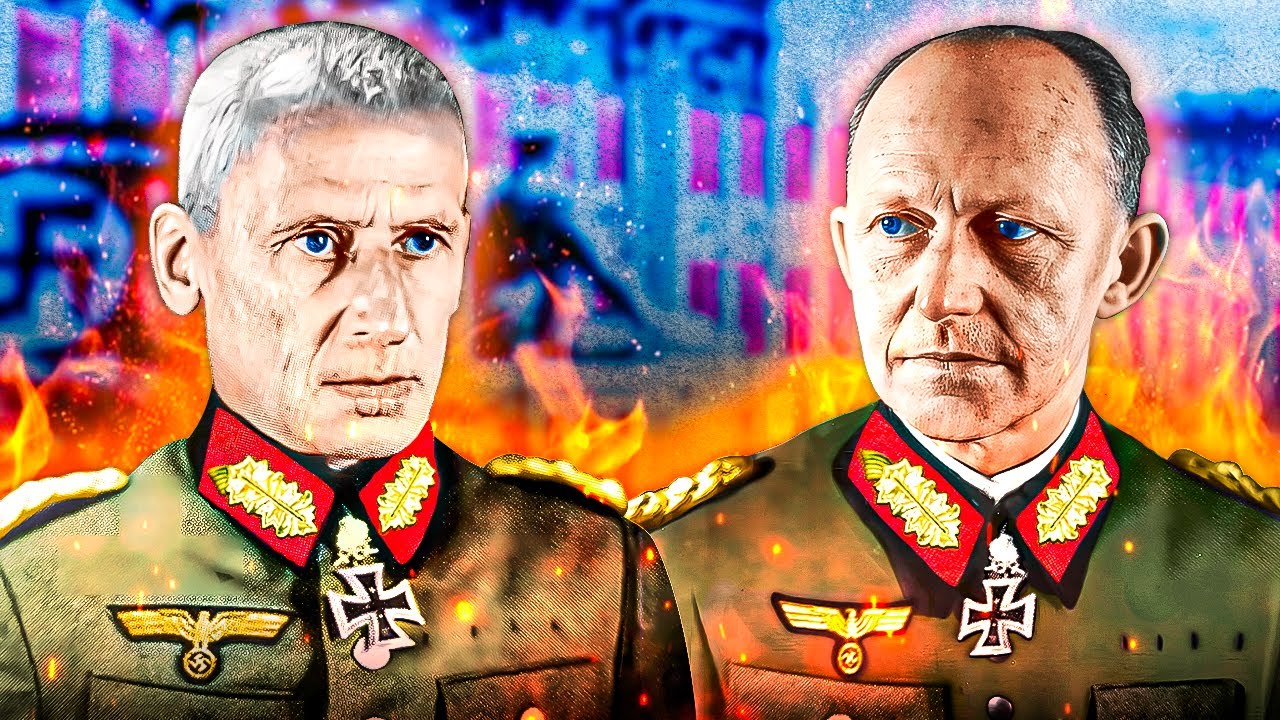
Back in Germany, Kesselring reunited with his wife Luise and later led veterans' associations, including the Afrika Korps association and the Luftwaffe association. He also advocated the European Defense Community during the Cold War and wrote two memoirs. He died on July 16, 1960, at the age of 75 after a battle with throat cancer.
Erich von Kleist was promoted to field marshal in late October 1943 and given command of the 17th Corps in Crimea. After proposing a tactical withdrawal that Hitler rejected, he was summoned to Obersalzberg on March 30, 1944, awarded the Knight's Cross with Swords, and removed from command.
Von Kleist recommended a peace agreement with the USSR, but Hitler refused. He lived quietly in Silesia until early 1945, when he fled the approaching Red Army and destroyed his estate. On April 25, 1945, a patrol of the US 26th Infantry Division captured him in Bavaria.
He was interned at Trent Park in Britain and later at Island Farm Camp in Wales. In 1946, he was extradited to Yugoslavia and sentenced to two years for organizing the 1941 war of aggression. Instead of being released, he was handed to the USSR and deported to Siberia.
Von Kleist spent time in various gulags and camps until 1954, when he was sent to Camp Vladimir near Moscow. Having passed through 27 prisons over nine years, he died of arteriosclerosis on October 15, 1954.
Oskar von Niedermayer was arrested by the Gestapo in August 1944 after the bomb plot against Hitler, despite having merely questioned his decisions. He was imprisoned for ten months, severely ill with tuberculosis. After the war, US troops liberated him only to hand him to the Red Army, which accused him of crimes in the USSR.
Sentenced to 25 years of hard labor in a Siberian gulag under the name Oskar Fedorovich, his health deteriorated from cold, lack of medication, and mistreatment. He died on September 25, 1948, in Vladimir prison near Moscow.
As the dust settled, the Allied Powers embarked on identifying, arresting, and trying those responsible for the regime's crimes. Field Marshal Wilhelm Keitel, who once headed the Wehrmacht High Command, stood trial at Nuremberg alongside other top Nazi officials.
Keitel's trial exposed his role in implementing the Commissar Order, which mandated the immediate execution of Soviet political officers. He and Colonel General Alfred Jodl were hanged on October 16, 1946. Keitel's final words were, "Alles für Deutschland" — everything for Germany.
General Anton Dostler was tried in Rome in October 1945 for ordering the execution of 15 captured US soldiers on a mission to blow up a railway tunnel. His defense that he was following orders failed. On December 1, 1945, he faced a firing squad, becoming the first German general executed for war crimes.
SS General Jürgen Stroop, infamous for crushing the Warsaw Ghetto Uprising, was tried in Poland. He was sentenced to death and hanged on March 6, 1952, in Warsaw.
Erich von Manstein chose to surrender to British forces in northern Germany rather than face capture by the Red Army. His trial in Hamburg in 1949 became a focal point for debates about military responsibility and following orders.
Manstein was found guilty on nine counts related to the execution and mistreatment of Russian soldiers and civilians, but acquitted of eight charges, notably those related to the extermination of Jews. He was sentenced to 18 years in prison.
After his release, Manstein advised on the reorganization of the postwar German Army as a member of NATO, regained his former rank, and helped British journalist Liddell Hart compile his World War II encyclopedia. He wrote a second set of memoirs titled "Aus einem Soldatenleben," published in 1958. He died on June 9, 1973, at the age of 85 and received a high-profile state funeral.

Gerd von Rundstedt was captured by the 36th US Infantry Division on May 1, 1945. He was held at Camp Ashcan in Luxembourg, then at Grizedale Hall in England and Island Farm in Wales. He was charged in connection with the Severity Order issued by Field Marshal Walter von Reichenau, which led to mass killings in Soviet-occupied territory.
Due to his advanced age and deteriorating health, he was released in July 1948 after three years in captivity. Life was hard for him and his family in Cella, but British historian Basil Liddell Hart and former German general Günther Blumentritt provided money until the West German government granted him his war pension. He died of a heart attack in Hanover on February 24, 1953.
Heinz Guderian surrendered to US troops on May 10, 1945, avoiding capture by the Red Army. He was held at Camp Ashcan and facilities in England's Lake District, where he showcased his tactical knowledge and distanced himself from the regime's worst atrocities.
Released on June 17, 1948, Guderian settled in Schwangau, Bavaria. In 1951, he published his memoir "Erinnerungen eines Soldaten," known in English as "Panzer Leader," which helped shape the myth of the clean Wehrmacht. He died on May 14, 1954.
Waffen-SS generals faced a harsher reckoning. Sepp Dietrich, former leader of the 1st SS Panzer Division Leibstandarte Adolf Hitler, was accused of war crimes for his role in the Malmedy Massacre, where American prisoners were executed during the Battle of the Bulge.
Paul Hausser, known as the father of the Waffen-SS, worked to rehabilitate the image of his fallen comrades after the war. He argued that the combat units of the Waffen-SS were simply soldiers fulfilling their duty, separate from the regime's atrocities, and became an advocate for veterans' rights.
Herbert Otto Gille commanded Waffen-SS units at regiment, division, and corps levels and was popular among his men for his personal bravery. He surrendered to US troops and was a prisoner for three years until May 1948. He later worked for a newspaper, ran a small bookstore, and founded a magazine for veterans of the Wiking division. He died of a heart attack on December 26, 1966.
Felix Steiner, the only SS general tasked with defending Berlin, was imprisoned by the Allies in May 1945 and later released by the British. He worked to improve conditions for SS veterans and wrote books about his combat experiences, including "Army of Outlaws" in 1953. The CIA later recruited him to found a propaganda and think tank organization for the rearmament of West Germany. He died in Munich on May 17, 1966.
Karl Wolff, one of the highest-ranking SS generals after Himmler, was arrested on May 13, 1945. During the Nuremberg trials, he avoided prosecution in exchange for facilitating early surrender in Italy and testifying for the prosecution. Released in 1947, he was later sentenced to four years in prison in November 1948.
During the 1962 trial of Adolf Eichmann in Israel, it was revealed that Wolff had organized the deportation of Italian Jews in 1944. He was tried again in West Germany and convicted in 1964 of deporting 300,000 Jews to Treblinka. Sentenced to 15 years, he served only part of his sentence and was released in 1971.
In the 1970s and 1980s, Wolff returned to public life, giving lectures and appearing in television documentaries, including "The World at War." He promoted the theory of a supposed plot to kidnap Pope Pius XII, based on a 1972 document he wrote. Holocaust historians have questioned his reliability. He died on July 17, 1984.
Friedrich Jeckeln, known for his brutality in implementing Nazi extermination policies in the Ostland territory, was captured by Soviet troops near Halbe on April 28, 1945. Tried by a Soviet Military Tribunal in Riga from January 26 to February 3, 1946, he admitted his guilt and accepted full responsibility. He was sentenced to death and hanged in Riga on February 3, 1946, before about 4,000 spectators.
The children of Germany's marshals met varied fates. Günther Guderian, son of Heinz Guderian, was born in 1914 and followed his father into the military. He was wounded twice in the campaigns of Poland and France, received the Knight's Cross in 1944, and surrendered in the Ruhr basin in April 1945. Released in 1947, he rejoined the Army in 1956 and reached the rank of Inspector General of armored forces, the same position his father held. He retired in 1974 and died in 2004 at age 90.
Manfred Rommel, son of Erwin Rommel, was born in 1928 and was too young to enlist in the early campaigns. At 14, he was sent as an aide to the Luftwaffe for air defense. After his father's death, he was transferred to the Reich Labor Service in March 1945 and deserted before the French First Army reached his position. He studied law and political science and later served as mayor of Stuttgart. He died in 2013 at age 84.

Gero von Manstein, son of Erich von Manstein, was born on the last day of 1922. Despite being described as a fragile, asthmatic child, he joined the invasion of the Soviet Union in 1941 with the 18th Motorized Infantry Division. He rose to the rank of corporal and later graduated as a lieutenant. In the summer of 1942, he joined the 18th Panzer Division near Leningrad under Army Group North, where his father was also sent. On October 23, 1942, he perished under his father's command at age 19.
Hansgeorg Model, son of Walter Model, was born in 1927 and enlisted in the Wehrmacht reserve in December 1944. The war ended before he saw combat. After the war, he obtained a journalist's license and studied law at the University of Bonn. In 1956, he joined the Bundeswehr, graduated as a lieutenant in 1957, and became a brigadier general in 1980. He directed the Bundeswehr intelligence office until his retirement in 1987 and died on April 16, 2016.
Friedrich Paulus's son Friedrich reached the rank of captain and died in February 1944 at the Battle of Anzio. According to historian Antony Beevor, his son's death was a decisive factor in Paulus signing a call for Germany's surrender. His other son, Alexander, also a captain, fought at Stalingrad and was evacuated due to wounds. When his father signed the document, Alexander was arrested along with his mother and imprisoned until the war's end. He later helped draft the book "Stalingrad," published in 1960, and committed suicide in 1970 at age 52.
Heinrich Hitler, nephew of the German leader, was born on March 14, 1920. He enlisted in 1939 and became a signals non-commissioned officer. Captured by the Soviets in 1942, he was tortured in Butyrka prison in Moscow and died in February 1942 at age 21 without revealing information.
As the Allied noose tightened, some generals fled to South America using the rat lines, a clandestine network orchestrated by the shadowy organization ODESSA and sympathetic Catholic clergy. Johannes Steinhoff, a high-ranking Luftwaffe officer, reached Argentina, where he lived among other Nazi fugitives.
Walter Rauff, a former SS Standartenführer, found refuge in Chile, living openly under his real name as a businessman and evading justice for decades. The capture of Adolf Eichmann in Argentina in 1960 by Israeli agents sent shock waves through the Nazi exile community.
Some fugitives died peacefully in their adopted homes, their crimes unpunished. Others were eventually tracked down and brought to justice, their captures making international headlines. Nazi hunters like Simon Wiesenthal dedicated decades to uncovering their whereabouts.
Field Marshal Friedrich Paulus surrendered to the Soviets at Stalingrad on January 31, 1943, disobeying Hitler's implicit order to take his own life. Hitler declared him a coward and condemned him as a traitor.
Initially sent to a special camp near Moscow, Paulus was exploited for propaganda. He eventually joined the resistance against Hitler after the failed assassination attempt in July 1944. He testified at the Nuremberg trials against his former comrades, including Hermann Göring, and admitted his own complicity in planning Operation Barbarossa.
Paulus was kept in Moscow for years after the war and only allowed to return to Germany in 1953, following Stalin's death. He settled in Dresden, East Germany, rather than reunite with his family in the West.
The fates of Hitler's generals became a complex tapestry of justice, evasion, and bitter endings. Some met their end on the gallows, others in Soviet captivity, and some in quiet retirement.
Their stories offer stark lessons about blind obedience and moral responsibility in times of conflict. The trials and testimonies exposed the hollowness of the "just following orders" defense and challenged deeply ingrained notions of military honor.
As Cold War tensions mounted, some former Wehrmacht officers found themselves in an unexpected position. Men like Heinz Guderian, once celebrated for their tactical brilliance, served as advisers in the reformation of the West German Army.
The concept of "innere Führung," or internal leadership, in the modern German Bundeswehr arose as a direct response to the ethical failures of the Wehrmacht leadership. It emphasizes personal responsibility and moral decision-making within the military hierarchy.
The legacy of these men continues to resonate, offering insights into leadership, ethical decision-making, and the consequences of moral failure. Their stories remain a somber reminder of the depths to which humanity can sink and the long shadow cast by decisions made in the crucible of war.