Just after 8:00 in the morning on September 27, 1864, a train pulled into the depot at Centralia, Missouri. The town held maybe 500 people. The platform was dusty, and the air smelled like goldenrod and late summer heat.
On board were 23 Union soldiers, mostly boys from the 100th Missouri militia, heading home on furlough. They had survived the war. Some carried letters from their mothers in their coat pockets. None of them were armed, because men on leave do not carry rifles.
They stepped off the train into the Missouri sunlight. Eighty men on horseback were waiting for them. The man at the front had human scalps braided into his horse's bridle. His name was William T. Anderson.
In roughly 40 minutes, every one of those 23 unarmed soldiers would be dead, stripped, scalped, and left on the wooden platform. That was only the first act. Before the sun set on Centralia, 145 Union men would be killed. Anderson's losses were zero.
The official story says one man killed Bloody Bill Anderson, a young militia officer who claimed he put a bullet through Anderson's skull at 30 feet. But that official story has cracks. Suppressed testimony from 1865 suggests it might not have happened that way at all.
And there was a 17-year-old boy riding with Anderson that morning, a preacher's son from Clay County, who would watch everything that happened on that platform and in that field. His name was Jesse James.
Before the scalps and the massacres, before the name that would terrify an entire state, William Anderson was a horse thief. Born around 1839 in Hopkins County, Kentucky, he was raised on hardscrabble farms across Missouri and Kansas. No formal education was recorded, and he had no military training.
By the time he was 20, his main skill was stealing horses and not getting caught. His family scraped by in Council Grove, Kansas, where the neighbors were Unionist and the Andersons were not. He was lean, restless, and angry in the way that young men without prospects are angry.
In early 1862, those Unionist neighbors arrested Anderson's father and brothers for horse theft. The charges may have been real. Kansas records say thief. Anderson later said set up.
What happened next is not in dispute. During transport to Leavenworth, a mob pulled the Anderson men off the road and hanged them from a telegraph pole on a bridge over the Marais des Cygnes River.
Whether William Anderson was a criminal or a victim before that bridge does not matter much. After it, he was something else entirely. He was 23 years old, and he wanted blood.
By spring of 1863, Anderson had found the only organization that would have him: William Quantrill's guerrilla raiders, a loose army of 400 to 450 men operating along the Kansas-Missouri border. These were not Confederate soldiers in any regular sense. They were partisans, farmers, horse thieves, and brawlers fighting a shadow war of ambush and reprisal.
Anderson fit right in. He was fast, he was mean, and he did not hesitate. Quantrill made him a lieutenant. Within months, he helped burn Lawrence, Kansas, to the ground.
On the other side of this war were men just as young and just as poor. The Union militias Anderson preyed on were mostly Missouri and Illinois farm boys, conscripted under the 1864 draft, poorly trained, sometimes unpaid, and often without enough horses or ammunition. Many had never fired a weapon before enlisting.
They were not an army. They were a collection of frightened young men sent to fight ghosts, guerrillas who dressed in civilian clothes, struck without warning, and vanished into timber.
In the summer of 1864, Anderson decided that Quantrill's brand of killing was not enough. He wanted his own command, his own methods, his own war. What he built in the next three months would make Lawrence look like a rehearsal.
The split came in the spring of 1864. The details depend on who is telling the story, but the core is simple. Anderson wanted to kill faster and harder than Quantrill would allow. Quantrill still maintained a rough hierarchy and something that resembled military discipline. Anderson had no use for any of it.
He gathered between 80 and 100 men, the most violent and most committed, the ones Quantrill's other lieutenants were glad to see leave, and rode out on his own. The most violent man in the most violent guerrilla band in the Civil War had looked at the man behind the Lawrence Massacre and decided Quantrill was not brutal enough.
Anderson's band operated like a roving execution squad. They rode 30 to 50 miles a day on fast horses, disguised themselves in stolen Union uniforms, and struck targets that had no way to fight back: isolated militia outposts, supply wagons, and farmsteads belonging to known Unionists.
When Anderson killed, he did not simply shoot. He scalped. He displayed. Sometime that summer, a fellow raider recalled Anderson saying, "I have no mercy for such men. None." It was not a boast. It was a diagnosis.
The scalps went on his horse's bridle, a garland of human hair that swung as he rode. This is where the name came from, Bloody Bill, not from one massacre but from the accumulation, the scalps, the mutilations, and the sheer theatrical cruelty that made Anderson different from every other bushwhacker on the border.
Over his career, historians estimate he collected between 25 and 50 scalps. Whether every victim was scalped or only selected ones is still debated. Raiders claimed all, but 1990s archaeological digs at Centralia found only five scalped skulls. The truth lies somewhere in the dark.
By this point, Anderson had already helped kill 150 to 200 civilians at Lawrence the previous August, a four-hour orgy of arson and murder that remains one of the worst atrocities of the entire Civil War. Two hundred buildings burned. Anderson's subgroup personally killed about 20.
But Lawrence was Quantrill's operation. Centralia would be Anderson's alone. His signature. His proof that he did not need anyone else to make the border bleed.
Among the men riding with Anderson that summer was a boy. Jesse James was 17 years old, the son of a Baptist minister from Clay County, Missouri, who had briefly been a school teacher before the war swallowed him.
Years later, an aging outlaw named Jesse James sat for an interview with a St. Joseph reporter and remembered the man he had followed at 17. "Bill wore a chain of Yankee scalps on his horse's bridle," James recalled. It was Bloody Bill himself.
James said it the way you would describe recognizing a force of nature. Not a man, a weather system. Everything he learned about killing, about terror as a tool, about how to disappear after the blood dries, he learned in this band, from this man.
Anderson's band was armed to the teeth: Colt Navy .36 caliber revolvers, multiple per man, plus rifles and shotguns. Each rider carried enough firepower to empty a room. Among this all-male killing outfit was one woman, Anderson's sister Josephine, roughly 20 years old, who served as cook and laundress.
She washed clothes and prepared meals in a camp where men dried human scalps by the fire. She would survive her brother, be captured after Albany, and then vanish from history entirely.
By September 1864, Anderson controlled a force of 80 hardened guerrillas with a reputation that made Union militia units desert rather than face him. He had weapons, horses, speed, and the kind of rage that does not tire. All he needed was a target.
On September 27th, he found one. Centralia, Missouri, sits in the middle of Boone County farm country, open fields stretching in every direction, covered in late September goldenrod, with visibility a mile or more. The town was barely a town, maybe 500 souls, a handful of buildings, and a depot where the North Missouri Railroad stopped to take on water and passengers.
On the morning of September 27, 1864, a low fog hung over the fields. By 9:00, it would burn off. By noon, the fields would be full of the dead. But at 8:00 in the morning, Centralia was just a train stop in the middle of nowhere.
Anderson's 80 riders appeared from the timber north of town just as the train pulled in. They surrounded the depot. Anderson himself dismounted. He was 25 years old, lean, armed with a revolver in each hand.
On board the train were civilians, a few women, and 23 Union soldiers of the 100th Missouri militia, young men heading home on furlough, unarmed because men on leave do not carry weapons.
Anderson could have robbed the train and ridden away. Guerrillas did this constantly. It was how they funded operations and how they survived. Theft was the baseline. But when Anderson saw those blue uniforms, he did not see payday. He saw targets.
A raider who was there later recalled Anderson saying, "No quarter for bluebellies." Whether those were his exact words does not matter. What matters is the decision. Anderson ordered the Union soldiers pulled off the train and lined up on the platform.
He could have taken their money, their watches, their boots. He could have humiliated them and ridden away. He had a choice. Every atrocity begins with a choice.
One of the men on that platform, a 19-year-old farmer from Illinois named William Woods, would write home the very next day from a hospital bed. "The guerrillas numbered about 80, all well mounted and armed with revolvers and rifles," Woods wrote. "They ordered us off the train and commenced shooting."
That letter is one of the only real-time accounts of what happened on the Centralia platform. The soldiers were stripped of their uniforms. Some were ordered to run. They were shot as they ran. Others were executed where they stood. The killing took 10 to 15 minutes. There was no battle. There was no resistance. There was nothing to resist with.
Those 23 soldiers were on furlough. They were going home. They had survived battles, camps, and disease, and they were murdered in a train station in a town of 500 people, miles from any front line, by men who looked exactly like them until the revolvers came out.
Not all of them died. Years later, a blacksmith from Boone County named Thomas Goodrich told a local historical society what he saw that morning. Goodrich was 24, a sergeant in the 100th Missouri, and he was standing on that platform.
Anderson rode up, revolver in each hand, and said, "Yankees, you are going to die." Then the slaughter began. Goodrich survived by falling among the dead and not moving. The blood on his face was not his own. He lay there for what felt like hours, breathing through the smallest possible gap in his mouth, listening to the boots of Anderson's men walking through the bodies around him.
After the shooting stopped, Anderson's men went through the bodies. They scalped. They stripped. They mutilated. The details are in the Union reports, and they are difficult to read. Ears cut, throats slashed, bodies arranged in deliberate positions of degradation.
This was not the frenzy of combat. This was methodical. It was staged. Anderson wanted anyone who found these bodies to understand exactly what had happened and exactly who had done it. The platform of the Centralia depot was soaked in blood that would not wash out for two weeks. The townspeople, 500 civilians trapped in a war zone, could only watch.
And then Anderson made his second decision of the day, the one that would turn Centralia from an atrocity into a catastrophe. Instead of riding away, he ordered his men to withdraw to the woods two miles north of town and wait.
He knew pursuit would hear about the train. They would ride to Centralia and follow his trail into the open prairie north of town. Anderson was not running. He was baiting a trap.
Two miles north, in a tree line at the edge of a golden field, Anderson and those same 80 riders dismounted, reloaded their revolvers, and waited. They did not wait long. By early afternoon, 150 Union cavalrymen were riding straight toward them. They had no idea what was coming.
Word reached the Union garrison within hours. A train had been stopped. Soldiers murdered, scalped. The details came in fragments: a terrified civilian rider, a telegraph message that stuttered into the nearest outpost. The response was immediate and, in hindsight, suicidal.
Major A.V.E. Johnston commanded the nearest available unit, 150 cavalry of the 39th Missouri Mounted Infantry, stationed near the Centralia rail line. Johnston was aggressive, reckless, some would say later. He had 150 men, but 50 of them were short horses and many had never seen real combat. Their carbines were standard issue, but their ammunition was low.
These were not hardened veterans. They were farm boys in uniform, the same kind of conscripts who filled Union militia roles across Missouri in 1864. Young, scared, and untested.
Johnston did not care. He gathered his men and rode for Centralia. He was a 28-year-old clerk from St. Louis who had volunteered for a war that was supposed to be almost over, and he burned with the kind of righteous fury that does not stop to calculate odds.
He had 150 men, green troops, short on ammunition, short on horses. He was riding toward a force he could not see in open prairie that offered no cover against men who had been killing since breakfast. He did not know any of this. He only knew that someone had massacred his comrades on a train platform, and he was going to make them pay.
The most terrifying thing about Anderson's men was not the scalps or the revolvers. It was that they looked like everyone else. Woods had written it in his hospital letter. "These devils look like our own boys till they yell and shoot." That was the guerrillas' advantage. You could not tell them apart from your own side until the guns came out.
Johnston reached Centralia by early afternoon. He saw the platform. He saw what Anderson had done to the unarmed men from that platform, and he made his decision: pursue.

Three miles north of town, the prairie opened up. Flat golden fields with no cover for a mile in any direction. Anderson had positioned his men just inside the tree line at the northern edge, invisible from the south. The field was a killing ground, and Johnston was riding straight into the center of it.
The Union cavalry formed a line and advanced across the open prairie, standard cavalry tactic against a tree-line position. It should have worked if the enemy had been a conventional force behind cover trading carbine fire. But Anderson did not fight from the trees. He waited until Johnston's men were fully in the open, committed, exposed.
Then he did something no Union officer in Missouri had ever seen. Anderson charged. Eighty men burst from the tree line at full gallop, revolvers blazing, screaming the rebel yell that a later report said pierced the air.
They did not stop to form ranks. They did not fire from distance. They rode straight into the Union line at close range, every man carrying multiple loaded revolvers, a technique the guerrillas had perfected over two years of border war. While a Union cavalryman fumbled to reload a single-shot carbine, a guerrilla could empty one revolver and draw another.
The Union line broke in seconds. It did not bend or waver or fall back in order. It shattered. Johnston's green troops, the farm boys, the conscripts, the men who had never seen combat, tried to turn their horses and run. On open prairie, against men who had been riding and shooting since childhood, there was no escape.
Johnston himself went down early, killed leading the charge. His body lay in that field for three days before anyone came to bury him. The teenager James was later credited with killing Johnston personally, though historians still argue whether he was even present that day or joined Anderson after Centralia.
The ambush lasted 20 to 30 minutes. In that span, Anderson's 80 men killed 123 Union soldiers, the highest single engagement casualty rate for the Union in the entire Civil War. The raiders expended roughly 2,000 rounds, 25 bullets for every minute of fighting.
That is not a battle. That is a storm of lead moving across a field of men who had nowhere to hide. In the time it takes to read a paragraph aloud, roughly 25 seconds, Anderson's men killed more Union soldiers than most Civil War skirmishes produce in an entire day.
The same golden fields that had been covered in goldenrod were now something else. The gunsmoke hung so thick it cut visibility to 50 yards. Horses screamed, men screamed. Those Colts cracked and cracked and cracked until the revolvers were empty, and the raiders drew fresh ones from their belts.
Then silence settled, punctuated only by the sound of hooves on packed earth and the distant shriek of crows circling the field. The Union soldiers who were not killed in the initial collision tried to run south. Some made it a few hundred yards. Most did not. Anderson's men rode them down individually, shooting men from the saddle as they fled on foot, the horses closing the distance in seconds.
Decades later, a man named James Blair sat in a pension office and tried to explain what he had seen in a Missouri field when he was 22. Blair was an Illinois farmer conscripted in 1864, just another young man who had been told the war was almost over.
"They shot us down like sheep," Blair said. "Scalped the boys while alive." The pension clerk wrote it down. Blair had survived by being wounded in the leg early and dragging himself into brush two miles from the field. He hid there until the next morning, listening to the sounds that drifted across the prairie as Anderson's men finished their work.
That night in camp, one of the raiders wrote a single entry in his diary: "We killed 123 and would have got the rest, but they scattered like sheep. Scalped every damn Yankee." The tone is not confession. It is arithmetic.
The aftermath was methodical. Anderson's men rode through the field checking bodies. Those still alive were shot. Goodrich, the blacksmith playing dead miles to the south on the platform, had been lucky. These men in the field were not.
Union reports documented the specifics. Later archaeological digs in the 1990s found buttons and bullets matching raider weapons scattered across a mile of prairie. The Centralia battlefield was not a battlefield. It was a crime scene.
Anderson's casualties were zero. Perhaps one or two or three wounded, depending on the source. Effectively zero.
One month. That is all Anderson had left. He did not know it. He was riding through Ray County, Missouri, with 200 men and a reputation that made Union militias desert rather than fight him. He believed he was invincible. He had reason to. No one had touched him. Not Quantrill, not the Union Army, not the state militia.
But a 27-year-old University of Virginia graduate named Samuel Cox was about to change that. After Centralia, Anderson's band swelled. Recruits poured in, drawn by the reputation, the loot, the promise of action. By October, the man who had outgrown Quantrill commanded 200 men or more, hitting Union militias across Ray and Davies counties in a series of raids that kept the region in perpetual terror.
But terror has a shelf life. The Union was done tolerating Bloody Bill Anderson. Lieutenant Colonel Samuel P. Cox was everything Anderson was not. Twenty-seven years old, born in Virginia, educated at the University of Virginia, a farmer and merchant before the war, married, with children, a man who had started the war as a Union sympathizer who had no particular desire to hunt guerrillas until Centralia forced his hand.
Cox commanded the 33rd Missouri State Militia Infantry Regiment, 350 men, trained, equipped, angry. He was sent to Ray County with a single objective: find Anderson and kill him.
An informant gave Cox what he needed, the location of Anderson's camp near Albany, Missouri. On the morning of October 27th, Cox's militia moved into position in the brushy woods of oak and hickory that surrounded the camp. The uneven ground slowed the approach. Fallen leaves crackled underfoot. By 10:00 in the morning, the skirmish began.
And here, Anderson made his final choice. He was outnumbered more than three to one. He had 50 to 80 men against 350. The smart play, the survival play, was to scatter into the timber, regroup, fight another day. That is what guerrillas did. That is what had kept them alive for three years.
Anderson charged. He came out of the brush on horseback, revolvers in both hands, screaming. Dave Poole, his lieutenant, roughly 30 years old, a former Quantrill man who had followed Anderson through every massacre and every mile, rode beside him.
The man who had burned Lawrence, emptied a platform, and turned a prairie golden with blood charged straight into the line of 350 men who had come specifically to kill him. The charge lasted seconds. Anderson rode directly at the militia line firing as he came. The brush and uneven ground tripped horses. Militia rifles cracked from the tree line. Autumn leaves swirled in the smoke. And then it was over.
In his report the next day, filed to the Missouri Adjutant General, Cox wrote with the flat precision of a man filing a receipt. "I discovered the villain Anderson," he wrote. "I shot him through the head at a distance of 30 ft."
Whether Cox really pulled the trigger is still debated. Testimony from 1865, suppressed afterward, possibly to protect Cox's rising political career, suggested it may have been group fire, or a private named James Blunt, or simply the accumulated bullets of an entire militia line firing at one man. No guerrilla survived to confirm or deny.
What is not debated is that Anderson fell from his horse and did not get up. He was 25 years old. In roughly two years of guerrilla warfare, he had participated in the burning of Lawrence, the Centralia massacre, and dozens of smaller raids that left a trail of scalped bodies across Missouri and Kansas. He died the way he lived: charging, screaming, guns in both hands. The difference is that this time someone shot back and did not miss.
Dave Poole died the same day. Anderson's men broke and scattered. Fifty were captured. Twenty more were killed in the woods as Cox's militia swept through the camp. The remaining raiders dissolved. Some went south to Confederate lines, some into the timber, some simply went home and buried their revolvers.
The Missouri guerrilla war did not end with Anderson's death, but its most terrifying chapter did. The man who had made the border bleed was lying in the Missouri brush with a bullet in his skull. Twenty-five years old, a horse thief's son from Kentucky who had turned grief into a weapon and pointed it at everyone.
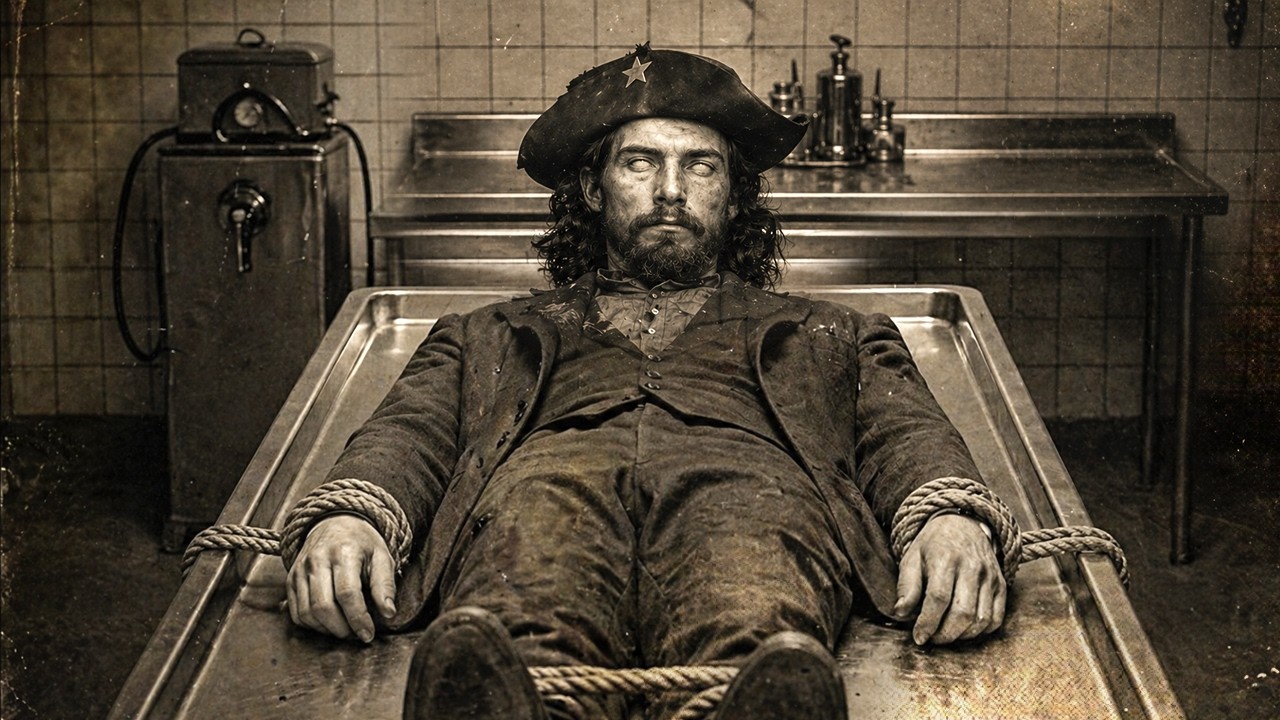
What happened to Anderson's body tells you everything about what he had become. The militia dragged him out of the brush and posed him for a photograph, propped in a chair, revolvers arranged on his chest, mouth slightly open. It is one of the most disturbing images of the Civil War, and it was taken as a trophy.
Then they cut off his head. They put it on a telegraph pole in Richmond, Missouri, the county seat, and left it there for three days. The symmetry is almost too perfect. His father hanged from a telegraph pole in Kansas. His own head was mounted on one in Missouri.
A militia doctor examined the skull afterward, not to identify Anderson. Everyone knew who he was. The doctor wanted to confirm the cause of death. They were that afraid he might not actually be dead.
The final numbers from Centralia and Albany, taken together, are staggering. At the Centralia train depot, 22 or 23 unarmed soldiers were executed on the platform. In the ambush field three miles north, 123 Union cavalrymen were killed, plus 20 or more wounded, and 20 to 30 mutilated. Anderson's losses at Centralia were effectively zero.
Centralia remains the highest single engagement casualty rate for Union forces in the entire Civil War. At Albany, Anderson and roughly 20 of his men were killed, and 50 were captured. Union militia lost five.
The disparity at Centralia was not a battle result. It was a mathematical expression of what happens when 80 experienced killers with unlimited revolvers meet 150 green conscripts in an open field with nowhere to run.
Word of Anderson's death reached St. Louis by telegraph on October 28th. The headline traveled faster than any of Anderson's raids. Missouri newspapers printed the news alongside descriptions of the Centralia massacre, ensuring that Anderson's death and Anderson's crimes would be linked in public memory forever.
For the Union militia and the civilians of Missouri's border counties, the reaction was not celebration. It was relief so deep it felt like exhaustion. The man who had made them afraid to travel roads, afraid to wear uniforms, afraid to be identified as Union, that man was dead. The terror was over. But it was the kind of over that leaves scars that never quite flatten.
James Blair, the 22-year-old who had hidden in the brush while his comrades were butchered, went home to Illinois. He returned to farming. For the rest of his life, he suffered nightmares. When he filed for a pension decades later, the memories poured out in clinical testimony: "Shot us down like sheep." He received his pension. He never talked about Centralia again.
Thomas Goodrich, the blacksmith who survived the platform by playing dead, went back to Boone County. He lived quietly until 1902. His memoir, self-published and given to a local historical society, is one of the few first-person accounts from the killing ground. He never became famous for surviving. He was just a blacksmith who fell down and did not move.
Samuel Cox rose. The man who claimed he killed Bloody Bill Anderson rode that reputation into the Missouri state legislature and then the United States Congress, where he served from 1873 to 1879. He died in 1897, respected, legitimate, a man whose entire political career was built on a single bullet fired in the Missouri brush. Whether it was actually his bullet remains an open question that no one in Washington ever asked him.
Anderson's sister Josephine, who cooked meals between massacres, was captured in the aftermath of Albany, the only woman in the camp. She was held briefly, then released, and then she vanished. No further records, no testimony, no pension filing, no memoir. She is a hole in the historical record shaped like a person, someone who saw everything and left no words behind.
The Centralia battlefield is a park now. There is a monument, Union-focused, listing the names of the dead. The platform is gone. The fields are still flat, still golden in September. If you stand at the north end and look south, you can see roughly what Johnston's doomed 150 saw when they rode toward the tree line, a mile of open ground with nowhere to hide. The landscape has not changed. The prairie remembers better than the monuments.
Anderson was dead. His band was scattered. The war itself would end six months later, but the story of Bloody Bill Anderson was just beginning its second life, the one where the truth got complicated, the myth got louder, and the most important facts got buried for a century.
Almost immediately, Anderson became two things at once. To former Confederates, he was a freedom fighter, a man pushed to extremes by the murder of his family, striking back against an occupying army. To Unionists, he was a monster. The truth, as usual, is worse than either version.
Anderson was not a Confederate soldier in any meaningful sense. He received a captain's commission late in his career and ignored it. He did not answer to Richmond. He did not follow orders. He killed for reasons that had almost nothing to do with the Confederacy and everything to do with a rope and a telegraph pole. The example he had wanted to make at Centralia was not a Confederate example. It was personal. It had always been personal.
And then there is Jesse James, the 17-year-old who watched Anderson work, or who joined afterward, depending on which historian you believe, and went on to become the most famous outlaw in American history. The James-Younger Gang, the train robberies, the mythology.
But the connection between James and Anderson is more than chronological. James learned in Anderson's camp that violence was not just a tool but a performance, that the display of cruelty was itself the weapon. Those scalps on the bridle, the bodies on the platform, Jesse James carried those lessons to every bank and every train he ever robbed.
Here is the uncomfortable truth that most Civil War documentaries skip. Anderson was not a Confederate soldier. He was barely a Confederate sympathizer. He was commissioned as a captain near the end, but he ignored orders, operated independently, and killed for reasons that had almost nothing to do with the Confederacy and almost everything to do with a telegraph pole bridge in Kansas where his father swung from a rope.
In the 1970s, previously unknown diary entries from Anderson's Raiders surfaced, confirming the systematic scalping that some historians had dismissed as Union propaganda. Then, in the 1990s, archaeological excavations at the Centralia battlefield recovered skulls, buttons, and bullets. Physical evidence matched raider weapons and confirmed the scale of the mutilation. Five scalped skulls were found.
The archaeological record is small but unambiguous. For decades, the worst details of Centralia had been treated as exaggeration. The ground proved they were not. The dirt remembers what the textbooks tried to soften.
And here is the question that makes the whole story harder. Was Anderson a horse thief who used his family's lynching as an excuse for the violence he already craved? Or was he a young man pushed past the point of sanity by a crime committed against his family, who became exactly what grief and rage and lawlessness create?
Kansas records say thief. Anderson said victim. The bridge, the rope, the telegraph pole say both things can be true at the same time.
Go back to that train platform. September 27th, 1864. Eight in the morning. Twenty-three unarmed men step into the Missouri sunlight. Eighty riders with scalps on their bridles. A 25-year-old man with revolvers in both hands and a hole where mercy should have been.
In 40 minutes, every one of those soldiers would be dead. By sunset, 145 would follow. The man responsible would be dead himself within 30 days, shot from his horse in a charge he did not have to make.
Bloody Bill Anderson is not a legend. He is a warning about what happens when grief meets violence, when violence meets impunity, and when impunity meets a country too broken to stop any of it.