In the cold days of January 1945, victory in Europe seemed like only a matter of time. But General Dwight D. Eisenhower was facing the most dangerous alliance crisis of the war.
A press conference transcript sat on his desk, and it threatened to destroy everything he had built over three years. The paper in his hands trembled, not from anger but from disappointment.
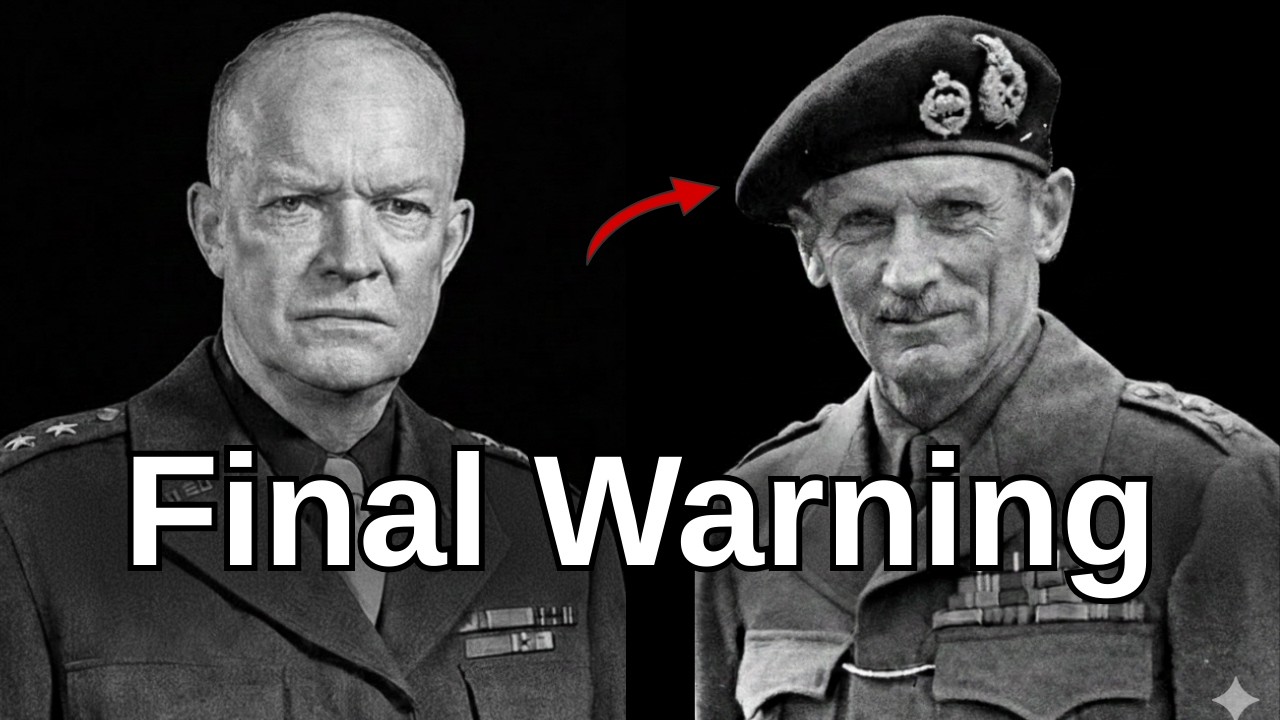
Field Marshal Bernard Montgomery had portrayed the American army as a force treated like children. He had spoken as if he had won the entire war single-handedly.
He had used the word "I" so many times that Eisenhower, reading the transcript, had lost count.
For three years, Eisenhower had shown patience. He had ignored Montgomery's insolence and swallowed his pride to keep the alliance together. But that patience had now ended.
Eisenhower began writing a letter that would change the course of history. The content was simple, but the consequences were shocking. Either Montgomery backed down, or his career would end there.
This is a story of the clash between two different leadership philosophies. On one side stood Eisenhower, a diplomatic commander who had mastered the art of keeping coalitions together.
On the other side stood Montgomery, a strategist who saw himself as the war's sole genius, preferring victories won on the map to political realities.
But this was not just an ego battle between two generals. It was a critical moment that determined the fate of World War II and defined the nature of modern military leadership.
The problem between Eisenhower and Montgomery wasn't just personality differences. The two looked at war through completely different windows.
For Eisenhower, war was no different from a team sport. Every player mattered. No country and no general was superior to the others. The goal was victory, and that victory could only be won by working together.
Eisenhower's genius was not in strategic planning but in his ability to manage people. He knew how to calm Churchill. He knew how to rein in Patton. He knew how to motivate Bradley.
And most importantly, he knew how to win the war without turning the British and Americans against each other.
Montgomery, however, saw war as a solo performance. There was only one star on the stage: himself. Everyone else was an extra, bringing his brilliant strategies to life.
When he defeated Rommel at El Alamein, he became Britain's national hero. Newspapers proclaimed him a genius. Churchill sang his praises, and Montgomery believed he deserved all of it.
His view of the Americans was clearly dismissive. Montgomery thought American generals were amateurs without war experience. He saw Eisenhower as a logistician who had never been in combat. He found Bradley slow and cautious. He considered Patton an uncontrollable savage.
"The Americans are brave but undisciplined," he wrote in private letters. They could be tremendous under good command, but proper command is essential. And according to Montgomery, that proper command was only himself.
This perspective might have been acceptable in 1942. Back then, Britain was more experienced in war. The British army had been fighting in Africa and the Mediterranean for years. America had only just entered Europe.
But it was now 1945. America was the steel backbone of the alliance. Eighty percent of the soldiers were American. Ninety percent of the equipment was American. Logistics were entirely on American shoulders.
The balance of power had shifted, but Montgomery hadn't noticed, or didn't want to notice. Eisenhower saw this change very clearly. What was needed now was not British experience but American power.
And this reality, whether the British accepted it or not, was beginning to shape Eisenhower's decisions.
Montgomery, meanwhile, sat in the map room, still planning the 1942 war. He saw himself as indispensable. He thought the Americans needed him so much that they would tolerate every insult and every demand.
He believed Eisenhower could never remove him from command. This belief would become the greatest miscalculation of his career.
On December 16, 1944, the Germans launched a shock attack in the Ardennes Forest. This attack, which would go down in history as the Battle of the Bulge, split American lines in two, and suddenly all post-Normandy gains were in jeopardy.
The German offensive drove a huge wedge between General Omar Bradley's headquarters and his southern units. To the north were First Army and Ninth Army, more than 200,000 American soldiers, but Bradley had lost communication with them.
Telephone lines were cut, radio signals were scrambled, and German panzers were still advancing. When Eisenhower looked at the map, he understood the seriousness of the situation.
Bradley couldn't command his northern armies from headquarters in the south. Someone had to be responsible for that front immediately. And geographically, the closest commander was Montgomery.
Eisenhower knew the political consequences of the decision he made that night. Giving American armies to British command was a humiliation for Bradley. For Patton, it was a betrayal. But the military logic was clear. Unity of command was needed, and Montgomery was the best option under the current conditions.
"Temporary," Eisenhower emphasized as he gave the order, "only until the crisis is over."
Bradley accepted, but there was anger inside him. Patton didn't hide his reaction. "We're giving my soldiers to that British chicken thief," he had shouted.
And how did Montgomery receive this news? With victory cries. Finally, he had seen the moment when the Americans really needed him. Finally, the chance had come to implement the strategy he had been advocating.
The Americans had been driven to disaster, and now they would have to listen to him.
When Montgomery arrived at American headquarters, he acted like a savior. He didn't even look at the weary American officers. He immediately rejected the defense plans. He reorganized the line. He stopped counterattacks.
He gave instructions to experienced American generals as if teaching students new to a military academy. "I'm going to straighten out this mess," he said. This sentence was etched into the memory of American officers.
Militarily, Montgomery was successful. He stabilized the northern front. He stopped the German advance. The defensive line was orderly. But the attitude he displayed while doing everything created deep anger among the Americans.
Montgomery summoned Bradley to his own headquarters instead of visiting him, as if a feudal lord were receiving a peasant visitor. In the meeting, he gave Bradley tactical lessons. Bradley was silently gritting his teeth.
Whispers began among American officers. Are we fighting the Germans or the British? But Montgomery noticed none of this. He interpreted silence as approval. He perceived discipline as submission.
He was winning on the map but losing in headquarters. And then he decided to go to the microphone to boast.
On January 7, 1945, Montgomery stood before the microphone in the British press tent. He saw himself as a hero of history. Camera flashes popped. Journalists prepared their notebooks. And Montgomery began making the biggest mistake of his career.
"The Battle of the Bulge was one of the most difficult battles I have ever directed," he said, as if the entire battle was on his shoulders.
When talking about American soldiers, he portrayed them not as allies but as inexperienced units he had to rescue. He didn't mention the heroism of the 101st Airborne at Bastogne. He ignored Patton's critical maneuver from the south.
He constantly used the word "I." I mobilized all forces. I went on the offensive. I provided organization.
British journalists were busy writing this down. Headlines were ready. Monty saved the Americans.
But 500 meters away in Eisenhower's office, the atmosphere was glacial. When Eisenhower read the press conference transcript, he had trouble controlling his hands.
For three years, he had endured Montgomery's arrogance, insolence, and unfortunate comments. But this was different. This was a direct insult to the American army.
Because 95 percent of those who died in the Ardennes were American. Nineteen thousand American soldiers had lost their lives in those snowy forests. Thousands more were wounded. And now Montgomery was talking as if this battle was a demonstration of his tactical genius.
Eisenhower's phones began ringing. General Bradley was calling. "I will never work under Montgomery's command again. Either he goes or I go."
Patton was calling. "Let me go break that Brit's jaw."
How did American newspapers see the news? With anger. Headlines read, "Monty steals American victory." Veterans associations were demanding statements. Congress members were asking questions.
And most dangerously, the entire American command structure was in revolt.
Eisenhower now had to make a choice. Either he would protect Montgomery and lose his American generals, or he would discipline Montgomery and enter a political crisis with the British.
But a third option was beginning to form in Eisenhower's mind. Perhaps there was no need to protect Montgomery. Perhaps there was no such thing as indispensable.
That evening, Eisenhower began writing a letter. The address was General George Marshall, the highest military authority in Washington. The content was cold and definite.
Unless Montgomery's attitude changes or he is removed from command, I will resign.
The equation was simple. Either me or him. This was not a bluff. Eisenhower was truly prepared to resign. Because he now understood that protecting Montgomery meant losing his own army. And a commander without his army is nothing.
When Eisenhower wrote the letter, he showed a copy to Montgomery's chief of staff, Major General Freddie de Guingand. When de Guingand read the letter, his face went pale.
De Guingand had worked alongside Montgomery for many years. He knew his patron's weaknesses: his arrogance, blind self-confidence, indifference to political realities. But this time, Montgomery had crossed a line.
De Guingand looked at the letter again. Eisenhower's order was ready. It was waiting to be signed. A telegram would go to Washington, and Montgomery's career would end.
"Is this real?" asked de Guingand. Eisenhower didn't answer. He just nodded.
De Guingand rushed out of the office. He jumped in his car and drove through the snowstorm to Montgomery's tactical headquarters. On the road, he was thinking about how he would explain this to Montgomery.
The boss believed he was untouchable. He thought Eisenhower could never remove him from command.
When he arrived at headquarters, Montgomery was cheerful, drinking his tea, looking at his maps, planning future operations. He didn't even know about the crisis the press conference had created.
De Guingand slammed the door. "Monty, we need to talk now."
Montgomery laughed. "What happened, Freddy? Did the Americans get a bit offended?"
"No," said de Guingand. "Eisenhower is going to remove you from command."
Silence. The smile on Montgomery's face froze.
"What did you say?"
"Eisenhower has prepared a letter. It's waiting to be sent to Washington. You either apologize immediately or you're finished."
Montgomery couldn't believe it. "Eisenhower can't do that. The alliance will fall apart."
"He can," said de Guingand. "And he will. I saw the letter. It's waiting to be signed. You either apologize or you'll go down in history books as the first British field marshal to be removed from command."

De Guingand described a determination in Eisenhower's eyes. This was no longer a funny situation. This meant career ending. Even Churchill couldn't save him.
Montgomery sank into his chair. For the first time, he was seeing the truth. Eisenhower wasn't a weak politician. Eisenhower was the most powerful man in the Western world. And Montgomery had pushed him one step too far.
"What should I do?" asked Montgomery. His voice was trembling.
"Write an apology letter," said de Guingand. "Now. And be humble, because Eisenhower won't forgive you for your sake, but for the sake of the alliance."
That night, Montgomery wrote a letter. It was the most difficult letter of his life.
The next morning, a letter arrived on Eisenhower's desk. It was written in Montgomery's handwriting.
"Dear Ike," it began, not formal, personal. "I am distressed that my note may have upset you. I am your loyal subordinate."
The letter continued. Montgomery promised Eisenhower he would do everything. He would obey orders. He wouldn't object. He just wanted to stay in the alliance.
"Your devoted servant, Monty," he had signed.
Eisenhower read the letter. He didn't feel proud. He didn't get drunk on victory. He just nodded. Then he opened his drawer and put the dismissal order he had written into his confidential file. He kept it in case it might be needed one day.
He wrote a reply to Montgomery. He accepted the apology, but the tone was cold, professional, distant, not warm like before.
The crisis had been averted. The press was told everything was fine. The alliance remained standing, but the friendship had died.
Eisenhower never trusted Montgomery again. Their relationship became purely functional. There was no longer personal respect, only military necessity.
From that day on, Eisenhower gave more weight to Omar Bradley. The Americans took the leadership role in the final race to Germany. When the Rhine crossing came, Eisenhower allowed the Americans to take this victory.
Montgomery's own great Rhine operation was showy but had no strategic importance. The "shut up or leave" moment was also the moment that cemented American dominance in the post-war world. The scepter of power had definitively passed from the British Empire to the United States.
Churchill knew this privately. He told his team that Montgomery nearly ruined everything.
They stood side by side in history books on Victory Day. But in the private corridors of power, Montgomery was isolated. He had won his battles but lost the respect of important people.
He maintained his heroism in the eyes of the British public. But according to the Allied high command, he was now a neutralized problem. He kept the stars but lost his voice.
The apology letter had resolved the crisis. But Montgomery's demands hadn't ended.
In February 1945, he came to Eisenhower with a new proposal. He wanted to permanently keep American armies under his command. First Army and Ninth Army, temporarily given during the Ardennes, more than 500,000 American soldiers in total.
Montgomery now wanted these permanently assigned to him. His logic was clear. I'm going to make a big strike from the north. I'll capture the Ruhr. I'll end the war in May. But I need these armies for this.
Eisenhower listened. Montgomery listed his arguments. The broad front strategy is wasting resources. American armies in the south are making limited progress. Everything should be concentrated for one big strike.
Montgomery's unstated truth was this. After five years of war, British units were at the point of exhaustion. Canadian units were insufficient. Without American power, a major offensive was impossible.
Eisenhower's answer was direct. The command arrangement was always temporary. The armies will return to American command.
Montgomery's face went cold. "This will ruin my offensive."
But Eisenhower had made his decision. Because Bradley had made his position very clear. If Montgomery keeps these armies permanently, I won't accept it. I won't accept being an army group commander who is a general without an army.
Patton also supported Bradley. If Monty takes these armies, I'm resigning too.
Losing two key American generals would collapse the entire American command structure. Eisenhower couldn't accept that.
Churchill intervened. He proposed a compromise. Give First Army back to Bradley. Let Ninth Army stay with Montgomery.
Eisenhower agreed, but he added a critical condition. Ninth Army would only stay for the Rhine crossing. After the operation, it too would return to American command.
"This is final," said Eisenhower. "No negotiation."
Montgomery had to accept because the alternative was losing everything.
In March 1945, Montgomery was preparing for Operation Plunder, a massive operation to cross the Rhine River. Air support, artillery bombardment, two airborne divisions. Every detail had been planned. Ninth Army would be on the southern flank.
But on March 22, something unexpected happened. Patton's Third Army reached the Rhine near Oppenheim. Within hours, Third Army was across the river.
Patton immediately called Bradley. "Tell the world. Third Army crossed before Montgomery. Let everyone know this."

This wasn't a tactical victory. This was a message. The Rhine could be crossed without Montgomery's detailed plans. American mobile warfare doctrine was working.
When Montgomery heard the news, he went mad with anger. "This is typical American recklessness. The Rhine requires serious preparation. Patton crossed by chance."
But Patton had proven something, and everyone had seen it.
On March 23, Operation Plunder began. Three hundred thousand Allied soldiers participated. Tremendous artillery support, airborne operation. Engineers built bridges under fire.
The operation was successful. Montgomery's units crossed the Rhine and established a bridgehead. By March 25, they were advancing into Germany.
Montgomery declared this a complete success. But American newspapers were writing that Patton crossed first with fewer casualties and less preparation.
And then Montgomery made a predictable move. After the Rhine crossing, he submitted operation plans. The plans included Ninth Army.
As the army was permanently under his command, taking Ninth Army now would disrupt ongoing operations, said Montgomery. The Ruhr encirclement must be completed.
Eisenhower saw what Montgomery was doing. Every operation was becoming an excuse to extend command.
Bradley spoke definitively to Eisenhower. "The time for your promise has come. Montgomery crossed the Rhine. Now demand the army back."
On April 4, 1945, Ninth Army officially returned to Bradley's 12th Army Group. The transfer was final. Montgomery would command only British and Canadian units for the rest of the war.
Montgomery protested to Churchill. Churchill didn't intervene. The political cost was too high.
Eisenhower's game had worked. He had given Montgomery one last chance. Montgomery had tried to exploit it, and he had lost everything.
Montgomery's tragedy was that despite his undeniable military genius, he completely failed in leadership. He was brilliant at the tactical level, meticulous at the operational level, but at the strategic level, he had blind spots.
Eisenhower's genius, on the other hand, was the exact opposite. He might not have been as brilliant as Montgomery at the tactical level, but at the strategic level, in coalition management, in understanding political realities, he could do things Montgomery couldn't.
Montgomery saw war as something to be won only on the map. The right strategy, the right tactics, the right logistics. These were sufficient.
Eisenhower, however, understood the human dimension of war. Morale, trust, alliance, politics. These were as important as military force. Perhaps even more important.
Montgomery, by belittling the Americans, ignoring their sacrifices, stealing their victories, destroyed his most important resource: trust.
Toward the end of the war, Eisenhower began keeping Montgomery out of strategic planning meetings. Important decisions were being made without consulting Montgomery.
Who would go to Berlin? Eisenhower allowed the Soviets to go. Montgomery's objections weren't even heard.
When the war ended, Montgomery was technically still a field marshal, but no one was asking for his opinion anymore.
The lesson Eisenhower gave Montgomery was simple but powerful. No general is bigger than the mission. No matter how brilliant you are, no matter how experienced you are, if you can't show respect to the people bleeding beside you, you're worthless.
Years later, Montgomery still told the same story in his memoirs. That he saved the Americans in the Ardennes. That the broad front strategy was a mistake. That Eisenhower ignored military logic because of political concerns.
But history's real verdict was different. Eisenhower won the war not just against the Germans, but against the conflict within his own coalition. He managed the tension between Britain and America. He was a bridge between Churchill and the American Joint Chiefs. And while doing this, he never compromised his fundamental principles.
Montgomery, despite his tactical genius, remained a controversial figure in history due to his strategic blindness. A hero to the British, a monument of arrogance for the Americans.
The Eisenhower-Montgomery conflict became a textbook for modern military leadership. It is studied at West Point, at Sandhurst, at military academies around the world.
The lessons are clear. First, in coalition wars, cultural sensitivity is as important as tactical genius. Montgomery lacked this.
Second, leadership is not just about winning. It's about keeping people with you while winning. Montgomery lost people.
Third, political realities shape military plans. The general who ignores this fails. Montgomery ignored it to the end.
Fourth, no person is indispensable. Montgomery thought he was indispensable. Eisenhower proved he wasn't.
Eisenhower's legacy, however, is deeper. He managed one of the most complex military alliances of the 20th century. He balanced Britain's pride with America's power. And in doing so, he showed that true leadership is not just defeating the enemy, but keeping allies together.
On January 7, 1945, Montgomery gave a press conference. He thought he was at the peak of his career. But that moment was the beginning of his decline.
Eisenhower picked up a pen that same day, and he gave Montgomery the most important lesson. Back off, or you'll lose everything.
Montgomery backed off, but he had already lost much. His respect, his influence, his rightful place in history.
Eisenhower, however, won both the war and the alliance, and he did it with character, patience, and determination when necessary.
The real hero of this story wasn't tanks or strategies, but leadership principles. And these principles are still valid today. No general is bigger than the mission.