In 1941, as Nazi forces occupied Paris, a French intelligence file was opened under a code name: Westminster. The agent's number was F7124. The agent, according to the file, wore couture.
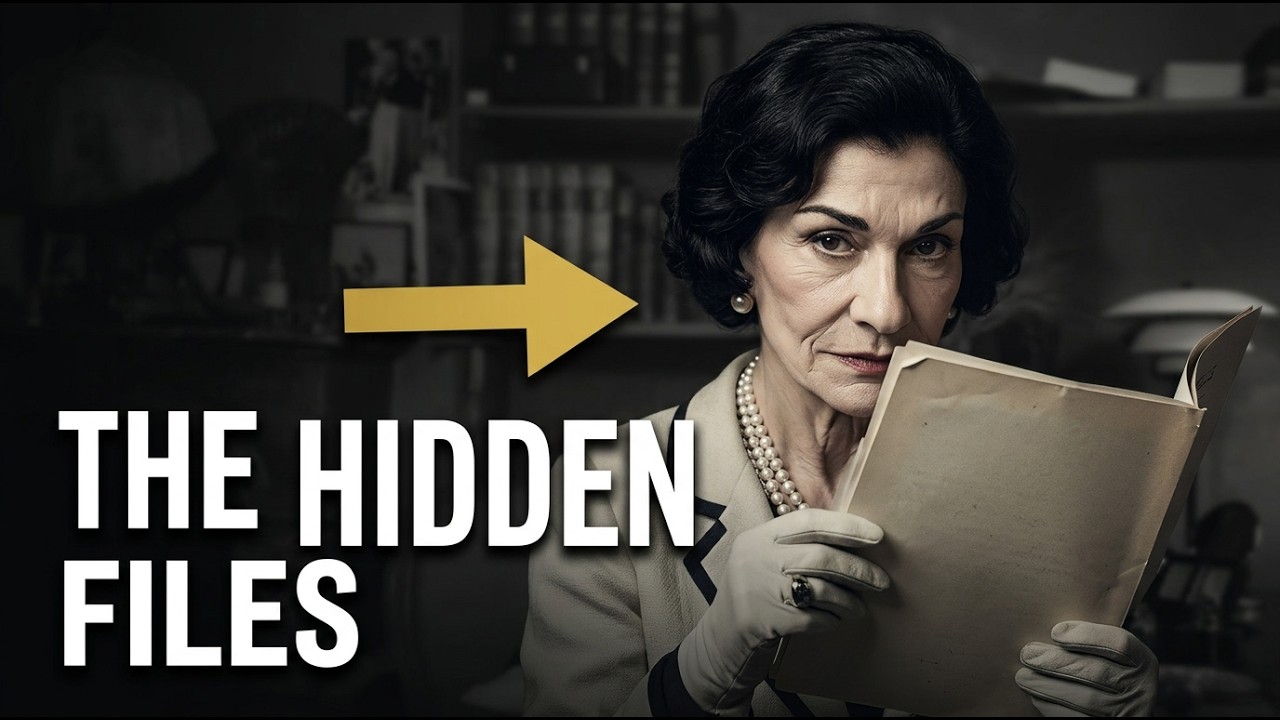
Her name was Coco Chanel. She had built the most famous fashion house on Earth. For decades, that file stayed buried — not lost, but buried on purpose by people who needed the world to keep believing in the little black dress.
To understand how Chanel ended up in that file, it helps to understand something about her first. Lying was not new to her. She had been doing it her whole life, starting with the one story she never let anyone correct.
The woman the world met as Coco Chanel was born Gabrielle Chanel, in a poor house, in 1883. For decades she told people she was born a full ten years later, in 1893. The lie was so consistent that even her own biographers took years to catch it.
When Gabrielle was 11, her mother died. Her father, a traveling street vendor, dropped her and her sisters at a convent orphanage in Oazine and never came back. She spent years there, raised by nuns among stone corridors and plain, functional habits.
For the rest of her life, she told the world she had been raised by wealthy aunts in the countryside instead. Being an orphan, possibly illegitimate, was not a sympathetic backstory in early 1900s France. It was a shame she refused to hand anyone.
Even her most famous nickname was a rewrite. Gabrielle spent her early twenties singing in cabarets, chasing a career that never took off, performing a novelty song called "Ki Ki Vu Coco." The crowd started calling her Coco. The failed singer disappeared from the story. The nickname stayed and became a global brand.
Design historians have long pointed out how closely Chanel's signature look — clean lines, black and white, stark minimalism — resembles the convent she spent her life trying to erase. Some even trace the interlocking double C, fashion's most recognizable logo, to the stained glass windows of that same orphanage.
She spent her life denying she had ever been that abandoned child, and may have built her empire out of the one place she refused to admit had shaped her. That instinct to erase what was inconvenient and build a better story on top of it resurfaced during the war in a much darker way.
By 1940, Coco Chanel had shut her fashion house down and moved permanently into the Ritz Hotel in Paris, which the Nazis had taken over as their own headquarters. Living one floor below German command, she began a relationship with Baron Hans Günther von Dincklage, a German aristocrat who was in reality an intelligence officer for the Abwehr, Nazi military intelligence.
That relationship became a recruitment. Chanel had one real point of leverage the Nazis could use: her nephew André, captured and held in a German prisoner of war camp. In exchange for help getting him released, she agreed to work for them.
She did not choose her code name. The Germans assigned her one — Westminster — a private joke referencing her past affair with the Duke of Westminster, one of the wealthiest men in Britain, years before the war. Her file number was F7124.

She was valued for exactly what made her famous: unmatched access to elite social and political circles in Paris, London, and Madrid. In 1943, that access got weaponized.
Nazi intelligence sent Chanel on a mission called Operation Modelhut. She traveled twice to Berlin to meet personally with Walter Schellenberg, the head of SS foreign intelligence, and was tasked with getting a secret peace proposal to Winston Churchill.
Using her old friendship with Churchill as the way in, she recruited a friend, Vera Bate Lombardi, to smuggle the message through Spain. Lombardi traveled to Madrid, then walked straight into the British embassy and told them everything. The plot collapsed. Chanel's one attempt to broker peace on Nazi Germany's behalf ended because the person she trusted to carry it turned her in.
Chanel was not just spying. She was also trying to use the machinery of the Nazi occupation to take an entire business from the people who actually owned most of it.
Chanel No. 5 was not hers alone. In 1924, she had partnered with two Jewish businessmen, Pierre and Paul Wertheimer, who financed and controlled 70 percent of Parfums Chanel. By 1941, with Jewish-owned property being seized across occupied France under Nazi Aryanization laws, Chanel saw her opening.
She petitioned Nazi officials directly, using the fact that the Wertheimers were Jewish as her legal argument to have their majority stake stripped from them and handed to her. It should have worked. It did not.

The Wertheimers had already seen this coming. They had fled to New York, quietly built a new perfume factory in New Jersey to keep making Chanel No. 5 legally on American soil, and — the move that actually saved the company — sold the original French business to a non-Jewish associate, an aviation manufacturer named Félix Amiot. It was no longer legally Jewish-owned at all under the exact laws Chanel was trying to use. Her own scheme had no target left to hit.
After Paris was liberated in 1944, French authorities detained and interrogated Chanel over her Nazi ties. She was released within hours. Many historians believe Winston Churchill personally intervened to keep her out of a trial that would have exposed wartime secrets on both sides.
She fled straight to Switzerland with von Dincklage and disappeared from public life for nearly a decade. Her intelligence file was not declassified in France until 2014, 60 years after the war ended.
But the twist that outlasted everything else concerns the same Wertheimer family she had tried to strip of their fortune using Nazi race laws. They ended up owning her financially for the rest of her life.
In 1947, rather than fight her in court, Pierre Wertheimer offered Chanel a settlement: a lump sum, plus a permanent 2 percent royalty on every bottle of Chanel No. 5 sold anywhere in the world, forever. It made her one of the richest women alive.
It also meant every franc she spent for the rest of her life came from the very family she had once tried to have erased. She got her comeback. She got her fortune. She never got to run the company that carried her name again.
The woman on the perfume bottle invented a childhood she never had, spied for the Nazis to save her nephew, tried to seize her own company from Jewish partners using the laws built to destroy them, and spent the rest of her life bankrolled by the family she failed to ruin.
That is not the story on the label.