When the coffin lid closed, Norman Chaney weighed only 110 pounds. He was just 21 years old. The boy known to millions as “Chubby” from *The Little Rascals* had died a lonely death, far from the sound stages where he had found a brief, complicated fame. His story was more tragic than any movie script.
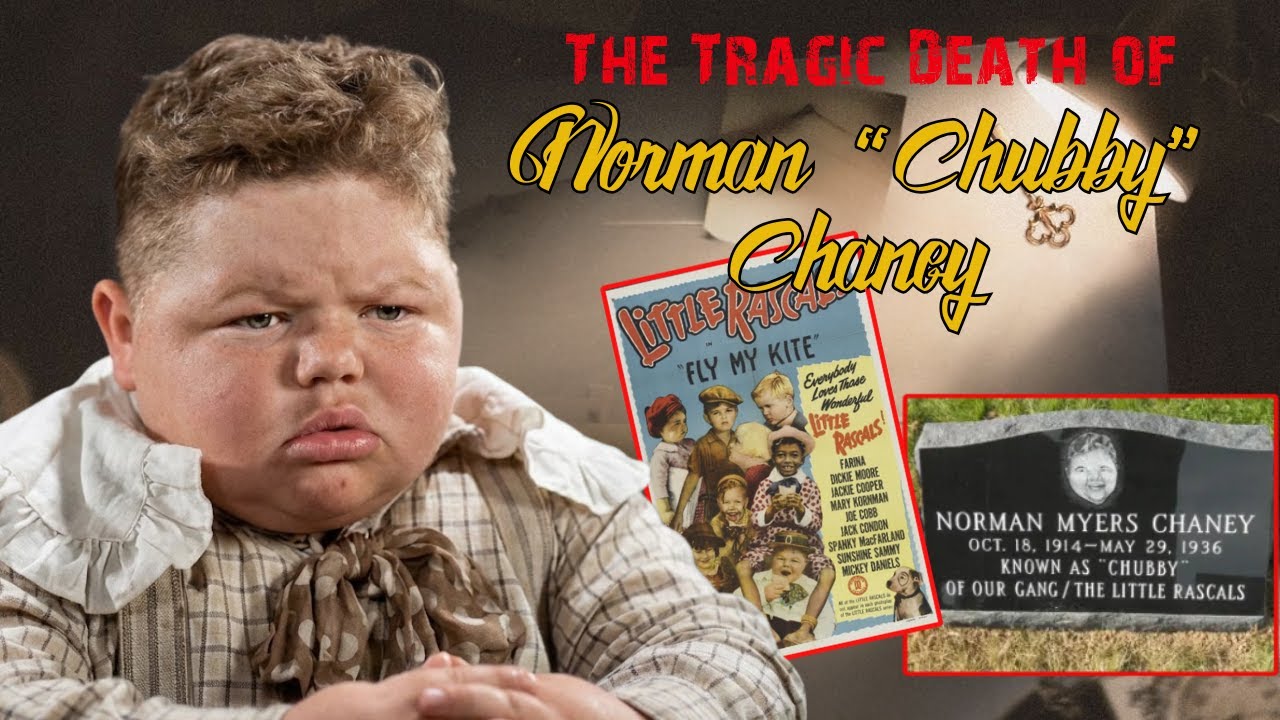
Norman’s life began far from the palm trees of California. Born in Maryland in 1914 to George and Margaret Chaney, his early childhood showed no warning of what was to come. George was an electrician, a practical man trying to build a life on the brink of the First World War. There were no stories of ancestors who could not fit through doorways.
But somewhere between his first and second birthdays, the genetic script flipped. The intricate dance of the pituitary gland, the thyroid, and the hypothalamus was still largely a medical mystery. Norman’s body began to store fat relentlessly, refusing to burn it regardless of his activity level. By the late 1920s, the entertainment industry was shifting.
In 1929, the studio system was looking for novelty acts. When the producers of *Our Gang*—soon to be known as *The Little Rascals*—put out a call for a heavy child, they were overwhelmed with applicants. It was a cattle call in the most literal sense. Norman had natural charisma, though.
He liked to perform. While other children stumbled over instructions, Norman listened intently, memorizing the entire script rather than just his own lines. He was heading to the dream factory, promised a life of luxury and adoration. But in exchange for that weekly check, Norman Chaney had to sign away his identity.
The studio gave him a new name, one that would stick to him like tar for the rest of his short life: Chubby. His body was the initial hook, but it was his voice and timing that sealed his fate. He was quickly integrated into the ensemble of professional child actors. His first credit was *Boxing Gloves* in 1929, and even then, his natural sense of timing shone through.
His true coronation came with the 1931 short film *Love Business*. It contains the sequence that would define his legacy forever—a moment that was viral decades before the internet. But behind the laughter was physical torment. He was a professional in a child’s body, enduring chronic pain to deliver the laugh.
He was a 300-pound teenager in a world not built for him. The simple act of standing for long periods under hot studio lights was exhausting. If the script said Chubby gets stuck in a window, Norman had to wedge himself into a frame until he was genuinely stuck, his ribs compressed, his breathing shallow, while the directors shouted for more flailing. Even then, there was a heartbreaking awareness in him.
He was likely the only one who understood the silent, sad trade-off happening in his own body. The studio was literally feeding the disease that would eventually kill him, all for the sake of a ten-second gag. And when the weight became the punchline, they used it. When the weight became a problem, they discarded him.
Matthew “Stymie” Beard, his co-star, described Norman not as a clown, but as the nicest guy on the lot. He never lost his temper, even when the director’s demands were humiliating. He was the gentle giant of the lot. But in the cold calculus of Hollywood, you are only as valuable as your last laugh.
After the production of *Fly My Kite* in 1931, the decision was made. Norman was 17 years old, and the studio decided he was no longer funny. He had outgrown his gimmick. The contract was not renewed.
When the weekly check stopped, the income stopped instantly. He was no longer an asset; he was a liability. The journey back east must have been agonizing. He was leaving the sunshine and the limelight to return to the gray reality of the Depression-era East Coast.
He was returning not as a conquering hero, but as a curiosity who had outlived his usefulness. In the real world, being a 300-pound teenager wasn’t funny. Determined to give their son a normal life, George and Margaret Chaney enrolled Norman in the Baltimore public school system. The American school system of the 1930s was designed for uniformity—rows of identical desks, rigid schedules.
On his first day at Public School 80, the logistical nightmare became immediately apparent. Norman, approaching 300 pounds and standing roughly 4 feet 7 inches tall, could not fit into a standard school desk. He had to sit in a piece of furniture that looked different from everyone else’s. He was often the first to raise his hand to solve an algebra equation, his eyes bright with satisfaction, even as his classmates snickered at the effort it took him to stand up to recite it.
Socially, his life was a solitary confinement. He was a celebrity, which created a weird distance. The fame he had known did not translate to the schoolyard. Between 1932 and 1935, the situation devolved from difficult to critical.
His weight crept upward, defying all logic. He was suffocating inside his own skin. His family knew that if they didn’t do something drastic, Norman would not see his 25th birthday. Their diagnosis confirmed what had been suspected but never treated.
To do nothing was a death sentence. The interventions began, and the result was a biological collapse. Almost immediately, Norman started to lose weight. 290, 280, 270.
At first, it must have seemed like a blessing. But then the descent accelerated. He was losing weight at a rate that the human heart and organs are not designed to withstand. After months of treatment, Norman was discharged.
If you saw him on the street, you would never have connected him to the jovial giant of the *Our Gang* films. When the weight suddenly vanished, the heart couldn’t simply shrink back down. The winter of 1935 turned into the spring of 1936. The *Little Rascals* shorts were still playing in theaters, delighting new audiences.
On screens across the country, the ghost of Chubby was still stuck in windows, still eating pancakes, still laughing. But in a quiet bedroom in Baltimore, the real Norman Chaney was fading. Hollywood had discarded him because he was too fat. First too big, now too small.
He never got to be just right. On May 29th, 1936, the struggle ended. The news of his death was a footnote. The studio system had moved on.
Norman was yesterday’s news, a depreciated asset written off the books years ago. He was invisible in death, just as the real Norman had been invisible behind the character of Chubby in life. His legacy was packaged into VHS collections and later DVDs. Norman Chaney was a guest in millions of living rooms every single week, but his actual grave remained unmarked for decades.
His story struck a particularly painful chord. It was heartbreaking, his co-star Matthew “Stymie” Beard later said in interviews. Eventually, a fundraising effort was launched. They needed roughly $4,000 to purchase high-quality black granite headstones for both Norman and his mother, Margaret.
Two headstones were unveiled. The inscription reads: *Norman Myers Chaney, “Chubby,” October 18th, 1914 to May 29th, 1936*. Below that is a simple line that acknowledges his contribution without defining him solely by it. For the first time in nearly a century, Norman Chaney was visible.
His story is a difficult mirror for the entertainment industry and for the audience. Norman was a gig worker before the term existed, used for his physical abnormalities and discarded when he broke. But his story is also a testament to the endurance of the human spirit. When you watch *The Little Rascals* today, you will still laugh.
But now you know that inside that suit was a boy from Maryland named Norman. He was the boy who grew too fast, but in the end, he was simply Norman.