The most perilous moment of Wyatt Earp’s life may not have been the famed gunfight at the OK Corral, but a later, far more harrowing confrontation in the Whetstone Mountains. That 30-second shootout in Tombstone, while iconic, was neither his closest brush with death nor the event that defined his legacy. Instead, it was the ambush at Iron Springs—a violent encounter that pushed Earp to the brink and reshaped his path. To understand what happened, one must set aside the cinematic polish that has long surrounded Tombstone’s dusty streets.
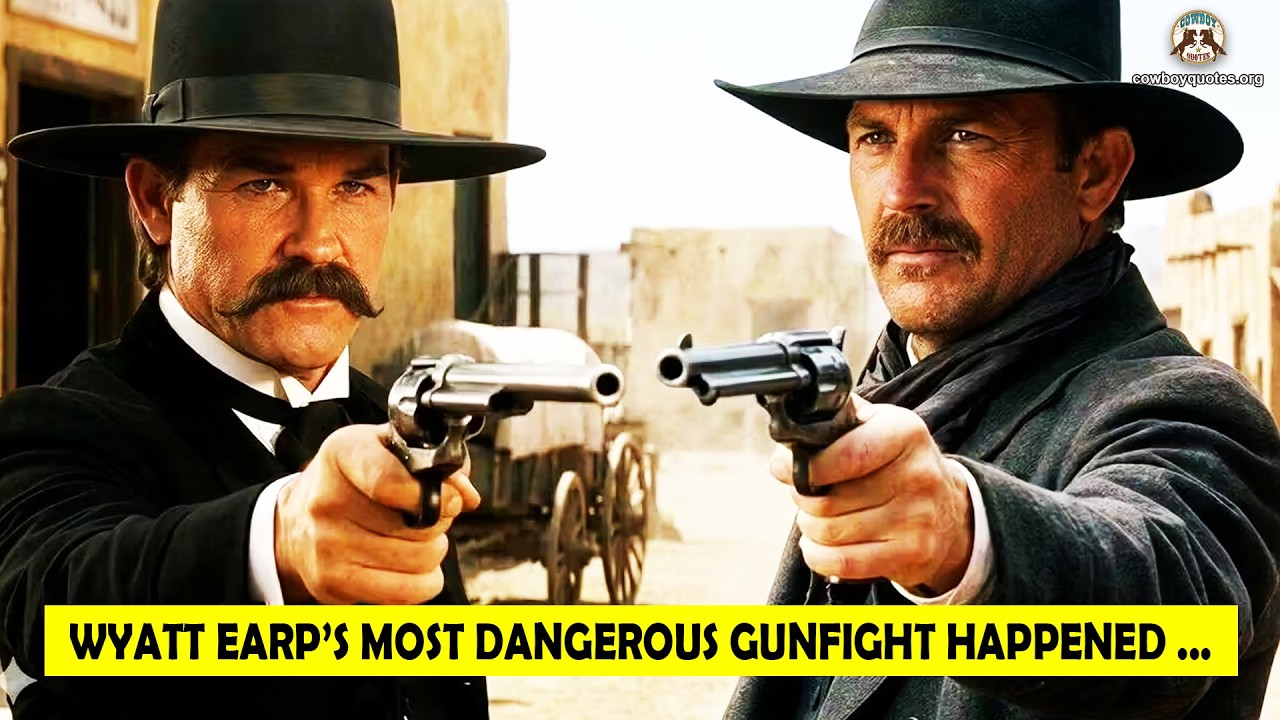
When Wyatt, his brothers Virgil and Morgan, and an ailing Doc Holliday faced Frank and Tom McLaury, Billy Clanton, and Ike Clanton, the two sides were separated by only a short distance. The heavy single-action revolvers of the era, like the Colt Cavalry Single Action, filled the air with thick smoke after the first exchange, collapsing visibility. Men fired blindly through the haze, their hearing dulled by the echoes bouncing off nearby buildings. Billy Clanton was struck while retreating toward a fence, and Tom McLaury was hit as he tried to shield himself behind a startled horse.
The encounter was brief and chaotic, ending before its full consequences could be grasped. The real fallout, however, unfolded in the months that followed. On the frontier, authority rested not only on firearms but also on newspapers and courtrooms. The rival Tombstone Nugget told a different story than the Earps’ allies, casting them as lawmen who had used their badges to attack men attempting to surrender.
For weeks, Wyatt and Doc Holliday endured a tense legal process, as Judge Wells Spicer weighed whether to send them to trial for murder. Records from the hearing reveal how genuinely close Wyatt came to facing execution—not in the street, but in a courtroom. This legal pressure deepened Tombstone’s divisions. By relying on the legal system to avoid prosecution, the Earps inadvertently pushed their rivals toward more drastic measures.
The OK Corral, then, was not the climax of the story. It left behind an uneasy stillness that settled over Tombstone like a winter chill. The Earps’ rivals chose to answer under the cover of night instead. This period marked a turning point where Wyatt’s role as a measured lawman gave way to something far more personal.
The first blow landed on the night of December 28, 1881, when Virgil Earp was ambushed and left badly wounded. Three months later, on March 18, 1882, Morgan Earp was shot while playing billiards. The 31-year-old, known as the most easygoing of the brothers, reportedly spoke quietly to Wyatt, recalling a promise the two had made about what might come after death, before passing away roughly 40 minutes later. Morgan’s death broke something in Wyatt.
He had spent months working within the boundaries of territorial law, wearing a badge, appearing in court, and following legal process. But losing Morgan, on top of Virgil’s lasting injury, convinced him that the legal system could not deliver justice. According to historical analysis, Wyatt resolved to step outside the formal legal process entirely. He abandoned warrants and court proceedings, choosing instead to handle matters directly and on his own terms.
The Cowboy faction may have expected the Earps to withdraw entirely, but Wyatt was already moving his family to safety so he could return to Cochise County without that concern weighing on him. That decision gave rise to the Earp Vendetta posse, a small, well-armed, and highly mobile group that crossed a legal line. This expedition was not an impulsive reaction. It was a deliberate shift.
While the group was moving through the region, they stopped near the town of Tucson. As the train pulled into the railyard after dark, a man named McMaster spotted two familiar figures near the passenger cars: Frank Stillwell and Ike Clanton, both linked to the earlier attack on Morgan. Once the two realized they had been spotted, they ran. Historical accounts record that Stillwell was killed in the encounter, while Clanton escaped into the darkness.
Another figure, a man named Cruz, was questioned about the others involved and also did not survive. Following these deaths, the legal situation reversed dramatically. Wyatt and his men now faced pressure from two directions: sought by the legal system they had once represented, and pursued by those seeking retribution for Stillwell’s death. They took refuge in remote areas, moving frequently and relying on their horses and instincts to stay ahead of pursuit.
The harsh conditions themselves posed a serious challenge, above all the need for water. Within a canyon in the Whetstone Mountains lay an important water source known as Iron Springs, later called Mescal Springs. A large group from the Cowboy faction, numbering between nine and twelve men, had left Tombstone and set up camp directly at the springs. To approach Iron Springs from the east—the direction Wyatt’s group was traveling—riders had to cross a small exposed ridge before descending into the wash below.
This created a natural blind spot. Those waiting below could remain hidden in the shade of the embankments, while anyone approaching would be clearly visible against the open sky. Historians who have studied the terrain in detail, including Jeff Morey and Peter Brand, note that the geography gave a considerable advantage to whoever controlled the low ground. Curly Bill and his men reportedly heard the approaching riders on the rocky trail well before they came into view.
They extinguished their fires, prepared their rifles, and took up positions using the natural cover. At a distance of less than 30 yards, the ambush might have ended the Vendetta Ride entirely. Instead, it led to a tense, moment-by-moment struggle. Wyatt, wearing a long canvas duster and carrying his shotgun secured to his saddle, dismounted to face the situation directly.
But the commotion startled his horse, which ran off into the brush, taking with it the ammunition belt he had set aside just minutes earlier. With his companions scattered and the opposing group still nearby, Wyatt remained in place. He fired both barrels of his shotgun, and by his account, this ended the confrontation with Curly Bill at close range. Historians remain divided on this point.
Curly Bill’s fate relies heavily on Wyatt Earp’s own retelling rather than independent corroboration and remains a subject of historical debate. Despite continued gunfire in his direction, Wyatt managed to get back on his horse and return to where the rest of his posse had regrouped. His long canvas duster had multiple bullet holes throughout. Whether this outcome was due to skill, chance, or some combination of both, it became part of what cemented his reputation on the frontier.
The aftermath at Iron Springs marked more than the end of a single desert confrontation. The Cowboy faction had lost a key organizer and one of its most recognized leaders. For Wyatt and his posse, however, the outcome came with real consequences. If the OK Corral demonstrated his ability to handle a chaotic close-quarters situation, Iron Springs contributed to a broader public image of a composed, seemingly untouchable figure associated with frontier justice.
Historians examining the larger arc of Wyatt Earp’s story often point out that its most consequential moment may not have been the well-known encounter in Tombstone’s alleyway but the events in the Whetstone Mountains, where he found himself isolated during an ambush and emerged without physical injury. In the end, the gunfight most people remember may not be the one that actually defined Wyatt Earp.