Many may recognize the name Hastein from *The Last Kingdom*, where he is portrayed as a cunning and self-serving Viking. Yet the true story of Hastein is far grander, etched into history as a saga of a warrior whose ambition and prowess knew no bounds. He was one of the most successful and infamous Vikings of all time, far more powerful than his portrayal in the series, although the two do share some characteristics. His life was a tapestry of conquest, spanning from the shores of France to the lands of North Africa, where he raided cities and kingdoms across Europe.
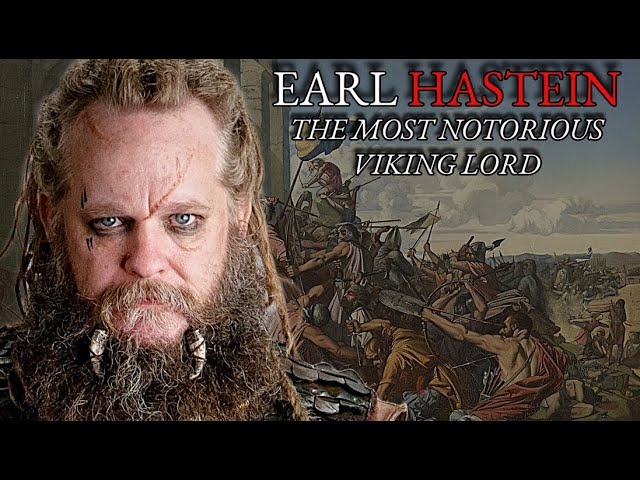
His endurance on the battlefield, combined with his ability to navigate dangerous political waters, made him a formidable force. He was a veteran of a hundred battles, having outlived countless foes. His exploits inspired countless tales, songs, and sagas, immortalizing his deeds in the collective memory of the Viking world. He lived the true Viking life, raiding, pillaging, and leading multiple expeditions across the seas.
Although time may have faded the details of his final years, his legendary exploits in Jael and Hastein will always be remembered as one of the greatest—albeit forgotten—Viking sagas to ever sail the seas. Hastein’s early life remains shrouded in mystery. Born around the year 810, he may have been raised in a foreign land, later uncovering his Scandinavian roots through family lore or ancestral disputes, which prompted his return to the North. Alternatively, his true parents may have been lost to the ravages of time, forever obscured in the fog of history.
Whether born among the Saxons, the Danes, or the bloodline of Ragnar, his origins remain a mystery, with competing theories offering glimpses into the past but none providing a definitive answer. In the year 859, Hastein sailed from France aboard a formidable fleet of 62 ships. These dragon-headed longships, designed for speed and maneuverability, were ideal for raids upon distant shores, enabling the Vikings to strike quickly. Their first target was the Iberian Peninsula, where they capitalized on the relative weakness of the Christian kingdoms and the ongoing strife between local rulers and the Muslim Saracens.
The kingdom of Asturias, located in what is now Northern Spain, was ruled by King Ordoño I, a monarch embroiled in relentless war against the Saracens. These Muslim invaders had swept across the Iberian Peninsula since the year 711, leaving destruction in their wake. Overwhelming the defenders, the Vikings eventually took the city, looting the homes of the wealthy. In an act of utter defiance, still worshiping the Norse gods of old, the Vikings set fire to the mosques in the city.
With their raid complete, they amassed great wealth in gold, silver, and slaves—goods they would later sell or use to fuel their ongoing Mediterranean campaign. Emboldened by their success, Hastein and his ally Bjorn turned their sights southward. Their reputation as ruthless raiders preceded them, seizing wealth and slaves while striking fear into the hearts of the local populace. Their next targets were the wealthy cities in southern France, where they wreaked havoc, looting treasures and taking prisoners.
Hastein eventually set his sights on the fabled city of Rome itself, the heart of the ancient world. However, the town, a center for marble mining in its prime, had long since lost its importance, now a quiet village of stone and dust with only the faintest echoes of its past grandeur. Ever the strategist, Hastein knew that brute force alone would not win the day. He could see the imposing walls of the town and recognized that a frontal assault would be fruitless.
Instead, he devised a plan so devious and cunning that it defied belief. Pretending to be on the verge of death, Hastein requested the gods allow him to enter the town and convert to Christianity before his final breath. Word quickly spread that the Viking warlord sought to embrace the faith, and moved by the belief in redemption, the townspeople ushered him into the church. Once inside, Hastein sprang from his deathbed, signaling his warriors to attack.
The ruse worked, and the town was taken. Yet, the victory was not without its bitter irony. When Hastein learned that he had sacked the wrong town—not Rome, but a lesser settlement—he flew into a rage. In his fury, he ordered the massacre of the townspeople, sparing none, and enslaving many women and children who had become his captives.
His victory, once glorious, became a tale of brutal vengeance. The Vikings then sailed along the Italian coast, turning their sights on the city of Pisa. There, their longships met a fierce defense, and they lost two vessels at the Straits of Jalar. Despite this, Hastein pressed on, his fleet battered but still formidable.
He turned his attention to the city of Luna, where the Vikings struck once more, raiding and pillaging as they had done before. By 893, Hastein’s ambitions turned back to England. With a force of 80 ships, he landed on the shores of Kent, occupying the royal village of Milton Regis. His ally, with a much larger fleet of 250 ships, disembarked at Appledore, yet the two forces were prevented from joining forces.
Ever the pragmatist, Hastein sought to avoid an all-out conflict and agreed to come to terms with Alfred the Great. One of the conditions of the peace was the baptism of his two sons, a symbolic act of peace. With these terms in place, Hastein withdrew from Kent, moving his forces to Essex. But the peace would not last.
The larger Viking force, having raided Hampshire and Berkshire, sought to reunite with Hastein. However, their movements were restricted by relentless English pressure. By the year 896, with their options dwindling, the Viking raiders began to disperse. Some made their way to East Anglia, while others journeyed northward to Northumbria.
Those without the means to continue the fight found ships and sailed south, leaving England for a time. Hastein, ever relentless in his pursuit of wealth, launched a second devastating raid across England. His forces ravaged the countryside, but the English forces pursued them and trapped them at a place called Buttington. The Anglo-Saxon Chronicle recounts the desperation of the Viking defenders, noting that after many weeks had passed, some of them starved.
Despite his legendary status, Hastein’s quest for wealth, power, and glory in England ultimately yielded little for the kingdoms of Wessex and Mercia. He broke his word to Alfred not long after the peace agreement, knowing that the result would mean war. His forces moved up the River Lee, seeking to attack vulnerable positions. But Alfred the Great, recognizing the precariousness of the situation, devised a clever strategy.
He ordered the construction of two fortresses on either side of the river, blocking the Vikings’ advance. Their movements restricted, the Viking force was effectively neutralized. Hastein, with his son’s wife and children, was at Benfleet, where the English captured his wife and sons. One of the boys was the godson of Alfred, and the other the godson of Earl Ethelred.
The English offered to return them if Hastein would leave the kingdom, a deal he was forced to accept. Hastein’s forces continued their campaign, moving up the River Lee, but by this time, the Viking threat had begun to wane. Even the once-mighty Hastein, his fleet reduced and his options exhausted, could not escape the relentless pressure of the English. His forces eventually dispersed, and he sought refuge in the ruined Roman fortress at Chester, located in East Anglia.
By the year 893, he was determined to rebuild the fortifications and use the site as a base for further raids into Northern Mercia. But the Mercians, ever watchful, prevented him from joining forces with his allies. After several days of evading the English forces, they eventually arrived at Mersea, an island off the eastern shore of Essex, where they established a new base. In the following months, the Viking raiders continued their campaign, but the English forces captured several of their ships, adding another blow to Hastein’s already stretched resources.
Despite these setbacks, Hastein’s forces continued their relentless campaign, moving up the River Lee, seeking to strike at the heart of the English kingdom. But the Viking force that had once threatened to fracture the very foundation of the English kingdom ultimately fell short of its goal. Hastein, a man described as a lusty and terrifying old warrior, had outlived countless foes, but his fearsome spirit had never dimmed. He was one of the most notorious Vikings of all time, having raided dozens of cities across many kingdoms in Europe, the Mediterranean, and North Africa.
He navigated the seas of most of the known world during his time, a veteran of a hundred battles. Although the details of his final years may have faded, his legendary exploits will always be remembered. He lived on as a symbol of the Viking way of life, his name forever etched into the annals of history as one of the greatest Vikings to ever sail the seas.