The morning of February 14th, 1929 began like any other winter morning in Chicago. Inside a quiet North Side garage, members of the North Side Gang, one of the most powerful criminal groups in Chicago, waited beside a truck. None of them knew they were standing inside a room that would soon become one of the most infamous crime scenes in American history. The door opened, and two uniformed police officers entered the building.
Following behind them were two more men dressed in dark civilian coats. The presence of the police was meant to be reassuring. After all, the police had guns pointed at them. But then the two uniformed men stepped aside, and the men in civilian coats lifted their weapons.
Weapons capable of spraying bullets faster than most people could react. What happened next lasted only a few seconds. Bullets slammed into the brick wall, ripping through coats, flesh, and bone. The sound was deafening inside the small building, a violent storm of metal and smoke.
But the most chilling part came after the shooting stopped. Two of the gunmen pulled the police caps lower over their eyes and raised their hands as if surrendering. From the outside, it looked exactly like a successful police raid. By the time real officers arrived, the killers were already gone.
Inside the warehouse, the scene looked like something from a battlefield. Seven bodies were stacked near the back wall, exactly where they had been ordered to stand. Within hours, newspapers across the country were printing the story. The nation would soon give the massacre a name that would never be forgotten.
The Saint Valentine’s Day Massacre had just become the most sensational gangland killing in American history. In police headquarters, inside smoky speakeasies, among reporters chasing the biggest story of the decade, one name came up again and again: Al Capone. Reporters even spoke to him there that same day. Photographs and interviews placed him far from the crime scene.
No written orders or recorded conversations tied him to the killers. Every lead collapsed into silence. But inside Chicago’s underworld, the answer felt obvious. Because an operation like this required planning, discipline, and absolute authority.
Not because anyone could prove it, but because no one else was powerful enough. Above it all stood Capone. He was the system. But beneath the public generosity was a darker truth.
The same empire feeding the poor also ran one of the most violent murder operations in Chicago’s history. The massacre in that quiet North Side garage was only the most infamous example. If Capone never pulled the trigger, who actually did? Who walked into that warehouse wearing a police uniform and carried out one of the most precise gang executions the country had ever seen?
In Chicago’s criminal world, violence rarely appeared by accident. And somewhere behind the gunfire of that winter morning was the beginning of a story far bigger than a single massacre. But the story of Al Capone did not begin in Chicago. It began in a rough neighborhood in New York, where a boy who would one day build an empire powerful enough to make an entire city bow to his rule first learned about violence.
Life in their neighborhood was harsh and unforgiving. Poverty shaped daily life. Arguments between teenagers often turned into fist fights. School did not hold his attention for long.
He could understand lessons quickly, but his temper often created problems. Eventually, that temper would change the course of his life. He was expelled and never returned to school. At first, he ran simple errands and spent time with older boys who already had connections to criminal networks.
It was a pipeline into organized crime. Capone began working inside these establishments. It was in one of those bars that the moment happened which would define his appearance for the rest of his life. A man pulled a knife, and the blade flashed across Capone’s face before anyone could stop it.
Three thick lines were carved into the left side of his face. The scars gave him the nickname that would follow him for the rest of his life: Scarface. Among gangsters, the mark only increased his reputation. Instead of chaos, he believed crime should be organized like a corporation.
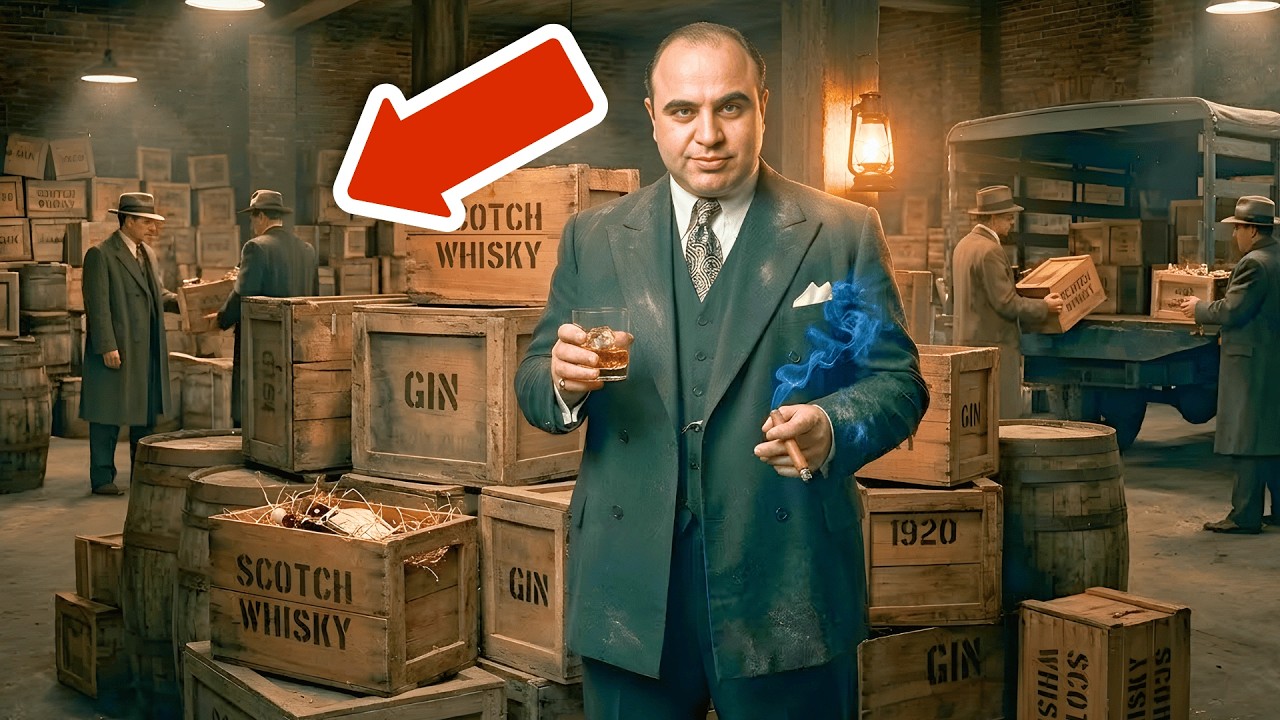
Violence was sometimes necessary, but the real power came from structure, money, and influence. Chicago in the early 1920s was about to experience a transformation unlike anything the city had seen before. The law banning alcohol did not stop people from drinking. Instead, it created the most profitable black market in American history.
Millions of people still wanted whiskey, beer, and gin. This was not simply a law banning alcohol. Trucks transported alcohol across state lines during the night. Behind unmarked doors, customers drank illegally while jazz bands played and waiters moved between crowded tables.
Money poured into the operation. Every night, thousands of customers paid for drinks that the law claimed should not exist. Within only a few years, the business had grown into one of the most profitable criminal enterprises in the country. Then a violent moment changed the structure of power inside the organization.
Bullets shattered the windows of his car and struck him several times. After recovering, he decided he had earned enough money and seen enough violence. Before leaving, he handed control of the entire empire to the man he trusted most. Capone was only 26 years old.
Soon, the conflict between the two gangs turned into one of the bloodiest criminal wars in Chicago’s history. Each side tried to eliminate the other’s leadership, and every attack pushed the conflict toward something even more dangerous. Because in Chicago’s underworld, wars like this rarely ended quietly. The war between Capone and Moran was spiraling out of control.
Each side tried to wipe the other from Chicago. Gunfire echoed between brick buildings and explosions shattered windows in the middle of the day. Cars filled with gunmen raced through neighborhoods while bullets tore through storefronts and restaurant windows. Taxi drivers avoided certain streets after dark.
Each attack from George “Bugs” Moran felt like a direct challenge to Capone’s authority. He believed the war had only one real solution: eliminate Moran, not just weaken his gang, destroy it completely. Somewhere inside Capone’s organization, a plan began to take shape. It would be precise, theatrical, and terrifying enough to end the conflict in a single moment.
If they entered a building wearing uniforms, the rival gang members would never suspect what was about to happen. If the plan worked, several of Moran’s most trusted men would be there at the same time. Inside the building, several members of Moran’s organization waited beside a truck. Then the gunmen pulled out Thompson submachine guns.
What followed lasted only a few seconds. Bullets tore through the narrow garage, smashing into bodies and brick with terrifying speed. Two of the raiders raised their hands as if surrendering while the men dressed as police escorted others outside. Within hours, the story exploded across the nation.
But the most shocking twist came soon afterward. The true target of the attack, George “Bugs” Moran, had never entered the warehouse. He had arrived only minutes too late. That small delay saved his life.
Although investigators could not prove his involvement, the public already knew the mastermind behind the attack. Reporters began calling him something no gangster had ever been labeled before: Public Enemy Number One. Federal investigators began searching for any crime that could bring him down. Evidence often disappeared before reaching courtrooms.
If they could not prove murder, they might prove something else: taxes. Investigators began building a case based on one simple idea. If Capone had earned millions of dollars but never reported the income, he had broken federal law. The sentence shocked even experienced observers: 11 years in federal prison.
The most powerful crime boss in America was finally defeated, not by gunfire or gang warfare, but by tax law. Years earlier, he had contracted untreated syphilis, a disease that gradually attacked his nervous system. After serving several years, Capone was released due to declining health. Yet his story did not disappear.
Capone became one of the most famous figures in the history of organized crime. His name became permanently linked to the violent glamour of the Prohibition era in the United States, a time when a single law intended to eliminate alcohol instead created one of the most powerful criminal empires in American history. It simply handed control of the market to men willing to break the rules.
But in the end, the same legal system he had manipulated eventually closed in around him, not with bullets, not with gangsters, but with the quiet power of the law itself.