In the middle of December 1944, an American soldier with the Third Army stood in snow up to his knees and watched a column of Sherman tanks grind toward a town he had never heard of two weeks earlier. He was 21 years old and had been fighting since France fell behind him months before. By then he thought he understood the nature of this war: slow, exhausting, and measured mile by mile. December 19 was about to change that entirely.
Three days earlier, on December 16, the Germans had launched a massive surprise offensive through the Ardennes, punching through the center of the American lines and splitting Bradley's army group in two. From his position, the soldier did not yet grasp the full scale of it. All he knew was that an entire American airborne division was trapped somewhere to the north, in a town called Bastogne, and that headquarters had suddenly stopped talking about anything except moving fast.
On December 22, German commanders sent Bastogne an ultimatum demanding honorable surrender. Within two hours, the American general leading the defense, Anthony McAuliffe, sent back a one-word reply that became legendary within days. The soldier never heard the exchange. He only felt its consequences in the ferocity of the German fighting around Bastogne after the deadline passed without a surrender.
At a meeting in Verdun, Eisenhower turned to Patton and asked when the Third Army could attack north to relieve the town. Most generals in the room believed the honest answer was weeks. Given the distances and the weather, no one could really blame them for thinking so. Patton did not hesitate. Forty-eight hours, he said. No one in that room, including Eisenhower, quite believed he could actually do it.
Turning an entire army 90 degrees in the middle of a winter campaign is not something military logistics is designed to absorb easily. It means redirecting supply lines, artillery, and thousands of vehicles that had been pointed in one direction for weeks, suddenly aimed somewhere else entirely. Most officers around the soldier assumed the paperwork alone would take days, let alone moving the tanks.
The German breakthrough had just split the battlefield. It split the chain of command. It split itself. With Bradley's headquarters in Luxembourg cut off from his forces north of the bulge, Eisenhower made a decision that would shape the soldier's story more than anything else that week. He placed British Field Marshal Bernard Montgomery in temporary command of everything north of the breach, while Bradley kept the south, including the Third Army, now tasked with counterattacking from the bottom upward.
For a moment, it seemed like it might be simple. Two armies, two directions, converging on the same crisis. The soldier expected both halves to move at roughly the same pace. They did not.
The weather was merciless to both sides in the early stages. In the first days of the offensive, a full blizzard settled over the entire Ardennes region, grounding every aircraft on both sides of the line. The same weather that had made the whole campaign miserable since the autumn rains had not truly let up. The skies finally cleared on December 23, allowing Allied fighter-bombers to return to the fight for the first time in more than a week, just as the soldier's column crept north.
On December 22, in the middle of that same blizzard, Patton's three divisions attacked exactly where he promised and almost exactly on the timeline he promised, breaking the German flank along a 20-mile front and pushing it back 7 miles on the first day. The soldier was part of that attack, driving through snow so thick he could barely see the tank ahead of him, heading toward a town everyone in the column now knew: Bastogne, where the 101st Airborne had been surrounded for days, refusing every surrender demand.
He did not know it yet, but while his column crawled mile by mile through the suffering, the man now commanding the entire northern wing was spending these days doing something very different. Field Marshal Bernard Montgomery, who had just taken charge of American forces north of the breach, spent the period reinforcing his positions and pulling his reserves back to the Meuse River to make sure the Germans could not cross it.
This was no small thing. Those reserves genuinely helped prevent the German advance from pushing further north. Arguably, a cautious and methodical commander was exactly what that wing needed at that precise moment. But it was not a counterattack either. While the column struggled through snow-choked roads toward a besieged town, the northern wing remained essentially static, waiting and watching, massing for an offensive that would not truly begin until January 3, eleven days after the column reached Bastogne.
Patton wrote in his diary during this period that his men were in high spirits, full of confidence, and that the situation at Bastogne was dangerous but not hopeless. The soldier felt the danger more than the confidence on most days. Confidence is easier to write on paper than to feel while your feet freeze inside your gear, moving through terrain that punishes every mile with a cold most men in the column had never experienced, not even during the worst autumn rains this army had endured for months before winter truly set in.
By Christmas Day, elements of the 4th Armored Division, the spearhead of the entire attack, were close enough to Bastogne that the soldier could hear the fighting from inside the defensive perimeter itself. He expected the final stretch to be the easy part. It was not. German resistance around the villages surrounding Bastogne was ferocious, and some of the fighting in those last few miles cost more casualties than anything since the counterattack began.
Near a village called Assenois, an artillery barrage meant to pave the way for the column fell in the wrong places, hitting some of the men in the open. As German soldiers rushed into the gap to plant mines on the road behind the advancing tanks, a handful of vehicles made it through anyway, alone, ahead of the rest of the column, unsure whether the perimeter they were racing toward had even held after eight days of siege.
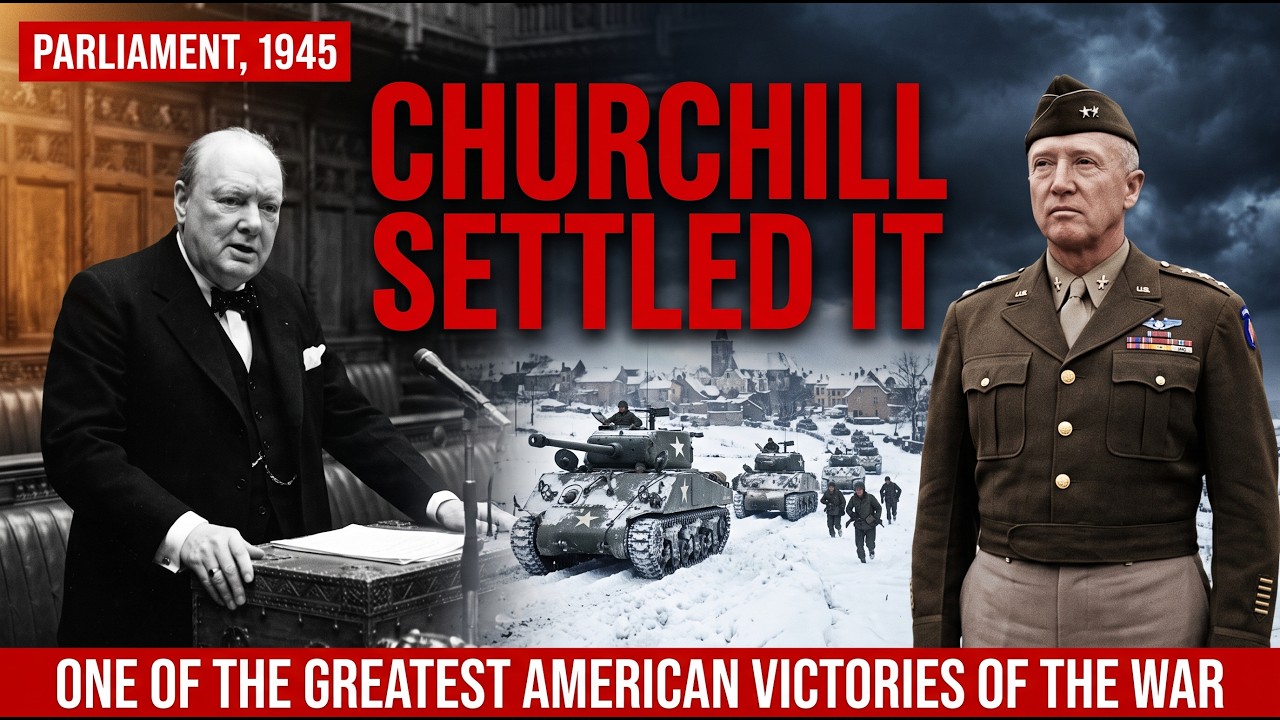
On December 26, exactly four days after the counterattack began in the snow, the lead elements of the Third Army finally broke through and reached the besieged perimeter, ending the siege that had held the 101st Airborne since before Christmas. An American engineer from the 101st came out to meet the lead tank, raised his hand, and said something brief and simple enough to end the siege in four words.
The soldier was one of thousands of men who had covered that distance through weather and resistance that should have taken far longer than four days to overcome. He did not know it yet, but the stand at Bastogne and Patton's speed in reaching it were about to become the center of an argument he would never personally be part of. An argument in rooms he would never enter, between generals and a prime minister who had never once had to walk through the snow the soldier had just crossed.
Less than two weeks after the liberation of Bastogne, on January 7, Field Marshal Montgomery held a press conference. At that conference, he left a clear impression that he had saved the entire battle himself, praising the American soldier while hinting cautiously that American military leadership had needed a British hand to steady it. News of the press conference spread quickly, and its effect was very bad, especially among American commanders who had spent Christmas week fighting through snow and mines.
While Montgomery's counterattack had not yet begun, his own assessment of the situation, written around the same period, described Bradley as a good officer who had let Patton rush too far, while acknowledging that Montgomery himself, on his own front, had done no more than hold the line using American forces already in position before he arrived. The political fallout was bad enough that it reached Parliament.
The soldier heard none of this directly. He was not in London and not in any press room. But the argument that followed was, in its own way, entirely about what he had just done. About whether the four days he spent frozen in a tank column truly mattered, or whether history was about to quietly credit someone who had stood still for eleven days longer on a different wing.
On January 18, 1945, Winston Churchill stood in the House of Commons to settle the matter. He did not mention Montgomery's press conference directly. He did not need to. He simply stated for the official record what had actually happened, describing it without reservation as one of the greatest American victories of the entire war. A victory history would remember in exactly that way.
The soldier never heard him say it. He was still somewhere in Belgium when Churchill said it, still fighting in the same offensive that had not quite ended. Unaware that a prime minister had just stood in Parliament specifically to ensure his four days in the snow would not be quietly folded into someone else's account of the battle.
The numbers, when they finally emerged, made the scale of what had just happened hard to argue with in any form. American casualties in the entire Battle of the Bulge reached roughly 81,000, including more than 19,000 killed. It was the bloodiest battle the United States Army fought in the entire war, more costly in American lives than any other engagement of World War II.
British casualties on the northern wing during the same period totaled around 1,400, with roughly 200 killed. A real contribution and a real sacrifice, but on a scale that made the comparison Montgomery's press conference seemed to invite look, to anyone doing the math, grossly unequal.
The soldier did not need Churchill's speech to understand what those two numbers, placed side by side, said about whose battle this really was. By every important measure, it was an overwhelmingly American battle, fought mostly with American blood, on ground defended entirely by American units before any reinforcements arrived from any direction. The 101st Airborne held at Bastogne alone for more than a week before the column got close enough to make any difference.
Historians would spend decades afterward analyzing how much credit truly belonged to each side. Montgomery's reserves helped hold the Meuse, and that stand was essential. The way he moved British troops south to prevent any German crossing was, by the most honest accounts, a real and necessary contribution to shaping the battle's course. Patton's four-day drive through snow and resistance broke the siege of Bastogne at the moment it mattered most, and at a speed no one at the Verdun meeting believed possible. Both things are true. Neither entirely cancels the other out.
But only one of these two men had a prime minister stand in Parliament specifically to correct the record in his favor. And only one of these two men spent the two weeks after the battle holding press conferences instead of counting his losses.
The soldier spent four days reaching a town most men in his column had not heard of two weeks earlier, fighting through snow, mines, and an enemy that did not stop resisting until the last mile. Elsewhere on the same battlefield, another army spent those same four days simply holding its positions, waiting for a larger, more cautious offensive that was still eleven days away.
History remembers both. But it remembers them differently. It was not a general who decided that. It was not the men freezing in the snow on either side who decided it either. It was a prime minister who stood in a room the soldier's feet had never touched, to say aloud what the soldier had proven true in the snow, days and weeks after the fighting itself had ended.