In the spring of 1943, reports about a new German vehicle circulated through the staffs of the Soviet tank forces. Front-line scouts, intercepted radio traffic, and scattered statements from displaced crews all described a heavy tank, larger and more angular than anything the Wehrmacht had fielded before.
In the command posts, these reports were read with the calm of men who believed they had long since seen through the German armored force. That calm had a name, and the name was T-34.
Since the autumn of 1941, Soviet crews had known that their medium tank was technically superior to German machines. The sloped armor, the wide tracks, and the gun had delivered a blow to the German panzer troops in the first winter of the war that Soviet staffs still spoke of with pride two years later.
Anyone who had torn apart the Panzer III and the early Panzer IV at range saw no reason to fear another German box. On paper, the calculation was simple: more tanks, better shape, harder crews. Reality would look different.
At a situation briefing of a tank brigade of the Voronezh Front, recorded in a brief protocol from April 1943, a judgment was passed on the new German vehicle that captured the mood of those weeks exactly. A political officer is said to have dismissed the reports with the words that the Germans were now building iron boxes because they were running out of men.
It was said to be too heavy a vehicle, slow, clumsy, a target rather than a hunter. The commanders present laughed. It was not malicious laughter. It was the laughter of soldiers who believed they had the worst behind them.
That very laughter would fall silent in the summer, in the wheat fields around Kursk.
The sober truth was that Soviet intelligence knew of the German vehicle without understanding it. Its existence was known. First examples had already appeared in August and September 1942 south of Lake Ladoga near Leningrad, sent forward individually under poor conditions in swampy terrain, several of them breaking down or being knocked out.
From this failed debut, the Soviet staffs drew a fateful conclusion. They took the new tank to be an immature stopgap solution, a technical experiment by a hard-pressed enemy.
What they overlooked was the combination that placed this vehicle in a different performance class from anything that had driven on the Eastern Front so far: armor, firepower, and a gun whose range neutralized that of the Soviet cannons in any direct duel.
The mistake was not an isolated case and not a Russian peculiarity. It was a human error, and it repeated itself almost word for word a year later on the other side of the continent. When Allied intelligence officers in the spring of 1944 had reconnaissance photos of another new German tank, the Panther, on their desks, they reached a similarly reassuring conclusion: a good vehicle, but technically no quantum leap. That error, too, would be paid for with burning tanks and dead crews.
The common denominator of both misjudgments was a single assumption, as plausible as it was false: that superiority in numbers means superiority in every single encounter.
Within the Soviet tank staff there were voices that looked more closely. Technical scouts had examined the knocked-out examples near Leningrad, had measured the strength of the frontal armor, noted the caliber of the gun, and registered the length of the barrel. Their reports were on file. They were read and set aside.
Against the weight of two years of war, in which their own tank had been the measure of all things, a technical table had no chance. People believe what they have experienced, not what is written on paper.
So the Red Army marched into the battle that would go down in history as Operation Citadel with thousands of T-34s, with the experience of won battles, and with the calm conviction of being technically a match for the German opponent. The new tank that had been laughed at in April was meanwhile waiting in the German assembly areas. It bore a name that would soon make no Soviet tank driver laugh anymore.
In the German army it was called Panzerkampfwagen VI. The men who drove it, and soon also those who faced it, called it by a single word: Tiger.
The Tiger was not a spontaneous idea and not a stopgap product. Like the Panther, it was the direct answer to a shock. In the summer and autumn of 1941, German tank crews faced the T-34 and the heavy Kliment Voroshilov in larger numbers for the first time, and the experience was sobering.
The German guns of 1941, above all the short cannon of the Panzer IV and the 5 cm armament of the Panzer III, bounced off the sloped Soviet armor at range. Several reports from those weeks describe how German crews hit a single KV-1 with a dozen rounds without knocking it out.
Out of this helplessness arose the demand for a vehicle that could penetrate at any combat distance and at the same time be almost invulnerable. The Henschel firm in Kassel received the contract for the chassis. The result was a monster.
The vehicle weighed around 57 tons combat-ready, more than twice that of a T-34. The frontal hull armor measured 100 mm, the front of the turret also around 100 mm, the sides 80 mm. Unlike the T-34 and the later Panther, the designers largely dispensed with slopes. The Tiger relied not on angling but on sheer thickness.
That made it tall, angular, and heavy, but it made it practically impenetrable from the front at the usual combat distances of 1943 against the standard Soviet cannons.
The heart of the vehicle was its gun. The 8.8 cm tank gun with a barrel length of 56 calibers descended from the notorious 88 anti-aircraft gun, which had already been used against tanks in France and North Africa. It fired a shell with a muzzle velocity of around 800 meters per second and hit at long range with a precision that was unmatched in 1943.
Here lay the decisive difference, and it can be captured in a single number. At 1,000 meters, the Tiger's gun penetrated over 100 mm of armor steel. The 6.0 cm gun of the early T-34 could not get through the 100 mm thick vertical Tiger front at the same distance.
The Tiger could destroy the T-34 at distances where the T-34 was unable to strike back. It was the same deadly asymmetry that Sherman crews would experience a year later in Normandy. Whoever hits and penetrates first wins. Everything else is statistics.
But the Tiger had a price, and that price was as high as its armor. The vehicle was a mechanical diva. The Maybach engine, originally designed for a significantly lighter vehicle, operated at the edge of its load limit and tended to overheat under overload, in individual cases to catch fire.
The complicated, interleaved running gear with its overlapping road wheels offered excellent cross-country mobility but clogged with earth, stones, and ice in the mud and frost of the Eastern Front. The range was short, the fuel consumption enormous.
A bridge first had to be able to bear the weight of 57 tons, which sharply limited march routes. Every Tiger that broke down failed at a spot where it was hardly recoverable, since only a second Tiger or several tractors could tow it at all.
The first deployment under precisely those unfavorable conditions from which the Soviet staffs derived their false conclusion took place in late summer and autumn 1942 south of Lake Ladoga near Leningrad. The terrain was as unsuitable for a heavy vehicle as could be imagined: swampy, narrow, cut by trenches.
The few available Tigers were sent forward individually and in haste, instead of as a concentrated force on firm ground. Several got stuck in the morass, one fell into Soviet hands. From the German point of view, this debut was a failure of leadership, not of the equipment. From the Soviet point of view, it was proof that the new tank was a clumsy, vulnerable experiment.
Both sides drew opposite conclusions from the same event, and both erred in opposite directions.
By the summer of 1943, the picture had changed. The German leadership had learned from the failed debut. The Tigers were now grouped into their own heavy tank battalions, led by crews that had been carefully selected and trained. These battalions were not a mass weapon; they were a scalpel.
A single heavy tank battalion had barely more than 40 Tigers, often significantly fewer serviceable vehicles. Against the thousands of Soviet tanks ready for the summer battle, that was a vanishingly small number. On paper, the matter was decided before it began.
But battles are not decided on paper. They are decided at a concrete place, at a concrete hour, at a concrete distance. That place had a name that would soon stand for the largest tank battle in history: a wide arc of Soviet-held land jutting deep into the German front, framed by wheat fields, gentle heights, and dusty roads. The Germans called the planned operation Citadel. The world knows the place by another word: Kursk.
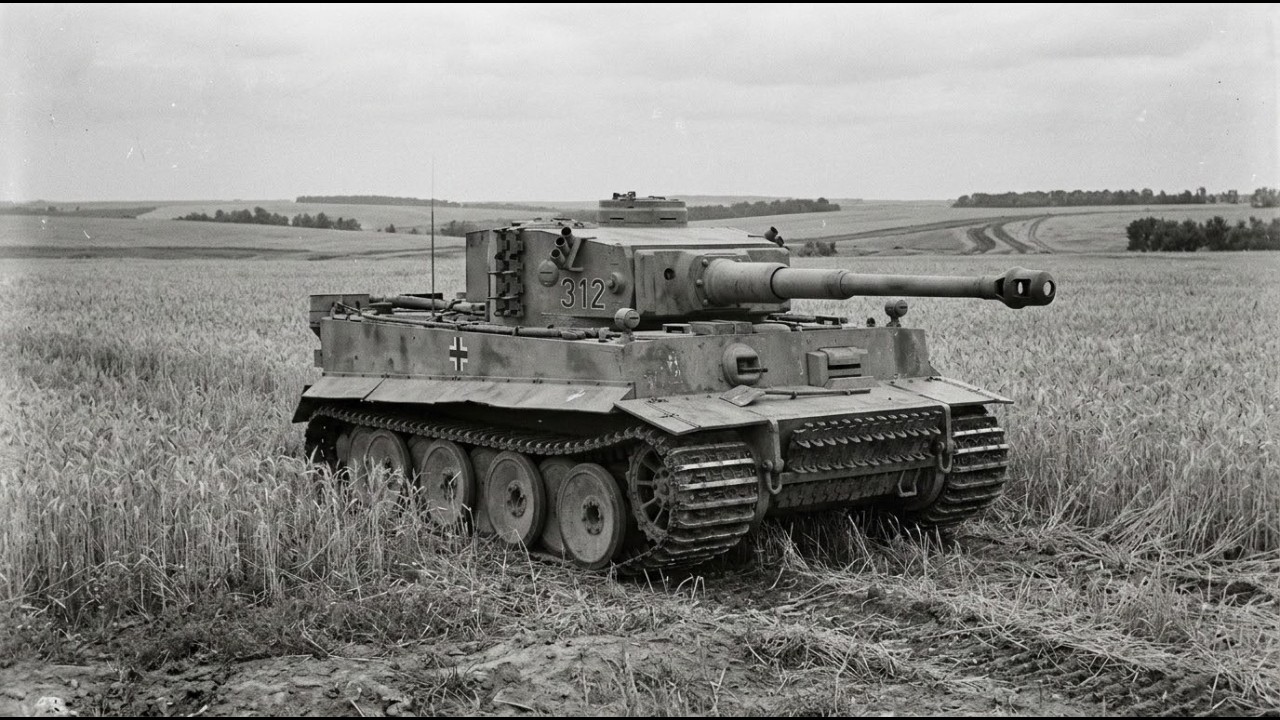
On July 5, 1943, in the early morning hours, Operation Citadel rolled forward. On the northern and southern edges of the Kursk salient, German formations advanced against deeply echeloned Soviet defensive lines. In the days that followed, the push developed into a battle of materiel of a density that even this war had not yet seen.
At the center of many of these engagements stood the heavy tank battalions with their Tigers, sent forward as the spearhead, as a battering ram against a depth of trenches, minefields, and dug-in tanks.
One engagement from those days, recorded in the war diary of a heavy tank battalion of the southern sector, can be reconstructed in its details. It is not a single duel and not a heroic saga. It is a lesson about distance, armor, and the cold geometry of armored combat.
On the early morning of a July day, a group of Tigers stood at the edge of a flat ridge. The commander was a captain whose name appears in the records only by initial. Before them lay open, gently rising field, wheat, in places chest-high, and behind it a fold in the terrain.
The Tigers stood half dug in, only turret and gun above the earth, the barrels aimed at the open field. The sun was at the Germans' backs, a position that offered two advantages: their own muzzle flash was harder to make out, and the enemy drove into the light.
Around 7 a.m., the radio operator reported movement. Soviet tanks emerged from the terrain fold. First a handful, then more T-34s. Among them lighter vehicles in a broad front, at full speed.
The Soviet tactic was as understandable as it was desperate. At troop level, it was now known that the Tiger could not be beaten at range. So the only hope was to cross the deadly zone as quickly as possible, to get within a distance where their own gun could reach the Tiger's sides and overwhelm it by mass. The calculation was simple, and it was also deadly.
The captain let them come. The records note the distance at which he opened fire: at 1,400 meters, the T-34 was a sure target for the 88, and the Tiger was unreachable for the T-34's gun.
The first shot fell, and at the forward edge of the Soviet wave a tank stopped, jerked, and began to burn. Seconds later, a second. The Tigers did not fire hastily; they fired in rhythm. One after another, each hit a vehicle.
The gunners had time, the distance was their ally, and the Tiger's optical sight was superior to the Soviet sights of the early T-34. The Soviet drivers did the only thing possible: they gave full throttle. The wave pushed closer. 1,200 meters, 1,000.
With every meter, the safety of the German position sank, because the closer the T-34 came, the more likely its gun could threaten the Tiger's armor, at least on the sides and turret. But the way from a few hundred meters was long, and it led across open field, every meter under the fire of the heavy guns.
Whoever survived the shelling drove into smoke and burning wrecks that obscured the field of fire of those following and tore apart their own order. Can a handful of tanks stop an entire wave? On paper, with a ruler over the map and the number of vehicles in hand, the answer is no. In the field that morning, the answer was different.
The battle was not over. Individual T-34s got through. They reached medium distance, swung out, and sought the flanks. And now the second side of the story showed itself, the one not in the tables.
At short range, the Tiger lost part of its advantage. Here it was no longer only armor that counted. Here it was nerves, loading speed, and the question of who got the turret around first.
One Soviet tank pulled up beside a Tiger and fired at short range. The hit did not fully penetrate the side armor but tore open a road wheel and immobilized the Tiger. The crew fought on from a standstill, turned the turret, and returned fire. A second Soviet hit tore open the loader's arm. He did not report it; he kept loading with one hand until the next vehicle burned.
By midday, the wave had broken off. The field before the ridge was littered with burned-out and abandoned Soviet tanks. The exact number varies in the sources, but the ratio was overwhelming. For every Tiger lost, many Soviet vehicles were destroyed, and more than one Tiger was not finally lost that morning but only damaged and later repaired.
The laughter of April, the mockery of the iron box that was too heavy and too slow, had found its price on that wheat field. It was paid in a currency that no statistic captures.
But the German crew that cleaned its guns and counted its wounded that evening knew something the victors of the day did not say aloud. Behind the terrain fold, there were not a hundred more Soviet tanks waiting. There were thousands.
Here is the point where the story must become honest. The Battle of Kursk did not end with a German victory; it ended with a German defeat, and the Tiger, however superior it was in the individual duel, could change nothing about that. The tactical picture of that wheat field and the strategic picture of the overall battle stood in a cruel contradiction to each other, and precisely that contradiction is the real lesson.
The numbers name it unmistakably. Germany produced around 1,350 Tigers of the first type over the entire course of the war. The Soviet Union built more than 50,000 T-34s alone, plus heavy types and assault guns in further tens of thousands.
If a Tiger cost several Soviet tanks on average before it was itself knocked out, then from the German point of view that was a brilliant balance, and from a strategic point of view it was meaningless. The Red Army could endure that exchange. It had the vehicles, it had the crews, it had the industry behind the Urals that pushed replacements forward month after month. Germany had none of that.
Every Tiger that remained on the field was harder to replace than the many T-34s it had destroyed. Added to this was the mechanical burden. Of the Tigers that did not survive Operation Citadel, a considerable portion fell not to enemy fire but to their own drive systems, the mud, the mines, and the simple fact that a broken-down Tiger was hardly recoverable under enemy fire.
A damaged machine that the enemy could see was a lost machine, because recovering a 57-tonner required several tractors or a second Tiger and time that no one had on a retreating front. When the German offensive in the south stalled and was finally broken off, Tigers remained behind that had been unbeaten in the duel and were nevertheless lost, because the battlefield stayed in Soviet hands. Whoever holds the field keeps the wrecks. Whoever clears the field also loses what was only damaged.
The Red Army drew its conclusions quickly and soberly, faster than the Soviet staffs had done in April. The answer to the Tiger was not a single wonder weapon but a bundle of measures.
Heavy self-propelled guns were brought into position, whose shells also tore open Tiger armor and which, because of their effect against heavy vehicles, soon carried a nickname that spoke for itself: animal hunters. The armament of the T-34 was improved; in its later version it received an 85 mm gun and thus finally had a chance against the heavy German armor at combat distance.
Heavy breakthrough tanks were developed whose frontal armor and gun met the Tiger on equal terms, and the tactics were refined that had been the only ones that worked on the wheat field: not frontal, but in movement from several sides, accepting one's own losses, until the flank was reached.
The psychological effect nevertheless remained. On the Soviet side, a phenomenon emerged that German reports labeled with its own word: Tiger fear. The tendency to suspect a Tiger behind every heavy German tank, the hesitation before advancing, the exaggerated report of Tigers where ordinary vehicles actually stood.
The mockery of the spring had given way to a caution that many a commander had to laboriously work back out of his crews. It was the same restraint that a year later seized Sherman drivers in Normandy when the word Panther fell. Two armies, two fronts, the same human reflex before a superior gun.
What remains is a double truth, and it cannot be shortened to a single statement. In the summer of 1943, the Tiger was one of the most dangerous combat vehicles in the world in individual combat, recognized not only by German but equally by Soviet, British, and American military historians.
Whoever met it on open field at 1,400 meters had poor cards, and the laughter from the April briefings was, against this background, an error paid for with human lives. And yet it was not the single superior tank that decided the war, but the mass, the industry, the fuel, and the ability to replace losses.
Both statements are true. Whoever tells only the first romanticizes. Whoever tells only the second does not understand the wheat field. Perhaps that is the real lesson of this encounter, and it sits in the doctrine manuals to this day.
Technological superiority is not a statistical quantity. It decides at a concrete place, at a concrete hour, over the lives of concrete people, and it thereby wins a battle, but not necessarily a war.
The Soviet commanders who had laughed at the iron box in April learned this lesson in the most expensive way imaginable. They learned it in time to win the war in the end, for at the end stood not the question of whose tank was better. At the end stood the question of who still had tanks that could fight. That question was answered not on the wheat field of Kursk, but in the factories behind the Urals.