Ethel Kennedy was three months pregnant when her husband was shot in the kitchen of the Ambassador Hotel in Los Angeles. She was 40 years old, with ten children at home and an eleventh on the way. Within 26 hours, Robert F. Kennedy was dead at 42, and she was a widow.
The world gave her about 48 hours of grief before moving on. What followed was 56 years of a life that history has largely reduced to a footnote. This is the story of what Ethel Kennedy actually did with all that time.
She was born Ethel Skakel on April 11, 1928, in Chicago, the sixth of seven children. Her father, George Skakel, had started as a railroad clerk before founding Great Lakes Carbon Corporation. By the time Ethel arrived, the family was wealthy — new money, loud, boisterous, Catholic, and full of noise.
In 1934, the family moved to Greenwich, Connecticut, into a 31-room English country manor. Ethel was educated at the Convent of the Sacred Heart in the Bronx and then at Manhattanville College of the Sacred Heart, where she became roommates with Jean Kennedy, the youngest sister of John and Robert Kennedy.
In December 1945, 17-year-old Ethel went on a group ski trip to Mont Tremblant in Quebec. There, standing in front of a fireplace, was Robert Kennedy. She later recalled thinking, "Wow, pretty great." Her next move was to challenge him to a race down the mountain.
There was one complication: Robert was dating Ethel's older sister, Patricia. That relationship ended, and Robert gradually began to see Ethel differently. They became engaged in February 1950 and married on June 17, 1950, at St. Mary's Catholic Church in Greenwich.
On her wedding day, Ethel made a private vow she later shared: she was going to have more children than her mother-in-law. Rose Kennedy had produced nine. Ethel intended to outdo her.
In 1956, Robert and Ethel bought Hickory Hill, a 13-bedroom estate on six acres in McLean, Virginia, just outside Washington. They purchased it from Robert's brother John and his wife Jackie, who had bought it but never moved in after a miscarriage.
Ethel turned Hickory Hill into the beating heart of the Kennedy political universe. It was a home, a salon, a campaign headquarters, and a party venue all at once. Bobby would call at the last minute to say he was bringing 20 people home for lunch, and Ethel would somehow make it work.
The animals became legendary. At one point the estate housed a pack of dogs, two horses, four ponies, 15 pigeons, 22 goldfish, 40 rabbits, and a sea lion named Sandy. Sandy was eventually banished to the National Zoo after shoving 8-year-old Kathleen Kennedy into the swimming pool.
The parties were extraordinary. Historian Arthur Schlesinger Jr. was once pushed fully clothed into the pool. Ethel, in a competitive moment, bit a man on the ankle during a touch football game. Guest lists mixed senators, ambassadors, novelists, scientists, athletes, and entertainers.
Underneath the chaos, Ethel was raising a family. She gave birth to 11 children between 1951 and 1968. By one calculation, she was pregnant for a combined total of nearly eight years of her life. She organized schedules with military precision and cross-examined her children at dinner about current events and history.
She was also her husband's most trusted political partner. When Bobby became chief counsel to the Senate committee investigating organized crime in 1957, she was there. When JFK ran for president in 1960, she campaigned relentlessly. When Bobby became attorney general, one observer called her the most powerful unelected woman in Washington.
Civil rights leaders came to Hickory Hill. Martin Luther King Jr. had conversations there. Harry Belafonte, who became a close family friend, wrote that of all the Kennedy women, Ethel was the one he admired most. When he needed to persuade Bobby to take a more aggressive position on civil rights, he went to Ethel first.
On November 22, 1963, the phone rang at Hickory Hill. It was FBI Director J. Edgar Hoover, who had never called the Kennedy home before. Ethel answered, recognized his voice, and understood in a fraction of a second that something had happened. She handed the phone to Bobby and watched him learn his brother was dead.
What happened to Bobby after that day — the grief that changed him, the moral reckoning that reshaped his politics — is a documented part of American history. What happened to Ethel is less told. She watched her husband break. She held the house together while he grieved. She carried her own grief somewhere it could wait.
Bobby decided to keep going. He ran for Senate, championed the causes his brother believed in, and eventually ran for president. Ethel was not just supportive. Biographer Evan Thomas wrote that she was Robert Kennedy's most consistent advocate for a run at the White House. She believed in him completely.
By the spring of 1968, the campaign had caught fire. On the night of June 4, Bobby won the California Democratic primary. Standing backstage at the Ambassador Hotel, Ethel was 40 years old, three months pregnant, and at the absolute peak of the life she had built.
Bobby finished his victory speech, thanked Cesar Chavez and the farm workers, thanked Rafer Johnson and Rosie Grier, and made a joke about his dog. The crowd roared. He turned to leave through the kitchen. The shots came from a 24-year-old man named Sirhan Sirhan, standing near the ice machine.
Three shots hit Bobby Kennedy. He fell onto the kitchen floor. Ethel pushed through the crowd, knelt beside him, took his hand, and held it while the room became chaos. He lingered for 26 hours and died on June 6, 1968.
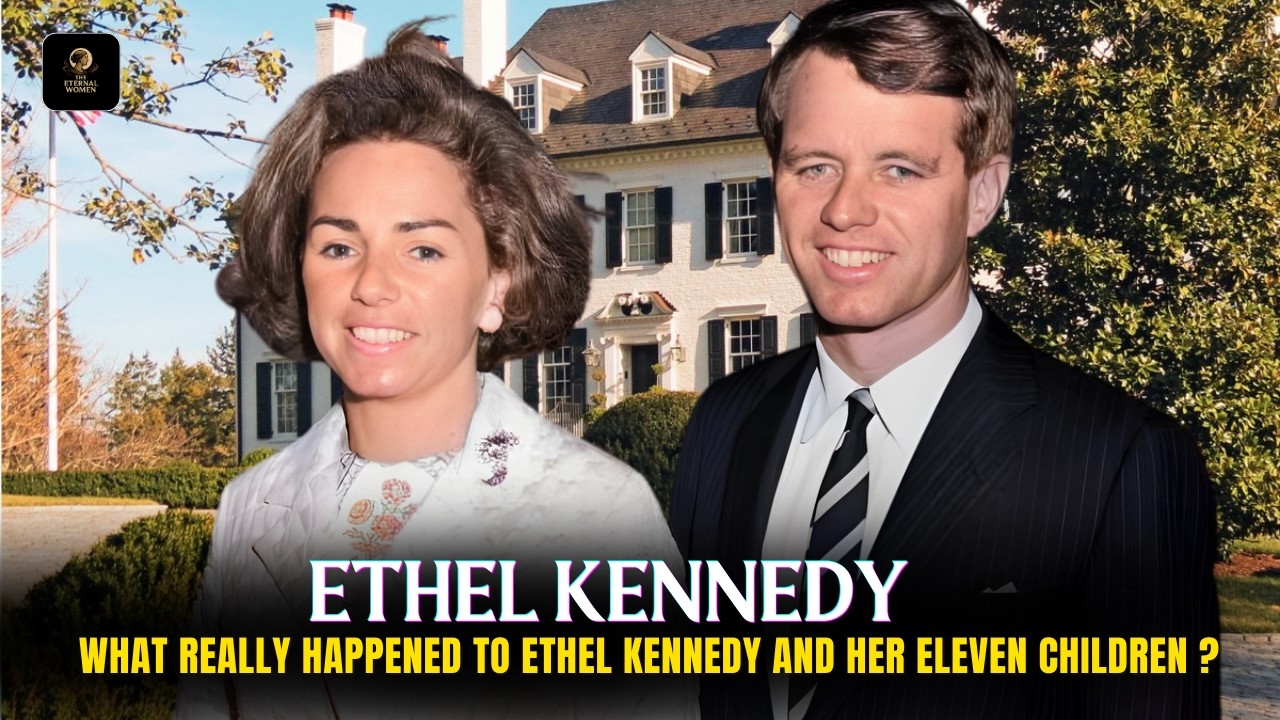
She had ten children at home, ranging from 16-year-old Kathleen to one-year-old Douglas. She was carrying an 11th child. She had a 13-bedroom house in Virginia and a husband who had just been murdered in front of her.
One detail from that night would echo for decades. Her son David, 13 years old, watched his father's assassination on a hotel television set, alone in a room, while the chaos swirled elsewhere. Nobody came for him in the immediate aftermath.
When the funeral was over and the cameras left, Ethel went home to Hickory Hill and had to figure out how to keep going. Biographer Laurence Leamer wrote in his 1994 book "The Kennedy Women" that her mood swept from deep private despair to manic irritability to frenetic highs of ceaseless activity.
She kept moving. She went to parties, attended events, hosted dinners, traveled, functioned. But functioning is not healing. The children, ranging from teenagers to toddlers, were left largely to themselves in ways that no one who was there looks back on with pride.
Friends and family who visited Hickory Hill in the early 1970s described it as pandemonium. The Shriver household began to pull away, with the parents making a conscious decision to create distance because the chaos was affecting their own kids. Jackie Kennedy's children had virtually no contact with their RFK cousins for long stretches of the 1970s.
Ethel was surrounded by 11 children, a full household staff, and the social world of the Kennedy political universe — and completely, essentially alone.
Six months after the assassination, on December 12, 1968, Ethel gave birth to her 11th child. She named her Rory Elizabeth Catherine Kennedy. Rory would never know her father except through photographs, stories, and the enormous weight of his absence.
Rory became a documentary filmmaker, focusing on social issues, addiction, nuclear power, border politics, and human rights. In 2012, she made a film about her mother that became the most intimate portrait of Ethel ever captured on screen.
In that film, Rory asked her mother directly about the assassination. Ethel began a sentence — "When we lost daddy…" — and then stopped. She teared up, turned to her daughter, and said, "Talk about something else." That moment captured her entire relationship with her own grief.
But grief does not disappear because you refuse to name it. It goes somewhere. It seeps into the walls of the house and comes out in the children, in their wildness and recklessness and hunger for something to fill the hole where their father used to be.
Kathleen, the eldest, was born July 4, 1951. She was 17 when her father was killed. She attended Harvard and law school at the University of New Mexico, worked in Jimmy Carter's Justice Department, and in 1995 became Lieutenant Governor of Maryland — the first woman to hold that office. Her daughter Maeve died in a canoeing accident in 2020 along with her young son Gideon.
Joseph Patrick Kennedy II was born September 24, 1952. Bobby gave him a letter as a boy telling him he bore a particular responsibility to serve his country as the oldest of the next generation. He founded Citizens Energy Corporation in 1979 and served in the U.S. House from 1987 to 1999. His son, Joe Kennedy III, later served in Congress as well.
Robert Francis Kennedy Jr. was born January 17, 1954, and was 14 when his father was assassinated. He began as an environmental lawyer, founded the Waterkeeper Alliance, and sued polluters. He later became increasingly radicalized on vaccines, alienating his family publicly. In 2024, he ran for president, dropped out, and endorsed Donald Trump. Several siblings publicly condemned him.
David Anthony Kennedy was born June 15, 1955. He was 13 on the night his father was shot, watching alone on a hotel television. In the years that followed, he drank, used drugs, dropped out of Harvard, and cycled through treatment programs. He was described as extraordinarily sensitive, the one for whom the loss landed hardest.
On April 25, 1984, David was found dead in his room at the Brazilian Court Hotel in Palm Beach, Florida. He was 28. The cause was a drug overdose. Ted Kennedy said, "We all pray that David has finally found the peace that he did not find in life." Ethel buried her son and did not speak publicly about the causes.
Mary Courtney Kennedy Hill was born September 9, 1956. She led a relatively private life by Kennedy standards. She later married Paul Hill, one of the Guildford Four, who spent 15 years wrongfully imprisoned for an IRA bombing he did not commit. She became involved in wrongful conviction advocacy.
Michael Leominster Kennedy was born February 27, 1958. He worked in the family's nonprofit sector, helping run Citizens Energy with his brother Joe. On December 31, 1997, he was skiing at Aspen Mountain, playing a game the Kennedy kids called ski football — catching a ball while careening down a slope. He skied into a tree and never regained consciousness. He was 39. His sister Rory, who was present, attempted CPR.
Mary Kerry Kennedy was born September 8, 1959. She became a human rights activist and lawyer and founded the Robert F. Kennedy Human Rights Center. She traveled the world investigating injustice, was arrested at protests, and married Andrew Cuomo, son of former New York Governor Mario Cuomo. They later divorced.
Christopher George Kennedy was born July 4, 1963. He ran the Merchandise Mart in Chicago and later ran for governor of Illinois, winning the Democratic primary in 2018 but losing the general election. He publicly criticized his brother RFK Jr.'s endorsement of Donald Trump as a betrayal of their father's values.
Matthew Maxwell Taylor Kennedy was born January 11, 1965, and was three when his father died. He became a lawyer, served as a prosecutor in Philadelphia, and co-founded the Urban Ecology Institute in Boston. He edited a book of his father's journal entries and favorite sayings titled "Make Gentle the Life of This World."

Max said the most honest thing any of Ethel's children have said about growing up without their father: "Obviously, I've had a life of enormous privilege and opportunity. But the essential fact of that life is the absence of this man. There's not a single day that any member of my family wouldn't trade all that privilege and opportunity to have our father back."
Douglas Harriman Kennedy was born March 24, 1967, and was one year old when his father was murdered. He became a broadcast journalist, reporting for Fox News Channel. His most public moment came from a 2012 hospital incident in which he was accused of obstructing nurses; the charges were eventually dropped.
Rory Elizabeth Katherine Kennedy was born December 12, 1968, six months after the assassination. She never knew her father. She became a documentary filmmaker with a serious, socially engaged body of work and received an Academy Award nomination. Her 1999 wedding was delayed when her cousin John F. Kennedy Jr.'s plane went down off Martha's Vineyard. Weeks later, in Greece, the family gathered to celebrate. Ethel danced at her youngest daughter's wedding.
The phrase "Kennedy curse" has been used so often it has become a cliche. But from where Ethel stood, the curse was not a metaphor. It was a list.
Her parents were killed in a plane crash in 1955. Her brother was killed in a plane crash in 1966. Her husband was assassinated in 1968. Her son David died of a drug overdose in 1984. Her son Michael died in a skiing accident in 1997. Her nephew John F. Kennedy Jr. died in a plane crash in 1999. Her daughter-in-law Mary Richardson Kennedy died by suicide in 2012. Her granddaughter Saoirse Kennedy Hill died of an accidental overdose in 2019 at 22. Her granddaughter Maeve and great-grandson Gideon died in a canoeing accident in 2020.
Family friend Philip Johnson, after Michael Kennedy's death, asked the question everyone was thinking: "One wonders how much this family must be expected to absorb." Ethel's answer, demonstrated across five and a half decades, was everything.
In October 1968, in the months between Bobby's assassination and Rory's birth, Ethel founded the Robert F. Kennedy Center for Justice and Human Rights. She was pregnant, grieving, managing a household and ten children — and she founded an organization dedicated to carrying forward the work Bobby never finished.
The organization, later renamed Robert and Ethel Kennedy Human Rights, grew into one of the world's most significant human rights organizations. It investigates injustice in dozens of countries and champions the rights of workers, migrants, prisoners, and the poor.
She also co-chaired the Coalition for Gun Control, advocating for the kind of laws that might have saved her husband's life. She did this without drama and without public grievance.
In 2014, President Obama awarded her the Presidential Medal of Freedom. He said she had dedicated her life to advancing social justice, human rights, environmental protection, and poverty reduction, and that she had created "countless ripples of hope" — a phrase drawn from one of Bobby's most famous speeches.
A bridge over the Anacostia River in Washington, D.C., is named the Ethel Kennedy Bridge in her honor.
You cannot tell Ethel Kennedy's story without telling the story of her faith. She attended daily Mass her entire adult life — not Sunday Mass, daily, every morning before the day started. She once seriously considered becoming a nun. When Bobby heard about this, he said, "I'll compete with anyone. But how can I compete with God?"
Her faith was also why she never remarried. When friends gently suggested she might find companionship, she said the same thing each time: How could she do that with Bobby looking down from heaven? That would be adultery. She genuinely believed her marriage did not end on June 6, 1968.
Eunice Kennedy Shriver offered a different explanation when asked about Ethel's permanent widowhood. She said she did not believe Ethel ever thought another man was as good as Bobby. Both things were probably true. The faith and the love were, for Ethel, the same thing.
It is impossible to tell Ethel's story without addressing the shadow of Jackie Kennedy. Jackie is the Kennedy widow of the public imagination — the pink suit, the veil, the icon of grace under pressure. She is Camelot's queen.
Ethel watched her husband murdered five years after Jackie watched hers. Ethel's loss was in many ways just as devastating — more so in some respects, because she had more children, less warning, and no preparation. She was three months pregnant, standing in a hotel kitchen holding her husband's hand while he died.
The world looked right past her because Jackie had already filled the role. In the American cultural imagination, there is only space for one Kennedy widow at a time. Jackie got the mythology. Ethel got the children.
The two women were fundamentally incompatible in temperament. Jackie was controlled, private, carefully curated. Ethel was loud, competitive, devout, unfiltered. Jackie married Aristotle Onassis and left the country. Ethel stayed at Hickory Hill and raised 11 children.
But Ethel's grief was just as real as Jackie's. Her loss was just as complete. She gave up not just her husband but, in a very real sense, herself — the independent woman she might have been, the life she might have built on her own terms. She made that sacrifice quietly, without the mythology, without the pink suit. That is its own kind of courage.
By the 1980s, Ethel was settling into the long middle of her widowhood. She hosted political fundraisers at Hickory Hill, endorsed candidates, championed causes, and traveled for human rights work. She was a fixture at Democratic events and Kennedy family gatherings.

Privately, she managed losses that arrived with terrible regularity. David died in 1984, when she was 56. Michael died in 1997, when she was 69. John F. Kennedy Jr. died in 1999, when she was 71. Mary Richardson Kennedy died in 2012, when she was 84. Saoirse Kennedy Hill died in 2019, when she was 91. Maeve and Gideon died in 2020, when she was 92.
She kept going.
She sold Hickory Hill in 2009 for $8.25 million. Frank Mankiewicz, who was Bobby's press secretary and was there the night Bobby was shot, compared the sale to selling Mount Vernon. Hickory Hill was not just a house. It was the physical container of a life, a marriage, and a chapter of American history.
She divided her time between the Kennedy compound in Massachusetts and Palm Beach, Florida, surrounded by children, grandchildren, and great-grandchildren. She nominated Barack Obama for the Ice Bucket Challenge in 2014, weeks after he awarded her the Medal of Freedom. She was constitutionally incapable of sitting still.
In 2012, Rory released the HBO documentary "Ethel." It was the first time Ethel allowed herself to be the subject of sustained public attention rather than the background of it. What it revealed was not a monument but a woman who was funny, warm, self-deprecating, occasionally sharp-tongued, and very obviously the most alive person in any room.
Her children appeared in the film and talked about their mother with a mixture of admiration, exasperation, and love. They laughed about her. They imitated her. They described her demanding nature and unstoppable energy and her absolute refusal to acknowledge anything that might be called a limitation.
The film's most extraordinary moment was the one where Rory asked Ethel directly about Bobby's death, and Ethel's voice broke, and she said, "Talk about something else." Rory respected the boundary. She did not push through it, because she knew something about her mother that the whole world needs to understand.
The grief was never gone. It was still there 60 years later, as raw and real and present as it was in a hotel kitchen in Los Angeles in 1968. Ethel simply chose, for the sake of 11 children and a human rights organization and a faith that required her to keep living, to carry it rather than be carried by it.
On October 3, 2024, Ethel Kennedy suffered a stroke in her sleep. She was hospitalized. One week later, on October 10, 2024, she died from complications related to the stroke. She was 96 years old.
She was buried at Arlington National Cemetery alongside her husband. She outlived him by 56 years — more than half a century. She lived an entire second lifetime without him.
She raised all 11 children. She buried two of them. She built an organization. She earned a Presidential Medal of Freedom. She attended events and campaigns and fundraisers and graduations and weddings and funerals and more funerals. And every morning, every single morning, she went to Mass.
At her memorial service at the Cathedral of St. Matthew the Apostle in Washington, D.C., eulogies were delivered by President Joe Biden, former President Barack Obama, and former President Bill Clinton. Biden said she had a spine of steel and a heart of gold, and that she taught him after his own devastating losses how to channel grief into the service of a greater good.
That is the legacy. Not the Kennedy name, not the dynasty, not Camelot, not the pink suit or the election victories or the political offices. The legacy is the lesson: how to channel grief into the service of a greater good. Ethel Kennedy spent 56 years teaching that lesson — not by talking about it, but by doing it every morning, every day. Forward.
Why does history know Jackie Kennedy and not Ethel Kennedy? The easy answer is that Jackie arrived first, that she occupied the role of Kennedy widow before Ethel had to, that in the cultural imagination there is only room for one at a time.
The real answer is that Jackie offered the world something it could consume — a style, an image, a composed photogenic grief that could be packaged and admired. Jackie's grief was beautiful in the way that makes people comfortable. It was grief with good posture.
Ethel's grief was real in the way that makes people uncomfortable. It was grief with 11 children and a sea lion named Sandy and a son dying alone in a hotel room and a house in Virginia that had to keep running regardless. It was grief in the trenches, grief in the daily, grief that doesn't photograph well. And history has a habit of choosing the grief that photographs well.
But the truth is that Ethel Kennedy was the most remarkable of all the Kennedy women. Not the most glamorous, not the most photographed, not the most mythologized — the most remarkable, because she showed up every day for 56 years.
She had children who struggled and children who thrived and children who broke her heart and children who made her proud and children who died before her. She carried losses that would have ended a lesser person. She turned grief into work and work into change and change into something that will outlast the name it was built on.
She was Bobby Kennedy's most fervent believer, his most consistent advocate, his most important partner. And then he was gone, and she became something else — something that doesn't have a ready name in the American vocabulary of famous women. She became herself: loudly, persistently, faithfully, competitively, with daily Mass and 11 children and 40 rabbits and an ice bucket challenge at 86 and a bridge named after her in Washington, D.C., and a human rights organization still carrying his name and her work into a world that needs both.
Ethel Kennedy was not Bobby Kennedy's widow. She was Ethel Kennedy. The woman who bet a Kennedy she could ski faster. The woman who helped steal a demerit book and burn it. The woman who bit a man on the ankle during a touch football game and called it competing. The woman who answered J. Edgar Hoover's phone call, handed it to her husband, and then spent the next 56 years making sure the work he started did not die with him.
She deserved better than a footnote. She was the whole story.
Ethel Kennedy died on October 10, 2024, at the age of 96. She is buried at Arlington National Cemetery alongside her husband. She is survived by nine children, 34 grandchildren, and 24 great-grandchildren. The Robert and Ethel Kennedy Human Rights Center continues its work.