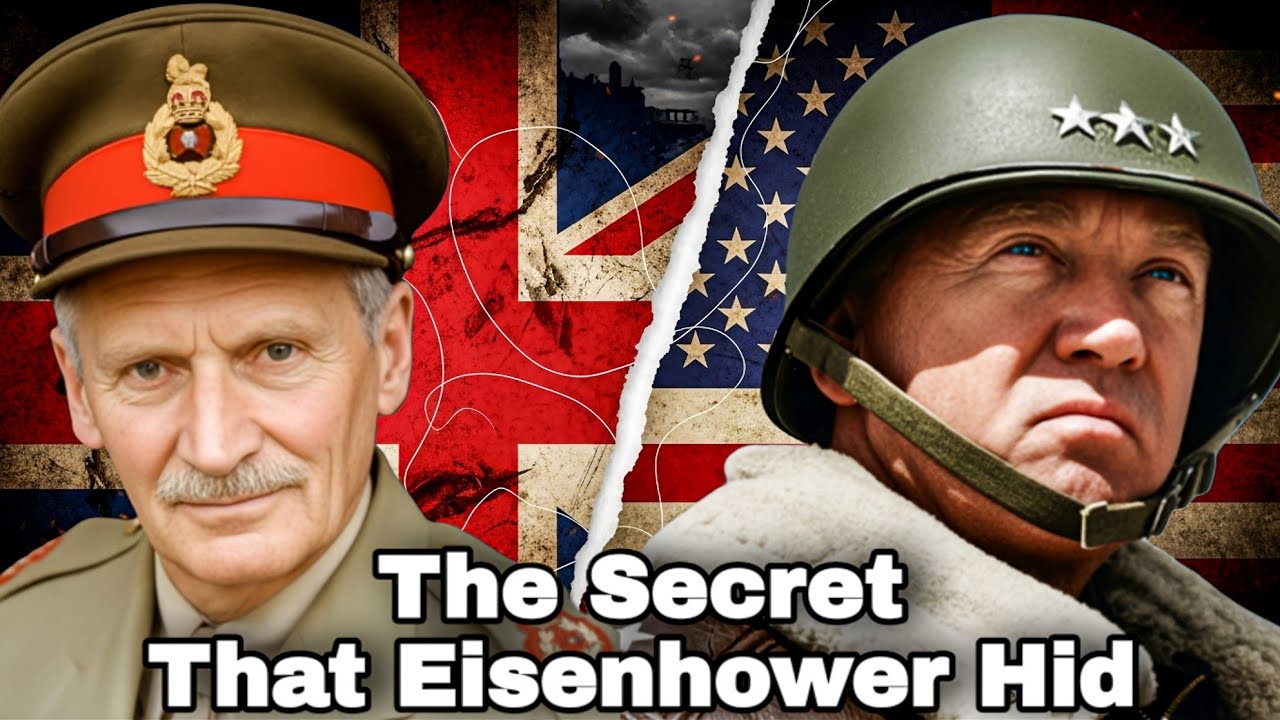
The rivalry between George Patton and Bernard Montgomery was one of the most bitter and consequential personal conflicts of World War II. It began in the dust of Sicily and ended in the heart of Germany, shaping Allied strategy and straining the Western Alliance along the way.
By the summer of 1943, Montgomery was a living legend. He had salvaged British pride at El Alamein after three years of humiliating retreats, and he had outmaneuvered the Desert Fox, Erwin Rommel.
Montgomery carried himself with a theatrical arrogance, wearing a distinctive black beret with two cap badges. He cultivated the image of a military savior who was absolutely certain of his own infallibility.
Patton, by contrast, was a man possessed by a desperate need to prove that the American soldier was second to none. The American ground war had begun with the catastrophic embarrassment at Kasserine Pass in February 1943, where inexperienced troops were routed by veteran German panzers.
Patton was brought in to fix the disaster, and he did so with a brutal discipline that transformed the slovenly II Corps into a professional fighting force within weeks. Yet he still felt cast as a supporting actor while Montgomery was the undisputed star.
The planning for Operation Husky, the invasion of Sicily, turned professional rivalry into a personal vendetta. The original plan envisioned a balanced assault, with Patton's Seventh Army and Montgomery's Eighth Army driving toward shared objectives with equal chances for glory.
Montgomery viewed the Americans as junior partners who lacked the seasoning for a primary role. He used his political leverage to demand a total revision of the invasion strategy.
He appealed directly to Dwight D. Eisenhower, insisting that his Eighth Army should have the main thrust toward Messina while the Americans were relegated to protecting his flank. Eisenhower, caught between military efficiency and the political reality of a fragile alliance, ultimately gave Montgomery what he wanted.
Patton was furious at being reduced to a subservient role. He privately told his staff that Montgomery had essentially stolen the campaign before the first soldier had even stepped onto the Sicilian beaches.
The invasion began on July 10, 1943, and Montgomery's carefully orchestrated plan almost immediately began to unravel. The British Eighth Army found itself bogged down in a bloody stalemate near Catania, where rugged terrain and fortified coastal roads favored the German defenders.
Montgomery blamed everyone except his own rigid planning. He accused the Americans of failing to draw enough German forces away from his front while his own troops bled in the shadow of Mount Etna.
Patton saw his opportunity to break the shackles of his secondary role. He went to General Harold Alexander with a bold proposal to drive his army across the island to capture Palermo.
Although the move was not part of the original plan, Alexander realized the stalemate needed to be broken. He granted Patton the freedom to unleash his armored divisions.
What followed was one of the most spectacular displays of mobile warfare in the entire conflict. Patton's forces covered over 100 miles of mountainous terrain in a mere 72 hours.
The capture of Palermo on July 22, 1943 turned Patton into a global sensation. Headlines that once belonged exclusively to Montgomery were now screaming the name of the American general.
Patton had deliberately stolen the spotlight, and Montgomery was deeply humiliated. He had been shown up by the man he had dismissed as a mere flank guard.
The race for Messina was now truly on. Both commanders pushed their exhausted men beyond the limits of human endurance to reach the symbolic trophy of the campaign.
Patton drove his Third Infantry Division relentlessly through the night, fighting off heat and scattered German rear guards. Montgomery launched desperate amphibious operations to bypass bottlenecks on the eastern coast.
The rivalry had become so personal that operational decisions were being made based on ego rather than military necessity. Neither man could stand the thought of arriving second.
On the morning of August 17, the vanguard of Patton's army entered the outskirts of Messina just hours before the British patrols arrived. Patton staged a theatrical welcome for the arriving British officers, rubbing their defeat in their faces with exaggerated courtesy designed to be as insulting as possible.
Montgomery was so stung that he refused to appear in person. He sent his subordinates to witness the American flags already flying over the city he had claimed as his own.
While Patton had won the race, he had also sown the seeds of his own temporary downfall. During the final days of the Sicilian campaign, he committed two catastrophic mistakes that gave his detractors the ammunition they needed.
In two separate incidents in field hospitals, Patton slapped soldiers suffering from combat fatigue. He accused them of cowardice and threatened them with physical violence.
When the incidents became public, the outcry was immediate and severe. Politicians and the press demanded Patton's dismissal and court-martial.
Eisenhower was caught in a political firestorm. Although he valued Patton's tactical genius, he was forced to demand a series of public apologies that deeply wounded Patton's pride.
Montgomery watched the scandal unfold with a sense of vindicated satisfaction. He told anyone who would listen that Patton was an undisciplined and reckless commander unsuited for high-level leadership.
The slapping incidents provided Eisenhower with the perfect excuse to sideline Patton when planning for Operation Overlord began in earnest. As the Allied high command gathered in England, the power dynamic shifted heavily in favor of the methodical Montgomery.
Montgomery was named overall ground commander for the D-Day invasion, thanks to his perceived stability and his status as a British hero. Patton was left in professional purgatory, assigned to lead a fictional unit known as the First United States Army Group, a massive deception operation designed to trick the Germans.
The man who had outpaced Montgomery in Sicily was now being used as a decoy. His rival was given command of every American, British, and Canadian soldier who would storm the beaches of Normandy.
Montgomery's performance in Normandy soon reignited controversy over his cautious, slow-moving style of warfare. He had famously promised to capture the city of Caen on D-Day itself, but the reality was a month-long grinding stalemate that produced immense casualties for British and Canadian forces.
Montgomery's inability to achieve a breakout led to growing frustration within the American ranks and even within the British government. Just as in Sicily, he refused to admit any flaws in his planning, blaming the weather, the terrain, and even the lack of aggression from American units.
Patton languished in England, watching his colleagues struggle. He wrote in his diary that he could have finished the campaign in half the time if given the chance.
On August 1, 1944, Patton's Third Army finally became operational in France, and the dynamic of the war changed almost overnight. While Montgomery was still focused on the static battle lines around Caen, Patton launched his armored columns into the open plains of France with a speed that left the German high command in total confusion.
Patton's tanks covered 30 to 50 miles a day, liberating towns and capturing thousands of prisoners before the Germans even realized the front line had moved. The contrast with Montgomery's slow progress was impossible for the press to ignore, and the rivalry was reignited with new and dangerous intensity.
Montgomery viewed Patton's success as a direct threat to his authority. He began complaining to Eisenhower that the Americans were receiving an unfair share of supplies and fuel.
He argued that Patton's recklessness was leading the Allied armies into a potential trap. He demanded that all resources be concentrated for a single thrust into Germany under his own command.
This disagreement over strategy, the broad front versus the narrow thrust, became the defining argument of the final year of the war. Patton believed a broad front would keep the Germans off balance, while Montgomery wanted the glory of leading the final charge into Berlin himself.
As the Allied armies approached the borders of Germany, the debate over how to deliver the final blow turned into a bitter struggle for dwindling resources and historical prestige. Montgomery proposed a radical departure from existing strategy.
He demanded that Eisenhower concentrate all available Allied resources into a single massive thrust into northern Germany under his personal command. He claimed this pencil-like thrust would let him drive straight to Berlin and end the war by Christmas, provided Patton's Third Army was halted and stripped of its supplies.
Patton was livid at the suggestion. He argued instead for a broad front strategy where multiple axes of advance would keep the German defenders from concentrating their remaining strength in any one sector.

Eisenhower, ever the diplomat, attempted to find a middle ground by approving a broad-front approach. But he ultimately sided with Montgomery for a high-stakes airborne gamble known as Operation Market Garden.
This decision meant vital fuel, ammunition, and transport resources were diverted away from Patton's surging tanks. They were redirected to Montgomery's ambitious plan to drop three airborne divisions behind German lines in the Netherlands.
Patton felt Eisenhower was rewarding Montgomery's previous failures and methodical slowness while punishing the very success and momentum the Third Army had fought so hard to achieve. On September 17, 1944, the largest airborne assault in human history began.
Thousands of paratroopers descended upon the Dutch towns of Eindhoven, Nijmegen, and Arnhem to seize key bridges. The plan relied on British ground forces racing up a single narrow highway to link up with the paratroopers, but the operation quickly descended into a strategic disaster.
German resistance proved far more formidable than British intelligence had predicted. The single road became a literal shooting gallery for German anti-tank crews.
At the bridge too far in Arnhem, British paratroopers held out heroically for nine days against overwhelming odds. The relief columns never arrived, leading to the deaths or capture of over 8,000 men.
Despite the clear failure to achieve the primary strategic objectives, Montgomery stubbornly declared Market Garden to be 90 percent successful. Almost no one else in the Allied high command accepted that claim.
Patton, who had been forced to halt his own advance because his tanks had literally run dry of fuel, felt completely vindicated in his warnings that Montgomery's plan was a reckless gamble. The failure of Market Garden meant the war would not end in 1944, and the Allied armies settled into a grueling winter campaign along the German border.
The tension was momentarily pushed aside on December 16, 1944, when the Germans launched their last great offensive through the Ardennes Forest. The attack caught the Allied forces in a state of total surprise.
Within days, German panzer divisions had punched a massive hole in the Allied lines, creating the famous bulge and threatening to split the British and American armies apart. Eisenhower was forced into a desperate command decision.
He gave Montgomery temporary control over all American forces north of the breakthrough while ordering Patton to perform a nearly impossible maneuver from the south. Patton was told to wheel his entire Third Army 90 degrees and counterattack the German flank in the middle of a brutal winter storm.
What Patton achieved in the following hours became a legend in military history. He moved three full divisions across over 100 miles of icy, clogged roads in just 48 hours.
This logistical and tactical feat allowed the Americans to relieve the besieged paratroopers at Bastogne and began the process of rolling up the German advance. While Patton was executing this master stroke, Montgomery remained extremely cautious in the north, focusing on reorganizing his lines rather than launching an immediate counterattack.
The rivalry turned toxic once again on January 7, 1945, when Montgomery held a press conference to discuss the Battle of the Bulge. Instead of praising the bravery of the American soldiers who had held the line at Bastogne or Patton's incredible march, Montgomery implied that his own leadership had saved the Americans from their own incompetence.
He talked about bringing order to chaos and essentially portrayed the British army as the savior of a reeling and disorganized American force. This presentation of events nearly destroyed the Allied alliance.
The American press erupted in fury, and General Omar Bradley threatened to resign if Montgomery was ever given command of American troops again. Eisenhower had to intervene personally to prevent a total fracture, as Montgomery had effectively stolen credit for what was arguably the greatest American victory of the war.
As the Allies prepared for the final crossing of the Rhine River, the competition reached its final absurd conclusion. Eisenhower had designated Montgomery's 21st Army Group to make the primary crossing, and Montgomery spent weeks accumulating a massive force with overwhelming artillery and airborne support.
However, on March 7, American forces unexpectedly captured the Ludendorff bridge at Remagen while it was still standing, giving the Americans the first foothold across the river. Not to be outdone, Patton launched a hasty and daring assault across the Rhine on the night of March 22, catching the Germans completely off guard.
Patton called Bradley and explicitly asked him to keep the crossing a secret for a day so he could get more troops across before Montgomery's massive choreographed operation even began. When Montgomery finally launched his operation on March 23, complete with massive naval support and airborne drops, he discovered that Patton had already been across the river for 24 hours.
The international press could not help but point out the irony that Montgomery needed an entire army group and weeks of preparation to do what Patton had achieved on the fly with minimal resources. This final act of one-upmanship served as the perfect bookend to a rivalry that had started on the dusty roads of Sicily and ended in the heart of the German Reich.
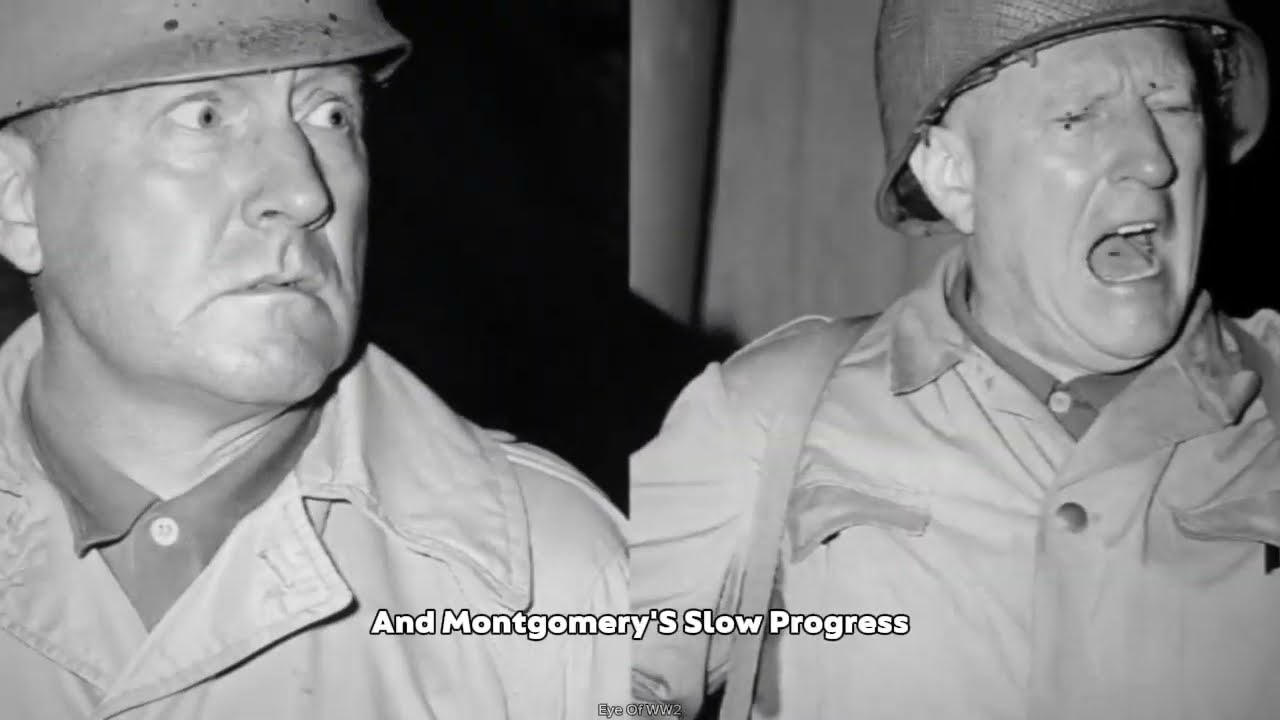
The feud was never merely a matter of personal dislike. It was a fundamental clash between two different philosophies and two vastly different national egos.
The consequences were often measured in the lives of the soldiers who served under them, as resources were sometimes divided to satisfy egos rather than strategic necessity. Eisenhower was forced to spend a significant portion of his time managing these two titans instead of focusing purely on the destruction of the German military.
Patton's life came to a tragic and premature end on December 21, 1945, following a car accident in Germany. He was left unable to ever write his memoirs or formally defend his record.
Montgomery lived until 1976 and spent decades carefully crafting his own legacy through memoirs and interviews, where he often minimized Patton's contributions. He famously wrote that Patton was good for pursuit, but not much else.
Patton's private diaries revealed he viewed Montgomery as a tired little man. History has ultimately delivered a nuanced verdict on both men, recognizing Montgomery as a capable, if overly cautious, commander who provided the British people with a much-needed hero.
Yet the legend of George Patton continues to grow. He is remembered for achieving more with fewer resources and for being right about strategy more often than his British rival.
Patton fought not only the German Wehrmacht but also a political and personal battle against a rival who held more influence and support throughout the conflict. The race to Messina, the stalemate in Normandy, the gamble of Market Garden, and the miracle of the Bulge all stand as testaments to this incredible rivalry.
The psychological toll extended deep into the staff levels of both armies, creating a culture of suspicion that sometimes hindered intelligence sharing and joint planning. Patton's staff often felt the British were withholding information to ensure Montgomery's success, while Montgomery's officers viewed the Americans as amateurish cowboys who were lucky rather than skilled.
This lack of trust was most evident during the breakout from Normandy, where a more coordinated effort might have trapped and destroyed the entire German Seventh Army at the Falaise Pocket. Instead, delays caused by arguments over boundaries and responsibilities allowed thousands of veteran German troops to escape and fight again.
Patton's aggressive spirit was often his greatest strength and his greatest liability. It drove him to push his men to the brink of exhaustion, but it also led to the public relations disasters that nearly ended his career.
He truly believed he was a man of destiny, a reincarnated warrior who had fought in every great conflict in human history, from the legions of Rome to the cavalry of Napoleon. This mystical belief in his own purpose gave him the courage to take risks that other generals found terrifying, but it also made him incredibly difficult for a superior like Eisenhower to manage.
Montgomery, by contrast, was a man of cold logic and meticulous detail who believed war could be solved like a mathematical equation if one only had enough preparation and material. The special relationship between the United States and Great Britain was tested to its absolute limit by these two men, as they represented the competing interests of a declining empire and a rising superpower.
Montgomery was fighting to maintain Britain's prestige on the world stage, while Patton was fighting to prove that the American industrial and military machine was now the dominant force in the West. Their rivalry was a microcosm of the larger geopolitical shifts occurring as the old world gave way to the new.
Even in the final days of the war, as they raced toward the Elbe River, the competition remained fierce. Each man tried to liberate as much territory as possible to secure his place in the history books.
The logistical miracle of Patton's Third Army, which traveled further and faster than any other army in history, was a direct result of his blood-and-guts philosophy. He demanded that his officers lead from the front and that his soldiers maintain a professional appearance even in the heat of combat.
He famously insisted on neckties in the jungle and polished helmets, believing that discipline in small things led to discipline in the face of death. Montgomery's discipline was of a different sort, based on the absolute confidence his men had in his ability not to waste their lives in poorly planned attacks.
While Patton was feared, Montgomery was respected by his Desert Rats, who believed Monty would always provide them with the tools they needed to win. The ultimate irony of their rivalry is that both men were essential to the Allied victory.
Without Montgomery's steady hand in the early years and his ability to organize massive amphibious operations, the Allies might never have returned to the continent. Without Patton's relentless drive and operational brilliance, the war in Europe might have dragged on into 1946, causing countless more casualties and allowing the Soviet Union to occupy even more of Western Europe.
They were two halves of a necessary whole, even if they could never see the value in each other. Their mutual hatred acted as a strange kind of catalyst, pushing each man to perform at his absolute peak to avoid being outshined by the other.
Today, the names Patton and Montgomery remain inseparable from the history of World War II. Their feud has become the stuff of military folklore, studied in war colleges around the world as a lesson in the importance of command temperament and the complexities of coalition warfare.
The two columns of dust that rose in Sicily eventually settled. But the echoes of their clash still resonate through history, reminding us that even the greatest of events are driven by the very human passions of those in command.