Irma Grese was born on October 7, 1923, in Wrechen, then part of the Weimar Republic. She was the third of five children, and both her parents, Berta and Alfred, worked as dairy workers.
When Hitler and the Nazi Party came to power in January 1933, Irma was nine years old. Her father was not a Nazi sympathizer and despised everything associated with the party, so he never allowed his children to join Nazi youth organizations, even though they wanted to.
In January 1936, when Irma was twelve, her thirty-three-year-old mother Berta committed suicide by drinking hydrochloric acid after discovering her husband's affair with the local pastor's daughter. Irma was then raised only by her father.
Alfred Grese was a devout Christian who was very stern and strict with his children and would often use physical violence to discipline them. In school, Irma performed poorly in academics, and according to her sister Helena, she was bullied badly.
Helena recalled that when girls were quarreling and fighting, Irma never had the courage to fight but ran away. In 1938, the fourteen-year-old Irma left school and her father's house and worked at a dairy factory. She then moved to Lychen, where she worked in a retail shop for six months.
In 1939, at the age of fifteen, Irma Grese went to the Hohenlychen sanatorium, where she worked as an assistant nurse for about two years and trained under the sanatorium's medical superintendent, Karl Gebhardt.
The Second World War began on September 1, 1939, when Nazi Germany invaded Poland. At this time, Grese was still at the sanatorium, where she wanted to become a full-fledged nurse. Because she did not do well enough academically, in 1941, at the age of seventeen, she was instead sent to a dairy farm where she operated a butter machine.
She remained there until June 1942. The following month, she was deployed to serve as a guard at Ravensbrück, the only major women's concentration camp established by the Nazis.
Starting in the summer of 1942, SS medical doctors subjected female prisoners at Ravensbrück to unethical medical experiments. The main coordinator of these experiments was Karl Gebhardt, whom Irma knew from the Hohenlychen sanatorium.
His assistants became doctors Herta Oberheuser and Fritz Fischer. They often used a hammer to break the legs of female prisoners, then infected opened wounds with aggressive bacteria and monitored the healing with and without various chemical substances such as sulfonamide, an early antibiotic.
Believing it could help in treating amputee soldiers, they also tested various methods of setting and transplanting bones. Such experiments included amputations and were often performed without any anesthesia.
It is believed that Grese served as an assistant nurse during the experiments and was exposed to these atrocities, which might have had a damaging impact on her personality and turned her into a violent SS woman.
In early 1943, when she came home and told her family that she was supervising the female prisoners working inside the compound at Ravensbrück, her father gave her a thrashing with a belt or a whip and forbade her from coming home again.
In March 1943, Irma Grese was deployed to Auschwitz-Birkenau, located in German-occupied Poland. Birkenau was the largest of more than forty camps and subcamps that made up the Auschwitz complex. It opened as a branch of Auschwitz in March 1942 and served at the same time as a center for the extermination of the Jews.
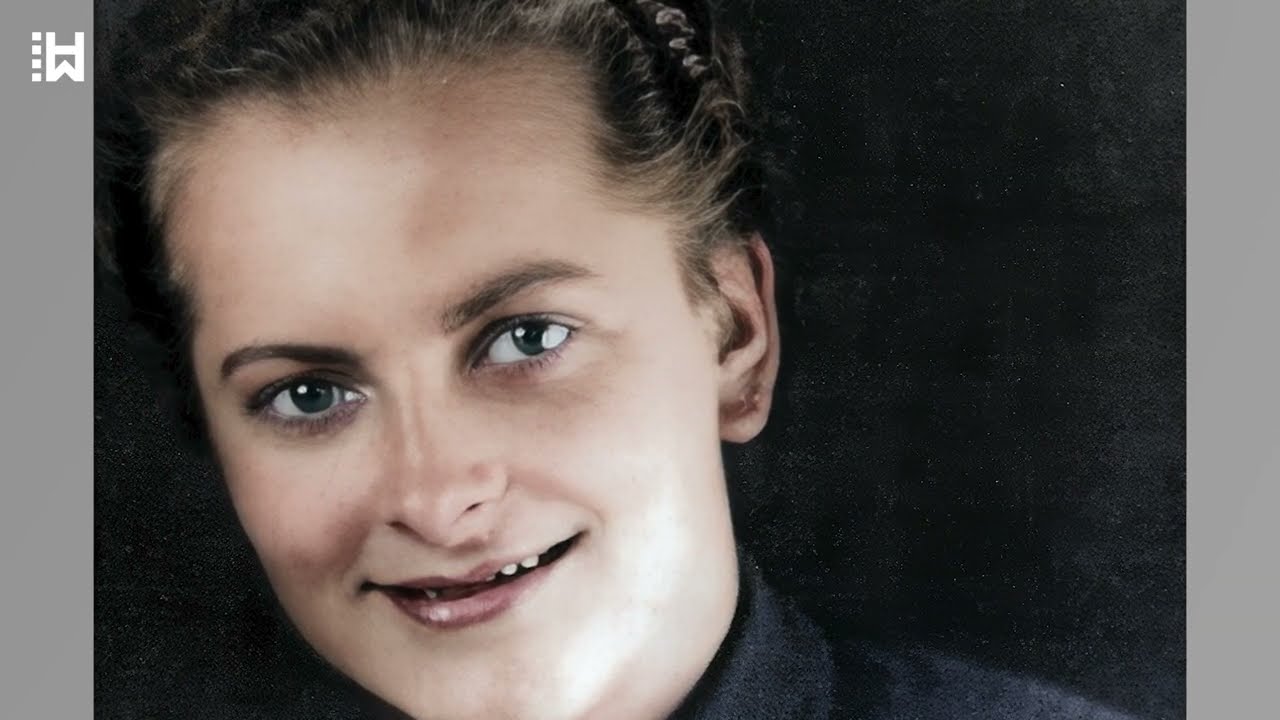
Some Auschwitz survivors remembered Grese as a beautiful young woman. Nina Kalesa later recalled their first meeting, saying Grese took her cheek and told her that people said she looked a lot like her and she wanted to be sure it was true.
Kalesa said she naively replied that she did not think there was any resemblance and that she had never seen anyone more beautiful, and she meant it. She described Grese as being like a vision.
Dr. Gisella Perl, also an Auschwitz survivor, later said Grese was one of the most beautiful women she had ever seen. She said her body was perfect in every line, her face clear and angelic, and her blue eyes the gayest, most innocent eyes one could imagine.
And yet, Perl said, Grese was the most depraved, cruel, imaginative pervert she ever came across. In her memoir "Five Chimneys," Auschwitz survivor Olga Lengyel writes that Grese had affairs not only with Dr. Josef Mengele but with many other Nazis as well.
When it came time to select women for the gas chamber, Lengyel noted that Grese would purposefully pick out the most beautiful prisoners due to jealousy and spite. Masha Greenbaum remembered that when prisoners saw her, they used to run, because when she met someone she kicked them to the floor and then went to the neck with her boots and killed people.
However, there were other female prisoners to whom Grese would show another side of her personality. Such was the case of Caran Steinhart, then a young Jewish woman from Germany.
Steinhart later recalled that her sister arrived in the camp and she wanted to know what happened to her parents. Her sister said they were all dead. Grese witnessed this, saw her speaking to and hugging her sister, and stood there and cried, something no one had ever seen before.
Grese then told her that she did not have to worry and that her sister was going to stay with her. But Steinhart said her sister then had to go through all kinds of different routines, and though she thought they would be together, it was just a false promise. They then sent her sister to a different camp.
There were also some women that Irma even liked. Such was the case of a Jewish woman from Slovakia, Magda Hellinger. Grese treated Magda like an elder sister and even asked her what she thought of her new boyfriend, whom she introduced to Magda.
However, towards the other inmates she remained cruel. After the war, Magda recalled that one day before roll call, two runners came with four women whose breasts had been split open after Irma Grese had struck them with her whip.
After Magda took care of the women, she told Grese to imagine if someone did that to her and said shame on her. At that moment, Grese lifted her whip at Magda, and Magda said, "Strike, strike, I know you like to see blood, I am offended." Then she walked away, and Grese came after her and quietly said, "Forgive me."
At Auschwitz, Grese fell in love with SS man Franz Wolfgang Hötzinger, who was the chief engineer of the construction department in the Auschwitz main camp. However, despite this relationship, Grese had many lovers.
The aforementioned Nina Kalesa, then sixteen years old, was used by Irma as a messenger and lookout girl when Irma held lesbian orgies in the barracks. Kalesa later recalled that Grese took a liking to her and, thank God, never abused her, but made her stand guard in front of the barracks while she made love to the most beautiful Jewish girls there.
When Grese was making love to another woman, she wanted to be alerted, so Kalesa would stay guard to see if other guards of her caliber or other Germans would be coming. Kalesa said Grese had total power and could do anything she wanted to anyone at any time.
Irma Grese had numerous affairs with female inmates, especially pretty Polish women, and when she grew bored of them she would beat them or select them for the gas chamber to be killed. However, she also abused male prisoners.
When a handsome Georgian man refused Grese's advances towards him, he had to watch Irma dragging his naked girlfriend around the camp by the hair and then whipping her. After Grese tortured the woman he loved, she had the man shot and the woman sent to the camp brothel.
When Mengele discovered that she was having affairs with Jewish inmates who were deemed racially inferior, he ended his intimate relationship with her. Grese had so many lovers that at one point in January 1944 she contracted syphilis.
She also had numerous abortions. Dr. Gisella Perl performed one of these abortions, and Grese's only concern was the pain she would feel. Perhaps because of these abortions, Grese hated other pregnant women, and at Auschwitz-Birkenau she would tie together the legs of women in childbirth so that they were unable to deliver and died in great agony.
Because of her cruelty and brutality, the prisoners nicknamed Irma Grese the Hyena of Auschwitz. Her other nickname was the Beautiful Beast.
At Auschwitz, Grese first performed telephone duties, then she was transferred as a sort of light punishment to be in charge of the commando which carried stones from the outside into the camp. She received this punishment because she did not wear her cap.
She was also in charge of the commando making the roads inside the camp and the gardening work. Auschwitz survivor Margaret Yasto Klug remembered that one day she went to work and two SS soldiers with dogs were watching them.
One soldier put sunglasses on his dog, and the girls told her this, and she looked and thought it was funny. Grese came to her and hit her with such force that she lost three teeth.
In May 1944, the extermination of Hungarian Jews was to take place during eight weeks, from May 15 to July 9, 1944. Hungarian gendarmerie officials, under the guidance of German SS officials, deported around 424,000 Jews from Hungary to Auschwitz-Birkenau, where upon arrival and after selection SS functionaries killed the majority of them in the gas chambers.
It was in May 1944, at the age of twenty, that Grese became the senior guard of Birkenau's Camp C, supervising six or seven female guards who changed every week. Camp C consisted of twenty-eight blocks where prisoners were accommodated, as well as other blocks such as a food block, two stores with underwear and clothing, two or three blocks for latrines, and two wash houses.
Normally the accommodation would only have been suitable for one hundred or a maximum of three hundred prisoners, but the camp was so overcrowded that Grese had one thousand prisoners in each block. In some of the blocks there were bunks large enough for five people to sleep in, but in most of the blocks there were neither beds nor bunks.
There were approximately thirty thousand prisoners, and because the camp was overcrowded, sanitary conditions were horrible. The latrine ceased to function, and Grese would later describe how wherever you went it was just as if the prisoners thought any place was good enough for a latrine.
In the camp, Grese would carry her woven leather whip, which was covered with cellophane so that human blood could easily be washed from it. Grese described her whip, saying it was cellophane paper plaited like a pigtail and was translucent like white glass.
She would stand at the gate when the working parties were going out and coming in and regularly beat inmates there with her whip, all for her sadistic pleasure. Later she would proudly say it was a very light whip, but if she hit someone with it, it would hurt.
Grese beat and ill-treated prisoners to such an extent that Josef Kramer, the commandant of Auschwitz-Birkenau who was also Grese's lover, told her to stop using it. However, she went on using her whip anyway. Nevertheless, Kramer also abused prisoners.
As Nina Kalesa said, Grese and Kramer were a different breed of people. They looked human, but these were not human beings, because normal people cannot possibly behave in that manner.
For Grese, the most frequent reasons to whip the prisoners were that they stole food because they were hungry or that they showed up late for the roll calls during which they were counted. Nina Kalesa recalled that Grese would make them stand for hours at a time in freezing horrible weather or very hot weather.
People would sometimes faint. She would trot on them, she would beat them, she would unleash her dog, she would punish people very badly. Kalesa said she was very cruel, extremely cruel, and tortured thousands of people.
After the war, Grese's explanation for whipping prisoners during roll calls was that they were running to and from and she could not count them properly. Her other specialty in making these roll calls as difficult as possible was to order the prisoners to stand holding a large stone above their heads in each hand, and if they faltered she would beat them.
Grese's favorite habit was to beat women until they were bleeding and fell to the ground, and then she kicked them as hard as she could with her heavy boots. Grese also participated in selections of veteran female inmates for gas chambers with her lover Dr. Josef Mengele. They often performed these selections together.
Holocaust survivor Alice Gahana later recalled that when Grese and Mengele appeared, it was terror and fear. It always meant death. The way Grese looked and walked made them all feel that they were less than animals.
Auschwitz survivors remembered how during the selections the female prisoners were very often paraded naked and inspected like cattle to determine whether they were fit enough to work or only fit to die. Grese would be there keeping order, and if some women ran away she would bring them back and give them a beating.
The female prisoners knew what those selections meant, and sometimes they tried to escape. However, they were brought back terribly beaten until they bled all over the place and put back in their lines again.
A former Auschwitz prisoner named Zaffran recalled what happened during one such selection. Two selected girls jumped out of the window trying to escape. Grese approached them as they were lying on the ground and shot them twice.
At Auschwitz, Grese had two huge dogs that she starved. Survivors recalled her riding on a bicycle with dogs at her side, accompanying the female inmates on their sixteen-kilometer trek to work. Those who could not keep up with the column she ordered the dogs to attack.
On one occasion, when the female commando was carrying stones from outside into the camp, the female prisoners hesitated and lost control of their wagon. It swayed, bowled down the hill, and capsized, scattering stones over the whole area.
One survivor later testified about what happened afterward. Irma sicked the two police dogs on them. The girls tried to escape their fangs, but the trained killers easily overtook them. The dogs were tearing at the girls' bodies.
Irma came closer to observe what they were doing. Her eyes were bloodshot. The sight of blood seemed to intoxicate her. All this time, Irma Grese had a smile on her face.
Another of her specialties was sending women outside the wire fence when they were working to make it appear they were attempting to escape. Helena Kopper later recalled that while Grese was in charge of the working party she always carried a rubber truncheon.
She was responsible for at least thirty deaths a day resulting from her orders to cross the wire, but sometimes this number was even higher. Kopper said it was always her job, ordered by Grese, to count the dead, and she and some other women used to load the bodies into one of the railway wagons after working hours.
Thanks to the plunder from the murdered victims, Irma Grese also had her choice of the finest clothing from all over Europe. She had her dresses tailored by the best Jewish dressmakers who had become prisoners at Birkenau, and she was particularly fond of a sky blue jacket with a dark blue tie.
Irma would spend hours in front of her dressing mirror styling her hair and imagining herself as a movie star. Grese once declared after the war that she was going to be in films and that people would see her name as a star on the screen.

She said she knew life and had seen many things, and she felt her experiences would be useful in her career as an artist. But of course this vulgar display of arrogance could not have been farther from the truth.
Grese left Auschwitz on January 18, 1945, when Soviet forces approached the Auschwitz concentration camp complex and the SS began evacuating Auschwitz and its subcamps. These forced marches of concentration camp prisoners became known as the death marches.
The prisoners had to march over long distances under guard and in extremely harsh conditions. Grese accompanied one such forced transport from Auschwitz to Ravensbrück, and from there to Bergen-Belsen, where she arrived along with a large number of Ravensbrück prisoners in March 1945.
When they arrived at the camp, there was almost no food. The daily portion of food consisted of a watery soup made from a variety of turnips cooked in water and three and a half centimeters of bread a day.
Sanitary conditions were terrible, and in March 1945, due to starvation and the outbreak of typhus epidemics, the average daily mortality rate of the prisoners was between 250 and 300. Holocaust survivor Dara Krauss, who was among the prisoners liberated at Bergen-Belsen, described seeing a group of women squatting around a pot in which they had cooked a human liver.
After her arrival at Bergen-Belsen, Grese requested to remain at the camp because her lover, Franz Wolfgang Hötzinger, was deployed there as well. Even at Bergen-Belsen, Grese kept mistreating the prisoners, who according to her own words were so dirty and ill until the bitter end.
She also compelled the female inmates to perform exhausting physical exercises, which she called making sport. She later added that she herself made sport with the prisoners. However, while she received food, the women were starving and receiving almost no rations.
The aforementioned prisoner named Zaffran recalled that about a fortnight before the British troops liberated Bergen-Belsen, she saw Grese beat a girl in the camp. She had a pistol but she was using a riding crop. The beatings were very severe. If they were not the cause of death, they were not called severe.
Upon the eve of liberation, when it was clear that the war was lost for Germany, Grese knocked together the heads of two sisters when she caught them trying to eat potato peel scraps from the camp kitchen. Even though she worked at the camp for only three and a half weeks, she was so cruel that the prisoners dubbed her the Beast of Belsen.
Holocaust survivor Eda Dorest recalled how after the liberation the enraged prisoners pushed Irma Grese's head into a toilet. On April 17, 1945, two days after Bergen-Belsen's liberation, Irma was captured by the British forces, who forced the former SS camp personnel to help bury the thirteen thousand dead bodies in mass graves.
The personnel were given starvation rations, not allowed to use gloves or other protective clothing, and were continuously shouted at and threatened to make sure that they did not stop working. Within two months, seventeen staff members had died of typhus due to being forced to handle the bodies with no protection.
Among them was Irma Grese's lover, Franz Wolfgang Hötzinger, who died of typhus on April 23, 1945. Grese and other SS female guards were temporarily imprisoned in a Wehrmacht Panzer training academy about three kilometers from Belsen.
At this time, when she was interviewed by an English journalist who asked her why she had committed the crimes she had, Irma unashamedly replied that it was their duty to exterminate antisocial elements so that Germany's future would be assured.
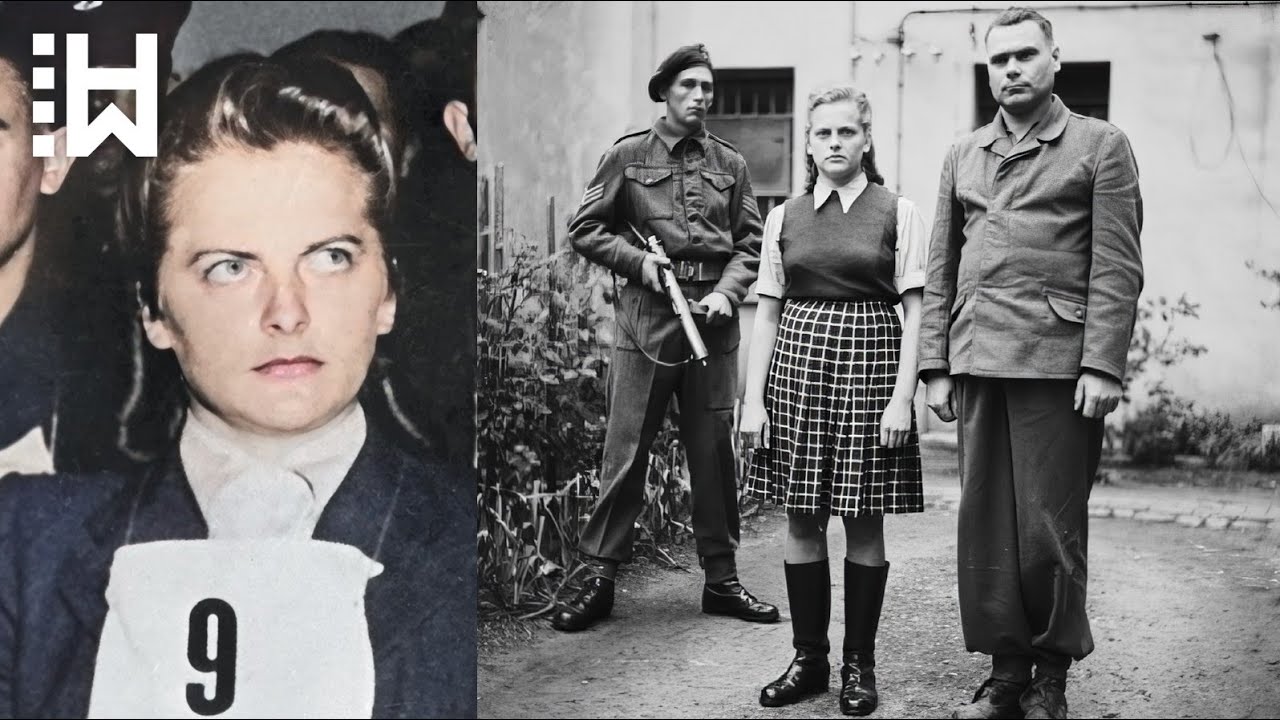
Justice finally caught up with her when Grese was tried at the Belsen trial, which began on September 17, 1945. During the trial, Irma Grese twice laughed so hard that she had to lean forward in the prisoner's box to try to control herself.
She held her hand to her mouth while alongside her Ilse Lothe, her fellow Nazi colleague, tried to conceal her giggles with her handkerchief. As the thirty-two-year-old P. Vine Gardner, another Nazi guard, said that when he had beaten one girl with a piece of rubber tubing it was the only time he had beaten anyone, Grese also laughed uncontrollably.
She also laughed when the wife of Josef Kramer, her former lover and once camp commandant of Auschwitz-Birkenau, said that when her husband used to come home from his day's work at Auschwitz he used to pace the floor at night, tormented by the fact that the Nazi commanders were having people put to death in gas chambers, and he cried, "Why, why, why?"
Other women, however, were less amused. When Kramer's wife left the court, she was slapped in the face by a Polish woman. During the trial, when the witnesses claimed that she was the worst SS woman in the camp, Grese responded that they were all lying, exaggerating, and making an elephant out of a small fly.
In the end, however, she gave up and said, "I confess to the ill treatment of prisoners because it has been on my conscience." Grese admitted to the beatings but never killing anyone, and added that if prisoners had their faces slapped it was only their fault. If they were more intelligent they obeyed orders.
When during the trial she broke down and wept, it was never because she was sorry for the crimes she had committed. Once Irma Grese cried when she heard her sister Helena telling the story of their home life to the court, and then when she saw her twenty-three-year-old brother Alfred, who had twice been wounded while fighting on the Eastern Front.
On November 17, 1945, the British Military Tribunal sentenced Irma Grese to death. After the sentence was pronounced, she looked awful and cried continuously. Her eyes were red and sunken and she was extremely nervous.
Afterwards, Irma Grese, who never showed an ounce of mercy to the prisoners she supervised, asked for clemency. But in early December, Field Marshal Montgomery rejected all appeals and ordered Grese, Kramer, and others to be hanged.
When she was hanged by British executioner Albert Pierrepoint at Hamelin prison on December 13, 1945, she was twenty-two years old. Walking to the gallows, her final and only word was "Schnell," meaning quickly.
Grese was the youngest woman to die judicially under British law in the twentieth century. There were no tears shed for Irma Grese.