On July 4, 1946, several thousand people gathered on a hill near the town of Gdansk in recently liberated Poland. Before them stood a row of gallows. One by one, 11 bound prisoners were noosed on the backs of Allied military trucks. When the signal was given, the trucks drove forward, leaving the condemned suspended.
Among the executed were the commandant of the Stutthof concentration camp, Johann Pauls, and 10 of his loyal officials, including five women. All five women were under 25 years of age. They had committed some of the cruelest acts known to humankind and were known among prisoners for their brutality.
Their punishment was just, but they were only a few of the women responsible for torturing and killing millions in the concentration camps. Many others managed to elude execution or even conviction altogether.
The Nazi party put much effort into recruiting women and spreading Nazi ideals among them. Although the public discourse of the Third Reich favored married women because of their ability to expand the Aryan race, single women were valuable to the German state because they had fewer household responsibilities and more time for non-domestic activities.
The outbreak of war in September 1939 brought more demands on women as men took on combat roles. Women were urgently required as auxiliaries, or "female helpers." They served in different organizations supporting various sectors of the German Army and the SS, contributing to the functioning of the Army, Navy, and Air Force. Each division had its own training system, methods, and uniform for its female helpers.
Hundreds of German women, however, had more sinister jobs. Around 3,500 women worked in the camps, which had a strict and complex hierarchy. Female guards were collectively known as SS helpers, or SS-Helferinnen. Women frequently joined the ranks of the SS at a very young age, and it was not uncommon for particularly ambitious young women to ascend the ranks quickly.
The war effort required that more and more women take on positions of responsibility, and these responsibilities sometimes included the extermination of Jews and other camp prisoners.
Among the lower-ranking women at the Stutthof concentration camp was a young girl named Herta Bothe. She was born in December 1920 to a German Protestant family stationed in the Polish city of Teterow, now called Lebork. She spent her childhood and part of her youth there and studied at a local public school until 1935, when she decided to quit school and begin working.
It remains unclear what kind of employment she pursued, but in the late 1930s she resided in several cities such as Berlin, Erfurt, and Lemberg. When the war started, she felt the calling of Adolf Hitler and decided to help the government. In 1944 she enrolled in her local branch of the League of German Girls, where she learned that the SS were recruiting ardent young Nazis to work in one of their many concentration camps.
In August 1944, when she was only 23 years old, she arrived at the Stutthof SK3 camp for training as an overseer. Two months later she finished training and became a wardress. Training with the SS had been hard and exhausting. There she learned the basics of prisoner management, including how to punish prisoners so that they would respect her.
Women, even more than men, were instructed to use physical violence such as hitting, kicking, and flogging to control the inmates. In October 1944 she was reassigned to Stutthof's Bromberg-Ost subcamp, which was only for women. There she was able to put into practice everything she had learned.
According to statements at her trial, she would eagerly wait for new prisoners to arrive at Bromberg-Ost early in the morning, then arbitrarily decide who was fit to work and who would go straight to the gas chambers. She seemed to enjoy playing God with those poor women.
During early morning roll calls she would hit the inmates with a stick in their faces and bodies, laughing at their inability to stop her. In the harsh winter months she enjoyed pouring cold water over the naked bodies of women who were expected to stand still. If they moved, she flogged them until they were left unconscious on the ground.
Her lack of mercy or empathy earned her a reputation as one of the cruelest wardens at Bromberg-Ost, if not the cruelest. This impressed her superiors, who decided that she was indispensable and that they needed her back in Stutthof.
From early 1945 until she fled the camp in April, she dedicated her time at Stutthof to handpicking which prisoners should be sent immediately to the gas chambers. When operating at full capacity, up to 150 people could be killed in any given day at Stutthof.
By this time, however, the threat of the Soviet Army had become too tangible for Stutthof to function as usual. The evacuation of prisoners from the Stutthof camp system began on January 25, 1945. By that time there were nearly 50,000 prisoners, most of them Jews, interned in the system.
The death marches that had brought many people to Stutthof now resumed westward. Most of the prisoners were marched in the direction of Lemberg in eastern Germany. Cut off by advancing Soviet forces, the Germans forced the surviving prisoners to march back to Stutthof.
In late April 1945 the remaining prisoners were removed from Stutthof by sea, since the camp was completely encircled by Soviet forces. In April 1945 she accompanied one of the last transports of women prisoners to the Lauenburg subcamp and fled during this evacuation.
Hundreds of prisoners were forced into the sea and shot. Over 4,000 Jews were sent by small boat to Germany, some to the Neuengamme concentration camp near Hamburg and some to camps along the Baltic coast. It is thought that she boarded one of the boats to Hamburg, where she was finally spotted by the Soviet Army, captured, and sent to jail to await trial.
The executioners at Stutthof did not bother with formality. The criminals were not granted the honor of being put to death by a professional executioner. Even at the Nuremberg trials, a man who claimed to be a professional was sought to take care of the operation.
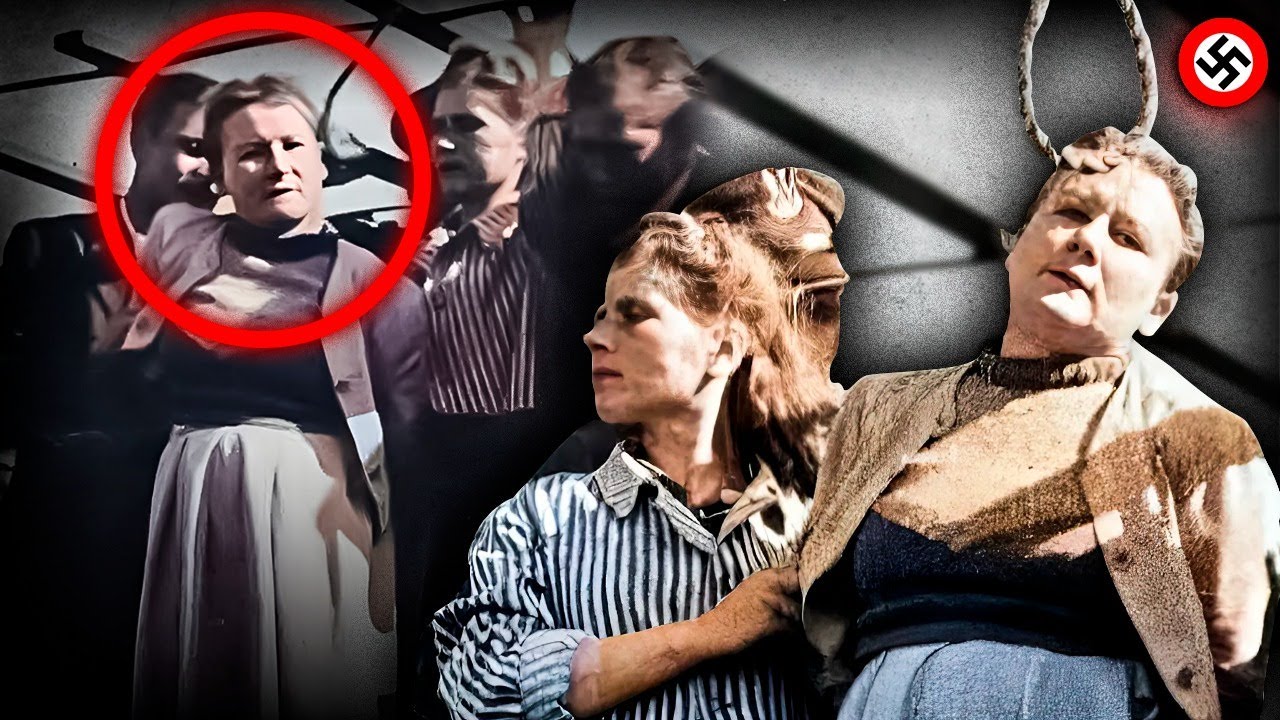
At Stutthof, a fleet of open trucks brought the prisoners to the execution ground, their hands and legs tied with cords. The trucks were backed under the gallows and the condemned were made to stand on the backs of the trucks. A simple cord noose was put around their necks, and when preparations were complete each truck was driven forward, leaving them suspended.
They were not hooded and were given only a short drop, meaning that they died from strangulation rather than from a broken neck. Witnesses claimed that some of them struggled for some time after suspension. Documents from the time mentioned that one man and two women struggled and fought with their guards prior to being hanged, although it does not clarify which of the women put up this sort of resistance. The others seemed to accept their fate calmly.
The whole event was recorded by official press photographers who were among the thousands that gathered to witness the hangings.
There were nearly a thousand concentration camps distributed along the territory controlled by the Third Reich, but none had a reputation for violence and cruelty like Auschwitz. It was a deserved reputation, as the men and women who worked there overseeing prisoners were known for their inhumane treatment of the people interned there.
Irma Grese earned many nicknames along her short but cruel career. She was feared by both prisoners and guards, who called her "The Beautiful Beast" on account of her unconventional beauty. After all, she was only 19 years old when she became a female guard at Auschwitz.
Soon enough she became known as "The Hyena of Auschwitz" and later "The Bitch of Belsen." Finally, the newspapers reported her demise in 1945 under the moniker "The Angel of Death," a name she shared only with Josef Mengele, one of the most evil members of the SS.
Grese had quit school at the age of 15, a short time after her mother ended her own life. A Nazi fanatic from an early age, she joined the SS and devoted her time to the organization's activities. When she was 18 years old, Grese volunteered for training in the Ravensbrück concentration camp, making her father furious.
After finding her new work uniform, Grese denounced her father and he was arrested soon after. At that time she realized that she enjoyed the sense of power she got by forcing people to do her will. At Ravensbrück her only thought was to finally become a full-time concentration camp guard.
Her opportunity came in 1942, when she was finally appointed as a guard at Ravensbrück. She had arrived there in April 1941 but was told to come back six months later, once she turned 18. Due to her good performance, she was transferred to Auschwitz in early 1943, where she was put in charge of 18,000 female prisoners.
There were around 2,500 female guards in all the Nazi camps, but Grese was without a doubt the worst of them all. She did not see working at the camps only as a means of satisfying her sadistic desires but also her sexual ones.
Irma first started having intimate relations with male SS officers at Ravensbrück. Sexual relations between the SS and prisoners were strictly prohibited, but intercourse between SS of opposite sexes was encouraged. According to witnesses, all of the female guards, married or unmarried, had had one or more constant SS lovers.
It typically took a month to train an SS female guard to her fullest depraved potential of sadism. Grese was trained in three weeks. She felt as though she had reached a major milestone and achievement in her life at that moment.
Brutality was part of the concentration camp system, but Grese's sadistic excesses in terms of sexual perversions and brutal beatings were for the most part rare. Most of the female guards were not brutally cruel. Grese participated in inmate beatings at Ravensbrück, and this was merely a part of her training.
She earned 54 Reichsmarks per month, significantly less than what her colleagues earned. At Ravensbrück she trained under Theodora Binz and learned to be as sadistic as Binz was. Binz continued to serve in Ravensbrück during the entire war. She had begun her career in September 1940 and became an SS chief overseer by 1943. She held this rank until the end of the war, and finally she was sentenced to be hanged on May 2, 1947, in Hamelin, at the same place where her disciple was hanged two years before.
Grese became notorious in her role as a guard and is remembered by many survivors as wearing heavy boots and carrying a whip and pistol. Every survivor account refers to these three sadistic objects. Grese became infamous for owning and using them.
Grese used her whip and pistol to punish inmates for the slightest infractions of camp rules and was fond of lashing well-endowed women across the breasts with her whip. Many of the women developed infections in their breasts from injuries caused by the braided wire end of her cellophane whip. An inmate was called upon by Grese to operate on these women with an unsterilized knife, but she had no anesthesia available for these operations. The women screamed in agony.
Grese also employed one or two huge dogs as part of her brutal regime in the Bergen-Belsen women's camp. Survivors recall her riding around camp on a bicycle with a dog at her side, accompanying the female inmates on their 16-kilometer trek to work. If they couldn't keep up with the column, she ordered her dog to attack them without mercy.
When Irma Grese, the youngest woman to ever be sentenced to death under British law, walked up to the gallows, she met face to face Albert Pierrepoint, one of Britain's most famous executioners. He tried to place the black hood over Grese's head, but she refused and violently tried to shake it off. She wanted to be able to see Pierrepoint in the eyes until the final second, but finally the guards held her while the executioner placed the black hood.
Some witnesses claimed that he even slapped her in the face, but this is not confirmed in the written report. What is confirmed is that Grese, who was 22 at the time, yelled "Schnell," meaning "quickly," while waiting for Pierrepoint to pull the lever. But it was not a quick death.
Pierrepoint, an experienced executioner who had been overseeing these procedures for over 15 years, placed the noose wrongly on Grese's neck, causing her a painful death by strangulation rather than her neck snapping. It became apparent to all the witnesses that this was done on purpose because of all the contempt Pierrepoint held towards the young Angel of Death.

After Irma Grese was hanged on December 13, 1945, it was Johanna Bormann's turn to step up to the gallows. She was a very small woman, which earned her the nickname "the Weasel." Completely defeated, she warned the executioner, "I have my feelings," she said. Her execution was quick and relatively painless.
So was that of Elisabeth Volkenrath, who had claimed during the trial that life conditions in the Bergen-Belsen camp were unbearable not only to the prisoners but to her and other common workers. Despite this incredible claim, she was sentenced and died at the gallows in December 1945 together with her former colleagues.
But how unbearable were the conditions at the Bergen-Belsen camp, and how much of this was the fault of the SS female wardens? When the Allied soldiers stormed the camp in April 1945, they found 60,000 people who were dying and 13,000 corpses. Because of an ongoing typhus outbreak and the lack of manpower, nobody had bothered to bury the deceased.
During the following days and weeks, it is estimated that 500 people died every day due to the typhus epidemic that had been going on in the camp for months. Once the situation was somewhat contained, the British turned their attention to those who had been responsible for the atrocities that were revealed to the world in April 1945.
Foremost among these was the commandant of the Belsen camp at the time of its liberation, SS Captain Josef Kramer. Kramer had been in charge of Bergen-Belsen concentration camp since December 1944, having previously been a senior camp administrator at Auschwitz, where he oversaw many of the gassings of Jews in the Birkenau subcamp.
Towards the end of the war, because Bergen-Belsen was located in the heart of the German land, it became a reception camp for many of the prisoners evacuated from camps further east as the Soviet Army advanced westwards. This of course resulted in the chronic overcrowding, starvation, and disease discovered by the British liberating forces.
These conditions were made even worse by Kramer's brutal regime, which earned him the nickname "the Beast of Belsen." During his time in Bergen-Belsen, the camp became one of the worst, perhaps the deadliest, camps in Germany without a gas chamber.
Under the service of Kramer there were several women, including Irma Grese. Elisabeth Volkenrath had earned a reputation for murdering Jews in Auschwitz, which in turn earned her a promotion to chief overseer for all the female camp sections at Auschwitz. She carried this position until the camp was liberated by the Allies, at which time she fled and was sent to Bergen-Belsen.
In the heart of the German homeland, she continued with the killings, this time by means of starvation and denial of medical attention instead of gassing. Witnesses during the Belsen trials claimed that female guards killed the weaker ones and threw many of the girls onto the ground and trampled on them.
Just like their male counterparts, the female guards upon entering the camps were trained to become hardened and to punish prisoners severely when necessary. Many became accustomed to beating and kicking prisoners, sometimes to the point of death, with their jackboots, sticks, and truncheons, or, like in the case of Irma Grese, with a whip made of cellophane.
Volkenrath had no whip, but she carried a gun everywhere she went inside the camp. Elisabeth Volkenrath's work in Bergen-Belsen was very short but bloody. She threw prisoners down the stairs, slammed them against the walls, and beat them mercilessly.
Volkenrath arrived at Bergen-Belsen on February 5, 1945, and was appointed chief overseer. She became sick within days of beginning her new job and was sent to the hospital. She was unable to return to work for over a month. When she returned to work, Volkenrath tried to make up for the lost time.
Volkenrath was later accused of heinous, nightmarish crimes while she was at Auschwitz and at Bergen-Belsen, from abuse and torture to participating in selections, although she would adamantly insist that she took no part in them. She argued at her trial that she simply observed and kept order. Thanks to the testimony of eyewitnesses, she was finally hanged for crimes that were atrocious and deliberate in nature.
Another female guard hanged because of her crimes at Bergen-Belsen was Johanna Bormann, who had become part of the SS as a civilian employee in March 1938 in order to increase her income. When she went to work in the camp system, she made more than 150 marks per month, considerably more than she had made at other jobs.
She was initially assigned to work at Ravensbrück as a kitchen helper and later became a guard. In this position she was known for her cruelty and propensity for violence, often applied by her dog. On May 15, 1943, Bormann was assigned to work at Auschwitz. While there she probably took part in selections for Dr. Josef Mengele, the Nazi doctor responsible for some of the most gruesome medical experiments of the Holocaust, but Bormann denied these charges at her trial.
Bormann was then sent to the Birkenau detachment, where she stayed until December 1943. Another assignment led her to Budy, a detachment of Birkenau. While at Birkenau, Bormann was assigned to work at a commando and took part in selections, although she denied this at her trial.
She was finally sent to Bergen-Belsen, where according to her own words she was put in charge of looking after the camp pigs. She used her status to engage in barbaric abuses. These included beatings, whippings, and savage torture against prisoners who tried to steal the pigs' food. Dogs continually provided her a way to express her power over the innocents.
While employed at the camps, Bormann used her dog to attack prisoners. Several female survivors related horrific accounts about Bormann and her sadistic use of her dog or dogs. Numerous accounts existed that corroborated the fact that Bormann continually used a dog to punish prisoners.
In her defense, Bormann stated at her trial that she had purchased a dog as a pet and only kept the animal as such. She also stated that she had given her dog away and had not had him while she was working at Budy, but that she only took the dog back once it fell ill. She stated that she certainly did not use the animal for any attacks against prisoners under her care.
Despite the fact that five different survivors testified to the contrary at her trial, she was said to have set her dog on a menstruating prisoner in Bergen-Belsen. Although Bormann always claimed that her dog was only a pet and was not an official SS-trained dog, nor was she ever granted permission to use her dog at work, it is unclear why she so emphatically denied that she had ever let her dog attack anyone, as if she was attempting to save the dog's reputation.

Many horrifying accounts came from female prisoners who witnessed Bormann's use of her dog to hurt inmates. Further evidence comes from the words of Heinrich Himmler himself, who actively encouraged the use of dogs as a tool for the women guards in the death camps.
Not every female guard was hanged for their crimes. The case of Herta Ehlert is very clear in demonstrating how seemingly innocent and harmless individuals can very quickly become death machines. Ehlert had been working as a bakery assistant in Berlin until she was called for SS work by the labor exchange on November 15, 1939.
Women were not allowed to actually join the SS, but they could work for them, and it was not uncommon for the SS to issue official uniforms and credentials to women. During her trial, Ehlert always maintained that she was a conscript when she began working as a novice at Ravensbrück concentration camp.
As a result, she always held minor positions and did not take part in any torture or killing, according to her own words. All she had to do in Ravensbrück was to see that civilian workers did not mix with the prisoners, and later on she accompanied working parties outside the camp.
In October 1942 she was moved as a female guard to the Majdanek camp near Lublin, Poland. Again according to her testimony at trial, she claimed she was moved as a punishment for being too nice to the prisoners by not giving them harsh enough punishments and helping to feed them. However, according to the Belsen trial, she had received a bonus as well as better working conditions at this camp. This extra money proved that she had not been punished.
By mid-1944 she was transferred to Kraków, where SS officers noticed she was too lenient, polite, and helpful to the prisoners, so the SS returned her to Ravensbrück to undergo another training course, this time by Dorothea Binz. During this time Ehlert divorced her husband.
Binz had also been the trainer of Irma Grese and others, and faithful to her reputation, she made a ruthless killer out of Ehlert. Ehlert was later moved to the Auschwitz concentration camp as a female overseer, where she oversaw women who were in charge of commandos.
Ehlert later served as a guard at the Auschwitz subcamp in Rajsko, Poland, before she was transferred to the Bergen-Belsen concentration camp, where she became deputy wardress under the direct orders of Elisabeth Volkenrath and Irma Grese. It was during this time that she committed most of the crimes she was ultimately convicted of.
When the British army liberated the Belsen camp, Ehlert was arrested and tried at the Belsen trial. While on trial, Ehlert was asked if she had committed theft, witnessed severe beatings, had committed murder, and so on, to which she denied all of the accusations. However, there were multiple eyewitnesses who claimed to have experienced torture and beatings on her part.
Ehlert pleaded not guilty to all charges. She was found guilty at Belsen and innocent at the Kraków camp, where there was not enough evidence to convict her. Ehlert was sentenced to 15 years in prison, but her sentence was later reduced to 12 years, and finally she was released early on May 7, 1953. She had completed barely half of the initial sentence and lived the rest of her life as a free woman.
A similar case is that of another Herta. Herta Bothe was born on January 8, 1921, in Teterow, Mecklenburg. Bothe came of age when the power of the Nazi party was rising. Little is known about her social class or her family life.
Both her parents held different jobs, which included working as domestics, until she decided to train as a nurse. Her nursing training lasted for a very short period until she went to work in the camp structure in October 1942. Bothe was conscripted to work as an overseer at Ravensbrück.
During her training at Ravensbrück she was taught to manage a commando. She stayed at Ravensbrück for over a week before being sent to Stutthof. She stayed at Stutthof for two years until July 1944, when she was sent to Bromberg. After six months, in January 1945, she was forced to evacuate the area along with other camp personnel.
Bothe, along with other Nazi personnel, marched for six weeks until they reached Bergen-Belsen. In Bergen-Belsen, Bothe initially worked in the bathhouse, but later she was assigned to the wood commando, a position she held until the British army captured her in April 1945.
While in charge of the commando, Bothe supervised about 60 prisoners. Male and female prisoners were both used for slave labor purposes in the wood commando, and Bothe was one of the few overseers assigned to the duty alongside a male SS guard.
Numerous survivors testified that while the prisoners were carrying their meager food rations, Bothe shot at them for sport. Part of Bothe's duties was to ensure that wood was delivered to the kitchen and other areas of the camp where wood was needed.
One survivor alleged that Bothe beat a Hungarian Jew named Eva to death with a block of wood for reasons unknown, and another prisoner testified to having seen Bothe shoot two prisoners in the back, again for no apparent reason. Her defense at her trial reminded the court that several witnesses also testified that Bothe never carried a pistol, but others testified otherwise.
Bothe also allegedly beat a woman for stealing turnip peels, a beating so severe that the woman died from the injuries. After Bothe realized the woman was dead, she ordered some of the women inmates to remove and dispose of the body.
Bothe only admitted at her trial that there were many cases of prisoners stealing from her commando unit, but that when she caught the thieves in the act, the only punishment she meted out was a minor slap on the face with her hands, and then she would set about trying to recover the stolen items.
Her defense attorney maintained that Bothe was only 24 when captured and had arrived to work at Bergen-Belsen when conditions had already disintegrated. Thus her attorney argued Bothe could not be held responsible for the conditions of the camp.
This was convincing to the authorities, and it was long debated whether to convict Bothe or not. Finally it was decided that she would serve a sentence of 10 years in prison, but she was released on December 21, 1951.
The different cases of female guards working in Nazi concentration camps during World War II proved that brutality and cold-bloodedness were not a patrimony of men alone. Whether it was their training, the conditions of the camps, or an inner desire to cause pain to others, these women were collectively responsible for the suffering and death of millions.
Their punishment was not always comparable to the crimes they had committed. Although many of them were hanged alongside men, others lived long lives as free women. Because they frequently changed their names, most of the people who knew them never suspected their monstrous behavior in the camps.