In October 1944, Erwin Rommel was no longer commanding armies. He was recovering at his villa near Ulm from a fractured skull suffered when a British fighter plane attacked his car in Normandy that summer, and he was still nearly blind from the injury.
Only months earlier, he had been one of the most feared commanders in the German army, the man the British themselves nicknamed the Desert Fox, admired even by the soldiers sent to kill him. Now, on paper, he was simply a wounded officer waiting to heal at home with his wife and son.
Two months earlier, on July 20, a bomb hidden in a briefcase had exploded at Hitler's headquarters in an attempt to end the war by ending Hitler. The plot failed. The Gestapo arrested dozens of officers connected to it, and under brutal interrogation, the conspirators began naming names to save themselves.
One of the names revealed was Rommel's. It did not matter that Rommel had not planted the bomb, had not been in the room, and had not fired a shot. In Hitler's Germany by late 1944, having your name mentioned was enough to condemn you.
On the morning of October 14, two generals arrived at his home, not to arrest him but to offer him a deal. What no one outside that house knew yet was that the deal was not a choice between guilt and innocence. It was a choice between two different endings, both of which had already been decided for him.
The offer was simple and final. Face the People's Court, where conviction and execution were certain, and his family would lose everything: the pension, the house, and possibly their freedom as well, since Sippenhaft, the Nazi concept of collective family responsibility, was already being applied against relatives of other conspirators that autumn.
Or take the cyanide capsule the generals had brought with them, and the regime would announce that he had died of his wounds, hold a state funeral, and protect his wife's and son's pension. It was not really a choice between life and death. Rommel would almost certainly die either way. It was a choice about what his death would cost the people he loved.
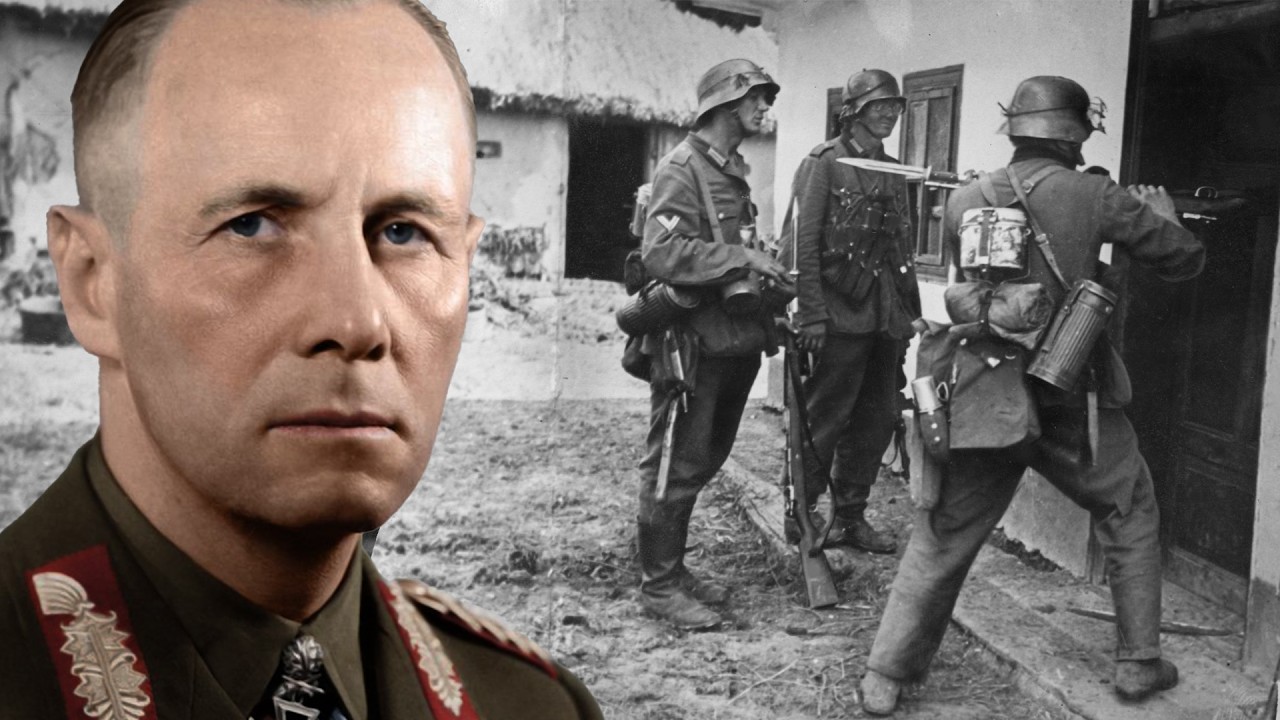
Rommel spoke privately with his wife Lucie and his 15-year-old son Manfred. Lucie wanted him to face the charges. Rommel did not believe that was possible. The house was already surrounded by plainclothes security men standing around the property as if waiting for something.
He put on his old Afrika Korps jacket, took his field marshal's baton, and walked to the car as if heading to an ordinary meeting. Manfred later said his father never looked back. Minutes later, on a quiet road outside the village, Rommel swallowed the capsule.
His body was taken to a nearby field hospital, where the doctor who examined him realized immediately that the death was not natural. Bodies that die of strokes or aneurysms do not look like that. The doctor requested an autopsy. He was flatly refused.
Ten minutes after the car left, the telephone rang in Rommel's house. Lucie was told her husband was dead. She was given no chance to absorb the news before she was required to go along with a fabricated story about his death.
You might think a state funeral four days later, with Hitler declaring a day of national mourning and sending another field marshal to deliver the eulogy, would be the end of the story. But the man who gave that eulogy, Field Marshal Gerd von Rundstedt, had no idea he was lying to an entire country. He sincerely believed Rommel had died of his wounds.
The only people in that crowd who knew the truth were Lucie, Manfred, now 16, and Rommel's loyal aide. The three stood there and said nothing.
The cover story was believed not only by the public but also by the men who praised him. Picture that moment: a 16-year-old boy standing at his father's grave, watching thousands mourn a lie he was not allowed to correct, because correcting it would mean losing the pension the regime had promised, and perhaps worse. Grief and performance merged until it was impossible to separate them.

The lie held for another six months. Then, in April 1945, American forces crossing the Danube captured the village of Herrlingen, and an anti-aircraft unit reported, almost by accident, that Field Marshal Rommel's widow was living quietly a few streets away.
An American intelligence captain went to the house expecting to find a palace built on looted Nazi wealth. Instead he found a modest home with a library full of military history books, including, surprisingly, a translated copy of an American general's writings on infantry tactics.
He sat with Lucie. For the first time since October, she told the true story aloud: the generals, the ultimatum, the poison capsule. Manfred, now 16, confirmed every detail in a separate statement.
Here was the wife of one of the most legendary generals in German history, sitting before an Allied officer and calmly exposing the falsehood her own government had invented. That was the moment the official account of Rommel's death stopped being fact and became something the Allies could prove was a lie.
Consider what that meant for the people left behind. Lucie was not arrested. She was not put through a denazification court, unlike the families of other senior officers. The Allies treated her as a soldier's widow, not a political enemy, and she spent the following decades quietly working with historians, helping publish her husband's wartime letters and memoirs, even consulting on a Hollywood war film. She died in 1971 and was buried beside him.
But think about what those 30 years were like for her, raising a teenage son alone in a country trying to forget the war had happened, while privately holding on to a truth no one wanted to hear repeated.
Manfred's situation was harder. He had already served in an anti-aircraft unit as a young teenager, was dismissed from the air force in the final months of the war, was briefly drafted into a labor battalion, and then fled to surrender to the French as the war collapsed around him. A 16-year-old walking away from a collapsing army, carrying the name of a father half the country considered a tragedy and the other half a traitor.

He finished his education, studied law, and eventually became mayor of Stuttgart for 22 years, a conservative politician who spent his career defending migrant workers and reconciliation at a time when few of his peers did. In 1977, when three domestic terrorists died in a German prison, Manfred insisted they be given a dignified burial despite his party's outrage. His words on the matter are still quoted today: hostility must end at some point, and in this case, it ends with death.
He became close friends with the sons of his father's old wartime opponents, the son of an American general and the son of a British field marshal, two sons of enemies dining in Stuttgart decades later, regarded across Europe as living proof that wartime grudges should not outlive the people who held them.
But here is a detail almost no documentary includes. Years before he married Lucie, the young Rommel had fathered a daughter with another woman named Gertrud. When the girl was 15, her mother died, and Rommel and Lucie quietly took her in and raised her. Manfred grew up believing she was his cousin. He only learned the truth about his half-sister very late in life.
Gertrud wrote her father hundreds of letters during the war and even knitted him the checkered scarf he wears in almost all his famous desert photographs. She sat by his hospital bed. She remained close to the family for the rest of her life, and decades later her son published roughly 150 of Rommel's private letters, a hidden chapter of the story that had stayed locked in a family drawer all along.
So what does all of this actually mean? It means the story of the hero's death that you read in most textbooks was manufactured immediately, not only by Hitler's regime to hide a forced suicide, but later by Rommel's former chief of staff, who spent the postwar years rebuilding Rommel's image as a symbol West Germany could rally around as it prepared to rearm during the Cold War.
The Allies needed a "good German." West Germany needed a hero untainted by the reputation of the regime he had served for years. The myth-making machine never asked whether Rommel was a reluctant soldier trapped by circumstance or a loyal officer who only turned on the regime when it turned on him. It only asked which narrative served its interests.
Consider what that really required. Speidel had to quietly shift focus away from Rommel's loyal and effective years of service to Hitler and toward the ambiguous, unproven question of how close he truly was to the July plot. The biographies followed. A bestselling book by a British officer turned Rommel into a household name in the English-speaking world. A collection of his wartime letters and diaries, published with direct help from Lucie and Manfred, gave the legend documented credibility. By the time historians began seriously questioning the story decades later, the "reluctant hero" version had been repeated so often it had become the dominant narrative.
And that brings us back to where we started. The regime believed a state funeral and a fabricated cause of death would bury the truth about Rommel forever, along with any inconvenient questions about his family. It worked for six months. An entire nation mourned a brain hemorrhage that never happened, and the only field marshal who knew the truth was already dead.
Instead, his widow kept the real story alive long enough to hand it to the Allies herself, in her own words, in her own living room. His son built an entire political career on reconciliation with the countries his father once fought, symbolically closing the kind of hostility that had killed his father in the first place. And the hidden daughter, raised in secret and erased from the official story for decades, was one of the people who knew him best, close enough to knit the scarf that appeared in nearly every famous photograph of him.
The cover-up did not erase the family. The family endured and outlasted it. So the question worth reflecting on is this: was Erwin Rommel a reluctant soldier destroyed by a regime he secretly opposed, or a loyal officer whose family spent decades building a myth more comfortable than the truth?