By late April 1945, the collapse of Nazi Germany was no longer a military campaign. It had become a descent into hell.
General George S. Patton's Third Army was tearing through the Bavarian countryside and into Austria, moving so fast that their maps were obsolete within hours. But as the American tanks rolled deeper into the dying Reich, the nature of the war shifted.
They were no longer just fighting the Wehrmacht. They were unearthing the darkest secrets of Hitler's empire.
Patton's men had already liberated Ohrdruf, the first concentration camp discovered by the Americans. Patton himself had vomited at the sight of the stacked corpses and had forced local German civilians to march through the camp to witness the atrocities.
But Ohrdruf was above ground. It was visible.
As the Third Army pushed into the jagged, forested hills of Thuringia and Bavaria, they began to discover a new kind of nightmare: the subterranean Reich. Deep beneath the picturesque mountains, the Nazis had built sprawling, labyrinthine tunnel complexes.
These were underground factories designed to build V2 rockets and munitions safe from Allied bombers. But the machinery wasn't run by mechanics. It was run by slaves.
On one chilling spring morning, a forward scout unit of the Third Army stumbled upon a sealed mountainside bunker that hid a secret that would push General Patton to the absolute limits of his legendary rage.
An infantry platoon from the 11th Armored Division was clearing a dense pine forest near a disguised railway siding when they found it. A massive, riveted iron door was set directly into the side of a limestone cliff.
The facility had been camouflaged with netting and fake foliage. The retreating SS units had blown the main railway entrances, but this heavy pedestrian door remained intact. And it was bolted shut from the outside.
The American GIs approached cautiously, their M1 Garands raised. The air around the door smelled distinctly of cordite, damp earth, and something much worse: the unmistakable, sickly sweet stench of rot and human waste.
Then they heard it. It wasn't a shout. It was a faint, rhythmic tapping against the thick steel. Tap. Tap. Tap. It was the sound of desperate, failing strength.
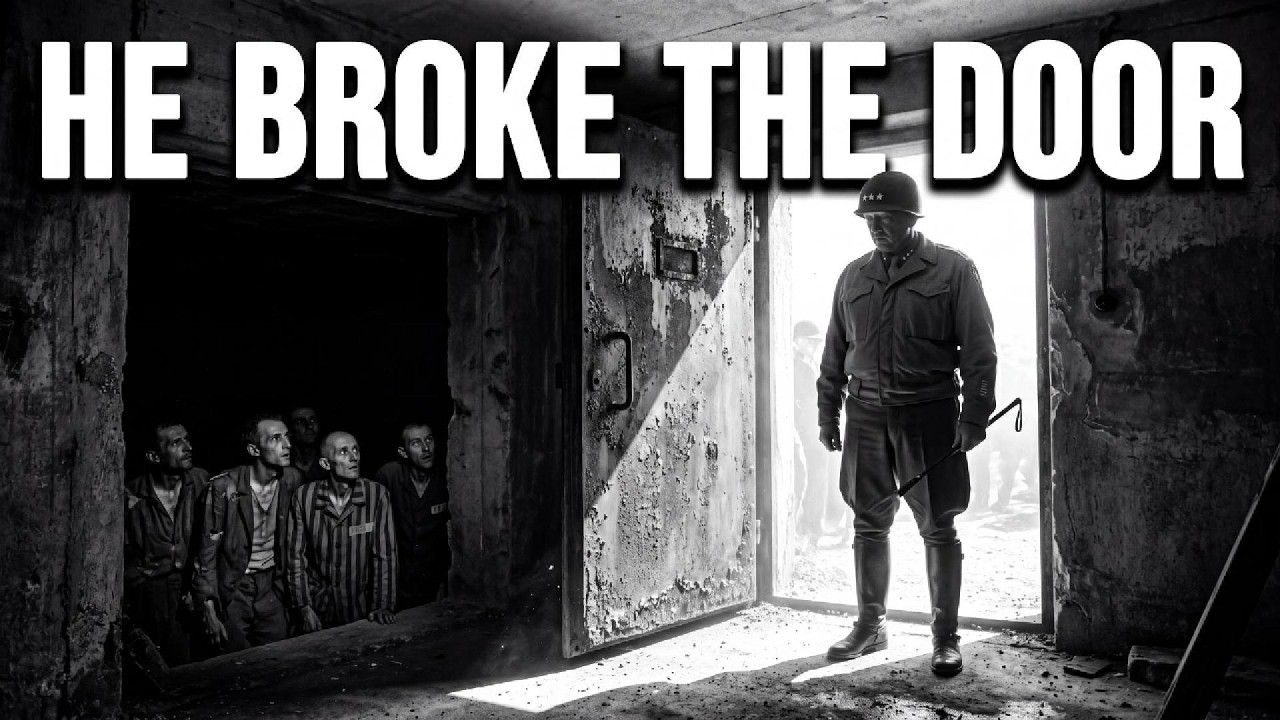
The American lieutenant ordered his engineers forward. They didn't have time to pick locks. They brought up a half-track, hooked a heavy steel winch cable to the iron handle, and ripped the door off its hinges. The sound of screaming metal echoed through the valley.
As the heavy door fell away, a wave of putrid, suffocating air washed over the Americans. The soldiers clicked on their flashlights and stepped into the pitch-black void.
What the beams of light revealed would haunt the men for the rest of their lives. Huddled in the freezing, dripping darkness of the cavernous tunnel were dozens of human beings.
They were little more than living skeletons, dressed in rotting, filth-encrusted rags. They held their hands up to their faces, screaming and weeping in pain because their eyes, adjusted to weeks of total, absolute blackness, were physically burning from the beams of the flashlights.
The American medics rushed forward, speaking in gentle German and Polish, assuming these were Eastern European slave laborers. But then one of the emaciated figures, a boy who couldn't have been older than 19 and weighing barely 90 pounds, reached out a trembling hand, grabbed a medic's sleeve, and spoke.
"God bless you," he whispered in a raspy, unbroken American accent. "What took you guys so long?"
A shockwave ripped through the American platoon. These weren't political prisoners. They were American GIs.
They were men of the 106th Infantry and the 28th Division, soldiers who had been captured months earlier during the freezing chaos of the Battle of the Bulge. Instead of being sent to standard stalags, POW camps monitored by the Red Cross, the SS had quietly siphoned off this group of Americans.
They had been marched into the mountains, stripped of their dog tags, and forced into subterranean slavery, hauling heavy rocks and munitions in the damp, freezing dark.
When the Third Army approached, the SS guards didn't evacuate them. To hide their war crimes, they simply locked the iron door, extinguished the generators, and left the Americans to starve to death in the pitch-black. They had been trapped in the dark without food or fresh water for over two weeks.
When the radio message reached Third Army headquarters, it didn't go through the standard chain of command. It went straight to the top.
Within hours, the roar of a siren echoed through the forest as General George S. Patton's command jeep skidded to a halt outside the bunker. Patton stepped out, his face a mask of stone.

He walked past the medics, past the stretchers, and stood at the entrance of the cave. He watched as his men, American soldiers, were carried out into the sunlight. They were blindfolded with bandages to protect their ruined eyes. Their skin was translucent, covered in sores from the dampness.
Patton, a man who believed the American soldier was a sacred warrior, felt tears welling in his eyes. But the sorrow vanished in a millisecond, replaced by a cold, calculating, and terrifying wrath.
He turned to the intelligence officer on site. "Who did this?" Patton demanded, his voice dropping to a dangerous, gravelly whisper.
The officer pointed to a group of German prisoners sitting under heavy guard by the tree line. It was the bunker's SS commandant and his staff. They had been caught trying to flee through the woods in civilian clothes, their SS uniforms discarded in the bushes.
Patton walked slowly toward the prisoners. His hand rested instinctively on the ivory grip of his Colt .45. The American GIs guarding the Germans took a step back, sensing that Old Blood and Guts was about to commit a summary execution right there in the dirt.
The SS commandant, a hardened fanatic who still believed in the superiority of his rank, stood up. Through a translator, he attempted to justify the horror.
He arrogantly claimed that the Americans were criminals who had bombed German cities. He claimed he had locked the door to protect them from the artillery. He tried to invoke the rules of war.
Patton didn't scream. He didn't rant in French like he had at the chateau. He stepped so close to the SS officer that the brims of their helmets almost touched.
"You want to talk about the rules of war?" Patton said quietly. "You don't know the first thing about war. You are not soldiers. You are rats who hide in the dark."
Patton drew his revolver. The collective breath of the American platoon stopped. But Patton didn't aim it at the commandant's head. He pointed the heavy barrel straight at the black, gaping maw of the iron door.
Patton delivered his sentence. It wasn't a trial, and it wasn't a firing squad. It was a descent into the psychological terror the Germans had just inflicted.
"Take their boots. Take their coats," Patton ordered his MPs.
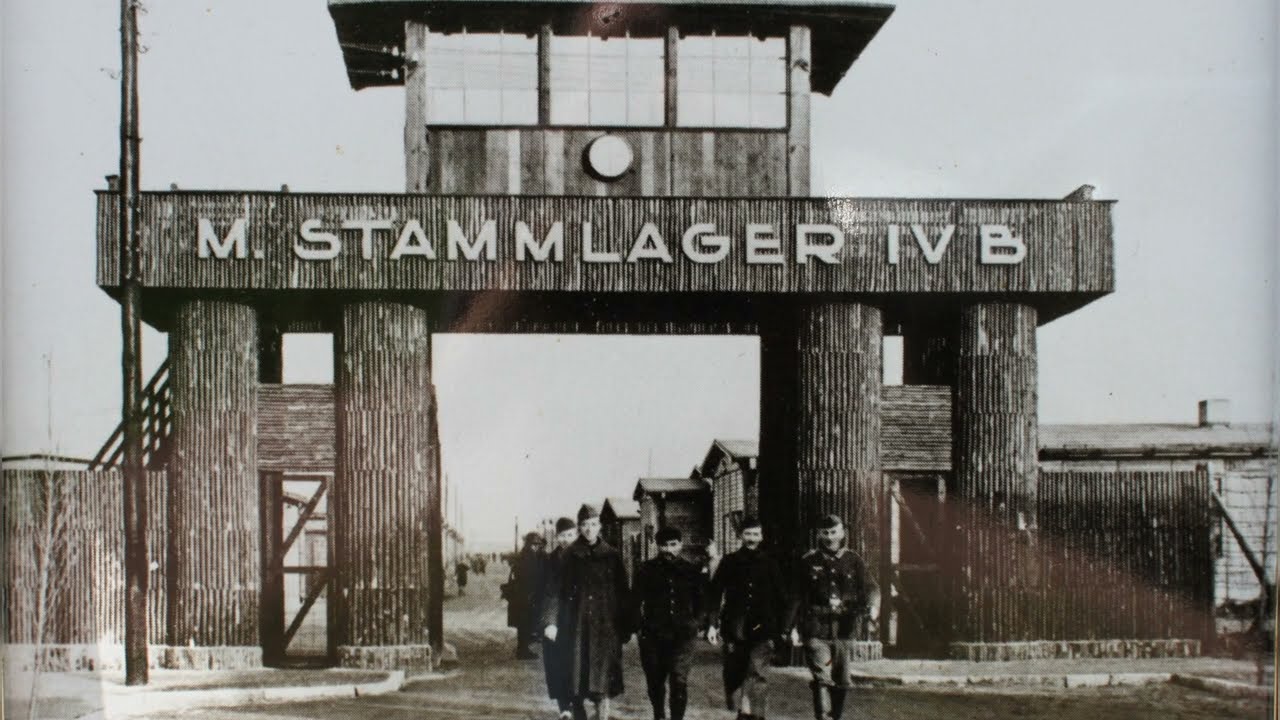
The MPs quickly stripped the SS guards of their footwear and warm clothing. Patton then ordered the German officers and guards to walk into the tunnel. He forced them to personally pick up the buckets of human waste, to carry out the bodies of the Americans who hadn't survived the starvation, and to clean the filth from the floors with their bare hands.
But that was just the beginning. Once the last living American was safely in a Red Cross ambulance, Patton ordered the SS commandant and his entire staff back into the deepest, darkest recess of the subterranean bunker.
"You like the dark?" Patton yelled into the cavern, his voice echoing off the damp walls. "Then you can stay in it."
Patton ordered his engineers to swing the massive iron door shut. The German officers inside, suddenly realizing what was happening, began to scream. They slammed their fists against the steel, begging for mercy, pleading not to be left in the pitch-black.
Patton stood outside the door. He ordered the engineers to weld the hinges locked.
Patton turned to the captain of the military police detail. "You will leave them in there for exactly 24 hours," Patton ordered. "No lights. No water. No sound. Let them feel what my boys felt. Tomorrow, you can cut the door open and march whatever is left of them to a POW cage. If they complain, lock them back in for another day."
For 24 hours, the SS guards were left in absolute, crushing darkness. The psychological torture of the pitch-black, combined with the freezing temperatures and the lingering smell of the atrocities they had committed, broke them.
When the American MPs finally torched the door open the next day, the arrogant, fanatical SS men crawled out on their hands and knees, weeping, utterly shattered.
The story of the underground bunker became a whispered legend among the units of the Third Army. It was the ultimate example of Patton's core philosophy during the closing days of the war: the only way to defeat a regime built on cruelty was to turn their own terror against them.
Patton made sure the liberated Americans were given the highest priority for medical evacuation. He personally visited them in the field hospitals, pinning Purple Hearts on their tattered hospital gowns. But he never apologized for what he did to their captors.
To this day, military ethicists debate Patton's actions. The critics argue that by locking the prisoners in the bunker, Patton engaged in psychological torture and collective punishment. They argue that as a high-ranking American general, he was obligated to rise above the barbarism of the Nazis, and that his eye-for-an-eye mentality bordered on the very war crimes the Allies were trying to stop.
The supporters see it entirely differently. They argue that standard justice, a warm POW camp, and three meals a day would have been an insult to the American boys who had rotted in the dark. They argue that Patton's 24-hour sentence of darkness was a brilliant, necessary form of instant karma that stripped the SS of their arrogance and showed them the true weight of their cruelty.
Was General Patton's decision to lock the SS guards in the pitch-black bunker an act of profound poetic justice, or did it cross the line into the dark realm of psychological torture? Did the punishment fit the horrific crime?