In November 1943, in Cairo, Egypt, President Franklin Roosevelt sat across from Army Chief of Staff George C. Marshall and offered him the most powerful military position of World War II. Roosevelt told Marshall he would command Overlord, the invasion of Nazi-occupied France. The decision, Roosevelt said, was final.
Overlord was the largest military operation in human history. It meant command of 3 million men, 5,000 ships, and 11,000 aircraft. It was the operation that would decide whether democracy survived or Hitler's Reich stood for a thousand years.
Marshall looked at his commander-in-chief and said something that shocked everyone in the room. He preferred to remain as chief of staff.
Roosevelt stared at him. Churchill, sitting nearby, could not believe what he had just heard. Marshall had turned down the greatest military command in history, the job that would make whoever led it the most famous general since Napoleon.
Within 48 hours, Roosevelt gave the job to Dwight Eisenhower instead. Eisenhower was a general who had never commanded troops in combat before Pearl Harbor, a staff officer who had spent most of his career behind a desk.
Eisenhower would lead D-Day. Eisenhower would liberate Europe. Eisenhower would become a household name, and later president of the United States. All because Marshall said no.
The decision made no sense on its surface. Marshall had been preparing for this moment his entire career. He had spent four years building the army from 175,000 men to 8 million. He had personally selected and trained the commanders who would fight the war. He had planned the strategy. He had convinced Roosevelt and Churchill that France, not the Pacific, should be the main effort.
This was his operation, his strategy, his army, and he gave it away. He did not do it because he was incapable. He did it because he chose to step aside.
Supreme Allied Commander was not just a title. It was immortality. Whoever commanded Overlord would be remembered as the man who defeated Hitler, the liberator of Europe, the savior of Western civilization. Marshall knew this. Everyone knew this.
Churchill had been pushing for Marshall to get the command for months. Stalin had asked for Marshall by name. Even Hitler knew Marshall was coming. German intelligence had already identified him as the likely invasion commander. The entire world expected George Marshall to lead the invasion.
George Catlett Marshall Jr. was born on December 31, 1880, in Uniontown, Pennsylvania. His father was a coal merchant. It was a middle-class family, nothing special.
Marshall attended the Virginia Military Institute, not West Point. He graduated in 1901 as a second lieutenant. For the next 40 years, Marshall would be the Army officer nobody remembered.
While Patton and MacArthur were making headlines, Marshall was writing training manuals. While Eisenhower was playing football at West Point, Marshall was teaching at infantry schools. While other officers sought combat commands and medals, Marshall built administrative systems. He was a planner, an organizer, a manager, not the kind of officer who becomes famous.
By 1939, when World War II started in Europe, Marshall was 58 years old. Most officers that age were retired or in dead-end desk jobs. Marshall had never commanded a division in combat. He had never led troops in battle. His entire career had been staff work.
Then Roosevelt did something unexpected. In September 1939, the same month Germany invaded Poland, FDR appointed Marshall as chief of staff of the United States Army. He passed over 34 more senior generals, officers with combat commands and Medal of Honor citations. Roosevelt picked the staff officer.
Marshall took command of an army that ranked 17th in the world, smaller than Portugal's, with 175,000 men and obsolete equipment. There were no tanks worth mentioning and an air corps flying planes from the 1920s. It was a military utterly unprepared for modern war.
Within two years, Marshall transformed that force into the foundation of the most powerful military in human history. He did it by doing what he had always done: planning, organizing, and building systems.
Marshall created the promotion structure that identified talented officers. He established the training programs that turned civilians into soldiers. He designed the logistics networks that would eventually supply armies on three continents.
He also started picking the commanders who would fight the war. Marshall promoted Eisenhower from lieutenant colonel to brigadier general in 1941, one of the fastest promotions in Army history. Eisenhower had never commanded troops in combat. He had spent his entire career in staff positions, just like Marshall.
But Marshall saw something in him: an ability to work with difficult personalities, a talent for coalition management, and a strategic mind that understood politics as well as tactics. Marshall made Eisenhower his protege, brought him to Washington, and put him in charge of war planning.
When the US needed a commander for North Africa in 1942, Marshall recommended Eisenhower. When they needed someone for Sicily and Italy, Marshall pushed Eisenhower again. By 1943, Eisenhower had proven himself. He had held together the fractious Allied coalition in North Africa. He had managed the egos of British and American generals. He had learned how to run a coalition war.
But he still had not commanded the kind of operation Marshall had in mind. The invasion of France would be different, bigger, more complex, and more important.
Throughout 1943, the question everyone was asking was who would command Overlord. The British assumed it would be a British general. Montgomery wanted it. Alexander expected it. Churchill pushed for a British commander since the operation would launch from Britain with significant British forces.
But Roosevelt and Marshall had already decided an American would command. The US was providing the majority of troops and equipment. American strategy, to invade France rather than pursue Churchill's approach through Italy and the Balkans, had won the argument. An American would lead.
The question was which American. By mid-1943, there were really only two candidates: Marshall and Eisenhower. Eisenhower had the coalition experience. He had worked with the British. He had commanded Allied forces in the Mediterranean. He understood the politics.
But Marshall had designed the entire strategy. He had built the army that would execute it. He had selected and trained the commanders. He had spent four years preparing for this exact moment. Everyone assumed it would be Marshall.
Churchill told Roosevelt directly that he had the greatest confidence in Marshall and that Marshall should command Overlord. At the Tehran conference in November 1943, Stalin asked Roosevelt point blank who would command Overlord. Stalin wanted Marshall's name. He trusted Marshall.
Even the American press expected it. Time magazine had already prepared articles about Marshall taking command in Europe. The army's plans assumed Marshall would leave Washington and move to London to run the invasion.
Roosevelt wanted Marshall to have it. The president told his chief of staff multiple times that he deserved the command and had earned it. Marshall kept deflecting. He never said yes, but he never said no either. He just stayed quiet.
Then in late November 1943, Roosevelt made the decision for him. They were in Cairo for a conference before heading to Tehran to meet Stalin. Roosevelt called Marshall to his villa, just the two of them, with no witnesses and no official record. Roosevelt told Marshall he was giving him Overlord. He was not asking. He was telling.
Marshall looked at the president of the United States and said he could not accept. Roosevelt was stunned and asked why not. Marshall gave him the answer he had been thinking about for months.
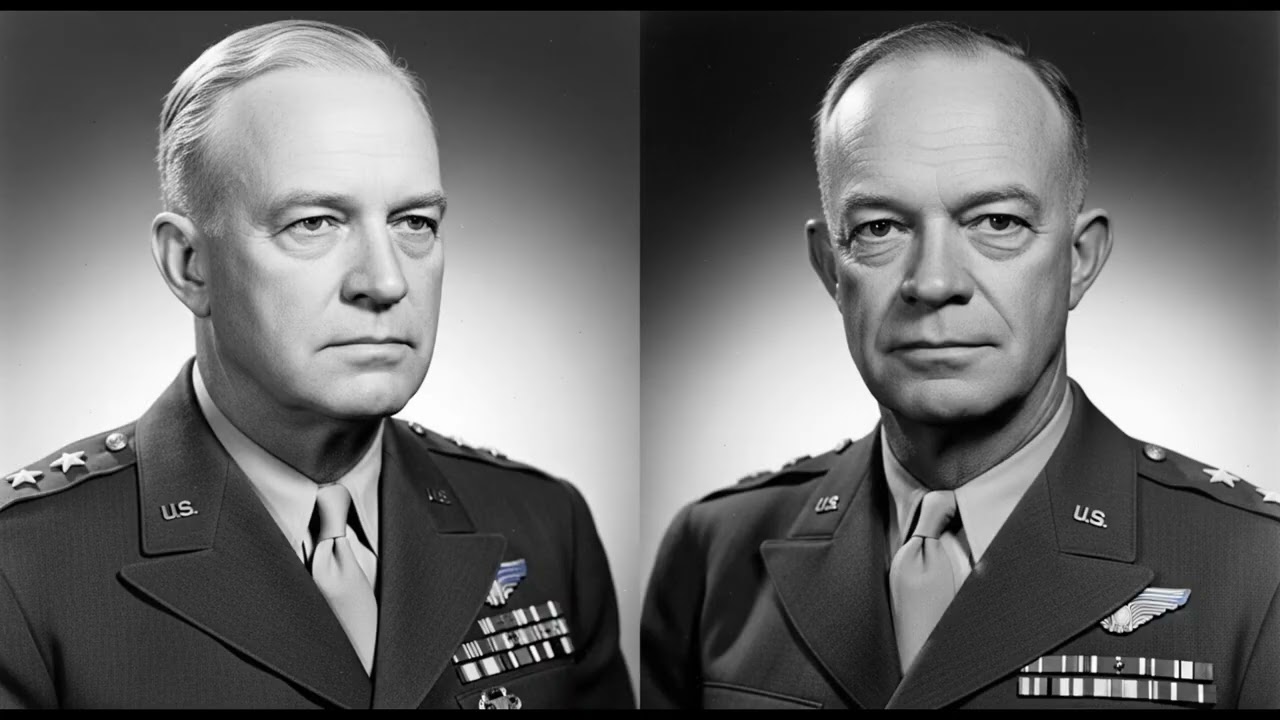
He told the president he could not sleep at night with Roosevelt in Washington and himself in London. Roosevelt needed someone in Washington who knew the army, who built it, and who could keep it running while the invasion happened. If Marshall went to Europe, who would run the war from Washington?
Roosevelt started to argue. There were other generals who could be chief of staff. Eisenhower could do it, or Bradley, or McNair. Marshall shook his head. They did not know the systems. They did not know the people. They did not know how to work with Congress, with the War Production Board, or with the logistics networks. Marshall had built those systems. He knew how they worked and how to keep them running.
He paused, then said the thing that decided it. He knew Roosevelt. He knew how the president thought. He knew how to translate Roosevelt's decisions into military action. Whoever replaced him as chief of staff would not have that. And Roosevelt would need that when the invasion started and things went wrong.
Roosevelt sat back. He understood what Marshall was really saying. The invasion would be the most visible part of the war, the dramatic part, the part everyone would remember. But the invasion would only work if everything behind it worked.
The training camps in the US had to keep producing soldiers. The factories had to keep producing tanks, planes, and ammunition. The shipping network had to keep moving supplies across the Atlantic. The replacement system had to keep feeding fresh troops to Europe. All of that happened in Washington, not London. And all of it required someone who understood the entire machine.
Marshall was telling Roosevelt that he did not need him to command the invasion. He needed him to make sure the invasion had everything it needed to succeed.
Roosevelt looked at his chief of staff, the man who had transformed the US military in four years, the man who had built the systems that made American victory possible, the man who was now turning down personal glory because he understood the bigger picture. Roosevelt said quietly that Marshall would stay in Washington. Eisenhower would get Overlord.
Two days later, Roosevelt met with Stalin in Tehran. Stalin asked his question: who would command Overlord? Roosevelt answered, General Eisenhower. Stalin looked surprised. Not Marshall? Marshall would remain in Washington, Roosevelt said. He was too valuable there. Stalin nodded slowly. He understood. The Americans were keeping their best general in the position where he could do the most good.
On December 5, 1943, Roosevelt sent Eisenhower a brief message: You will command Overlord. Eisenhower's reaction, according to his aide Harry Butcher, was shock. He had assumed Marshall would get it. Everyone had assumed Marshall would get it. When Eisenhower learned that Marshall had turned it down, he could not believe it.
Marshall did not decline because he wanted Eisenhower to have glory. He declined because he understood that winning the war required more than commanding the invasion. It required keeping the entire American war machine running smoothly. And only Marshall could do that.
The invasion of France would succeed or fail based on what happened months before the first soldier landed on the beach: training, equipment, logistics, shipping, supplies, and coordination between the War Department, the Navy, the Air Force, the British, and the Soviets. All of that required Washington. It required someone who understood how the US government worked, how to manage Congress, how to keep production running, and how to balance competing demands from MacArthur in the Pacific and Eisenhower in Europe.
Eisenhower was brilliant at coalition command, at managing Montgomery and Patton, and at planning operations. But Eisenhower did not know how Washington worked. He had spent most of his career overseas or in tactical commands. Marshall knew Washington. He had spent four years learning how to work with Roosevelt, with Congress, with the War Production Board, and with the industrial base. He had built the relationships. He understood the political landscape.
If Marshall went to London, someone else would have to learn all of that during the most critical phase of the war, while the invasion was happening, while the Pacific campaign was expanding, and while the Soviets were demanding more supplies.
Marshall made a calculation. The invasion would succeed with Eisenhower in command because Eisenhower was competent and had the right skills for coalition warfare. But the invasion might fail if the systems supporting it broke down. And those systems required Marshall in Washington. So he stayed.
The world would remember Eisenhower, not Marshall. Eisenhower's face would be on the newspapers when Paris was liberated. Eisenhower would accept the German surrender. Eisenhower would become president. Marshall would remain in Washington, writing memos, managing logistics, dealing with Congress, and doing the unglamorous work that made victory possible. And Marshall was fine with that.
In early 1944, after Eisenhower had taken command of Overlord, a reporter asked Marshall if he regretted not commanding the invasion. Marshall's answer was that he had the job that mattered most. Eisenhower had the job everyone would remember. Those were not the same thing.
The reporter pressed him, asking if he did not want to be remembered. Marshall said something remarkable. He did not care about being remembered. He cared about winning the war. If staying in Washington helped win the war, that was what mattered. History could remember whoever it wanted.
That was not false modesty. Marshall genuinely believed that his job in Washington mattered more than commanding the invasion, even if nobody would remember it. And he was right.
Throughout 1944 and 1945, while Eisenhower was commanding in Europe, Marshall was performing miracles in Washington. He kept the replacement pipeline flowing when casualties exceeded projections. He balanced resources between Europe and the Pacific when MacArthur was demanding more troops. He managed Congress when they wanted to cut war production. He coordinated with the British when they wanted to divert resources to other theaters. None of it was glamorous. None of it made headlines. But all of it was essential.
When the war ended in May 1945, Eisenhower got the victory parades. Marshall got a thank you note from Truman.
But what happened afterward revealed the truth about Marshall's decision. After the war, when Europe was devastated and needed rebuilding, Truman sent Marshall to do it. The Marshall Plan provided $13 billion to rebuild Europe. It was the program that prevented Western Europe from falling to communism and the most successful foreign aid program in history.
Marshall designed it. Marshall implemented it. Marshall made it work. He understood how to work with Congress to get funding, how to coordinate with European governments, how to manage a massive bureaucratic program, and how to think strategically about long-term consequences, not just immediate military victory. All the skills he had used as chief of staff, all the experience he had gained by staying in Washington instead of going to London.
If Marshall had commanded D-Day, someone else would have been chief of staff during the war. That person probably would not have had the relationships, the experience, or the strategic vision to run the Marshall Plan afterward. Marshall's decision not to command Overlord did not just help win World War II. It helped win the Cold War.
In 1953, Marshall received the Nobel Peace Prize, not for commanding armies, but for rebuilding Europe. The citation specifically mentioned the Marshall Plan as the most unselfish act by any great nation in history. Eisenhower, by then president of the United States, sent Marshall a personal letter. He told Marshall that he had made the decision Eisenhower benefited from. History would remember both of them, but Marshall had made the harder choice.
Marshall did not refuse to command D-Day because he was not capable. He would have commanded the invasion brilliantly. He did not refuse because he lacked ambition. Marshall cared deeply about his legacy and his place in history. He did not refuse because Roosevelt forced him to stay in Washington. FDR offered him the command multiple times.
Marshall refused because he understood something most leaders miss. The most important position is not always the most visible one. The job that matters most is not always the job everyone remembers.
Marshall knew that winning the war required more than a brilliant invasion of France. It required keeping the entire American war machine running smoothly, building and training millions of soldiers, producing and shipping mountains of equipment, and managing the politics in Washington that made all of that possible. And only Marshall could do that job.
Eisenhower could command the invasion. Bradley could command armies. Patton could lead tanks. But only Marshall could run the war from Washington. So Marshall stayed, let someone else get the glory, and did the job that actually mattered most.
That is leadership: not taking the position everyone expects you to want, but taking the position where you can make the biggest difference, even if nobody notices.
History remembers Eisenhower as the supreme commander who liberated Europe, and Eisenhower earned that recognition. He did the job brilliantly. But historians who study World War II closely know the truth. Marshall's decision to stay in Washington was more important than Eisenhower's command in Europe. Without Marshall managing the systems that supported the invasion, D-Day would have failed no matter who commanded it.
Marshall understood that, and he made the harder choice. That is why George C. Marshall refused to command D-Day. Not because he could not do it, but because he knew someone else needed him more in Washington than Europe needed him in London.
The greatest command decision of World War II was not made on a battlefield. It was made in a villa in Cairo when a general told his president, I am more valuable to you here. And he was right.