In 1956, a young man in Buenos Aires began dating a girl named Sylvia Hermann. He did not know that her father, Lothar Hermann, was a half-Jewish German lawyer who had survived the Dachau concentration camp. The young man spoke openly about his father’s role in the Nazi regime. Four years later, Israeli agents pulled that father off a bus stop in San Fernando.
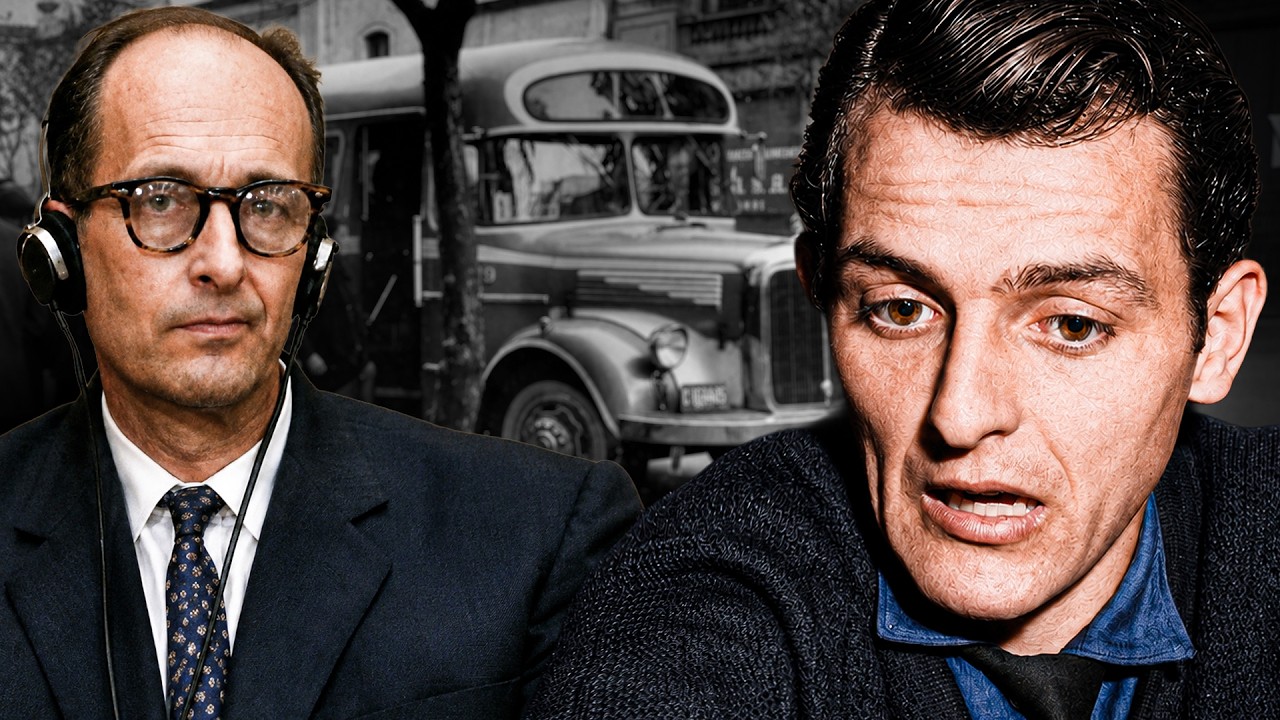
The young man was Klaus Eichmann, and his father was Adolf Eichmann, the architect of the Holocaust. Adolf Eichmann had four sons, and each of them took a radically different path in the decades after his capture, trial, and execution. Klaus was born in Berlin in March 1936, Horst Adolf was born in Vienna in 1940, Dieter Helmut was born in Prague in 1942, and Ricardo Francisco was born in Buenos Aires in 1955. By 1945, Adolf Eichmann was one of the most wanted men in Europe.
He escaped American custody, lived under a false name as a forester for five years, and in June 1950, sailed from Genoa to Buenos Aires using Red Cross papers obtained through Bishop Alois Hudal’s network. In 1952, his wife Vera Liebl and the three boys followed him. While Adolf and Vera adopted the false names Ricardo and Catalina Clement, the sons kept the surname Eichmann on the street and at school. That decision would prove to be the most significant security failure of the entire fugitive operation.
In 1956, Klaus began dating Sylvia Hermann. He did not know her father had survived Dachau, and he openly boasted about his father’s Nazi work. Lothar Hermann became certain his daughter was dating the son of a wanted war criminal. In 1957, he sent a letter to Fritz Bauer, the attorney general of the West German state of Hesse and himself a Jewish survivor.
Bauer distrusted the German diplomatic corps in Buenos Aires and passed the information directly to Israeli officials on September 19, 1957. Mossad investigated for more than two years. Sylvia was sent back to the Eichmann house on a fact-finding mission and was met at the door by Adolf himself, who claimed to be Klaus’s uncle. Klaus arrived shortly afterward and addressed him as father.
That confirmation, combined with later work by German geologist Gerhard Klammer, gave Israeli agents the proof they needed. On May 11, 1960, Mossad operatives stopped Adolf Eichmann near a bus stop on Garibaldi Street in San Fernando. He was flown to Israel nine days later disguised as an El Al crew member. His trial in Jerusalem ran from April to December 1961.
Just after midnight on June 1, 1962, he was hanged at Ramla prison. While his father stood trial, the eldest son went on the offensive. In 1961, Klaus Eichmann traveled to the United States and gave an interview to Parade magazine, defending his father, calling the charges propaganda, and suggesting that prominent Jewish figures had engineered wartime deaths. American authorities, alerted by the press coverage and tracked in CIA documents released later, deported him back to Argentina.
Klaus had also reportedly organized a press conference in Buenos Aires within hours of his father’s death sentence in December 1961, protesting what he called the injustice of the verdict. In 1964, the Austrian-Jewish philosopher Günther Anders published a short book addressed directly to Klaus. We, Sons of Eichmann, Open Letter to Klaus Eichmann argued that the Eichmann problem was not a closed chapter of history but a continuing condition of modern industrial life. Anders returned with a second letter to Klaus in 1988.
Klaus never publicly responded to either letter. By the mid-1960s, Klaus had left Argentina for West Germany. He abandoned his first wife and two children, settled into a new relationship, and fathered three more children. He never publicly renounced his views.
According to his sister-in-law’s testimony to the Daily Mail in 2018, he supported his father’s ideology to the end. Klaus Eichmann died in Germany in 2015 at the age of 79, following a long battle with Alzheimer’s disease. He outlived his father by 53 years. The most committed of the four sons, however, was not Klaus.
Horst Adolf Eichmann was 22 when his father was hanged. Born in Vienna in 1940, he was named in part for the dictator his father served. According to Carmen Bretin Lindemann, his long-time partner from the 1970s onward, Horst genuinely believed his father had done nothing wrong and treated the Holocaust as an invention. The cover story their father had given them, that Hitler had targeted Jews because of a plot to sterilize Germans, Horst took as fact.
The atmosphere Horst stepped into after his father’s execution was already incendiary. The Tacuara Nationalist Movement, an Argentine far-right group, launched approximately 30 anti-Semitic attacks across the country that summer. On June 21, 1962, Tacuara operatives kidnapped a 19-year-old Jewish student named Graciela Sirota and tortured her, branding her with a swastika before releasing her. Horst and Klaus did not limit themselves to interviews.
According to Lindemann’s later account, corroborated in parts by police records, the brothers formed a small Nazi cell in Argentina with plans to attack Jewish businesses and synagogues. Their targets allegedly included a Jewish school bus. The cell did not get that far. In 1962, Argentine police raided their headquarters after what was described as a shootout, recovering Nazi propaganda, firearms, and Molotov cocktails.
Horst was later jailed for possession of weapons and extremist material. In 1964, he appeared at a press conference in Buenos Aires wearing a Nazi armband with a swastika. In August 1965, Argentine Federal Police arrested him as part of a sweep of approximately 400 extremists. Interior Minister Juan Palermo announced that Horst had been released for lack of substantial evidence.
The decades that followed were quieter. Horst worked construction and eventually furniture removal, living a private life in Buenos Aires. He had married a woman named Elvira Puma and never legally divorced her due to her Catholic faith, but he left her for Carmen Bretin Lindemann in the 1970s. Horst Eichmann died in Buenos Aires in December 2015 from bowel cancer at the age of 75, outliving his older brother by only a matter of months.
Dieter Helmut Eichmann took the quietest path of any of his brothers. Born in Prague in 1942, he was 18 when his father was captured and 20 when the execution took place. Unlike Klaus, he gave no interviews. Unlike Horst, he kept his distance from politics and police records.
He built a career as a construction foreman, eventually managing rental properties, and for years divided his time between Argentina and Germany. He married an Italian woman named Martha Valle Notti and had two children. According to Lindemann, Dieter privately believed his father was innocent. He simply never said so in public.
Photographed in Buenos Aires in 2018 by the Daily Mail at the age of 76, he was living in an apartment a short drive from the spot where his father had been taken by the Mossad 58 years earlier. He declined to comment. The fourth son was different in almost every way. Ricardo Francisco Eichmann was born in Buenos Aires on November 2, 1955.
He was five years old when Israeli agents took his father from the bus stop on Garibaldi Street. He later said his clearest memories were of being walked to that bus stop by the hand and being bought chocolate at a sweet shop. After his father’s execution, Ricardo’s mother kept newspaper cuttings about the trial hidden under a sofa. He read them in pieces as a child, never receiving a full explanation until far later.
The family moved back to Germany. As a teenager, Ricardo studied his father’s history through books rather than family conversation. He enrolled at Heidelberg University in 1977 and completed a doctorate in prehistory, classical archaeology, and Egyptology in 1984. He chose ancient history deliberately, as far afield from the 20th century as he could find.
From 1996 to 2020, he served as director of the Orient Department of the German Archaeological Institute in Berlin, leading excavations in Saudi Arabia, Jordan, and Qatar. In 1995, he met Zvi Aharoni, the Mossad agent who had identified his father in Buenos Aires. Ricardo called the encounter emotional and said he held no resentment. He has stated that his father deserved to be brought to justice and that the following orders defense excused nothing.
When asked whether he had considered changing his surname, he replied that there would have been no point, that nobody escapes their own past. Four sons, two who defended their father to the end, one who lived quietly with the same belief in private, and one who built an entirely different life around the rejection of everything his father stood for. The name they all carried meant something different to each of them.
The decisions his sons made about him played out across the next 60 years.