Joan Jett has spent more than four decades as one of rock’s most recognizable figures, known for a fierce stage presence, a slashed-leather look, and anthems that defined a generation. But the public image of the unbreakable rebel has long obscured a far more difficult story. Behind the hits and the legend is a career marked by exploitation, rejection, isolation, and a survival instinct that came at an enormous personal cost. Jett entered the music industry at just 15 years old, with no connections, no backing, and little more than a cheap guitar and a determination that set her apart.
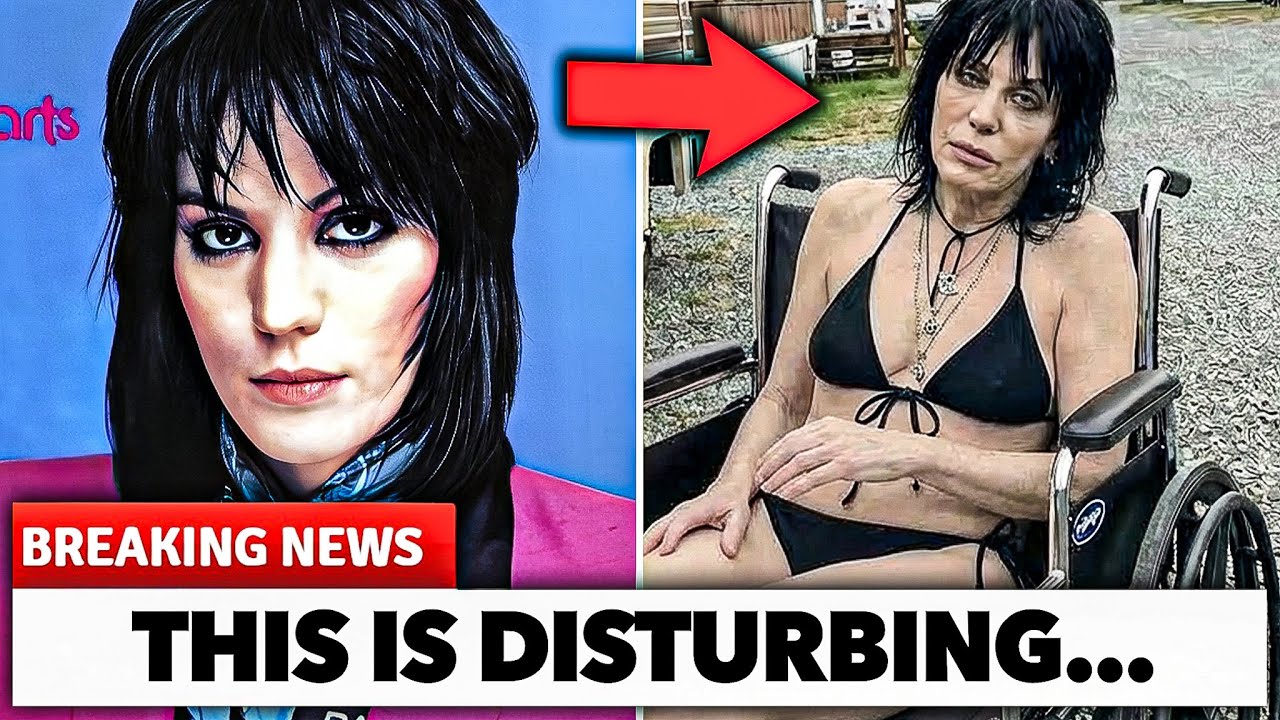
She joined the Runaways, a band of teenage girls formed in the mid-1970s that rose quickly to fame, especially in Japan, where they were treated like deities by screaming crowds. But the reality of that success was grim. The girls were marketed as a novelty, sexualized by the press, and often dismissed by critics who reviewed their appearance rather than their music. Behind the scenes, the environment was far darker.
Teenage band members were left unprotected in a world run by men who saw their youth and vulnerability as an opportunity. Managers shouted, contracts twisted, and substance abuse crept into the inner circle. Jett became the glue that held the chaos together, rehearsing while others crumbled, forcing herself to appear unbreakable because the industry made clear that girls in rock had no other option. When the Runaways collapsed, the fall was sudden and harsh.
Jett was left with no label, no manager, and no safety net. At 18, she was not planning for college or a first romance. She was fighting for survival. She carried raw demos to record label offices, only to be met with dismissals.
Executives told her to soften her image, to sing pop, to abandon the leather. One executive told her flatly that women do not sell rock records, especially not on their own. In total, 23 labels turned her down. She played tiny shows for pocket change, sometimes in front of as few as three people, and slept on floors with her guitar case as a pillow.
Rather than give up, she took a gamble that seemed insane at the time. She founded her own independent label with producer Kenny Laguna, pressing records themselves and selling them from the trunk of a car, going station by station, town by town. The turning point came almost by accident. A radio station in Rochester, New York, played “I Love Rock and Roll” on air.
The phones lit up with calls. Other stations followed, and the song exploded, propelling Jett from rejected artist to the top of the Billboard charts. Overnight, she became a superstar. But success did not heal what came before.
It magnified it. The same industry that had dismissed her now tried to own her image, marketing her as a permanent bad girl, a persona so strong that the world forgot the human being underneath. Interviewers sexualized her and questioned her femininity. She toured relentlessly, sometimes playing 60 shows in three months, performing through fevers and exhaustion while hiding tears behind stage lights.
The fortress she built around herself was not ego. It was armor, forged from years of insults, manipulation, and slammed doors. When the spotlight dimmed in the late 1980s and 1990s, the experience was not a dramatic fall but a quieter erasure. Trends changed, and Jett found herself treated as a nostalgia act.
Male peers were praised as timeless and honored with tributes, while she fought to be seen as relevant. She watched younger bands inherit the sound she helped create, often without any acknowledgment of her influence. Fans at her smaller shows described less fire and more ache, as though she was singing not to prove herself but to stay alive in a world trying to forget her. Age brought reflection, and reflection forced her to confront wounds she had buried for decades.
In a candid sit-down interview late in her career, she was asked when she realized she had made it. Instead, she answered a different question entirely. “I never felt like I made it,” she said. She spoke of being a teenage girl in a den of wolves, of the Runaways being exposed rather than protected, of waking up in hotel rooms and wondering if anyone cared about her or only about the myth she represented.
She admitted she had built a persona because no one cared about the girl beneath it. “Everyone needed the tough one,” she said. “So I never got to be anything else. ” She confessed she never expected to live into her sixties, that rock stars like her were supposed to die young or fade away.
She survived in the uncomfortable middle, living long enough to feel the full weight of what she endured. She spoke of the loneliness of performing in front of thousands while feeling completely unseen, and of aging in an industry that praises men for growing older and punishes women for it. She admitted she feared being forgotten, not out of ego, but because being erased from the story she helped write would mean the suffering was for nothing. Her voice cracked as she said, “I spent so long being strong for everyone.
I didn’t leave much strength for myself. ” She forced a smile when she finished, but her eyes carried decades of unspoken battles. Fans who had seen her as untouchable suddenly saw the cost of being unbreakable. At 66, Jett still performs with the same black eyeliner and the same growl that once made her famous.
But those who look closely can see every battle etched into the lines beneath her eyes. She carries decades of disrespect, sexualization, erasure, and expectation like a weight chained to her guitar strap. She speaks openly about the emotional scars she never treated because survival demanded she outrun them, about losing friends to addiction and loneliness, and about wondering why she lived when others did not. Sometimes backstage she sees teenage girls wearing leather jackets like hers.
She smiles with pride, but her chest tightens with memory. She thinks about the girl she once was, wide-eyed and afraid, forced to grow claws because being gentle was dangerous. She wonders what life might have looked like if she could have been soft without being destroyed for it. The audience never sees that part.
They see the hero, the icon, the immortal rock queen. But Jett knows the truth. She won by never letting them see her bleed. And now, she is finally letting the world see the woman beneath the myth: a survivor shaped not by glory, but by grit.
She changed music forever, and the heartbreak lies in how few people understand what it cost her to do it.