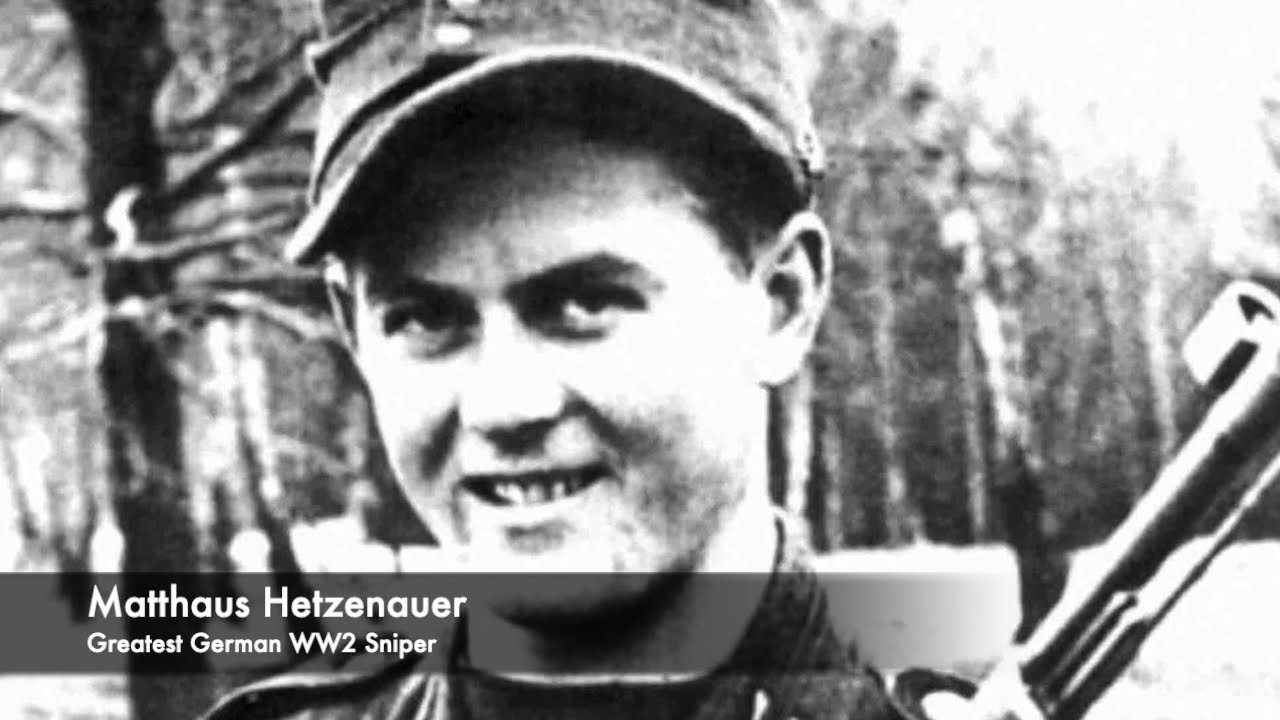
Matthäus Hetzenauer is remembered as the deadliest German sniper of the Second World War. He was credited with 345 confirmed kills during a period of service that lasted only about ten months.
He was born on December 23, 1924, in an alpine part of Austria. He came from modest beginnings and was a descendant of a long line of Austrian peasants.
His rural village stood close to the German border, and his family tried to live off the land as much as possible. His father was a skilled hunter who shot deer, moose, and turkey to feed the family.
Hetzenauer followed in his father's footsteps and became an adept sharpshooter at a young age. Through hunting, he learned how to conceal himself and use his surroundings and camouflage so that he would not give his position away.
He also learned how to trick an opponent and how to cover ground quickly if a shot missed. Those skills later helped him leave an area in a tight spot when an enemy had him pinned down.
At the age of 17, Hetzenauer was drafted into the German army. He was assigned to the 140th Mountain Rifle Reinforcement Battalion in Austria.
In January 1943 he changed units and received training on mortars and artillery. He was trained as a mountain infantryman for two years, a role that suited him.

During this time, one of his commanders noticed his skill with a rifle. From March to July 1944 he began formal training as a sniper in the German army.
He became adept with two weapons in particular. He relied on the Karabiner 98k sniper variant fitted with a six-power telescopic sight, which was his favorite weapon.
He also carried the Gewehr 43 with a four-power telescopic sight. With these two rifles, he became one of the deadliest snipers of the Second World War at a very young age.
Snipers needed to become used to their equipment and practiced with their weapons regularly. The German army deployed Hetzenauer in a number of different places, mostly on the Eastern Front, as the tide of the war turned against Germany.
He saw service in Carpathia, Hungary, and Slovakia. The Germans used snipers to good effect as they tried to prevent the advancing battalions of the Soviet Red Army from pushing toward Germany at breakneck speed.
On the defensive, the Germans used artillery, machine guns, and other weapons to break up the Soviet advance. Hetzenauer was deployed in this role and was tasked with defending mounting units from Soviet snipers and machine guns.
He had to think quickly against Soviet snipers and faced a number of different sniping duels on a daily basis. German mountain regiments faced constant barrages from Soviet artillery, and it was his task to try to slow the advances.
He chose to shoot Soviet commanders, unit leaders, and machine gunners. He would sometimes work through enemy lines, shooting targets to get close to a commanding officer and then inflict damage.
Sniping during the Second World War was often a slow and patient art, and it was sometimes a game of chess. Hetzenauer would bide his time, taking out low ranks in order to get a prize shot on the commanding officers.
He said he had to shoot enemy commanders and gunners because his own forces would have been too weak in numbers and ammunition without that support. He had to be incredibly patient and would sometimes lie in the snow for hours, frozen into his camouflage, waiting for the one moment when he could get a shot away.
He was very aware of his surroundings, knowing that poor decisions could easily give away his position. He also realized he could easily be hunted by a Soviet marksman.
During his efforts on the Eastern Front, he made an incredibly long-range kill, hitting a target at a distance of around 1,200 yards. Between August 1944 and May 1945 he recorded 345 confirmed kills.
On average, that meant a rate of more than one kill a day, and all of his kills occurred within those ten months of service. Hetzenauer holds the record as the most successful German sniper of the Second World War.
For his achievements he was rewarded with the Iron Cross First Class and Second Class. He was noted for a lack of fear and at times a disregard for his own safety, waiting patiently for kills even after coming under intense artillery fire.
As he lay prone in cover, he was regularly shelled and explosives went off all around him. He demonstrated immense bravery during these episodes.
He also received a number of other campaign medals and awards. These included a Close Combat Bar in Gold, the Infantry Assault Badge in Silver, the Black Wound Badge, the German Cross in Gold, and the Gold Sniping Badge.
Toward the end of 1944, things were bad for the Germans, who were losing a large amount of territory with defeat seemingly on the horizon. Hetzenauer's own fortunes also went wrong when he suffered a head trauma from artillery fire in November 1944.
He managed to recover from the head injury, but as the war came to a conclusion he was injured yet again. He continued to cover the retreat of his unit toward Germany as the Soviets stormed forward, and he was eventually captured by the Soviets in May 1945.
Like many prisoners of war held in Soviet camps, Hetzenauer was not kept in good conditions. His life as a prisoner was not pleasant, and many of his fellow soldiers were killed and tortured.
In total, around 3 million German soldiers were captured by the Red Army, and a huge number would end up dead. Hetzenauer spent five years inside a tough Soviet prison, where conditions were harsh, and he was finally released five years after the conflict in Europe ended, in 1950.
Very little is known about what he did after the war. He returned to Austria on January 10, 1950, and remained in his hometown until he passed away at the age of 79 on October 3, 2004.
Matthäus Hetzenauer is the deadliest German sniper of the Second World War. He finished just over a hundred kills short of Simo Häyhä, the "White Death," and his record.
As with many snipers, a background in hunting was key to Hetzenauer's success, and during the Second World War he claimed a huge number of accolades. Perhaps one of his greatest achievements was not the kill count of more than 300, but surviving the hellish conditions of the Soviet prisoner of war camps, which had an extremely high death rate.