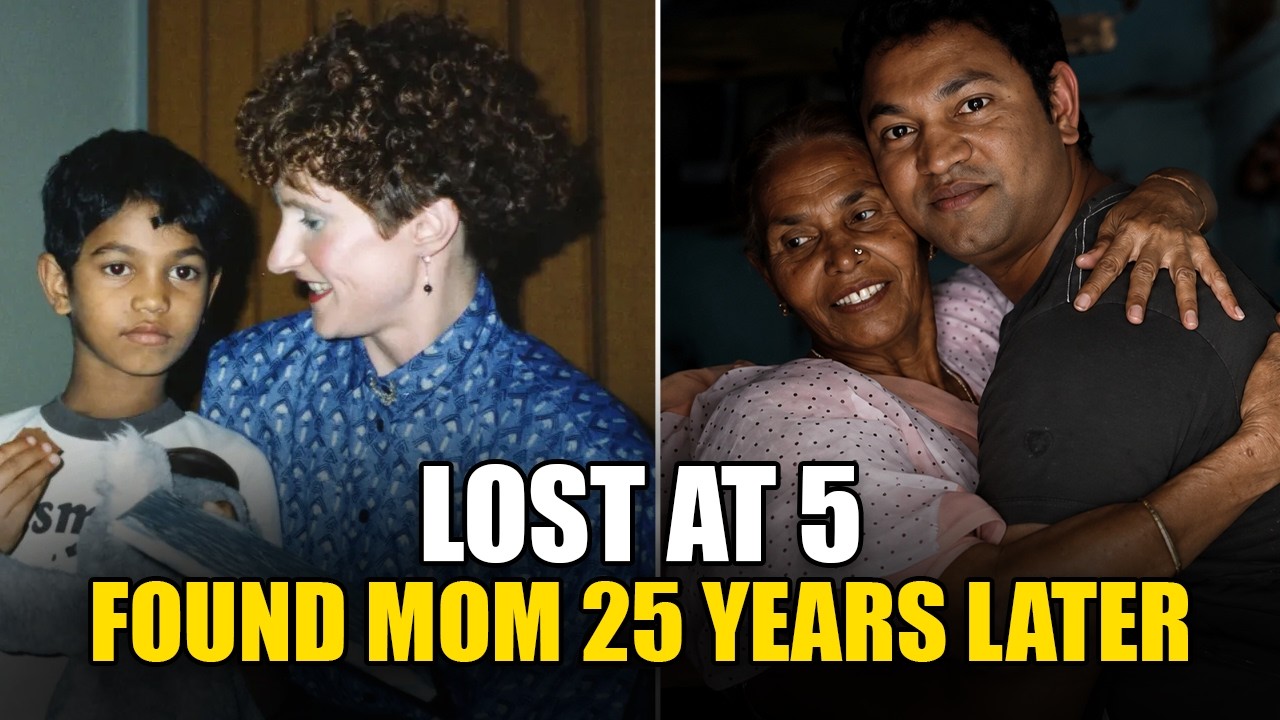
One evening in 1987, a five-year-old boy boarded the wrong train, believing his older brother was waiting inside. By sunrise, he had lost everything that made the world feel safe. Twenty-five years later, against all odds, his mother’s love led him back home. Saroo grew up in Ganesh Talai, one of the poorest neighborhoods in India.
His home was a small hut with a leaking roof that barely sheltered four children. During monsoon season, rain dripped through the ceiling. In summer, the family often slept outside under the stars to escape the heat. Some nights they had nothing but water to drink, yet Saroo never considered himself poor.
As long as his mother gathered her children together each evening, the house felt complete. His mother, Kamla, worked tirelessly after her husband abandoned the family, carrying cement at construction sites to keep her children alive. Every rupee went toward food and necessities, but she refused to let them see her despair. If dinner was scarce, she promised them tomorrow would be better.
If exhaustion weighed her down, she hid it behind a gentle smile. Saroo adored her, but the person he admired most was his older brother, Guddu. Like many boys in the neighborhood, Guddu had grown up fast. He searched train stations for coins, collected bottles, and sometimes begged for food so his younger siblings could eat.
Saroo followed him everywhere, convinced that as long as Guddu was near, nothing bad could happen. One evening, the brothers traveled to a nearby train station hoping to earn a little money before heading home. Exhausted, Saroo curled up on a wooden bench while Guddu looked at him and said quietly, “I’ll be back in a minute. ” Neither of them knew those would be the last words they ever exchanged.
Half-asleep, Saroo noticed a train waiting beside the platform. Assuming his brother had already boarded, he climbed in, found an empty seat, and drifted off, expecting to wake up near home. Instead, he woke up alone. Guddu was gone.
Outside the window, unfamiliar cities raced by under the morning sun. Saroo searched every carriage, calling his brother’s name over and over, then crying for his mother. Only the sound of steel wheels answered him. After hours, the train pulled into Kolkata, nearly 1,500 kilometers from home.
The massive station overwhelmed him. Thousands of strangers hurried past, speaking a language he could not understand. To anyone else, he was just another child wandering the platforms. No one realized he had no idea where his family was.
When adults asked Saroo where he came from, he tried to explain, but he only knew the name of his neighborhood. He could not read or write, did not know his own surname, and had no way to describe where his real home was. For days, survival became his only goal. He begged for scraps, slept under railway benches, and wandered strange streets, hoping a train might somehow carry him back.
Instead, each step took him further away from the only life he had ever known. While Saroo struggled to survive in Kolkata, another heart-wrenching journey had already begun hundreds of miles away. In Khandwa, Kamla stayed up all night, convinced her two sons had simply missed the last train home. As darkness fell and the familiar sounds of the neighborhood faded, hope gradually gave way to fear.
Guddu had never failed to bring his little brother home. By dawn, she could no longer wait. Leaving her youngest daughter with neighbors, she rushed to the train station with a family friend everyone called Uncle Akbar. They searched every platform, questioned railway workers, visited markets, and checked every place the boys were known to look for food or coins.
No one had seen them. The possibilities became unbearable. Weeks passed. Then months.
Then years. Saroo remained lost in a city of millions, while his mother refused to accept that he was gone. She stayed in the same hut, waiting, hoping that one day her son would find his way back. Years later, as a young man, Saroo was adopted by an Australian couple and moved to Tasmania.
He built a new life, graduated from university, and rarely spoke of the past. But the memory of his mother and brother never left him. When he became a father himself, the need to find them became overwhelming. Driven by love and a desperate hope, Saroo began searching for his birthplace using Google Earth.
He spent months scanning satellite images, looking for a familiar landmark, any clue that might lead him home. After years of painstaking effort, he finally recognized a distinctive railway bridge near a small town in India. Saroo traveled back to India, unsure what he would find or if his mother was still alive. Making his way through the crowded streets of his old neighborhood, he saw a woman standing in front of the same small hut.
She was older now, her hair gray, but her face was unmistakable. She saw him at the same moment. For a long moment, neither of them moved. Then she whispered his name.
Saroo nodded, tears streaming down his face. The mother who had never stopped waiting wrapped her arms around the son she had lost twenty-five years earlier. It was only later that he learned the heartbreaking truth about the night he boarded the wrong train. A few weeks after his disappearance, Guddu’s body was found on the railway tracks.
He had been killed when he fell between two carriages while trying to hop a train. Kamla had buried one son without ever knowing what happened to the other. Still, she refused to leave the home where Saroo had grown up, hoping that one day he would return. The search had taken Saroo across oceans and continents, but the journey that began with a wrong step had finally ended.
After a quarter of a century, a mother’s love and a son’s determination had brought him home. The boy who once boarded a train by mistake had found his way back at last.