On the morning of August 13, 1945, First Lieutenant Oscar Perdomo banked his P-47N Thunderbolt hard left over Korea. Below him, five Japanese fighters broke formation some 8,000 feet down. He was 26 years old, with nine combat missions behind him and not a single kill to his name.
Within minutes, that would change.
Perdomo was the son of a Mexican immigrant who had once ridden with Pancho Villa. He was flying an aircraft whose nose carried the name "Lil Me's Meat Chopper," along with artwork of a baby in a diaper, chomping a cigar, wearing a derby hat, and clutching a rifle. The tribute was to his infant son, Kenneth, waiting back home in Los Angeles.
More than 50 Japanese aircraft had risen to meet 38 American Thunderbolts over what would later become Seoul. The Americans were outnumbered and 750 miles from home. The war that everyone assumed would last another year was just 48 hours from ending, though nobody in either formation knew it yet.
The atomic bombs had already fallen. Hiroshima on August 6, Nagasaki on August 9. Emperor Hirohito was meeting with his war council at that very moment, debating surrender. But over Korea, Japanese pilots were still flying, American pilots were still hunting, and Perdomo was diving toward the trailing enemy fighters with eight .50-caliber machine guns loaded and ready.
The mission profile called for eight hours of flying and a 1,500-mile round trip, most of it over open ocean where a single engine failure meant death. The P-47N was built for exactly this kind of mission. Republic Aviation had redesigned the Thunderbolt specifically for the Pacific theater, adding wet wings that carried 93 gallons of fuel in each wing root. Fully loaded with external tanks, the aircraft could haul over 1,200 gallons.
It had the range to escort B-29 Superfortresses all the way to Japan and back. It had the firepower to destroy anything it caught: eight Browning machine guns, 3,000 rounds of ammunition, and a 2,800-horsepower Pratt & Whitney radial engine that could push the seven-ton fighter past 460 mph.
For six weeks, the 57th Fighter Group had flown mission after mission from their base on Ie Shima, a tiny island four miles northwest of Okinawa. They had escorted bombers, strafed airfields, and burned fuel on targets that rarely shot back. The Japanese were hoarding their aircraft, saving them for the invasion everyone expected. Pilots joked that the enemy had simply run out of planes.
August 13 proved them wrong.
Mission 507-35 had launched 53 Thunderbolts at dawn. Fifteen turned back with mechanical problems or navigation errors. The remaining 38 droned northwest across the East China Sea, crossed the Korean coastline, and were approaching Kjo when radar operators reported contacts. Lots of contacts.
The Japanese 22nd and 85th Sentais had scrambled everything they had: Nakajima Ki-84 Frank fighters, Nakajima Ki-43 Oscars, even a pair of Yokosuka K5Y Willow trainers that had somehow found themselves in the wrong piece of sky.
Perdomo selected the trailing three fighters from the enemy formation, standard tactics. Hit the rear aircraft first. The leaders would not know they were under attack until their wingmen started burning. He pushed the throttle forward, felt the Thunderbolt surge, and watched the distance close. Two thousand yards, 1,500, 1,000. At 800 yards, he centered his gunsight on the nearest enemy fighter and pressed the trigger.
The first burst caught the trailing Ki-84 exactly where Perdomo had aimed: engine cowling, cockpit. The Japanese fighter shuddered, belched black smoke, and began a spiral that would end in the Korean countryside 8,000 feet below. Perdomo did not watch it fall. He was already shifting his gunsight to the second aircraft.
Nine combat missions without a single kill. Six weeks of escort duty, strafing runs, and empty skies. Now the enemy had finally appeared, and Oscar Perdomo discovered something about himself. He was good at this. Very good.
The Ki-84 Frank was Japan's best fighter in August 1945, faster than the Zero and better armed, capable of climbing with American aircraft that had dominated the Pacific for two years. Japanese pilots called it the Gale. Allied intelligence had classified it as one of the few enemy fighters that could challenge American air superiority on equal terms. The 22nd and 85th Sentais flying over Korea that morning had some of Japan's most experienced pilots at the controls.
None of that mattered when eight .50-caliber machine guns found their mark.
Perdomo's second target tried to break right. Too slow. The P-47N weighed nearly 20,000 pounds fully loaded. It could not turn with a Japanese fighter. It could not climb as fast. But it could dive like nothing else in the sky, and when a Thunderbolt pilot caught an enemy from above and behind, the mathematics of aerial combat became simple: speed plus firepower plus surprise equaled destruction.
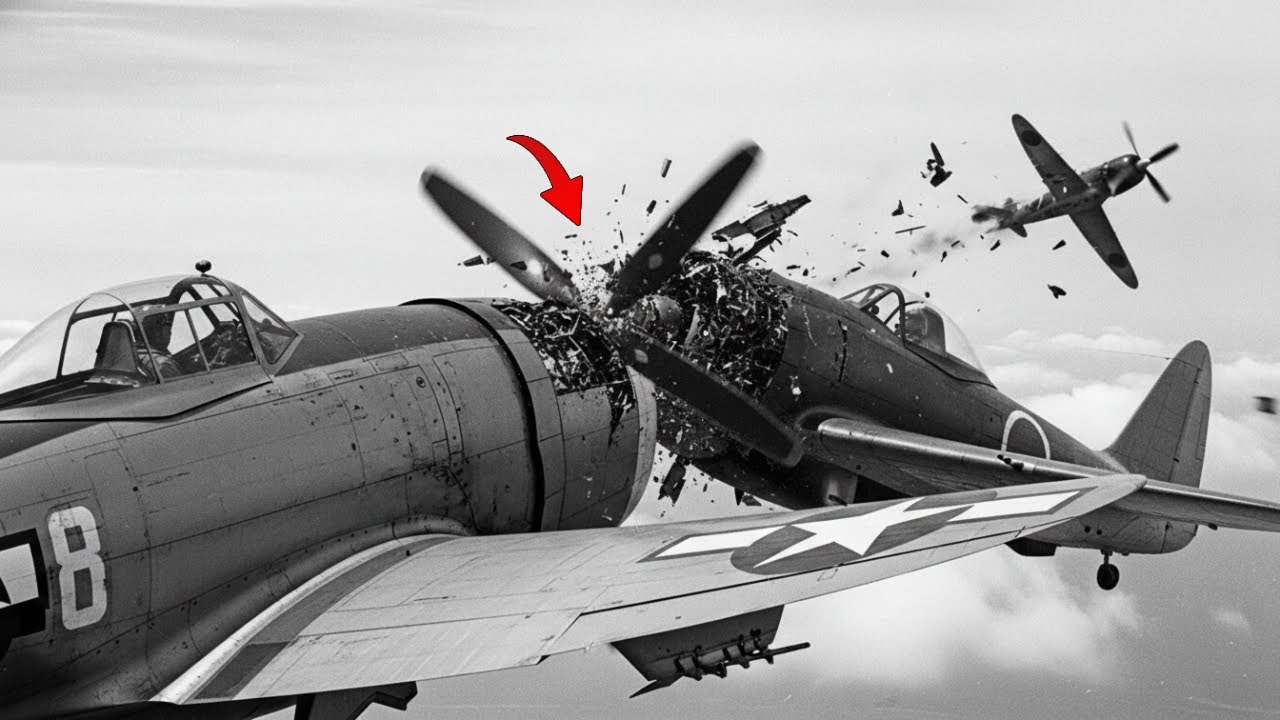
The second Ki-84 took hits across its entire fuselage. Perdomo saw pieces separate from the aircraft, a section of wing, part of the tail assembly. Then flames erupted from the fuel tanks and the fighter became a fireball tumbling toward Earth. Two kills in less than 60 seconds.
The third Japanese pilot had seen enough. He rolled inverted and dove for the deck, accelerating away from the American who had just killed his wingman. Perdomo let him go. The Thunderbolt had the speed to chase, but pursuing a single fleeing enemy meant losing sight of the larger battle. Somewhere in the chaos above Korea, 37 other American pilots were fighting more than 50 Japanese aircraft.
Perdomo pulled the P-47N into a climbing turn, scanning the sky for the distinctive silhouettes of friendly Thunderbolts. The morning sun made identification difficult. Aircraft twisted and dove in every direction. Smoke trails marked the paths of damaged machines. At least three parachutes drifted below, though Perdomo could not tell whether they carried American or Japanese pilots.
The fuel gauge showed the mission clock ticking. Eight hours total flight time. Every minute of combat burned fuel at three times the cruise rate. The external tanks had been dropped before the engagement. Now Perdomo was running on internal fuel only, and the return flight to Ie Shima would take nearly four hours. Mathematics again, simple and unforgiving.
He spotted movement at 800 feet. Two aircraft flying in close formation, heading northeast. Perdomo blinked, uncertain what he was seeing. The silhouettes belonged to training aircraft, not combat fighters. Yokosuka K5Y Willows, canvas-covered relics from another era. What they were doing in the middle of an air battle over Korea made no tactical sense.
It did not matter. They wore Japanese markings. They were legitimate targets.
Perdomo rolled the Thunderbolt inverted and pulled toward the earth, building speed for the intercept. The biplanes saw him coming. They separated, each pilot choosing a different escape route. Perdomo selected the closer aircraft and opened fire. A Willow trainer had a maximum speed of 132 mph. The P-47N was diving at over 400. The engagement lasted approximately three seconds.
Perdomo watched the biplane catch fire, spiral right, and impact the ground in a column of black smoke. His third kill of the morning. He searched for the second Willow but could not locate it. The pilot had escaped into a cloud bank or simply disappeared against the terrain below.
Perdomo pulled up, regaining altitude, and checked his ammunition counters. The numbers had dropped significantly. Three kills had consumed nearly half his rounds. The Meat Chopper still had teeth, but they were getting shorter.
He climbed above the clouds, searching for friendly aircraft. What he found instead were four Japanese fighters waiting in ambush.
Four Nakajima Ki-84 Franks held the altitude advantage. They had seen the American Thunderbolt climbing through the clouds. They had positioned themselves perfectly, sun behind them, speed building, the textbook bounce that had killed hundreds of Allied pilots over the Pacific.
Perdomo saw them at the last possible moment. Four shapes diving out of the glare, growing larger with terrifying speed. He had perhaps two seconds to react, two seconds to make a decision that would determine whether his son Kenneth ever saw his father again.
He did not try to run. Running from a diving fighter meant taking hits in the engine or the cockpit. The P-47N could absorb tremendous punishment, but not from four aircraft firing simultaneously. Instead, Perdomo did something that violated every instinct a pilot possessed. He turned into the attack.
The maneuver caught the Japanese formation off guard. They had expected the American to dive or break away. Instead, the Thunderbolt was climbing toward them, nose high, speed bleeding away. For a brief moment, all four Ki-84 pilots had to adjust their aim. That moment was enough.
Perdomo rolled the P-47N onto its back and pulled hard, reversing direction while the Japanese fighters overshot. Their diving speed carried them past and below, exactly as he had planned. Now the geometry had changed. The hunters had become targets.
He selected the trailing aircraft and opened fire. The Ki-84 pilot never saw the tracers coming. .50-caliber rounds tore through the engine cowling and the Japanese fighter exploded in a ball of orange flame. Four kills. Oscar Perdomo had just become an ace, not over months of combat, not through dozens of missions, but in a single engagement lasting less than five minutes.
The remaining three Ki-84s scattered. One dove for the deck. One climbed toward the clouds. The third tried to circle back for another pass. Perdomo ignored them all. His ammunition counters showed critically low numbers, perhaps 30 seconds of firing time remaining. He needed to find his squadron and begin the long flight home.
The sky over Kjo had transformed into chaos. Smoke columns rose from at least a dozen crash sites. Aircraft circled at every altitude, some fighting, others simply trying to survive. Perdomo spotted a pair of P-47Ns at 3,000 feet, their distinctive paddle-blade propellers catching the sun. Friendlies.
He banked toward them. Then he saw what they were fighting. A single Ki-84 had latched onto the tail of one Thunderbolt and refused to let go. The American pilot was jinking hard, trying to shake his pursuer, but the Japanese fighter matched every move. The second P-47N was attempting to help, but the angles were wrong. Every time the wingman lined up a shot, his squadron mate flew into the line of fire.
Perdomo pushed the throttle to maximum power and dove toward the engagement. The Meat Chopper had perhaps 20 seconds of ammunition remaining, maybe less. It would have to be enough.
He came in from above and behind, the same attack profile that had worked four times already. The Ki-84 pilot was focused entirely on his target, watching the American Thunderbolt fill his gunsight, waiting for the perfect moment to fire. He never checked his six o'clock. He never saw Perdomo diving toward him at 400 mph.
Perdomo pressed the trigger and held it down. Tracers reached across the sky, converging on the Japanese fighter. Hits sparkled along the fuselage. The Ki-84 shuddered. Smoke began pouring from the engine. Then the guns went silent.
Not a gradual slowdown, not a few final rounds. Complete silence. All eight Browning machine guns had run dry simultaneously. Three thousand rounds of .50-caliber ammunition, enough firepower to destroy a small building, had been expended in less than six minutes of combat.
The Ki-84 was damaged but still flying. Smoke trailed from its engine, but the aircraft remained under control. The Japanese pilot, suddenly realizing he was under attack from a new direction, broke off his pursuit of the American Thunderbolt and turned toward Perdomo.
Oscar Perdomo was now 750 miles from home, alone in hostile airspace, with a wounded enemy fighter turning to kill him and exactly zero rounds of ammunition remaining. Most pilots would have run. The mathematics demanded it. An unarmed fighter against a damaged but still dangerous enemy represented a calculation with only one rational answer: dive for the deck, use the Thunderbolt's superior speed, put as much distance as possible between yourself and the threat, return to base, live to fight another day.
Oscar Perdomo did not run.
The Ki-84 completed its turn and pointed its nose at the American Thunderbolt. The Japanese pilot could see the distinctive checkered cowling of the 57th Fighter Group. He could not know that the aircraft in front of him had expended every round of ammunition. From his perspective, this was simply another American who needed killing.
Perdomo watched the enemy fighter stabilize and begin its attack run. Smoke still poured from the damaged engine, but the aircraft was flying. The Japanese pilot had guns. Perdomo did not. The next 60 seconds would be determined entirely by skill, nerve, and the willingness to die.
He turned toward the Ki-84. The maneuver made no tactical sense. An unarmed aircraft charging an armed enemy violated every principle of aerial combat. But Perdomo understood something that the mathematics could not capture. The Japanese pilot did not know the Thunderbolt's guns were empty. All he could see was an American fighter coming straight at him, nose to nose, at a combined closing speed of nearly 800 mph. Aerial chicken, the deadliest game in the sky.
The Ki-84 pilot flinched first. With his engine trailing smoke and an apparently armed enemy boring in, he broke right, abandoning his attack run. Perdomo followed, turning inside the Japanese fighter, maintaining the illusion of an offensive posture. Every second he kept the enemy defensive was a second his squadron mates could use to reach the fight. He keyed his radio and called for help.
Somewhere in the chaos over Korea, another P-47N pilot heard the transmission. An American was in trouble. Engaged with an enemy. Needed assistance. The response was immediate.
Perdomo continued his deadly dance with the Ki-84. Turn, counterturn, dive, climb. The Thunderbolt's empty guns pointed at the Japanese fighter again and again, each time forcing the enemy pilot to react defensively. The deception could not last forever. Eventually, the Japanese pilot would realize that no tracers were coming. Eventually, he would understand that his opponent was bluffing with an empty hand.
The help arrived before that moment came. A second P-47N dropped out of the clouds at full power. The pilot had seen the engagement, understood the geometry, and positioned himself for a clean shot. The Ki-84, focused entirely on the Thunderbolt that had been chasing it for the past 90 seconds, never saw the new threat approaching from above.

Eight .50-caliber machine guns opened fire simultaneously. The Japanese fighter disintegrated under the concentrated barrage. Wings separated from fuselage. The engine tore free and tumbled earthward. What remained of the aircraft scattered across the Korean sky in a cloud of burning debris.
Five kills. Oscar Perdomo had just achieved something that fewer than 100 American pilots accomplished during the entire war. He had become an ace in a single day, the last pilot in United States history to earn that distinction.
The designation would not become official until intelligence officers reviewed his gun camera footage back on Ie Shima. The film would confirm that his first four kills were actually Ki-84 Franks, not the Ki-43 Oscars that initial reports suggested. It would document the biplane trainer, the absurd Willow that had wandered into the wrong battle. And it would show the final engagement, the damaged Ki-84 that Perdomo had attacked, chased, and harassed until his squadron mate could deliver the killing blow.
All five victories belonged to him. The gun camera did not lie.
But Oscar Perdomo's war was not over yet. He was still 750 miles from home. His fuel gauges showed numbers that demanded immediate attention. And the sky over Korea still contained Japanese aircraft who wanted very much to kill him. The morning was only half finished.
The flight home would kill more pilots than enemy fighters ever could. Seven hundred fifty miles of open ocean stretched between Korea and Ie Shima. No landmarks, no emergency airfields, no rescue ships positioned along the route. A pilot who ran out of fuel or suffered engine failure over the East China Sea had exactly two options: ditch in the water and hope for rescue that would probably never come, or ride the aircraft down and die on impact.
Perdomo checked his fuel gauges and performed the calculations every Pacific pilot learned to do in his sleep. Remaining fuel, distance to base, fuel consumption at cruise power. The numbers worked, but barely. Any deviation from the direct route would turn a marginal situation into a fatal one.
The 57th Fighter Group began reassembling over the Korean coastline. Thunderbolts appeared from every direction, some trailing smoke, others showing visible battle damage. Squadron leaders conducted radio checks, counting aircraft, identifying who had survived and who had not. The morning's engagement had scattered the formation across 50 miles of Korean airspace.
Twenty Japanese aircraft had fallen to American guns. The 57th had lost none. It was the kind of kill ratio that commanders dreamed about, the kind of victory that earned unit citations and medal recommendations. But the mission was only half complete. Every pilot still had to fly home.
Perdomo joined a loose formation of P-47Ns heading southeast toward the coast. The Thunderbolts flew at 12,000 feet, high enough to glide toward land if an engine failed, low enough to conserve fuel. Conversation on the radio remained minimal. Pilots monitored their instruments, watched their fuel gauges, and counted the minutes until Ie Shima appeared on the horizon.
The East China Sea passed beneath them in an endless expanse of gray-blue water. August heat created thermals that bounced the heavy fighters unpredictably. Perdomo trimmed the aircraft for maximum efficiency, adjusting throttle and mixture to squeeze every possible mile from his remaining fuel. The autopilot helped, holding course while he rested his hands and processed what had just happened.
Five kills in one morning. The number seemed impossible. Nine missions of empty skies, and then everything had changed in six minutes of concentrated violence. He could still see the tracers reaching out from his guns, still see the Japanese fighters catching fire, still feel the Thunderbolt shudder as 3,000 rounds of ammunition poured through eight machine gun barrels.
The gun camera would confirm everything. Film did not lie. Intelligence officers would review the footage frame by frame, matching each burst of fire to each enemy aircraft destroyed. The process took days, sometimes weeks. Until then, Perdomo's claims remained exactly that: claims. Every pilot made them. Not every pilot could prove them.
Two hours into the return flight, the formation crossed the invisible line where ocean became friendly territory. Okinawa appeared as a smudge on the southern horizon. Ie Shima lay just beyond, a flat speck of coral and sand that had become home to three fighter groups and thousands of support personnel.
The island had seen its share of death. Ernie Pyle, the most famous war correspondent in America, had died there four months earlier, killed by a Japanese machine gun bullet during the invasion. His grave marker stood near the beach where Marines had stormed ashore. Now the island served as an unsinkable aircraft carrier, launching missions against the Japanese homeland day after day.
Perdomo's fuel gauges showed nearly empty tanks as Ie Shima filled his windscreen. Other pilots in the formation reported similar numbers. The mission had pushed the P-47N's range to its absolute limit. Another 50 miles would have meant ditched aircraft and dead pilots floating in the East China Sea.
The Thunderbolts entered the landing pattern. One by one, wheels down, flaps extended, final approach over the beach where Ernie Pyle had fallen. Perdomo touched down on the coral runway and felt the aircraft settle onto its landing gear. Eight hours and 18 minutes after takeoff, mission 507-35 was complete.
He taxied to the hard stand where his crew chief waited. The man's eyes went immediately to the gun ports, checking for the carbon residue that indicated combat. He saw plenty. Then he looked at Perdomo's face and knew something extraordinary had happened.
The debriefing room filled with pilots, still wearing their flight suits, still smelling of sweat and aviation fuel and cordite. Intelligence officers moved between them, collecting initial reports, asking questions, cross-referencing claims. Twenty Japanese aircraft destroyed. The number seemed almost too large to believe, but 38 pilots had witnessed the battle and their stories matched.
Perdomo sat in a metal folding chair and recounted his morning. Five enemy aircraft, four fighters and one trainer. The intelligence officer wrote everything down, his pencil moving steadily across the form. Initial claims would be filed immediately. Confirmation would wait for the gun camera footage.
The 57th Fighter Group had entered combat on July 1, 1945. Six weeks of operations, dozens of missions, and until August 13, they had encountered almost no aerial opposition. The Japanese had been saving their aircraft, husbanding their resources, preparing for an invasion that military planners on both sides expected to cost millions of lives.
August 13 changed the calculus entirely. The 57th had stumbled into the largest concentration of Japanese fighters they would ever see. The result was the most one-sided aerial victory of the Pacific War's final month: 20 enemy aircraft destroyed against zero American losses. The mathematics of that exchange rate would earn the entire group a Presidential Unit Citation.
But the war was ending. Nobody on Ie Shima knew it yet, but the emperor had made his decision. Japan would surrender. The invasion would never happen. The millions of casualties that planners had grimly accepted would never materialize. August 13, 1945, was one of the last days of aerial combat in World War II. Oscar Perdomo had become an ace on almost the final day it was possible to become one.
The gun camera footage arrived at the intelligence section that evening. Technicians threaded the film into projectors and watched the morning's combat unfold frame by frame. Perdomo's camera had captured everything. The first Ki-84 taking hits, catching fire, spiraling down. The second fighter disintegrating under concentrated fire. The Willow trainer burning against the Korean landscape. The fourth kill, the ambusher who became the ambushed.
The fifth kill presented a problem. Perdomo's guns had run dry before the final Ki-84 was destroyed. His gun camera showed the damaged aircraft, showed the pursuit, showed the desperate maneuvering of an unarmed Thunderbolt chasing an armed enemy. But the killing burst had come from another pilot's guns.
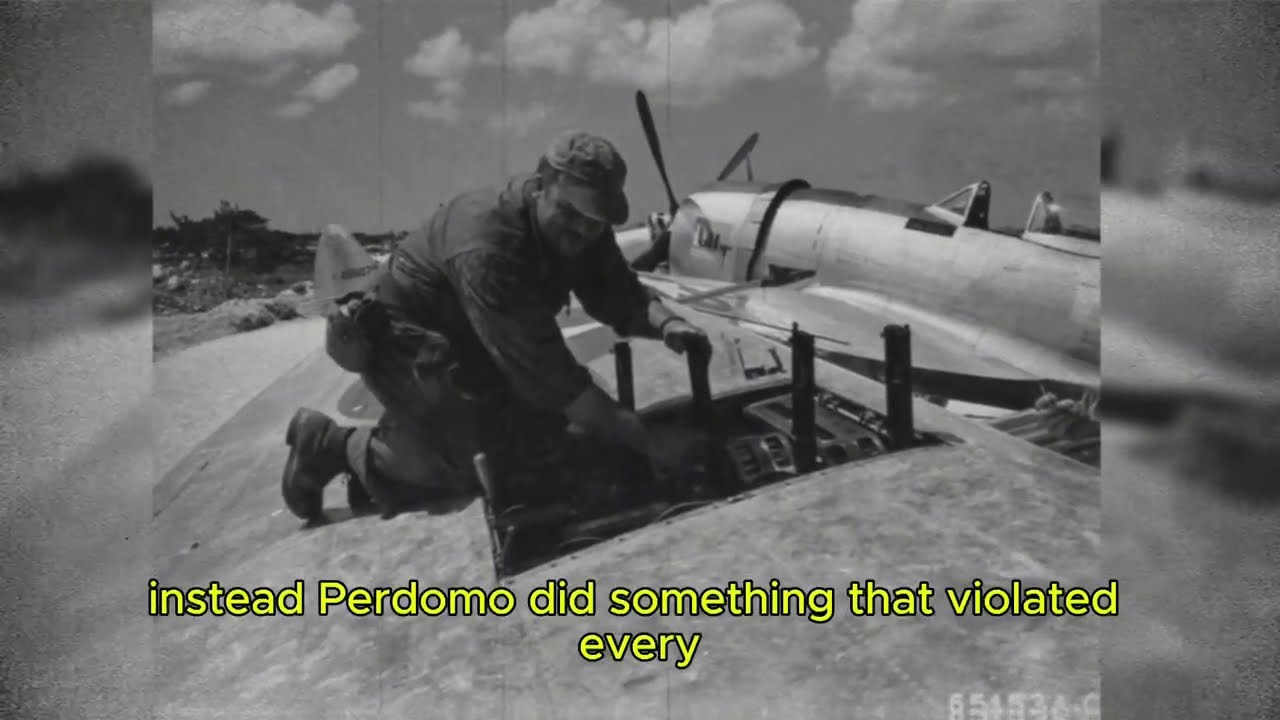
Intelligence officers debated the credit. Perdomo had attacked the aircraft. He had damaged it. He had chased it until help arrived. The other pilot had delivered the fatal blow, but only because Perdomo had set up the shot. Standard procedure awarded credit based on who inflicted the lethal damage. By that measure, the fifth kill belonged to someone else.
They gave it to Perdomo anyway. The reasoning was simple. Without his initial attack, the Ki-84 would have destroyed the American Thunderbolt it had been pursuing. Without his pursuit, the damaged Japanese fighter would have escaped. Without his willingness to chase an armed enemy with empty guns, the engagement would never have happened. The fifth kill was a team effort, but Oscar Perdomo had made it possible.
Five confirmed victories in a single day. Ace in a day. The designation placed him in exclusive company. Fewer than 50 American pilots had achieved the same feat during the entire war. Chuck Yeager had done it over Europe. Pappy Boyington had done it in the Pacific. Now Oscar Perdomo's name would join theirs in the record books.
The next morning, August 14, the 57th prepared for another mission. Pilots checked their aircraft. Crew chiefs loaded ammunition. Intelligence officers briefed the target. The war continued because nobody had told them it was over. Then the radio crackled with news that changed everything. Emperor Hirohito had announced Japan's surrender. The war was over.
Oscar Perdomo would never fly another combat mission. His five kills on August 13 would stand forever as the final ace-in-a-day achievement in United States military history. The guns fell silent. The Meat Chopper had earned its name just in time.
The Distinguished Service Cross arrived with a citation that read like poetry written by bureaucrats: extraordinary heroism in connection with military operations against an armed enemy. The second-highest award for valor the United States Army could bestow, surpassed only by the Medal of Honor. Oscar Perdomo, the son of Mexican immigrants, the kid from East Los Angeles who had worked at the Pacific Milk Crate Company before the war, now stood among the most decorated pilots in American military history.
The Air Medal with Oak Leaf Cluster followed. Then the Presidential Unit Citation for the entire 57th Fighter Group. The paperwork accumulated in folders and filing cabinets, official recognition of six minutes of violence over Korea that had changed one man's life forever.
Two days after the surrender announcement, Perdomo witnessed something that few American pilots ever saw: Japanese aircraft approaching Ie Shima. Not to attack, not to fight, but to surrender. Mitsubishi G4M Betty bombers painted entirely white, their red rising sun insignias replaced with green crosses. They carried the first Japanese representatives to coordinate their nation's capitulation.
The same airfield that had launched Perdomo toward his five kills now received the enemy delegation. He watched the white-painted bombers touch down, watched Japanese officers emerge in formal uniforms, watched the beginning of the end of the war he had fought. The juxtaposition seemed almost impossible to process. Forty-eight hours earlier, he had been killing men who flew aircraft just like these. Now those aircraft carried diplomats instead of bombs.
The 57th remained on Ie Shima through the fall of 1945. Occupation duties replaced combat missions. Pilots flew patrols over a defeated Japan, watching for resistance that never materialized. In January 1946, the group transferred to Okinawa. Four months later, it was deactivated entirely.
Oscar Perdomo's war had ended, but his flying career continued. He remained in the Army Air Forces after demobilization, one of the few wartime pilots retained for peacetime service. In 1947, the Air Force became an independent branch of the military and Perdomo transferred to the new service. He flew different aircraft now, jets instead of propeller-driven fighters. The technology had advanced beyond recognition, but the fundamental skills remained the same: stick and rudder, eyes outside the cockpit, the instincts that had kept him alive over Korea.
He left active duty in January 1950, returning to civilian life in Los Angeles. His son Kenneth was five years old now, no longer the diapered baby depicted on the nose of Lil Me's Meat Chopper. Perdomo joined the Air Force Reserve, maintaining his flying credentials while building a life outside the military. The transition seemed complete.
Then North Korea invaded South Korea.
In June 1950, five years after Perdomo had shot down five aircraft over the Korean Peninsula, war returned to the same territory. The United States mobilized rapidly, recalling reservists, activating units, preparing for a conflict that would last three years and kill nearly 40,000 Americans. Captain Oscar Perdomo reported for active duty on June 30, 1950. The Air Force needed experienced pilots. The man who had become the last ace in a day over Korea was going back.
He flew F-84 Thunderjets and F-86 Sabers during his second war. The aircraft bore no nose art, no pictures of babies with cigars and derby hats. Kenneth was a teenager now, too old for that kind of tribute. Perdomo flew training missions, qualified new pilots, and helped build the force that would fight communist MiGs over the Yalu River.
In February 1955, his skills saved lives one more time. Flying a T-33 trainer with a student in the rear seat, Perdomo's aircraft developed a severe fuel leak. Gasoline fumes filled the cockpit, burning his eyes, making it nearly impossible to see his instruments. Most pilots would have ejected, abandoning the aircraft to save themselves. Perdomo stayed with the plane, executed a dead-stick landing without engine power, and brought both himself and his student safely to the ground.
He retired from the Air Force in January 1958 with the rank of major, 20 years of service, two wars, five kills in a single day, a career that most pilots could only dream about. The man who had charged Japanese fighters with empty guns finally stopped flying.
Oscar Perdomo settled into civilian life in Los Angeles. He had survived two wars. He had achieved something that would never be repeated. He had a wife, a home, and children who knew their father as something more than a name on a metal citation. The years passed quietly. The memories of Korea faded into stories told at veterans' gatherings, details that grew sharper or softer depending on the audience.
Then Vietnam took his son.
Specialist Fourth Class Chris Mitchell Perdomo served as a door gunner on a UH-1 Iroquois helicopter. The same boy whose infant face had decorated the nose of Lil Me's Meat Chopper, the baby with the cigar and derby hat, had grown into a young man who flew into combat just as his father had done 25 years earlier. On May 5, 1970, his helicopter crashed and exploded five miles southwest of Phu Bai in South Vietnam. Chris Mitchell Perdomo was one of three crew members killed.
The loss destroyed Oscar Perdomo. He had survived Japanese fighters. He had survived empty guns and eight-hour missions over open ocean. He had survived fuel leaks and dead-stick landings and two wars that killed millions. But he could not survive the death of his son. The man who had charged armed enemies with an empty aircraft began drinking. The alcohol consumed him the way flames had consumed those Japanese fighters over Korea.
Major Oscar Francis Perdomo died on March 2, 1976, in Los Angeles. He was 56 years old. His family honored his wishes and scattered his ashes over the Pacific Ocean, the same waters he had crossed so many times during the war. The last ace in a day returned to the sky one final time.
His achievement remains unique in American military history. Pilots in the jet age have claimed five kills in a single day, but none have been confirmed with the certainty that gun camera footage provided in 1945. Oscar Perdomo stands alone as the last undisputed ace in a day the United States has ever produced. The record has survived nearly 80 years. It will likely survive forever.
The Commemorative Air Force maintains a flying P-47N Thunderbolt painted to replicate Lil Me's Meat Chopper. The nose art shows the same baby, the same cigar, the same derby hat. The aircraft appears at air shows across the country, introducing new generations to the story of a pilot who shot down five enemy aircraft in six minutes and then charged a sixth with empty guns.
His name appears on the memorial wall at the United States Air Force Memorial in Washington. His personal papers rest in the archives of the San Diego Air and Space Museum. His Distinguished Service Cross citation remains part of the official record, documenting extraordinary heroism that bureaucratic language cannot fully capture.
August 13, 1945. Forty-eight hours before the end of the deadliest war in human history. Thirty-eight American Thunderbolts against more than 50 Japanese fighters over Korea. One pilot from East Los Angeles, the son of a man who had ridden with Pancho Villa, flying an aircraft named after his infant son. Five kills, zero ammunition remaining, 750 miles from home. The Meat Chopper earned its name that morning. Oscar Perdomo earned his place in history.