A conflict that began with a tense verbal exchange the night before escalated into one of the most examined confrontations in Western history. What became known as the gunfight at the O. K. Corral unfolded in Tombstone on October 26, 1881, and while the encounter itself lasted only about 30 seconds, the disputes over what exactly happened have continued for more than a century.
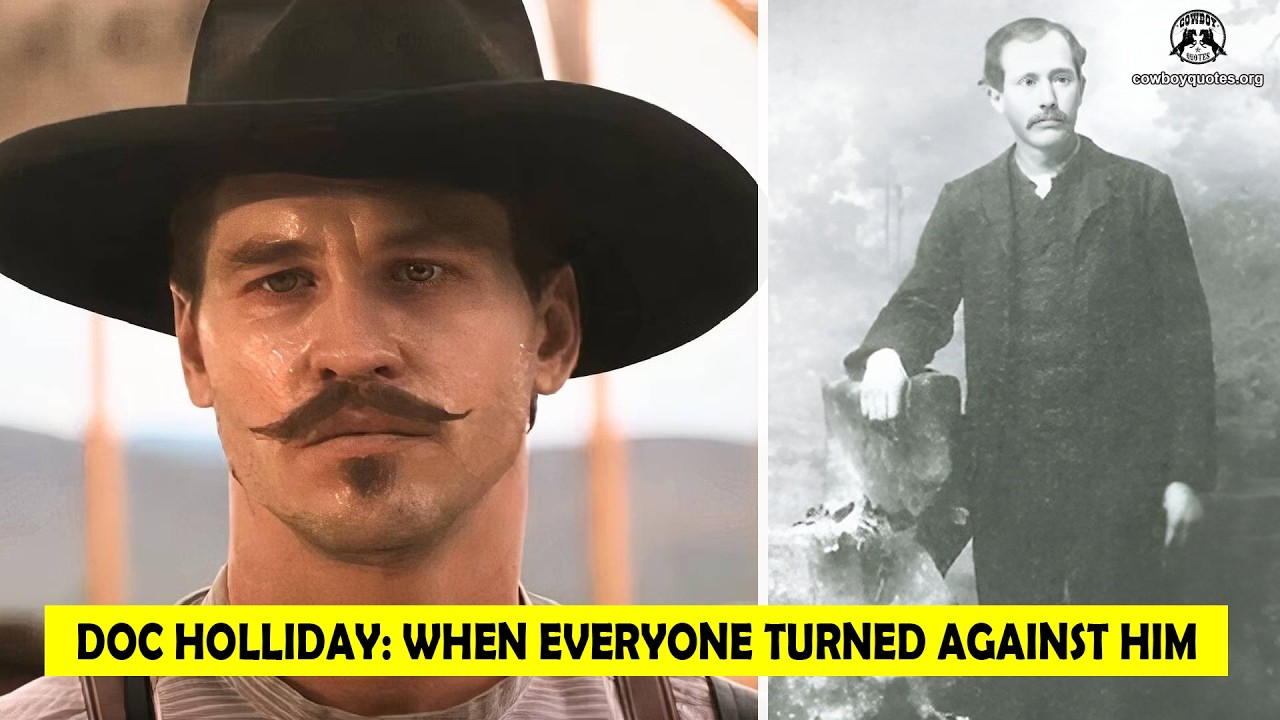
At the center of the debate is Doc Holliday, the dentist-turned-gambler whose reputation as a dangerous figure has dominated retellings of the event. Historians examining testimony, contemporary reporting, and physical evidence have consistently found that Holliday’s role was more complex and controlled than legend suggests. On the day of the gunfight, Holliday remained positioned on Fremont Street while Virgil Earp and Wyatt Earp moved into the narrow lot between Fly’s boarding house and the Harwood House. Virgil, holding Holliday’s cane, paused to assess the situation.
Across from them stood Billy Clanton and Frank McLaury, both visibly armed. Nearby, Tom McLaury appeared close to a rifle secured on a horse, heightening the tension. Sensing the growing danger, Holliday stepped forward and revealed his weapon. Acting in his role as town marshal, Virgil Earp called for the group to raise their hands and submit to disarmament.
There was a brief verbal acknowledgement, but the situation quickly shifted as members of the opposing side reached for their firearms. Wyatt Earp reacted, interpreting the movement as the beginning of a confrontation. Within moments, the standoff gave way to a rapid exchange of shots. Early in the encounter, both sides fired almost simultaneously.
Virgil Earp attempted to halt the escalation, reportedly signaling that he did not want the situation to turn into open conflict, but events had already moved beyond control. He was soon struck in the leg, which forced him temporarily out of action. As confusion intensified, Ike Clanton moved toward Wyatt Earp in a moment of panic and close contact. Morgan Earp returned fire and was himself injured shortly afterward.
Despite his wound, Virgil regained his footing and continued to respond to the threat. Frank McLaury, under increasing pressure, began moving away from the immediate scene toward Fremont Street. Wyatt eventually broke free from Ike Clanton, urging him either to take part or leave the area. Ike retreated from the scene by slipping into Fly’s boarding house.
Throughout the confrontation, Holliday held back momentarily, waiting for a clear opportunity to act. His line of sight toward Tom McLaury was partially blocked when Billy Clanton’s horse suddenly moved into the space between them. Interpreting the situation as an immediate threat, Wyatt Earp reacted by firing in a way that caused the horse to move away, briefly opening the view. Holliday stepped forward and fired toward Tom McLaury at close range.
McLaury turned and moved toward the direction of Third Street, where he soon collapsed. Believing he had not achieved the result he intended, Holliday quickly changed weapons and continued firing toward Billy Clanton, who had taken cover near a building west of Fly’s boarding house. Morgan Earp regained his footing and joined the exchange, focusing on Billy Clanton alongside Wyatt and soon after Virgil Earp. Despite being injured, Billy remained active, adjusting his stance and continuing to return fire even as his condition worsened.
Out on Fremont Street, Frank McLaury was still engaged, though clearly affected by earlier shots. During this phase, Wyatt moved out from the lot and warned Morgan of danger from behind, prompting Morgan to turn quickly and lose his footing on uneven ground. At the same time, Holliday had repositioned himself, circling outward into the street and closing the distance with Frank McLaury. A brief verbal exchange reportedly occurred before both sides resumed firing.
Holliday and Morgan responded almost simultaneously, and Frank McLaury soon fell, bringing the final moments of the confrontation into view. Back near the lot, Billy Clanton attempted to continue resisting despite his injuries. C. S.
Fly, who had been nearby, stepped forward and secured Billy’s weapon as the situation came to an end. The aftermath of the gunfight was shaped by legal proceedings and sharply conflicting witness accounts. Several witnesses for the prosecution claimed that Holliday may have been among the first to fire. However, historians have long debated these accounts.
Testimonies varied, and some statements were influenced by confusion, personal bias, or the chaotic nature of the moment. A key question concerns whether Holliday tried to provoke Ike Clanton into a gunfight the evening before the confrontation. Clanton later stated that Holliday approached him at a local eating establishment and spoke to him in an aggressive and insulting manner. Clanton claimed that Holliday had his hand near his weapon and challenged him while Clanton insisted he was unarmed.
He also recalled noticing Morgan Earp nearby, positioned behind him with his hand resting on his own firearm. It is generally agreed that a tense verbal exchange did take place between Holliday and Clanton. Wyatt Earp later testified that the argument continued outside, where he eventually intervened and led Holliday away. In some accounts, Wyatt suggested that Holliday had been drinking and was acting provocatively.
However, there are inconsistencies in Clanton’s version of events. He gave differing accounts regarding the location of the encounter, at times placing it at the Alhambra lunchroom and at other times near a different establishment. This lack of consistency raises questions about the reliability of his recollection when compared to other testimony. Big Nose Kate later recalled that she and Holliday were in Tucson on October 25, 1881, and that Morgan Earp urged Holliday to return to Tombstone as soon as possible.
She stated that later that night, Holliday and Morgan became involved in a heated verbal exchange with Ike Clanton. But contemporary reporting raises questions about Kate’s timeline. The Tombstone Daily Nugget reported that Holliday and Morgan had already returned from Tucson on October 22, several days earlier than Kate remembered. If Holliday was back in Tombstone before Ike Clanton even arrived in town, it weakens the interpretation that the Earps were preparing for a planned confrontation.
Instead, it suggests that events developed more gradually, shaped by ongoing tensions rather than a single urgent decision. Wyatt Earp’s testimony offers a deeper context for the tensions that developed prior to the confrontation. He explained that after an attempted robbery of a stagecoach near Benson in March 1881, he became frustrated by his inability to capture the suspected individuals, Bill Leonard, Harry Head, and Jim Crane. Wyatt sought assistance from Ike Clanton, offering him a reward from Wells Fargo in exchange for information leading to their capture.
Although the arrangement ultimately collapsed when the suspects were later found dead, it created a sensitive situation. Over time, Ike became aware that Marshall Williams had uncovered details of the agreement and began to worry that Doc Holliday might have knowledge of it. According to Wyatt, Ike questioned him repeatedly about what Holliday might know. Wyatt reassured him that Holliday was unaware but suggested that Ike could speak directly with him once Holliday returned to town.
By the time Holliday arrived back in Tombstone on October 22, Ike had already left. When Clanton returned on October 25, it is possible that he sought out Holliday not to provoke trouble but to address his own concerns. A witness named Martha J. King later testified that while she was inside Bauer’s Market butcher shop, she observed the group led by Virgil Earp as they passed by.
She recalled hearing one of the men, whom she believed to be one of the Earps, say something like “Let them have it,” followed by Doc Holliday responding “All right. ” However, Mrs. King admitted she could not clearly identify which Earp had spoken. Her testimony challenges the commonly repeated image of the Earp party advancing in a two-by-two formation.
Instead, her account suggests a looser arrangement, with the four men nearly side by side, Holliday positioned closest to the building and another man walking on the outer edge near the street. Given their close proximity, it is likely that all members of the group could hear the brief exchange, even if its exact meaning remains uncertain. Some interpretations suggest “Let them have it” may have been encouragement to proceed, but others argue that this reading is unlikely given the circumstances. At that moment, Johnny Behan was reportedly standing nearby and attempting to intervene.
Some suggest the phrase may have been misheard, and “Let him have it” spoken quickly could have referred to handing over a weapon if requested by the sheriff. Members of the cowboy faction consistently maintained that Holliday and Morgan Earp were the first to begin the exchange and that it occurred without clear provocation. Ike Clanton stated that as the Earps and Holliday approached, they immediately drew their weapons, after which Virgil Earp ordered the group to raise their hands. Clanton claimed that Billy Clanton expressed reluctance to engage, while Tom McLaury opened his coat to show he was not carrying a weapon.
Ike further asserted that both he and Frank McLaury raised their hands in compliance with the marshal’s command. Johnny Behan later testified that his attention was drawn to a nickel-plated pistol he believed Holliday was holding. He stated that this was the first weapon he noticed being fired, although his observation was limited to only a brief moment. Another witness, Billy Allen, who viewed the scene from behind the Earp party on Fremont Street, supported this interpretation, suggesting that the initial shot appeared to come from Holliday’s position.
William Claiborne reported that the exchange began almost instantly, with shots from Holliday and Morgan occurring so close together that they were difficult to distinguish. Wes Fuller, positioned further inside the lot, offered a similar account, indicating that the first two shots seemed to come from the same pair. While multiple witnesses aligned in placing the first shots with Holliday and Morgan, their perspectives were shaped by positioning, visibility, and personal affiliations. Physical evidence and other testimony have led historians to question whether the situation was as clear-cut as described.
One issue with Johnny Behan’s testimony is his strong focus on a nickel-plated pistol he believed Holliday was holding. This emphasis makes it difficult to reconcile his account with other evidence indicating that Holliday also carried a shotgun during the encounter. Historical sources suggest that Virgil Earp had handed Holliday the shotgun prior to the confrontation, and Martha J. King confirmed seeing him with it.
The version presented by the cowboy witnesses requires a complex sequence of actions, suggesting that Holliday alternated between different weapons in rapid succession. From an analytical standpoint, this interpretation is difficult to support, as it introduces unnecessary complications during what was a very brief and fast-moving event. Billy Allen was the only prosecution witness at the hearing before Wells Spicer to specifically mention a shotgun being fired early in the encounter. However, if Holliday was indeed holding the shotgun, it would be reasonable to expect that he used it first.
Although several prosecution witnesses agreed that Holliday fired one of the initial shots, they disagreed about his intended target. Behan believed Holliday aimed at Billy Clanton, while William Claiborne stated that Holliday directed his fire toward Tom McLaury with Morgan Earp focusing on Billy. Ike Clanton claimed Morgan targeted Billy but expressed uncertainty about which of the McLaury brothers Holliday aimed at. Clanton’s own testimony raises additional concerns.
He stated that he was positioned near the corner of Fly’s building with Wyatt Earp directly in front of him, closely engaged at the time. If this positioning is accurate, it would have limited his ability to clearly observe actions occurring behind him where Holliday, Billy Clanton, and the McLaury brothers were located. A major weakness in the Cowboys’ version of events was their inability to present a clear and consistent motive for what they described as an unprovoked attack. During cross-examination, Ike Clanton alleged that Wyatt Earp, along with Doc Holliday and others, had prior knowledge of money on the Benson stagecoach before it departed Tombstone.
However, historical records indicate that no money was actually taken during that attempted robbery, which undermines the foundation of this claim. Clanton then asserted that Wyatt feared the suspected robbers might implicate the Earps and Holliday if captured. Yet this account raises a logical problem: if the suspects were supposedly connected to Wyatt, it is unclear why he would need Clanton’s assistance to locate them. The claims become even more difficult to accept when Clanton suggested that multiple individuals, including Holliday, Morgan Earp, and Virgil Earp, openly shared incriminating details with him about their alleged involvement in earlier events.
His explanation leaves key questions unanswered, most notably why, if he was central to this alleged threat, he was not treated as a primary target during the incident. The exact type and gauge of the shotgun that Virgil Earp obtained from the Wells Fargo office and handed to Holliday remain uncertain. Contemporary reporting simply described it as a short gun similar to those carried by Wells Fargo messengers. These were often 10-gauge weapons, although the number of pellets later found in Tom McLaury has led some researchers to suggest it may instead have been a 12-gauge.
Descriptions of Holliday’s handgun are also inconsistent across witness accounts. Johnny Behan testified that Holliday carried a nickel-plated revolver, while other observers, including saloon keeper Bob Hatch and Addie Borland, described seeing a darker colored firearm. Despite these differences, the overall weight of the evidence supports the conclusion that Holliday did possess a nickel-plated pistol, a position reinforced by the defense’s own acknowledgment during the hearing. The conflicting descriptions offered by witnesses can likely be explained by distance, angle, and the fast-moving nature of the event.
Addie Borland, who viewed the scene from across the street more than 75 feet away, may have mistaken the short-barrel shotgun for a large handgun, with the stock partially obscured by Holliday’s arm. According to reporting in the Tombstone Daily Nugget, a shot associated with Frank McLaury passed through a pocket in Holliday’s clothing, lightly grazing him. Unlike a standard holster worn on a belt, a pistol pocket was typically reinforced with canvas or leather and sewn into clothing to securely hold a handgun. Wes Fuller recalled seeing Holliday place a revolver into his coat pocket before the encounter, but it remains uncertain exactly which pocket was struck.
The evidence suggests that Holliday’s actions during the confrontation were relatively controlled and purposeful. Rather than initiating events, Holliday seems to have waited and observed, maintaining a defensive position alongside the city marshal. The situation involving Tom McLaury is particularly important in this assessment. Although later claims suggested McLaury may not have been armed, Holliday had no clear way of confirming that in the moment.
McLaury’s movement toward a nearby horse, where a rifle was known to be stored, could reasonably have been interpreted as an attempt to access a weapon or use the animal for protection. The physical evidence, including the location of McLaury’s wound, aligns more closely with accounts given by Wyatt Earp than with the testimony of Ike Clanton. The angle and position suggest that McLaury was turned toward Fremont Street and reaching forward at the time rather than standing passively as some claims later described. After this moment, Holliday’s involvement appears limited and selective.
Reports indicate that he directed only a small number of shots toward Billy Clanton, as supported by testimony from eyewitnesses such as C. H. Light, who observed the scene from a nearby building. Holliday’s later movement across the street, covering a considerable distance before the encounter concluded, further reflects a measured approach rather than uncontrolled behavior.
His actions required awareness, timing, and restraint under pressure. While Holliday’s reputation in the Old West was undeniably fierce, the available evidence indicates that on October 26, 1881, he acted as a disciplined participant, fulfilling a specific role and supporting the city marshal in a rapidly escalating situation. The details of who acted first and how each moment unfolded remain subjects of debate, shaped by differing accounts and later retellings that have contributed to the enduring legend. Holliday stood not just against men that day, but against the legends that would later define him, a figure whose true role in the gunfight at the O.
K. Corral continues to be weighed against conflicting truths.