LONDON — The execution of William Joyce, the Nazi propagandist known to millions as Lord Haw-Haw, was carried out in a manner so violent that it has been described for decades as a grotesque spectacle that shocked even the seasoned officials who oversaw it, according to newly resurfaced accounts of the January 3, 1946 hanging at Wandsworth Prison.
Joyce, who was 39 years old when he was led to the gallows, had been convicted of high treason for broadcasting defeatist propaganda into Britain on behalf of Adolf Hitler’s regime during the Second World War. His death, carried out by Britain’s most experienced executioner, Albert Pierrepoint, did not unfold as the clinical procedure that the long-drop method was designed to produce.
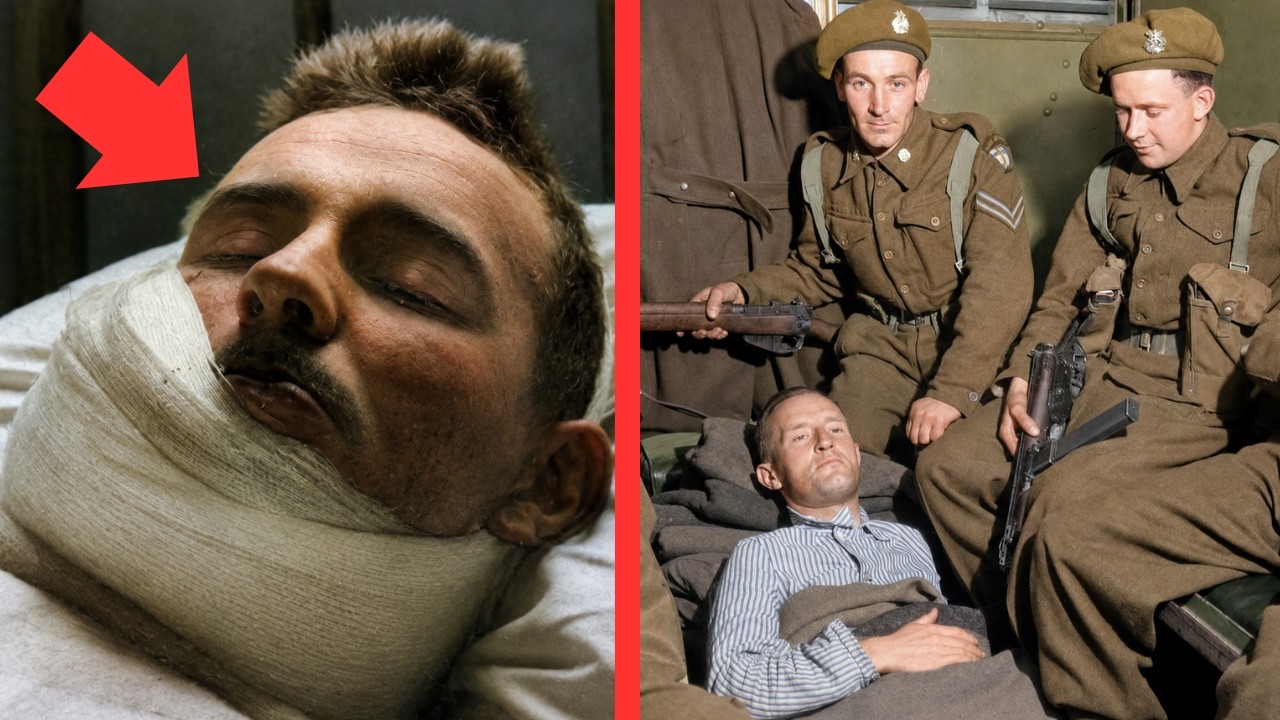 Instead, witnesses and subsequent historical examinations of the event indicate that the force of the drop caused a large scar on Joyce’s face, a wound he had carried since a violent political confrontation years earlier, to burst open under the immense pressure exerted on his head and neck. Blood poured onto the floor of the execution chamber, staining his clothing, the rope, and the surrounding area, according to accounts that have circulated since the war’s end.
The attending physician, whose duty was to confirm death, reportedly faced a far more difficult task than usual because of the condition of the body. Joyce’s remains were lowered and placed in a coffin while blood continued to flow from the reopened wound, a detail that has fueled debate about whether the execution crossed the line from lawful punishment into something closer to butchery.
Pierrepoint, who had perfected the long-drop technique through a government table of measurements calibrated to a condemned prisoner’s height and weight, had met Joyce beforehand to calculate the precise length of rope needed to break his neck cleanly. The method was intended to deliver an instantaneous death, avoiding the slow strangulation that had discredited earlier forms of hanging.
But the calculations could not account for the fragility of Joyce’s scarred face or the sheer violence of the drop. When the trapdoor sprang open and the rope snapped taut, the pressure proved catastrophic. The scene that followed has been cited by critics of capital punishment as evidence of the state’s capacity for cruelty, even when it claims to be acting with precision and restraint.
Joyce had been transferred to Wandsworth’s condemned cell to await execution after his appeals were rejected. He remained defiant to the end. In writings left behind, he declared, “I defy the dark forces they represent,” and warned the British people against what he called the crushing imperialism of the Soviet Union.
He also wrote, “Let Britain be great again,” and “I am proud to die for my ideal, and I pity the sons of Britain who died without knowing why.”
His final broadcast had been transmitted on April 30, 1945, the same day Hitler died, as Soviet forces closed in on Berlin. Joyce was reportedly drunk at the time. He fled the collapsing capital, aware that capture would be easier in Germany’s cities and towns, and made his way to the countryside near Flensburg, close to the Danish border, where Admiral Karl Donitz had established the last government of the Third Reich.
British intelligence officers, who had been hunting the infamous broadcaster, closed in after receiving rumors of a British couple living in the village of Kuffermark. Joyce was allegedly walking alone in a forest after an argument with his wife, Margaret, when he was confronted. During his arrest, British officers opened fire when he reached into his pocket for his passport, mistakenly believing he was reaching for a weapon.
He was transported to Britain to stand trial on three counts of treason. He pleaded not guilty, and his defense team argued that he had never been a British citizen and therefore could not be considered a traitor. They contended that he had never acknowledged the authority of the King or the Crown over his life, and that his British nationality had been extinguished when he acquired German citizenship in 1940.
 The legal argument hinged on a technicality that remains controversial to this day. Joyce was born in the United States, which made him an American citizen by birth. His father was Irish, and his mother came from an Anglo-Irish family.
The family returned to Ireland when he was a child, and at one point Joyce was said to have been recruited as a messenger for opponents of the Irish Republican Army. There was even an attempt on his life as he walked to school.
He later moved to England, where he became involved in right-wing politics and joined the British Union of Fascists in 1932 under Sir Oswald Mosley. By then, Joyce was already a seasoned political brawler. He bore a large scar on his face from an attack by communists, and within the BUF he found his true political home.
One witness to his speeches described him as “thin, pale, and intense,” adding that within minutes of hearing him speak, the audience felt electricity from a man terrifying in his dynamic power and biting in his words.
Joyce became the BUF’s director of propaganda and was known as a fighter unafraid to dirty his hands against his enemies. He spoke with the same venom as the Nazis in Germany against the people they would later persecute. At some point, he was expelled from the BUF and decided to seek inspiration and purpose in Nazi Germany and the Third Reich.
On the eve of the Second World War, Joyce and his wife left Britain and fled to Germany. In 1940, he became a naturalized German citizen and was granted Reich citizenship. Hitler welcomed those who had left their homelands and arrived in Germany carrying the same political beliefs as the Nazis.
Joyce found work in the Reich Ministry of Propaganda, initially on a contract as a newsreader for the German English-language radio service.
He became the most famous British broadcaster inside Germany. In his regular programs, he spoke against the British in support of the Nazis. His notorious program, “Germany Calling,” was broadcast to Britain and heard by millions.
 During these broadcasts, he mocked the British war effort and sought to demoralize the population, urging them to abandon their troops and government and turn toward the Nazis. It was for this that William Joyce earned the nickname Lord Haw-Haw.
The impact of these broadcasts was intended to undermine British morale, but most people chose to laugh at the programs and regarded them as ridiculous. In addition to broadcasting propaganda, Joyce wrote books and other propaganda materials distributed among prisoners of war. He even attempted to recruit British POWs into the Waffen-SS unit known as the British Free Corps, which was then being formed.
Hitler awarded him the War Merit Cross, though the two men never met.
After the war, Joyce’s body was placed in an unmarked grave within the walls of Wandsworth Prison and was not immediately handed over to his family. In 1976, thirty years after his death, his daughter petitioned for the release of the body. Joyce’s remains were exhumed from the original grave and returned to Ireland, where he was buried in a cemetery in Galway.
The case of William Joyce remains a subject of debate. Many argue that he was wrongly executed because he held a British passport unlawfully. Joyce himself argued that possession of a passport did not grant him the protection of the Crown and that he owed no duty of loyalty to the Crown or the country once he left.
It was said that Joyce was Irish and even American, and that his British nationality was revoked once he acquired German citizenship, meaning he was not guilty of treason and could technically have been considered a prisoner of war.
There is no doubt that he held American citizenship by birth and German citizenship by naturalization. But whether he was truly a British citizen, and therefore whether he could be executed for treason inside Britain, remains controversial today. In modern times, he would very likely have escaped most punishment.
The celebrated historian A. J. P.
 Taylor remarked, “Technically, Joyce was hanged for making a false statement when applying for a passport, the usual penalty for which is a small fine.”
Still, the manner of his death has left a lasting stain on the record of British justice. The image of a man bleeding out on the floor of the execution chamber, his face torn open by the very force meant to end his life swiftly, has become a grim footnote to one of the most notorious treason cases in history. Joyce is remembered as one of the most reviled figures of the Second World War, a man whose name is forever linked with betrayal.
The execution itself, carried out in the cold dawn of a January morning, was witnessed by a small group of officials whose accounts have been pieced together over the decades. The bloodshed that followed the drop was so extensive that it complicated the doctor’s examination and left the chamber in a state that required extensive cleaning. The rope, the hood, and Joyce’s clothing were all saturated.
Pierrepoint, who would later execute numerous Nazi war criminals, including several convicted at Nuremberg, was said to have been deeply affected by the Joyce hanging. The executioner, who took pride in his ability to deliver a humane death, reportedly regarded the outcome as a failure of the method rather than of his own skill. The scar on Joyce’s face, a legacy of political violence in Britain, had become the instrument of his final, gruesome spectacle.
The debate over Joyce’s guilt and the propriety of his execution has never fully subsided. Legal scholars have long questioned whether the British government stretched the law of treason to cover a man whose citizenship was ambiguous at best. The prosecution’s case rested on the argument that Joyce, by holding a British passport, owed allegiance to the Crown, and that his broadcasts from Germany constituted a betrayal of that allegiance.
Joyce’s defenders argued that he had renounced any loyalty to Britain long before the war and that his German citizenship had superseded whatever British status he might have held. They pointed out that he had been expelled from the British Union of Fascists and had left Britain voluntarily. The fact that he was born in the United States further complicated the question of his nationality.
In the end, the court rejected his arguments and sentenced him to death. The execution was carried out with the full weight of the law, but the manner of his death has been cited ever since as evidence that even lawful executions can descend into horror. The blood on the floor of Wandsworth Prison that morning became a symbol of the brutality that lurks beneath the surface of state-sanctioned killing.
Joyce’s final words, written before his execution, reveal a man who believed himself a martyr. He called on the British people to raise the swastika from the dust and warned of the Soviet threat. He expressed pity for the sons of Britain who died without knowing why.
His defiance in the face of death has been interpreted by some as courage and by others as the delusion of a fanatic.
The story of Lord Haw-Haw is a reminder of how war can turn men into monsters and how the machinery of justice can produce outcomes that shock the conscience. The execution of William Joyce was meant to be a sober act of retribution for treason. Instead, it became a bloody tableau that has haunted the history of capital punishment in Britain and left an indelible mark on the memory of the Second World War.