In July 1939, a 13-year-old girl watched an 18-year-old cadet leap over tennis nets at the Royal Naval College in Dartmouth and decided she would marry him. Princess Elizabeth never once changed her mind. Her mother had other plans. Queen Elizabeth, the most admired woman in Britain, wanted a Grenadier Guard for her daughter, an English gentleman of settled land and name, and she had a candidate already chosen.
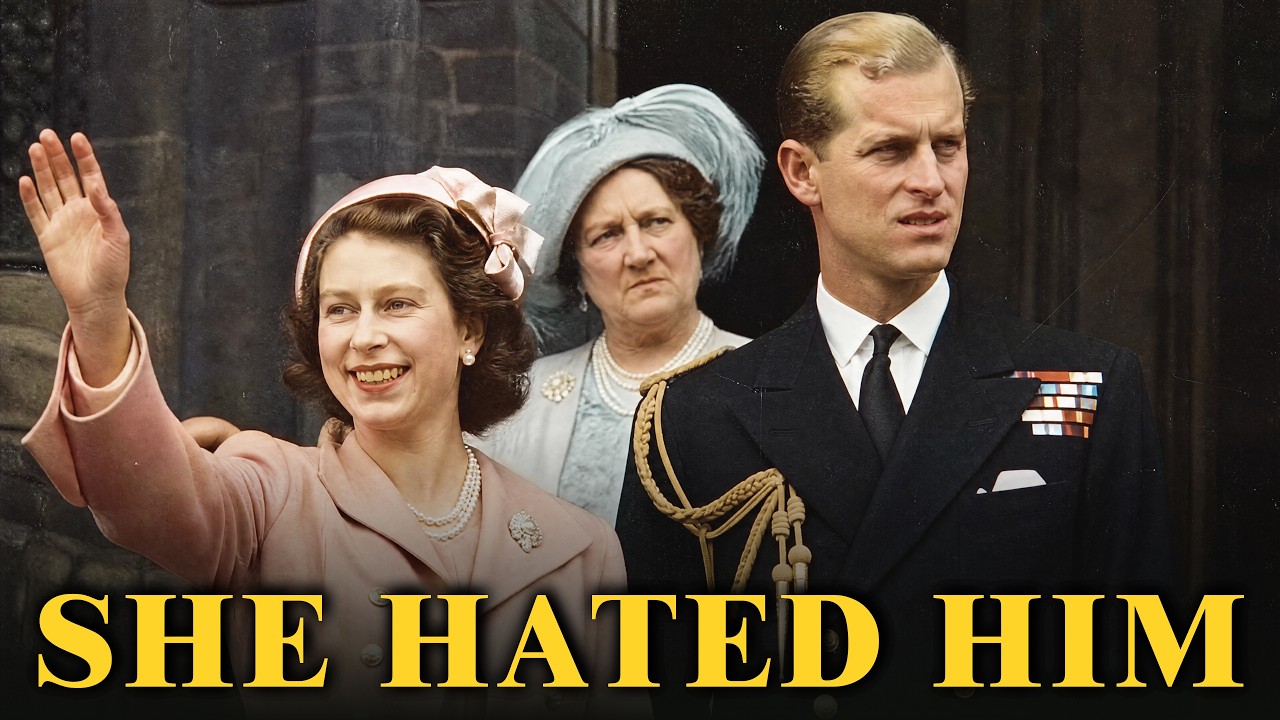
For eight years, the daughter waited. She said yes in secret and was not allowed to say it aloud. Elizabeth had not been expected to become queen. She was born in 1926 as the elder daughter of the Duke and Duchess of York, the king’s second son, and for the first ten years of her life she expected a quiet royal obscurity.
Then in December 1936, her uncle, the Prince of Wales, abdicated to marry the divorced American woman the church and country would not accept, and her shy, stammering father became King George VI. The ten-year-old girl became heir to the throne of the largest empire the world had ever known. She carried that weight with self-control that astonished those who watched her. She was tidy, dutiful, and contained.
Those close to the household said she had an almost unnerving sense of duty for a girl so young, an early understanding that her own wishes were the smallest thing in any room she entered. This is the child who at 13 looked at a penniless foreign cadet and decided without fuss that he was the one thing in her life she meant to keep for herself. The man she chose was Philip, a prince of Greece and Denmark by birth, though he had no country that wanted him and no money to his name. He was tall, fair, and showing off that July afternoon, eating shrimp and a banana with the appetite of a growing boy, careless and sure of himself in a way the sheltered daughter of a king had never been allowed to be.
From that summer, she kept his photograph on her desk. She wrote to him at sea. In the private reckoning of a girl raised to want almost nothing for herself, she wanted him, and she wanted no one else. The war came just two months later.
Britain declared war on Germany in September 1939, and Philip went to sea with the Royal Navy while Elizabeth grew up behind the walls of Windsor Castle. The courtship happened across the length of the conflict by letter and rare, closely watched visits. He came to Windsor at Christmas of 1943 on leave, and the family staged a small pantomime in which the princess, by every account, glowed at the sight of him. By the time the war ended in 1945, she was 19, and the feeling that had settled in her at 13 had not shifted an inch.
What stood between the wanting and the having was not the war, the distance, or even her father, the king. It was her own mother, and her mother had already begun, quietly and with great skill, to find her daughter someone else. Queen Elizabeth, the wife of King George VI, had been born Elizabeth Bowes-Lyon in 1900, the ninth of ten children of a Scottish earl. She had come into the royal family with great reluctance, had watched the abdication tear the monarchy nearly in two, and had spent the war years rebuilding its standing by refusing to leave bombed London.
Her world ran on a system of suitable matches. Suitable meant land, an old name, and a settled place in the order of the counties. A Guards officer from a family with an estate behind it was close to the ideal. Philip fitted none of it.
He had no land, no fortune, no English county, no fashionable regiment, only a foreign title and an ambitious uncle. According to royal historian Hugo Vickers, the queen was, in his phrase, very keen that her daughter should marry a grenadier guard. She had a candidate ready: Hugh, Earl of Euston, who would one day become the 11th Duke of Grafton. He was taken seriously enough that the diarist Henry Channon, known as Chips, wrote in his diary in 1943 that the young earl was “reserved for a higher destiny, the very throne itself.
”
The queen’s plan was quiet and patient. The first move was simply to make sure her daughter had other men in front of her. Then the story took a turn that reads like a novel. According to Hugo Vickers, Lord Louis Mountbatten, Philip’s own uncle, was instrumental in getting Earl Euston a fabulous job as aide-de-camp to the Viceroy of India.
It was a magnificent appointment. It also removed the queen’s favored rival to the far side of the world at the exact moment he most needed to be present and pressing his suit. The uncle of the man the queen did not want had arranged for the man the queen did want to be shipped off to another continent. By the autumn of 1943, the family had cooled on the earl altogether.
He was written off at last as too inert. But the objections to Philip had not faded. He was, in the verdict that circulated among the king’s household, too foreign, too rough-edged, too ambitious, and insufficiently English. There were anxieties about his money, of which he had almost none, and above all, about his family.
The queen did not rage or forbid or make a scene. She worked through charm and patience and the long slow game. At Balmoral in the autumn of 1946, Philip asked the princess to marry him, and she said yes. She accepted privately before any permission had been sought or consent given.
That order of events tells you almost everything you need to know about her. She did not ask whether she might be allowed to have him. She presented her choice as a thing already settled in her own heart. Her father did not refuse.
He attached a condition: there would be no engagement announced until after his daughter had turned 21. Her birthday fell in April 1947, which meant the better part of a year of silence stretched ahead of her. In the early weeks of 1947, the king, the queen, and both princesses set off on a long royal tour of southern Africa, and Philip did not go with them. For months on end, the princess was carried to the far side of the world without the man she had promised to marry.
That gave public statement of her early life, a grave dedication of herself to a lifetime of service. On April 21, 1947, from Cape Town, she made the broadcast that would define her. She dedicated her whole life, whether it be long or short, to the service of the great imperial family. What the country did not hear, because she was not permitted to say it, was that she was already secretly promised in marriage to a man her mother had spent years trying to keep out of her reach.
The silence held through to high summer. On July 9, 1947, the engagement was at last made public, and Britain, worn thin by six years of war and austerity, fell gratefully upon a royal love story. But there was a price on Philip’s side. To be allowed to marry her, he had to be entirely remade.
He renounced his royal titles of Greece and Denmark. He gave up the Greek Orthodox faith of his childhood and was received into the Church of England in October 1947. He took a new surname, Mountbatten, the anglicized form of the German Battenberg, and became a naturalized British subject. The Prince of Greece and Denmark walked into 1947 single and foreign.
He walked through it into a British commoner named Lieutenant Philip Mountbatten. Only on the morning of the wedding itself did the titles come back, in the English key. The king created him Duke of Edinburgh, Earl of Merioneth, and Baron Greenwich. The wedding took place on November 20, 1947, at Westminster Abbey.
Britain was still gray and rationed, and the bride’s wedding dress had been bought in part with ration coupons. The ceremony was broadcast by radio to an audience estimated at around 200 million people. The story looked from the outside like a fairy tale. It had not been resolved.
The objection that had gone deepest, the one about his family, could not be dressed away with any dukedom. Philip had four elder sisters, and three of them were still living in 1947. All three had married German princes in the years before the war. Barely two years after the war against Germany had ended, they were not invited to their only brother’s wedding.
The reasoning was put with cold simplicity by Lady Pamela Hicks: “So soon after the war, you couldn’t have the Hun. ”
There was one object from that wedding day that held the whole strange truth of it. The engagement ring had been made by the London jeweler Philip Antrobus, and the diamonds had been taken from a tiara that belonged to Philip’s own mother, Princess Alice. That tiara had been Alice’s wedding gift from Emperor Nicholas II and Empress Alexandra of Russia, murdered with their children in 1918.
The ring on the finger of the future queen of England had been cut from a Russian imperial jewel given by a tsar who was later shot to the mother of a prince who had no country of his own. They married, and by every account they were happy. Philip returned to the Navy and was posted to Malta, where Elizabeth had a brief spell of something close to an ordinary life, living as a serving officer’s wife in a Mediterranean garrison. Those who knew her spoke of it ever afterward as the happiest and most carefree stretch of her whole life.
It could not last. Two children came, first Charles and then Anne. Then in February 1952, while Philip and Elizabeth were away on tour in Kenya, the king died in his sleep at Sandringham, worn out at 56. The young woman who had waited so long to marry her prince became, in a single morning under an African sky, queen of the United Kingdom and of a quarter of the world.
Within weeks of the accession, the first of her mother’s specific fears about the man she had married came true exactly as it had been foreseen. The charge was ambition. Lord Louis Mountbatten was heard to declare with evident satisfaction that the House of Mountbatten now reigned over Britain. And the queen’s husband, taking his uncle’s lead, proposed that the royal house should carry his name.
It should become the House of Edinburgh, or the House of Mountbatten, so that his children would bear into history the family into which they had been born. The reaction was immediate and ferocious. Queen Mary, the widow of George V, was appalled. She went to the prime minister, Winston Churchill, and Churchill and his cabinet came down on the question like a hammer.
On April 9, 1952, only two months after the accession, the young queen formally declared that the royal house would remain the House of Windsor, now and in the future. Philip took the defeat hard. According to the biographer Gyles Brandreth, who set the remark down decades later, Philip said in private and in real bitterness that he was “nothing but a bloody amoeba, the only man in the country not allowed to give his name to his own children. ”
The mother had read the man and his uncle correctly.
Her fear had been specific, and the specific thing she feared had come to pass in front of her. The name had been kept Windsor by royal proclamation in 1952. But it had merely gone underground to wait, and it would surface again eight years later. The story of what happened in 1960 is a quiet masterclass in getting your own way slowly.
Behind the scenes, a lawyer named Edward Wynn had been pressing a persistent campaign for years, arguing that it was wrong for the queen’s own descendants to carry no trace whatever of their father’s name. The argument worked its way upward until it reached the desk of the prime minister, Harold Macmillan. On February 8, 1960, by an order in council, the queen declared that while the royal house itself would remain Windsor, her descendants who needed a surname would bear the name Mountbatten-Windsor. It was a compromise, but it was real and permanent.
The declaration came just 11 days before the queen gave birth to her third child, Prince Andrew, on February 19, 1960. The defeated uncle’s long reach did not stop at the matter of the name. Lord Louis Mountbatten became mentor, teacher, and confidant to the young Prince Charles, so central to the growing boy that Charles would later describe him as “the grandfather I never had. ”
That mentorship ended in sudden horror.
On August 27, 1979, Lord Louis Mountbatten was murdered by the IRA, killed by a bomb hidden aboard his fishing boat as it left the coast of the west of Ireland. Members of his family were killed alongside him, including one of his young grandsons. On that same afternoon, the IRA killed 18 British soldiers in a double bombing at Warrenpoint. It was one of the bloodiest days of the whole long conflict.
The charge that the man was simply too rough was proved slowly over decades. It was not a phase that he passed through. It was simply and permanently who he was. In the run-up to the coronation of 1953, a great argument broke out over whether the sacred ceremony should be shown on television.
Churchill was firmly against it. The Queen Mother disapproved deeply. Pushing hard for the cameras to be let in stood Philip, who chaired the commission that organized the coronation. He won.
The coronation was televised, and something close to 27 million people in Britain alone watched it. The bluntness never softened with age. For the rest of his very long life, Philip said more or less exactly what came into his head. To anyone, anywhere.
In 1995, on a visit to Oban in Scotland, he asked a local driving instructor how he managed to keep the local people off the drink long enough to get them through their test. And yet the same quality that made him rough was also what made him useful. Philip took the energy and built a working life out of it where none at all had been mapped for him. A queen’s husband has no constitutional role whatever.
He is not made king. A queen’s husband becomes nothing in particular. Philip founded the Duke of Edinburgh’s Award in 1956, a scheme of challenge and service for the young that has since carried millions of teenagers across more than a hundred countries. He became the first president of the British arm of the World Wildlife Fund.
He reorganized the running of the great royal estates. He gave the first television interview any member of the royal family had ever given. And he carried out more than 22,000 solo public engagements. The roughness the queen mother deplored and the drive that built all of this were the very same quality wearing two different faces.
The darkest charge concerned Philip’s family. He had four elder sisters, Margarita, Theodora, Cecilia, and Sophie. In a single short span between the end of 1930 and the late summer of 1931, all four married German princes. Several of those husbands were drawn into the Nazi regime, some of them very deeply.
Sophie’s husband, Christoph of Hesse, joined the party and then the SS and rose to run a secret intelligence bureau of the Reich Air Ministry under the patronage of Hermann Göring. Cecilia and her husband both joined the Nazi party on the very same day in May 1937. The picture was not uniform. Margarita’s husband joined the party but was dismissed from the German army in the purge that followed the failed plot to kill Hitler in July 1944.
Theodora’s husband never joined the party at all. While his sisters were marrying deeper into Germany, Philip was being carried in the opposite direction, schooled in Britain and bound for the Royal Navy. The same family that gave the Reich an officer of the SS gave Britain a decorated sailor. Into that tangle fell a private catastrophe.
In November 1937, Philip’s sister Cecilia, then heavily pregnant, boarded a small aircraft with her husband, her mother-in-law, and two of her young sons, flying to a family wedding in England. The airplane came down in thick fog near Ostend, and every soul aboard was killed. Philip was just 16 years old. Photographs of that day show a fair-haired boy walking in the funeral procession of his favorite sister, surrounded on every side by grieving relatives in German uniform.
So when the wedding came at last in 1947, the three surviving sisters were not asked to come. And yet the same family held its own bright opposite. Philip’s mother, Princess Alice, spent the war in occupied Athens and sheltered a Jewish family in her own home at genuine and daily risk of her life. She is honored to this day at Yad Vashem among the Righteous Among the Nations.
By the coronation of the new queen in 1953, the surviving sisters were back inside the family, seated among the tiaras in the abbey. The last charge was the one that never went to trial because there was never any evidence to bring. Across 70 years of rumor about Prince Philip and other women, nothing whatever was ever proved. Not one single liaison was ever established as fact.
What there was instead was a reputation, built out of proximity, glamour, and the sheer repetition of names. The charge of unfaithfulness clung to Philip for an entire lifetime. The first of the names was Pat Kirkwood, a musical stage actress. In October 1948, when the queen, then still Princess Elizabeth, was heavily pregnant with Prince Charles, Philip was seen dining and dancing with her at a nightclub.
That single evening is the whole of what was ever actually established. Both denied the rumor. Kirkwood called it “the mythology of the press” and came to believe the whispered link had cost her the career and public honors she was otherwise due. Helen Cordet was a French woman Philip had known since childhood, a genuine and old friend, and he stood as godfather to her children.
From that ordinary kindness grew the claim that he was secretly the father of her son. Her son, Max Boisot, stated publicly in 1996 that Philip was not his father, and no paternity claim has ever stood up to scrutiny. In the winter of 1956, Philip left England on a long solo tour aboard the newly commissioned Royal Yacht, opening the Melbourne Olympic Games in November and then sailing on for months. He was away for close to four months.
During that absence, his friend and equerry Mike Parker was served with divorce papers by his wife. An American newspaper, The Baltimore Sun, ran a story openly hinting at a rift in the royal marriage. The palace did a thing it almost never did. It answered directly.
“It is quite untrue that there is any rift between the Queen and the Duke,” said the press secretary, Commander Richard Colville. Nothing was ever shown, and the marriage simply went on. Across all those decades of rumor, exactly one of the women involved ever chose to speak on the record. She was Alexandra, known to her friends as Sasha, the Duchess of Abercorn, a descendant of the Russian poet Alexander Pushkin, who met Philip through competitive carriage driving.
In 2004, in a book by Gyles Brandreth, she said: “It was a passionate friendship, but the passion was in the ideas. It was certainly not a full relationship. I did not go to bed with him. ”
In the last decades of his life, Philip’s closest companion was Penny, the Countess Mountbatten of Burma, who shared his passion for carriage driving and stood near him for 46 years.
She was at his side to the very end of his life and was one of only 30 mourners permitted at his funeral. In all that time, she never once gave a single interview or offered a single public word about him. Philip himself answered the charge directly once, to a journalist, reportedly in 1992. “Have you ever stopped to think that for the past 40 years I have never moved anywhere without a policeman accompanying me?
So how the hell could I get away with anything like that? ”
Mike Parker insisted flatly that the Duke had been entirely faithful to the queen throughout. Lord Charteris, the queen’s own long-serving private secretary, said there was no evidence of any kind that he had ever strayed. Even Sarah Bradford, the biographer who had believed the worst of him in the 1990s, came round in the end and conceded she might well have been mistaken.
The mother had feared above all other things that this restless man would betray her steadfast daughter. It was the one charge out of every charge she ever laid that the long evidence of a lifetime simply and completely fails to support. He had been rough, yes. He had been ambitious, yes.
His family had been a lasting problem, yes. But unfaithful, the one thing above all others that she had dreaded, was never once shown to be true. There remained the very last charge, the first one she had ever made against him, that he was simply too foreign. And that one, of all of them, she had got the most flatly and completely wrong.
This foreign prince had fought for Britain in the darkest years of the war. He had entered the Royal Naval College at Dartmouth in 1939 and passed out top of his term, winning the King’s Dirk as the finest cadet of his intake. At the Battle of Cape Matapan in March 1941, the 19-year-old Philip served aboard the battleship Valiant, and in the dark of the night action, he was given charge of the ship’s searchlights. He held two enemy cruisers steady in his beams so that the British guns could find them.
He was mentioned in dispatches for it. He rose to become one of the youngest first lieutenants in the fleet, second in command of a destroyer, and he was later given a command of his own, the frigate Magpie. He was present in Tokyo Bay in September 1945 when the Japanese signed the surrender that ended the war. When he married the heir, he gave that profession up, walking away from the sea he loved for a life of walking two paces behind his wife.
The court had called him foreign. The Royal Navy had called him one of its most promising young officers. The Queen Mother had looked at a stateless young man in 1939 and seen a foreigner who did not belong. What she had been looking at without knowing it was a decorated British naval officer in the making, a future pillar of the very institution she had given her own life to guarding.
In the end, the woman who had spent eight years building the case against him delivered the acquittal herself. The biographer Tim Heald recorded that the Queen Mother, late in her long life, came to describe Philip approvingly as “an English gentleman. ”
The very word that had been the whole foundation of the case against him, offered now freely as praise. The woman delivering that late verdict was by then a national institution in her own right.
Widowed at 51, she had lived on for half a century as Queen Elizabeth, the Queen Mother. She had bought and restored a storm-battered castle on the far north coast of Scotland, the Castle of Mey. She had become one of the great racing owners of the age. Through every phase of the long relationship, from the first cold resistance to the final warmth, the united front never once broke in public.
There was no leaked letter, no public quarrel, no scene at a wedding or a funeral. Two of the strongest personalities in the modern monarchy conducted a decades-long difference of temperament without ever letting the public see so much as a crack in the surface. The Queen Mother died on March 30, 2002, at the extraordinary age of 101, just seven weeks after the death of her younger daughter, Princess Margaret. She died having watched the marriage she had fought so hard to stop past its 50th year and keep going strong and unbroken.
The marriage her mother had tried to stop became the longest in the history of the British crown. 73 years. Elizabeth and Philip were married on November 20, 1947, and remained married until his death on April 9, 2021, when he died at Windsor Castle at the age of 99. No British sovereign in the whole thousand-year history of the crown has had a longer marriage.
Philip was, when he died, the longest-serving royal consort the country had ever had. His funeral fell in the depths of the pandemic and was cut down to just 30 mourners. The image that came out of St. George’s Chapel of the widowed queen sitting entirely alone, small and masked in a great empty choir stall, became the photograph of the whole year.
She had chosen him at 13, married him at 21, and now at 94, she sat alone at his coffin. She herself followed him within 18 months, dying at Balmoral on September 8, 2022, and she was laid to rest beside him. So render the final verdict, charge by charge. Too ambitious: she was right.
The Mountbatten agenda: she was right and lost that fight twice over, the name and the grandson both. Too rough: she was right, gloriously and permanently right. The family: she was right that it would always be a shadow, though she lived to see the same family produce a heroine. Too foreign: there she was flatly, completely wrong.
On four charges out of five, the mother had read the man with cold and painful accuracy. Almost everything she had feared about him had in some measure come true. And it had not mattered in the slightest, because the case she built was about his suitability, about whether he was the right sort of person to be fixed into the machinery of the crown. That was never the question her daughter was asking.
Elizabeth at 13 on a summer afternoon at Dartmouth had not been assessing a candidate for the role of consort. She had been choosing a husband. The mother was judging whether the man was good enough for the institution. The daughter was judging whether the man was hers and whether he would last.
On that question, the only one she was actually asking, the daughter was right, and the marriage outran every single objection by decade after faithful decade. The Queen Mother had wanted a Grenadier Guard, an English gentleman of settled land and settled name. In the end, by her own late and generous verdict, that is more or less what her daughter’s foreign prince became. Though he had to fight the whole establishment and win over the whole of a lifetime to be called it.
And the girl who stood on a tennis lawn at Dartmouth at the age of 13 and decided quietly and completely that she would have him and no one else, and who never once moved from that decision across the whole of her long life, turned out to have been from the very first afternoon the better judge of the two.