On August 24, 1814, the dinner table was set at the President's House in Washington. The wine was chilled. The British Army was a few miles from the door.
A boy stood in the dining room. He was the servant of President James Madison, and he was also the property of James Madison. He had been born in the year George Washington died.
Above him hung a portrait of Washington. Before the house burned that night, the painting would be taken out of it. He would be in the room when it came down. Fifty-one years later, he would write down what actually happened there. Almost no one would read it.
Twenty-nine years after that afternoon, the woman he had served since he was ten years old sold him to an insurance agent. What he did for her afterward appears in no American textbook.
In the East Room of the White House hangs a full-length portrait of George Washington. It has belonged to the President's house since 1800, with one interruption. It survived the night the British burned that house to the ground, and every American schoolchild is taught who saved it. The version they learn leaves someone out.
The servant of James Madison stood in that room and was treated as property, exactly like a table or a horse. His name was Paul Jennings, and the account he left behind is the only one written by a person in that house who was not free.
The story begins at midday in August, with a dinner set for three o'clock. The table had been laid that morning in the formal dining room of the President's House. Linen, silver, wine set out to cool. The Madisons expected members of the government that afternoon, along with what the language of the time called military gentlemen and strangers.
It was August 24, 1814. A few miles northeast of that table, at a Maryland crossroads called Bladensburg, American forces had just retreated and were running.
Paul Jennings had helped set that table. He was the President's servant. He dressed James Madison, shaved him, cared for his clothes, and stood behind his chair at dinner. He had been trained as a house servant, and when the dining room needed help he still worked under Mrs. Madison's direction, which is why he was setting tables on the morning of the twenty-fourth.
For years he had also been assigned to look after Dolley's grown son, John Payne Todd, a young man with expensive habits whose name would matter greatly later in this story.
He had come to this house five years earlier, brought from Montpelier in Virginia when he was a boy of about ten. Washington was the only city he truly knew. He was paid nothing for any of it. In the language of the records, he was simply property.
His mother was enslaved at Montpelier as well. She was of African and Native American descent, and she was the one who told him the identity of his father, a local English merchant named Benjamin Jennings. No record suggests the two ever met. Paul kept the family name anyway. It was the one thing about his origins he was able to choose.
At about three o'clock, a free Black man named James Smith rode up to the house, waving his hat above his head. "Clear out! Clear out!" he shouted. "General Armstrong has ordered a retreat!"
The President was not home. He had left that morning toward the battlefield and would not return. What remained inside was the servants, some enslaved and some free, the First Lady who had refused to leave for hours, and a dinner no one ate.
Dolley Madison finally left, and she did not leave alone. Charles Carroll went with her, and so did Sukey, an enslaved woman who was her personal maid, whose name survives in the records for that reason specifically and for almost nothing else. Two women went out that door that afternoon. History remembered only one of them.
What happened next, Jennings put on paper half a century later, in the only account of that afternoon written by a person who was owned.
The house began to empty, not in an orderly way but piece by piece. People came in from the street while the doors stood open and took what they could carry. Jennings described them as a rabble. They stole a great deal of the silver and whatever else their hands fell on. No one stopped them. No one was left whose job it was to stop them.
On the west wall of that dining room, above the fireplace, hung a full-length oil portrait of George Washington. Gilbert Stuart painted it in 1797, the last year of Washington's presidency, and it was placed in the President's House in November 1800. Dolley Madison wanted it hung in the oval drawing room. Her husband insisted it hang here, in the room where members of the government ate, where every secretary of state and every senator had to look at the first President while eating their soup. It had hung there for fourteen years. It stood eight feet tall inside its frame, and the frame was fastened to the wall.
A story grew up around what happened to that painting in the next hour. It was repeated for a full century. It reached textbooks and classroom walls. In that story, the First Lady of the United States uses a knife on the frame, cuts the canvas out with her own hands, and carries the father of the country out of the burning building.
Jennings, who was standing in that house, wrote this. It has often been stated in print that when Mrs. Madison escaped from the White House, she cut out the large portrait of Washington from its frame and carried it away with her. This is totally false.
He did not stop there. He gave a reason, and the reason was not an argument. It was a measurement. She had no time for it. It would have required a ladder to take it down. All she carried was the silver in her bag, with the British expected at any moment.
A ladder. That is the core of his case, and it is hard to answer. The painting sat above a fireplace in a frame fixed into the plaster, eight feet of canvas and wood. A woman in 1814 dress, alone, with an army on the road, could not bring that down with a kitchen knife.
According to Jennings, the order came from her. She wanted the painting out of the house, but the hands were not hers. The man in charge of the servants, a Frenchman named Jean Pierre Sioussat, and the gardener Thomas McGraw took the painting down. They then removed it from the city on a cart with some of the large silver and other valuables that could be gathered in a hurry.
That is one account. There were others. Over the next forty years, at least four other men claimed a share of the credit in print. Dolley Madison herself told her own version at parties and in letters for the rest of her life. Historians have never fully settled it and probably never will.
What is certain is that a group of people, most of whose names went unrecorded at the time, got a painting out of the house before the army arrived. Paul Jennings was one of the people in the house. He was born in 1799, the year the man in the painting died.
By dark it was over. The British entered Washington without resistance that evening, found the dinner still on the table, and burned the building entirely. From the far bank of the river, the glow of the fire was bright enough to read by. Rain fell the next day, heavy enough to put out what remained, and when the smoke cleared the President's House was a shell through which the sky showed.
No record shows where Paul Jennings slept that night. What the records do show is what the fire did not change. The republic lost a house and rebuilt it. The painting was carried to Maryland on a cart and came home in 1817, once the walls were up again. Government men wrote their letters and defended their reputations and eventually settled on an agreed version of events. And the boy who had set the table that morning went back to work, still owned by the President of the United States, exactly as he had been at breakfast.
The war ended. The city was rebuilt. Neither of those things applied to him. He would work for James Madison for another twenty-two years. He would hold the story in his memory for fifty-one years.
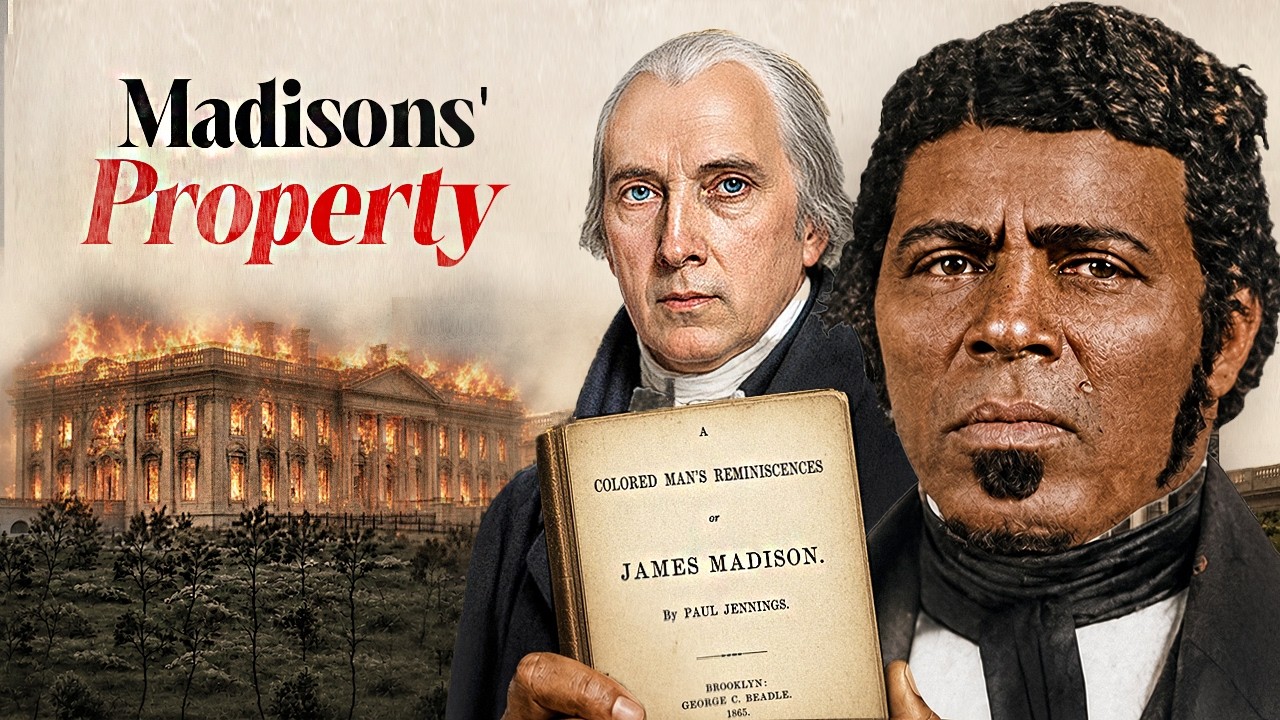
But in the spring of 1817, less than three years after the fire, something happened in Washington that almost no one wrote about. James Madison, the outgoing President, the author of the Constitution, the man Jennings had helped dress every morning, published a notice in the newspaper. He was offering fifty dollars for the recovery of his personal servant.
The notice ran on page three in a small-type column between shipping news and land advertisements. Fifty dollars reward. It appeared in the Daily National Intelligencer on March 14, 1817, and was repeated again and again for six weeks through the rest of March and into late April. Anyone in Washington who read the paper that spring read it. It appeared on the page in the same format as an advertisement for a stray horse, because that was the format for such notices.
To understand what that advertisement means, you have to go back two years, to a house four blocks away, and to the best night of Paul Jennings's life.
After the fire, the Madisons had no house. They rented rooms in the Octagon, a private mansion at Eighteenth and New York Avenue, and ran the country from there. And there, in the winter of 1815, news came from the coast. The war with Britain was over. A treaty had been signed at Ghent. It was finished.
Jennings remembered what happened next in the house. The head servant, John Freeman, was asked to serve wine generously to the servants and the others. Not to the guests. To the servants. Someone found a fiddle. And Paul Jennings, seventeen years old, played "The President's March."
That tune was not chosen at random, and it is worth knowing what it was. "The President's March" was written for the inauguration of George Washington. It was the music of the first President taking office. The same man whose portrait had been taken off the dining room wall two years earlier, in a house that was now a shell four blocks away.
Read that again, because everything that follows rests on it. A young man owned by the President of the United States stood in a rented house in a burned capital and played the anthem of the republic that owned him, while the wine went around and everyone in the room was happy. He was one of them and he was not. He never explained why he played it. He recorded only that he did.
Two years later, he ran.
By the spring of 1817, Madison's second term was ending. James Monroe took the oath on March 4, and members of the old household began packing for Virginia. This was not a summer trip. Madison was retiring. Montpelier was where he would live out his life, and where the people he enslaved would live out theirs as well.
Washington was a city. It had wharves and ships and captains who could be spoken to, and a free Black population that moved about openly, some of whom Jennings had known for eight years. Montpelier was a plantation in Orange County. The difference between those two places was not distance. It was the difference between a door left open and a door walled shut.
He was not the only one who saw it. On January 21, 1817, a full two months before the family left, Madison's nephew Robert Lewis Madison wrote to his uncle about something he had heard. He said there was talk of a plan by three men in the household to escape. They intended to go to the ship captains in Washington rather than return to Virginia. One of the three was Paul.
So Madison knew. He had the letter in January. And in March, when what his nephew warned him about actually happened, he did what a Virginia planter did. He wrote a description of the man, set a price, and sent it to the paper. Fifty dollars.
Consider what that number does. It is not an insult, and it is not a windfall. It is a laborer's wages for a full season, offered to a stranger for the return of a person who had dressed him every morning for eight years, a person who laid out his clothes, shaved his chin, stood behind his chair, and entered a burning house on his behalf. The servant and the reward are two faces of the same coin. They look like two different things. They are not.
Then the records do something worse than the advertisement itself. They stop. There is no notice of a capture. There is no letter about his seizure, no bill from a slave catcher, no mention of a deal struck, no diary entry. Nothing at all.
What sits on the other side of that silence is simply this. Paul Jennings returned to Virginia, working for the Madison household as though those six weeks of newspaper notices had never been printed. No one knows whether he was caught or returned on his own. No one knows whether he reached the water. No one knows whether someone he trusted informed on him, or whether he simply weighed the price of escape against what it would cost the people he would leave behind. Calculations a free man is never asked to make.
Historians have looked for answers. The details are very thin. They may remain so. And so this is the shape of what we have. A young man makes the most dangerous decision available to him, fails or gives up, and returns to the same life he tried to leave. And the country he lived in did not consider the episode worth recording. He was eighteen years old.
He went back to work for James Madison and kept at it for another nineteen years, until the old man died in his bed at Montpelier in 1836, with Paul Jennings in the room. Through all that time, there is no record of a second attempt. Which raises the question the rest of this story has to answer. A man who ran at eighteen does not stop wanting his freedom at nineteen. He waits.
And Paul Jennings did wait, through Madison's retirement, through his decline, through his funeral. He waited because there was a reason to wait. Because James Madison had written a will. And what that will said about the people he owned would take another ten years to matter.
When it finally mattered, it was not James Madison who broke it.
He signed it on April 19, 1835, fourteen months before his death. James Madison was eighty-four years old and had spent his life writing documents meant to outlive him. This will was short. It left the estate to his wife. It also left the enslaved people at Montpelier to his wife, not out of indifference but out of calculation. Dolley Madison was expected to become a widow burdened with debt, and under Virginia law human beings were the most liquid asset a widow could hold.
But he attached something to it. He requested that none of them be sold without their personal consent. And he was specific about it with regard to children and families.
Read the act again. He requested. He did not order. He did not require. He did not threaten to void the estate. The man who spent a summer in Philadelphia arguing that a republic cannot survive on the good intentions of the powerful, who built an entire machine of checks and balances precisely because he did not trust good intentions, protected the people he owned with a request only.
He died at Montpelier on June 28, 1836, at the breakfast table. Paul Jennings was thirty-seven years old and had been helping him dress for twenty-seven years.
And here is the thing worth pausing on, because it is the pivot of this entire story. For about ten years, that request was honored. That is the small, real result of everything so far. The boy who ran at eighteen and came back did not return to nothing. There was a piece of paper with a President's signature on it that said, in effect, these people are not to be sold against their will. And for a decade in Virginia, that sentence was respected.
It was not freedom. No one should call it freedom. But it was the difference between a life and a commercial transaction. And it was real. And it lasted.
What destroyed it was not cruelty. This is the part almost no one mentions, and it is why this story is not what you expect. The protection did not fail because Dolley Madison was a hard woman. It failed for a reason that had a name. And the name belonged to someone Paul Jennings had been looking after since he was a boy.
John Payne Todd was Dolley's son from her first marriage. Madison had raised him, paid his expenses, and covered for his mistakes. He drank. He gambled. He accumulated debts in Washington and Philadelphia and expected them to be settled. For forty years they were quietly settled out of an estate he had not built.
Then in 1837 the country's economy collapsed. The Panic of 1837 did to Dolley Madison what it did to many people who thought they were safe. It turned paper into nothing. The value of what she held fell apart. The debts did not. And the son kept spending.

So she began to sell. She sold Montpelier, the house, the land, the graves. Then she sold something James Madison had left behind: his papers, the notes he had taken in his own hand at the Constitutional Convention, day by day, the only complete record of the debate that produced the American government. Dolley sold them to the federal government because she needed money to live.
Consider that sequence. To survive, the widow of the fourth President sold the notes of the Constitution to the Congress that the Constitution created. And when that money ran out too, she turned to the last asset she had. She set aside her husband's request and sold people without their consent.
We do not know how many. We do not know, in most cases, where they went. The people sold away from Montpelier in those years leave the records at the moment of sale and do not come back into them. And that gap is not an archival error. No one was tasked with tracking them. Some of their names survive because they appear on a bill of sale. Most of what happened to them afterward remains entirely unknown.
It matters to say what this was and was not. It was not a woman waking up and deciding to be cruel. It was a woman drowning and grabbing the nearest thing at hand. The nearest thing at hand was other human beings. And Virginia law said that was permitted. And a dead man's request said it was not. And the law won. Because a request is not a law.
This is not a defense of her. It is a description of the machine she was standing inside. She could have chosen otherwise. She did not.
Paul Jennings was not sold. Not yet. What happened to him first was something else.
Dolley moved back to Washington and took him with her, away from Virginia. Away from his wife Fanny and their five children, who lived on the neighboring farm and were owned by someone else, the only reason they were not sold with him. He kept his family by the accident of their belonging to a different owner.
In Washington, short of money, she began renting him out to her friends in Lafayette Square. Among those friends were President James K. Polk and his wife Sarah. Which means that at some point in the 1840s, thirty years after the fire, Paul Jennings went back to work in the President's house.
It had been rebuilt. The walls were up, the paint was new, and hanging inside, returned to its place in 1817, was the full-length portrait of George Washington. The same canvas, from the same frame, that had been carried out of that building on a cart on the worst afternoon of 1814.
He was in his forties now. He had been born in the same year the man in the painting died. He had helped hold that house together on the day it burned. And he was there under a rental agreement, with his wages paid to someone else. He worked in that house for two Presidents, forty years apart, and was owned under both arrangements.
In September 1846, Dolley Madison ran out of friends to rent him to. So she sold him. The buyer was an insurance agent named Pollard Webb. That is all that is known about him in this story. He was not a planter, not a politician, not anyone Paul Jennings had served or spoken to across a room. A man who worked in risk assessment was living in Washington, and in September 1846 he had the money and wanted an experienced house servant. The price was reportedly two hundred dollars.
Jennings was forty-seven years old. He had worked in the President's house under two administrations. He had been in the room when the fourth President of the United States died. He could read and write, and he had a wife and five children in Virginia he was not permitted to live with. On a September day in Washington, all of that was converted into a number and moved from one house to another.
He belonged to Pollard Webb for about six months, and almost nothing is known about those months either. No letters, no description of the work. The man who eventually wrote down what he saw in 1814 left no record at all of the winter he spent as the property of an insurance agent.
Then, in March 1847, Daniel Webster bought him.
Webster was one of the two or three most famous men in the country, a senator from Massachusetts, a former secretary of state, the voice people quoted when they wanted to sound like the voice of the republic. He was also not, by the standards of his time, an extremist on the question of slavery. He made his compromises and would make more.
But in March 1847 he paid 120 dollars for a man, and then wrote what he had done in a single sentence. I paid 120 dollars for the freedom of Paul Jennings. He agrees to repay the amount by working at 8 dollars a month.
That paper still exists. It is at Howard University. Look at what it is and what it is not. It is not a gift. It is not charity handed down from a height. It is a contract between two men, one of whom puts up the money and the other of whom undertakes to pay it back at eight dollars a month, which is fifteen months of work. Paul Jennings bought his freedom on credit, and Daniel Webster was the bank.
And notice the arithmetic underneath it. Six months earlier he had been sold for a price reported as two hundred dollars. Now his freedom cost 120. The same man, the same city, the same year. The price of a human being was not a fact about the human being. It moved like the price of anything else, and no one involved in that market found the fluctuation strange.
Notice something else. Daniel Webster made his living from words. He could craft sentences that men memorized and repeated for a century. And when the subject was one man's freedom, he wrote it as a receipt. Sometimes that is the more honest form.
So by the spring of 1847, Paul Jennings was free. Free and carrying a fifteen-month debt, working it off at eight dollars a month in a senator's house.
Which brings us to what he did next, and it is not what a cautious man does.
In March 1848, less than a year after paying off the price of his own body, Paul Jennings went looking for a sea captain named Daniel Drayton. What they planned together, working alongside a free Black man in Washington named Samuel Edmonson, was the largest attempted escape from slavery in American history.
On the night of April 15, 1848, at about ten o'clock, a small schooner called the Pearl left a wharf in southwest Washington. Below deck were seventy-seven people, men, women, and children from families across the capital. Some were from families that had lived in the city for generations.
The plan was to sail down the Potomac into the Chesapeake and then north. The weather turned against them. They were caught at Point Lookout at the mouth of the river and brought back. The two captains went to jail. The seventy-seven were returned to their owners, and many were sold south, which everyone understood to be the punishment.
The Pearl did something else no one had planned. It put Washington through three days of rioting. Mobs went to the offices of an abolitionist newspaper and had to be held back. Congress argued about it on the floor. The escape failed completely, and yet it shook the city, because the departure of seventy-seven people at once made visible what everyone had agreed to ignore. That the capital of the republic rested on people who would leave the moment a door was opened.
Paul Jennings was not on the boat. He had helped plan it. He had gone to the captain, and on the night it sailed, he stayed in Washington. Because, according to the account we have, he felt he owed Daniel Webster fifteen months, and he intended to finish paying it.
There is no way to read that decision without discomfort. And it should not be softened. Seventy-seven people got on the boat, and he did not. He kept his word to the man who had fronted the price of his freedom, while others took the risk he had helped design.
But set that beside the story of the boy in 1817. And the perspective changes. At eighteen, he ran for himself. It ended in a newspaper notice and a silence in the records. At forty-nine, he organized an escape for seventy-seven other people and stayed behind at eight dollars a month. His role in it was never discovered. No one informed on him. He was not arrested, not questioned, not named at the trials. Which is why it took historians a century and a half to find out he had been there at all.
So he went on paying his debt in a senator's house, in a city where the men who had sailed on the Pearl were now sitting in cells at the foot of the Capitol.
About a mile from where he worked, in a rented house she could no longer afford, the woman who had sold him was running out of food. She had been the most famous hostess in America. For sixteen years, Dolley Madison had set the table that everyone in Washington hoped to be invited to. She had invented the American First Lady, the receptions, the introductions, the ability to make two men who hated each other talk in the same room. Congress had given her a seat in the chamber, an honor granted to no other woman. When she entered a room in Washington, everyone felt it.
By the late 1840s she was living in a house near Lafayette Square she could not pay for. There were days when she did not have enough to eat. Paul Jennings wrote that down plainly, without decoration, in the simplest sentence in his entire account. In her last days she was in a state of extreme poverty. And I believe she sometimes suffered for the necessities of life.
Daniel Webster knew. Webster had a house nearby and a servant who had once belonged to the Madisons, and a market basket. So he began sending food. He would fill the basket with provisions and send Jennings to her house with it. And he told him something else. That if he noticed anything she lacked, he was to bring it to her.
The man who carried the basket up the steps was the man she had sold. He had not been sold to a friend. He had not been sold on terms. He had been sold in September 1846 to an insurance agent who wanted a house servant, three years before this.
And here is the sentence, the one that is the reason this story is being told at all, the one Paul Jennings put in his book in 1865 without any emphasis on it whatsoever, tucked into a paragraph about someone else's misfortune. I frequently did this and sometimes gave her small sums from my own pocket.
Small sums. From his own pocket. Realize what that pocket was. Paul Jennings was paying off 120 dollars at eight dollars a month. Every dollar in that pocket was a dollar of the debt he had taken on to own himself. There was no surplus in that arrangement. There was nothing extra. And he took money out of it and gave it to Dolley Madison.
He does not say why. He does not present it as forgiveness, and he never uses the word. He does not ask the reader to admire him for it. He tells it the way he tells the weather on the day the British came, as something that happened and that he was present for.
She died on July 12, 1849. She was eighty-one. Her funeral in Washington was one of the largest the city had seen, attended by the President, with long eulogies.
Sixteen years later, in Brooklyn, a small book was published. By then Paul Jennings was in his sixties. He had finished paying Webster years before. He had a job at the Pension Office in the Department of the Interior. Webster had written him a letter of recommendation to get it. He had bought a house on L Street NW with his own money and in his own name. Some of his children had come to live near him.
The war was over. Slavery was over. The country he had watched burn in 1814 had been through a second fire and come out the other side without the thing that had defined his entire life.
At the Interior Department he met a man named John Brooks Russell, who loved history and realized, listening to him, what the person sitting in front of him was. Russell wrote the stories down in something close to Paul's own language, as he put it, and in 1865 it was published as a book. A Colored Man's Reminiscences of James Madison.
It is the first memoir of life inside the White House published by anyone at all. Not the first by a Black American. The first by any human being. And when it appeared, it did almost nothing. No one paid it serious attention. The men who wrote the history of the founding generation did not draw on it. The reason is not complicated, and no one bothered to hide it at the time. The author was a former slave, and a slave's account was not treated as a historical source. It was treated as a curiosity.
Read the book now, and the strangest thing in it is how much kindness it carries. He writes about James Madison with real affection, as a man he respected, a man he served closely for twenty-seven years, a man worth remembering accurately. He writes that about the man who put a fifty-dollar reward on his capture. He does not mention the price. He speaks warmly of Dolley as well. And he does not tell the reader that she sold him. That fact is not in the book.
A man wrote the only account he would ever publish in his life. And he left out the worst thing ever done to him. And there is no note anywhere explaining the decision.
On one subject only, he does not give an inch. The portrait. Fifty-one years after standing in that room, he set down what he saw. That the story everyone had been told was not what happened. That the frame was nailed to the wall. That it would have taken a ladder. That other men, whose names he gives, did the work. He corrected the record once and clearly, and then went back to being gracious.
He was not settling scores. He was filing a report. He was the only person in that house who would never be asked what he saw, and he understood that if he did not write it down, the truth would die with the last witness.
He died in May 1874 in the house on L Street. He left it to his children. And the account he had bothered to publish went largely unread in a country that had just fought a war over the fact of his existence for more than a hundred years.
Three of his sons are recorded as having enlisted in the Union Army. John, Franklin, and William Jennings all volunteered to fight in the Civil War. Their father had been born as property to a Virginia planter who became President of the United States. His sons wore the uniform of the government that had once run descriptions of their father in a newspaper and offered fifty dollars for his return. He lived to see it. He lived to see all of it. The war, the end of slavery, his children in federal uniform, his name on the deed to a house in the capital.
What did not happen in his lifetime was that anyone read his book.
There is one photograph of Paul Jennings, only one, taken in the middle of the century by a Washington firm called E. C. Perry Photography. It shows an elderly man, neatly dressed, looking directly at the camera. That photograph did not survive in an archive. It survived because his family kept it and passed it down through five generations of people who knew exactly who he was, even at a time when the country did not.
That is how the picture was still there to be found when the historian Elizabeth Dowling Taylor went looking for it. Taylor was working at Montpelier. She read the memoir and did with it what someone should have done a hundred years earlier. She traced the rest of his life, found the photograph, found the record of his marriage to Fanny Gordon on the neighboring farm, and found his descendants scattered across the country carrying the story privately, because no one had ever publicly asked them for it.
The painting still hangs. It returned to the White House in 1817, once the walls were rebuilt, and it has been there since. Today it hangs in the East Room, next to a full-length portrait of Martha Washington. It is one of very few objects in that building that predate the fire. At every state dinner, at every press conference in that room, with every school group that files through, the painting remains behind them, eight feet of canvas that came out of a burning house on a cart.
On August 24, 2009, the White House opened its doors for a private visit. It was the 195th anniversary of the day the British burned the building. Elizabeth Dowling Taylor arranged it, and about twenty people walked in off the street, through the gates, into the East Room. Descendants of Paul Jennings, and great-grandchildren, and their children, from across the United States. They were also descended from Fanny, the wife he was taken away from, and the five children who were not sold with him because they belonged to a different owner. The accident in the official papers that kept that family from being scattered in the 1840s is the reason there was a family to invite in 2009. Every person standing in that room was standing there because of a loophole in Virginia property law.
They stood in front of the painting. There is a photograph of that too. They are dressed for a formal occasion. Some of them are looking at the oil portrait. Some of them are looking at each other. The photographer, Jonathan Ernst, took the picture, and it ran the following spring in Smithsonian magazine alongside an article about a memoir no one had read.
The book is in print and available now. Historians call it the first White House memoir. It is cited. Its account of August 24, 1814, the ladder, the frame nailed to the wall, the two men who actually carried the painting out, appears in the footnotes of serious books about the burning of Washington, alongside the other accounts, which do not all agree, which is what the record of a chaotic afternoon looks like when no one is protecting his reputation.
He waited 144 years to be read.
There is no grave. No one has found where Paul Jennings was buried. The house on L Street is gone. What remains is the photograph his family kept, the document he signed, the paper Daniel Webster wrote in one simple sentence, and a small book with his name on it.
And a room. On August 24, 1814, there was a boy in that room, and no one wrote down where he went afterward. On August 24, 2009, the room was full of his family, and someone took a photograph.