On a Tuesday evening in mid-May 2010, in a hotel suite in central London, a woman sat across a table from a man she believed to be a wealthy foreign businessman. She was in her fifties and smoking. Between them on the table was a black bag containing 40,000 dollars in cash. She spoke with energy and confidence, blending charm with negotiation, and named a price of 500,000 pounds. For that sum, she said, she could open doors, arrange a meeting with Prince Andrew, Duke of York, and provide the kind of introduction only her proximity to the royal family could make possible. She did not know the man was an undercover journalist, or that hidden cameras were recording every word. She picked up the bag and left the room, believing she had bought herself some time. That woman was Sarah Ferguson.
She had once been Her Royal Highness, the Duchess of York, the bride of Westminster Abbey, the mother of two princesses, and a member of the most scrutinized family in the world. That was before the divorce, before the debts, and before thirty years of exile from the rituals and rooms that had been hers by marriage. When she entered that hotel suite, the distance between her past and her present could not be measured by a title alone. This is the story of what happened after the palace took back the title but kept the name, the recognition, and the need.
The marriage, the title, the two daughters raised inside the institution their mother was pushed out of, and the question that followed her for decades, of whether belonging can survive the loss of everything that guarantees it, did not come from nowhere. The footage, the hotel suite, the money on the table, and the former Duchess of York negotiating the price of a meeting with a prince were the product of thirty years of a particular kind of exile, one that kept her close enough to the institution to feel its warmth and far enough to feel its cold.
To understand how Sarah Ferguson ended up in that room selling the only thing she had left to sell, you have to go back to the beginning. Not to the scandal, but to the need. Sarah Margaret Ferguson was born on October 15, 1959, in London. Her father, Major Ronald Ferguson, was an army officer and polo club manager whose social circle overlapped with the royal family, first through the Duke of Edinburgh and later through the Prince of Wales. That connection gave Sarah something both valuable and dangerous: proximity to the royal orbit. She grew up knowing the world of palaces, polo fields, and royal weekends without being part of it. She could see the life, but she was not born inside its protection.
The Ferguson family was respectable, well connected, and comfortable in the background of the social world surrounding the Crown, but it was not of it. That distinction, between orbiting a system and belonging to it, defined the whole course of Sarah's life. Her childhood carried a wound that shaped everything after it. Her mother, Susan Barrantes, left the family when Sarah was a teenager, remarried, and moved to Argentina. The departure was not idle gossip; it was a rupture. Sarah spoke about that abandonment for years, in interviews, memoirs, and eventually on American television, and it is impossible to understand the woman she became without understanding the girl who was left behind. She struggled with eating disorders. She described a constant hunger for acceptance that no achievement satisfied. She sought warmth with urgency.
She worked in publishing and public relations before meeting Andrew. That work gave her a media instinct, social confidence, and a fluency in performing for the public that later became both her survival tool and the cause of her fall. But beneath her professional competence and social ease, her sense of self was fragile. She was a woman built around a question she never stopped asking: Am I enough to stay? What Sarah wanted was not complicated. She wanted to belong. She wanted to belong to something larger and more enduring than herself. She wanted not to be abandoned again. That need, not ambition, greed, or a desire for fame, is the engine of this story. Everything that followed, including the worst of it, becomes clearer when you realize she was not chasing a crown. She was looking for a home.
Prince Andrew, Duke of York, was born on February 19, 1960, at Buckingham Palace, the third child of Queen Elizabeth II and Prince Philip. Where Sarah had openness, Andrew had identity. He was royal by birth, not by marriage. His place inside the institution was constitutional, permanent, and impossible to remove, unlike the position of any spouse. He served in the Royal Navy, fought in the Falklands War, and carried military credentials that still held value in royal circles. He moved through the world with the confidence of a man who had never wondered whether he belonged anywhere. That confidence drew Sarah in. It also created an imbalance that would define her life.
Andrew could survive scandal, divorce, disgrace, and public anger, and remain a prince. His name stayed on the palace balcony and his title remained in the court records. His royal identity was acquired and could only be stripped by Parliament. Sarah's identity, after marrying him, was entirely derived. Her rank, title, household, and security all flowed from the marriage, and all of it could be withdrawn. It was Princess Diana who helped bring them together, reintroducing Sarah and Andrew at a polo match in 1985. That detail matters not because this is Diana's story, but because Diana's own path would later become the most painful comparison for anyone trying to understand Sarah's position.
Two women married into the House of Windsor within five years. Both endured the emotional cost of royal life, the hostility of the press, and the loneliness inside an institution that prized duty over feeling. But their divorces revealed how differently the institution valued them. Diana negotiated a settlement estimated at around 22 million dollars. She kept Kensington Palace as her residence and her public standing. Sarah accepted a sum widely described as 475,000 dollars. It was a fraction of Diana's, and a fraction of what many ordinary divorce settlements in wealthy families might produce. The difference was not an accident. Diana had leverage. The palace feared her global admiration, her media control, and her willingness to confront publicly. Sarah had warmth, loyalty, and a deep reluctance to cut ties. She did not want to go to war with the family. She wanted to stay inside it. That reluctance would cost her decades.
Above both of them stood Queen Elizabeth II. She was not merely the constitutional sovereign in Sarah's story. She was the emotional center of belonging, the figure whose approval meant safety, whose affection meant security, and whose displeasure meant a particular kind of isolation that no amount of public performance could overcome. Sarah later said she prioritized her friendship with the family, and her friendship with the Queen, over a larger financial settlement. That single remark explains years of her later behavior. She did not want money more than she wanted closeness. She did not fight for security because she feared losing connection. The tragedy is that the connection she preserved was never stable, never guaranteed, and never enough to live on.
Then there was Prince Philip, Duke of Edinburgh. If the Queen represented the possibility of continued private warmth, Philip represented institutional memory that would not soften. Reports over decades from royal correspondents, biographers, and Sarah's own guarded accounts painted a consistent picture. Philip was the figure most associated with the long exclusion that kept Sarah away from Sandringham at Christmas, away from the annual family gathering, and away from the rituals that signaled belonging in the Windsor world. No formal decree was published and no letter was issued. The exclusion was embedded in upper-class British culture, through atmosphere and custom, and through an understanding that some people were not welcome. Philip embodied that understanding more clearly than anyone else in the family, and Sarah felt it. She felt it for roughly thirty years.
The children were born before the marriage ended, and their existence turned what might have been a clean break into a permanent tie. Princess Beatrice was born on August 8, 1988, followed by Princess Eugenie on March 23, 1990. Two daughters, both princesses, grew up partly inside the Windsor structure, in the nursery, under heavy security, near grandparents who were the Queen and her husband, and partly in their mother's unsettled world. These two girls were not decoration in this story. They were the reason Sarah could never fully leave, and the reason the institution could never fully disown her. She was the mother of the Duke of York's children. That fact kept a door permanently ajar, barely wide enough for hope, but never wide enough for security.
Every decision Sarah made over the next three decades, from deals to confessions to desperate attempts to reinvent herself, was shaped in part by her knowledge that her daughters lived in a world she had been pushed out of. There is something worth reflecting on in that position. A woman who longed to belong married into the most distinctive family in the country, bore two daughters who would remain part of it by blood, and then found herself standing outside her children's inheritance. At every Christmas she missed at Sandringham, her daughters attended. At every royal wedding she was excluded from, Beatrice and Eugenie walked through the doors. At every formal occasion, every family photograph, and every balcony appearance, the girls were present and the mother was absent. The institution did not need to punish her harshly. All it had to do was include the children and leave Sarah at home. That was punishment enough. And it lasted a generation.
But before the exclusion, before the humiliation, before the money in the hotel room and the tabloid scandal and the decades of exile, there were years when Sarah felt like everything she had ever wanted. Real years, not performance. Years in which the title, the marriage, the family, and the children formed a life that looked, from the inside and the outside, as though it would last. The cruelty of this story is that those years really existed. Sarah was not deluded about what she had. She had it, and then she watched it fade.
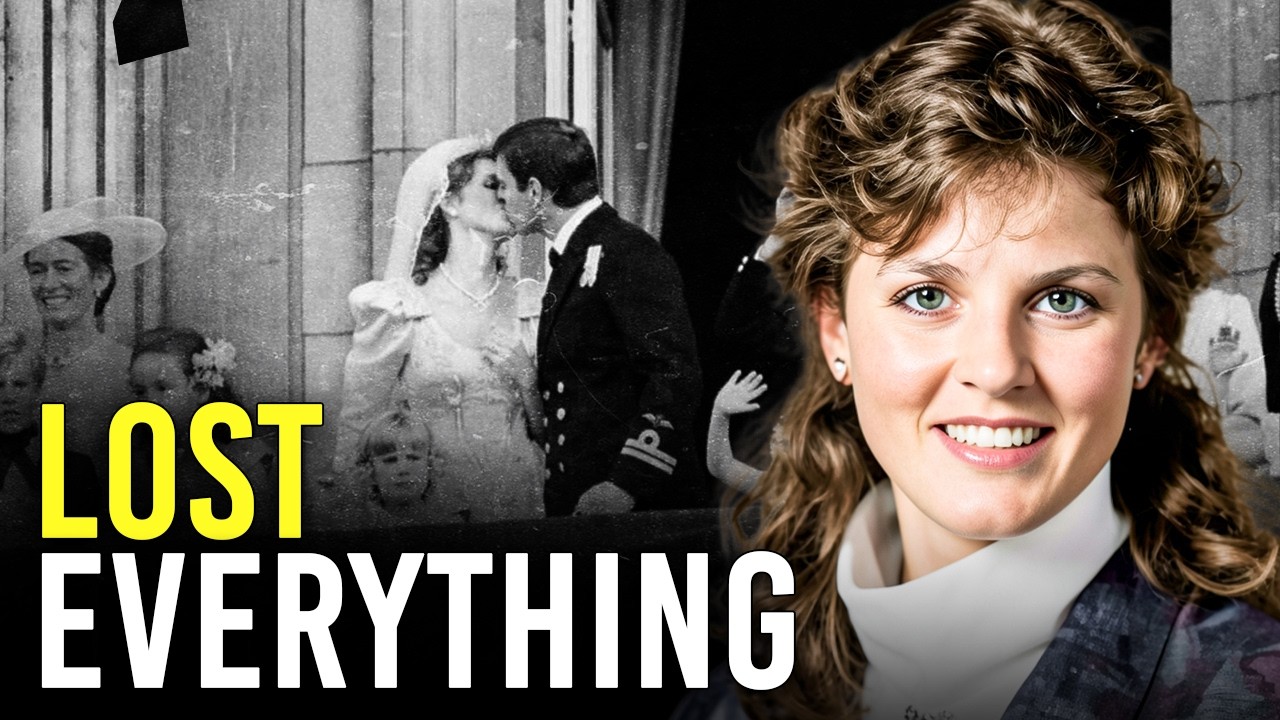
The wedding took place at Westminster Abbey on July 23, 1986. The Queen granted Andrew the title Duke of York, and Sarah became Her Royal Highness, the Duchess of York. Full pageantry, constitutional weight, and official standing inside the royal family. The ceremony was one of the great royal spectacles of the decade. A royal carriage moved through cheering crowds. The abbey seats were filled with prominent foreign figures and minor royals, and the full ceremonial machinery of the British monarchy was on display. At the center of it all was the red-haired bride, waving and smiling, visibly delighted, in a way no Windsor training manual would have recommended, yet she captivated the public. Fergie had arrived, not as a background figure, but as a story in her own right.
For a time, it worked. Not just as a performance, but as a life. Sarah brought the family something it did not naturally produce: visible warmth, physical affection, spontaneity, and a willingness to be seen laughing in a corridor or hugging a child on an outing. Where senior Windsors showed restraint, Sarah showed open emotion. Where the institution valued composure, she offered accessibility. And the British public responded. The tabloids, the same ones that would later destroy her, celebrated the marriage, her personality, and the idea that the monarchy could absorb a lively person without losing its dignity. The births of Beatrice and Eugenie strengthened the family bonds and cemented Sarah's place inside the system she had joined.
Motherhood was not a secondary detail in her story. It was the role she mastered completely, and it remained central to her identity long after all her other titles were stripped or diminished. By her own account and those of people who knew the family, she was fiercely and protectively devoted to her two daughters, rooted in the memory of her own mother's departure. Susan Barrantes left, but Sarah would not. However bad things got, and almost everything would get bad, her commitment to being present for Beatrice and Eugenie remained the one constant in a life defined by instability. That commitment was real, but over the long term it was also a kind of trap, because it meant Sarah could never fully separate from the Windsor world. She could not retreat into isolation because her daughters lived inside the institution. She could not stop caring about the family's opinion because that opinion shaped the world her daughters inhabited. Motherhood kept her tied to the very structure that was slowly deciding it could do without her.
The social world around the Yorks matters too. This was not an old ducal tragedy, a single great house and ancient lineage collapsing under estate taxes and changing times. The Yorks' world was the wider stage of the modern monarchy: Buckingham Palace, Windsor Castle, official overseas tours, military ceremonies, state dinners, and an annual calendar of royal appearances that gave participants both purpose and constraint. Andrew's identity was inseparable from that world. He was a working prince. His diary was the palace diary. His duties were the Crown's duties. Sarah's membership in that world depended entirely on the continuation of the marriage. She had access to everything, but access is not ownership. She could attend and participate, but she could not be the center. And the moment the marriage weakened, every room she entered required permission.
Those early years carried a quality Sarah spent the rest of her life trying to recover. Official tours, Australia, Canada, the kind of multi-day visits that put a duchess in front of cameras and crowds and gave her a role beyond being married, made her feel useful in a way the quiet rhythms of royal life did not. She was good at it. She was tender with children on hospital visits, at ease with veterans, and natural in the handshake lines and walkabouts that some royals endure and Sarah seemed to enjoy. The palace noticed she was a valuable addition on some public occasions. It also noticed she required more management than someone with deeper training. She talked too freely. She trusted too easily. She did not always understand which rooms had ears and which conversations were recorded in institutional memory. The family valued her and worried about her discipline in roughly equal measure. That tension, between seriousness and unreliability, charm and recklessness, followed her through every stage of her royal life and every stage of her exile afterward.
The cracks appeared quietly at first. Andrew's naval career took him away for periods Sarah later described as intensely lonely. She was a young mother inside an institution that provided staff and security but not the kind of emotional companionship she craved. She wanted activity, projects, movement, creative expression, and a chance to build something she felt was hers. The institution expected quiet, discretion, and the kind of emotional restraint that comes not from self-control but from socialization. Sarah had not been socialized that way. She had grown up in an adjacent environment. She knew the rules of behavior, but she did not have the protection.
By the late 1980s, Sarah's relationship with the press began to deteriorate. The same tabloids that had celebrated Fergie started criticizing her weight, her spending, her holidays, her fashion choices, her spontaneity, and the gap between what they believed a duchess should be and what she was. She was too loud, too visible, too much. The nickname that had once carried affection turned sharp. "Fergie" no longer meant fun. It meant embarrassing. The criticism was biting and personal in a way only the British tabloid press manages, intimate, repetitive, and delivered with total certainty that its subject deserved it. Sarah absorbed the hostility the way she absorbed everything else, publicly and emotionally, without the protective detachment a longer royal training might have given her. She had not been taught to ignore the noise. She had grown up in a world where noise mattered, where other people's approval was evidence of worth. The tabloid turn damaged not only her reputation but the internal mechanism she relied on to feel safe.
The formal separation came in March 1992. That date matters because it means the marriage had publicly collapsed before the photographs most people remember as the cause of everything. The announcement confirmed what those close to them had known for some time. The Duke and Duchess of York were living apart. But at that moment, there was still a chance of preserving her dignity. A quiet distance, a civilized arrangement, a former duchess who might fade gradually into the kind of respectable obscurity the palace preferred for its casualties. Sarah would keep her style. She would keep her place in the royal circle. She would be tolerated. That possibility lasted five months.
In August 1992, the photographs arrived and changed everything permanently. Sarah was on holiday in the south of France with John Bryan, an American financial adviser who had entered her circle as a business associate and became more. The images were scandalous by royal coverage standards. Sarah topless, Bryan kissing her feet, the kind of physical intimacy the British tabloids could turn into weeks of front-page excitement. And they did. Every newspaper, every breakfast table, every newsstand in the country. The timing made it worse. The photographs were published while Sarah was staying at Balmoral with the royal family. According to several accounts, she was sitting at breakfast when the front pages were prepared. Images of her body and her behavior spread across the table in front of the people whose approval she desperately needed.
Bryan was not a minor detail. He was the spark that ignited an irreversible turn. His presence in those photographs accomplished what a quiet separation could not: it made Sarah ridiculous. A duchess in distress might have inspired sympathy. The public understood unhappy marriages, recognized loneliness, and grasped the weight of an institution that grinds people down. But a duchess having her toes kissed beside a swimming pool by a Texas businessman while the Queen waited at Balmoral was something the British press and public met not with sympathy but with contempt. The story was no longer sad. It became absurd. And absurdity, in the world of royal reputation, is more damaging than tragedy.
The photographs destroyed whatever remained of a dignified withdrawal. Andrew, who may still have been privately struggling with the end of his marriage, lost any reasonable path to reconciliation. The Queen kept her composure as always. Her public discipline was not something that collapsed under tabloid pressure, and she did not descend into public comment on her son's humiliation. But the institution around her closed ranks as it always does when one of its own becomes indefensible. By all informed accounts, Prince Philip displayed a coldness toward Sarah that did not soften for years. Some who observed the family's internal dynamics later described his reaction as the harshest element of a broader judgment. This was the moment the long exclusion hardened. Not formal, as written, since the palace does not issue exile orders, but a settled conviction, an accepted understanding that Sarah Ferguson was no longer someone the institution wished to be associated with.
She had not merely failed at a royal marriage. She had failed publicly, visibly, and messily, in a way that confirmed every family fear about admitting someone who lacked the deep socialization required to survive inside it. The woman who longed to belong had produced a vivid, unforgettable image of not belonging. And the children. Beatrice was four, Eugenie was two. Too young to read the newspapers, but not too young to grow up in the shadow of what those newspapers set off. In the stories of ruling families, children are never minor characters. They are the mechanism by which the failures of adults become the inheritance of generations. The choices Sarah and Andrew made in the early 1990s shaped not only their own reputations but the emotional landscape their daughters navigated for the next thirty years.
The separation was now final. Divorce proceedings continued for four more years, ending on May 30, 1996. Somewhere in that period, between the wreckage of the August 1992 tabloids and the final decree that formally ended the marriage, Sarah began to discover the truth that would define the rest of her life. The distance between being a duchess and being a former duchess was not measured by the title alone. It was measured by protection, income, and the quiet machinery of inclusion that the institution could withdraw without issuing any public statement. She still carried her famous name. She was about to lose everything that name was supposed to guarantee.
When the divorce came, the language itself carried the wound. Under the conventions governing former wives of princes, Sarah lost the style of Her Royal Highness. She became Sarah, Duchess of York, not Her Royal Highness the Duchess of York. That technical distinction is not a footnote. It is the foundation of the entire story. She kept the ducal title as a courtesy. She lost the royal style that made the title a shield. She was left with the image of the royal family, famous enough to be scrutinized, exposed enough to be mocked, and stripped of the one designation that signaled institutional protection. And the settlement she accepted in exchange for that loss was, by all reliable accounts, modest. She chose proximity over conflict. She chose the hope of staying connected to the family over the certainty of financial security. She chose what she had always chosen, belonging over safety. That choice would follow her everywhere she went over the next three decades. Into the debts, into the deals, into the hotel suite where the money sat on the table and a hidden camera recorded every word.
The final decree came on May 30, 1996. The marriage was over. The elegant facade was gone. And Sarah Ferguson entered a public life for which there was no precedent, and no guarantees. She was thirty-six. She was globally known, one of the most famous women in Britain, recognized in America, recognized across the Commonwealth, recognized wherever tabloids and royal coverage reached. She was the mother of two princesses who would continue to grow inside the institution their mother had formally left. And she was, bluntly, financially exposed in a way that would alarm anyone without a title to exploit.
The settlement, widely reported at around 350,000 pounds in cash, plus custody and housing provisions whose full value was never clear in public reporting, was modest by royal divorce standards. It was modest by the standards of many ordinary divorces among the wealthy. Diana's settlement, concluded the same year, was far larger, estimated at around 17 million pounds, with Kensington Palace retained as a residence and a public platform the institution could not afford to lose. The comparison was not merely financial. It was existential. It revealed everything about how the palace valued the leverage of the two women. Diana fought. Sarah chose friendship. Diana had global admiration that forced generosity. Sarah had warmth, loyalty, two young daughters, and a sincere, stubborn, hopeful belief that maintaining good relations with the family would eventually restore her to the circle of influence.
It did not. What it brought instead was a particular kind of drift that lasted for decades. She was no longer Her Royal Highness. She was Sarah, Duchess of York. The comma, replacing the style, was a fine crack that separated her from every protection the institution provided. People could still call her a duchess. She could still enter a room and be recognized by anyone who remembered the wedding, the carriage, and the balcony. But constitutional protection was gone. Security detail was gone. The palace budget, the palace press office, and the infrastructure that managed a royal's reputation and diary were all withdrawn. The rules governing former wives of princes, as set out in royal convention, were precise and harsh. She kept the ducal title as a courtesy. She lost the royal style that made the title a shield. And the world she now inhabited was one in which the title created expectations without providing the means to meet them. People expected a duchess to live like a duchess. The institution expected her to fund that life herself.
Here the story shifts from the failure of a marriage to something structurally different: the economics of royal exile. Sarah did not retreat into total isolation, because she could not, materially or psychologically. She needed income, and her only significant asset was her fame. Her name, her face, her association with the Windsors. So she went to work, not in the discreet way the palace would have preferred, not consultancies here and charity there and a quiet absorption into public life, but openly, commercially, energetically, and in a manner that made the institution wince and the tabloids compete for access.
She wrote her autobiography and published it amid considerable public interest, revealing details of a marriage and a family the palace would have preferred kept private. The book sold well, because Sarah was willing to do what most royals, serving or former, refrain from doing: speak candidly about pain, failure, and the emotional reality of living inside an institution that prizes composure over honesty. That willingness was her greatest commercial asset and her deepest institutional liability, because every confession sold copies and confirmed, from the palace's perspective, that she could not be trusted with discretion.
She wrote children's books, a series that later grew into a substantial body of work, marketed through Simon & Schuster, and one of the few commercial ventures that endured for decades rather than collapsing in disgrace. The children's books mattered to her. They were not just products. They were proof she offered herself and anyone who cared to notice that she could create something lasting that was not defined by scandal. But lasting creative work rarely generates the income required to sustain a former duchess. The books kept her name in circulation, but they did not secure her financially.
She accepted promotional offers and corporate speaking engagements, crossing the Atlantic repeatedly because the American market was more forgiving of her flaws and more interested in her story than the British market. She appeared on talk shows, at business conferences, and on panels, where her candor about royal life was treated as insight rather than betrayal. For a long stretch she was a paid spokeswoman for Weight Watchers in the United States, a deal reported to have earned her millions over its duration, and one that required her to discuss her body, her eating habits, her emotional relationship with food, and her struggles with self-image in a manner both public and personal, seemingly designed to widen the distance between her and the family she still hoped to belong to.
The Weight Watchers deal was, financially, probably her most successful single venture after the divorce. Reputationally, in the world she cared about most, it was a confirmation of everything the palace feared. A former duchess on an American stage talking about her weight on camera, turning her royal failure into a wellness brand. The work was real, the effort genuine, the hours long, and the commitments continuous. Anyone who dismissed Sarah's post-divorce life as celebrity idleness was not paying attention. She hustled relentlessly, as people do when the alternative is insolvency. But every public appearance, every endorsement, every interview in which she discussed her feelings, her finances, or her failures, deepened the gap between what she was trying to become and what the institution believed a former duchess ought to be. She was monetizing her proximity to the royal family. She was converting her association with the royal family into commercial content. And the palace, which might have tolerated quiet, invisible ventures, could not tolerate the scale of Sarah's self-reinvention. Each one reminded the public she existed. Each one reminded the family that she was, in their view, out of control.
There is a harsh paradox in this dynamic, and it should be stated plainly. She was criticized for needing money. She was criticized for earning money. She was criticized for the way she tried to earn it. And the underlying structure that created the need in the first place, a settlement deliberately designed to preserve royal goodwill rather than financial independence from an institution whose wealth is measured in billions, was never discussed with the same energy as her commercial missteps. The institution gave her enough to remain grateful, not enough to remain solvent. Whether that was calculated generosity or indifferent neglect, the result was the same. Sarah needed to work. The work embarrassed her. The embarrassment widened the gap. The gap deepened her desperation. And eventually, that desperation would produce something far worse than weight-loss commercials.
By the early 2000s, the financial pressure moved from private worry to public knowledge. Reports appeared with increasing frequency about debts that grew rather than shrank, about business ventures launched with optimism and collapsed in embarrassment, and about a lifestyle that was not, and could not be, sustainable on the income available at the level the world expected of a woman still styled a duchess. Sarah's spending came under the same scrutiny as her marriage once had. She was extravagant for a woman receiving no royal funding. She was conspicuous, a woman the palace wished to forget. She was caught between two economic systems that could not be reconciled: the system of royal expectations, which demanded a certain level of appearance, residence, clothing, and social presence, and the system of post-royal reality, which provided none of the means to meet those demands. One cannot live like a duchess on an ordinary income, and one cannot earn an ordinary income while behaving like a duchess. The gap between the two was not a crack. It was a chasm, widening with every failed venture, every headline, and every year that passed without the institution offering the one thing that might have solved it: a real place inside the system.

Then, in 2009, the system collapsed publicly. Hartmoor, an American lifestyle company Sarah founded to build a sustainable brand around her name, her taste, and her reinvented identity as a woman who had survived royal life and emerged stronger, went under. The company was based in the United States, where Sarah's market value was higher and where her royal association carried a different, more glamorous, less resentful tone than it did in Britain. But it could not withstand the economic climate, and its collapse was not quiet. Its debts made headlines. Sarah herself told ABC News she owed 600,000 pounds. Other reports from the same period suggested the figure might be higher, that creditors were circling, that legal threats were active, and that personal bankruptcy, a form of public financial collapse that would have been unimaginable for a woman who had held the style of Her Royal Highness, was a real possibility.
She was forty-nine. She had spent thirteen years since her divorce building a future, working relentlessly, publishing, promoting, and appearing on any platform that would have her, and the accumulated result of all that effort was crushing debt and front-page headlines. The woman who had once traveled through London in a royal carriage was now explaining her insolvency to an American news camera. The contrast between the two images was not irony. It was the essence of the story. The significance of that moment was not the number. It was what it revealed about the structural trap she had fallen into. She was not a woman who inherited a vast fortune and squandered it. She was not a woman given a generous severance and failed to invest it wisely. She was a woman given a title, then stripped of part of it, then left to spend more than a decade trying to build a financial life from the remnants of her royal fame in a market that craved the glamour of her name but did not pay enough to sustain her living costs.
Every path she took, books, television, endorsements, corporate events, and business ventures, carried the same contradiction. She needed her royal association to attract attention and fees, but that association made every fee look like selling out the family. The market wanted the duchess. The institution wanted her to disappear. She could not satisfy both. And by 2009, the market was losing interest in the commercial duchess, while the institution had long since stopped being interested in the human one.
Amid all of this, the business struggles, the mounting debts, the tabloid hostility, and the failed ventures, her relationship with Andrew remained the strangest and most enduring thread in the story. They separated in 1996, but their separation was not emotionally or familially simple in a way the public or the press could easily understand. The couple continued to live near each other, sharing residence at Royal Lodge in Windsor Great Park on different occasions, appearing together at events and occasions for their daughters, and co-parenting in a close relationship that went far beyond what was required, evolving into something like a continuing partnership. Friends and acquaintances described a bond the divorce had not severed. Whether it was love, habit, attachment, or a combination of the three, the relationship between Sarah and Andrew persisted through every scandal and every period of disgrace.
Sarah spoke of him publicly with an affection that went well beyond diplomatic courtesy. Years later, she told interviewers she would marry him again. Absolutely. The tone carried no nostalgia, but a settled conviction, as though the divorce had been a bureaucratic procedure rather than the decisive rupture of her life. Andrew, for his part, did not distance himself from her publicly in the way the institution might have preferred. He issued no statements of separation. He did not treat her as an embarrassment to be managed at a distance. Their relationship puzzled the press and the public and further complicated the palace's efforts to draw a clear line around what it increasingly regarded as the York problem. Andrew's willingness to stay close to Sarah meant the institution could not fully isolate her without isolating him. And Andrew, whatever his later difficulties, remained a prince of the royal family.
This close relationship served a practical function. Andrew's continued presence in her life meant Sarah was never entirely cut off from the royal world. She could attend certain events at his invitation and remain closely connected to her daughters' daily lives at Royal Lodge, where the rooms, the grounds, and the proximity to Windsor Castle still carried the scent of the life she had lost. In Andrew she had an emotional anchor and a durable bond, a man whose royal membership meant that doors formally closed to her were still occasionally opened quietly at a birthday, a private dinner, or an important family occasion.
But this bond ran in one direction only. Andrew's royal identity protected his position. His place in the line of succession was unaffected by the divorce. His access to the palaces, to the monarch, and to every aspect of royal life continued uninterrupted. Sarah's access was conditional on his willingness and the family's tolerance. Andrew could survive scandal, embarrassment, public anger, and media vilification and remain a prince with constitutional standing. Sarah could not withstand those trials and remain the same. The imbalance that had existed since their wedding day, the structural gap between someone born into the royal family and someone who married into it, did not diminish with time or affection. It sharpened year by year until it became the dominant feature of her life.
And the daughters were no longer children. Princess Beatrice passed through her teenage years and into young adulthood, carrying the burden of being a York daughter in a family that had privately decided York was a difficult category. She attended school, then university, then entered professional life, and over time built a career in finance and technology, a deliberate turn away from the kind of media exposure that had consumed her parents. Princess Eugenie followed two years later, facing the same gap between her royal birth and her mother, whose name appeared in tabloid headlines with wearying frequency. Both daughters maintained a close and loving relationship with Sarah. They also maintained their standing inside the royal institution, attending Ascot, appearing at official occasions, and moving through the annual royal calendar with a quiet composure their mother had never managed.
Their position created a pain this account cannot ignore, because it was the pain Sarah lived with every day. Every family gathering the daughters attended while their mother was excluded was a fresh, intimate witness to that exclusion. Beatrice and Eugenie, growing from children into young women, understood exactly what their mother had lost and what the family had chosen not to restore. They saw the gap. They lived on both sides of it. They loved their mother, and they belonged to the institution. Reconciling those two loyalties required an emotional dexterity no child should have to acquire. They were not merely props in someone else's drama. They were human beings living with the consequences of decisions made before they were old enough to understand them. And with every year the exclusion continued, its weight on them grew heavier.
By the spring of 2010, the walls had closed to their narrowest point. Sarah was in her fifties, burdened by debts publicly reported and privately compounding. Her commercial reputation had eroded through too many ventures that began with press releases and ended with write-offs. Her relationship with the British media had become mutually hostile. The tabloids treated her as scandal material, while she regarded them as persecutors who had never forgiven her for being imperfect inside a perfect institution. She had tried books, television, business, public confession, private reinvention, therapy, and self-disclosure. None of it, not one attempt over fourteen years, had produced the financial foundation that would let her stop performing and simply live.
She was not destitute, and she was not sleeping rough, but she was a woman whose name still conjured images of royal wedding carriages while her daily reality involved a level of financial pressure that makes sound judgment difficult and catastrophic error almost inevitable. She later said she had been drinking. She later said she had been in a very bad psychological state. Those words, spoken on Oprah Winfrey's couch weeks after the scandal broke, were offered as context, not excuse, and should be treated the same way. What she described was not one bad evening but a long deterioration, the cumulative effect of years spent in financial anxiety, public ridicule, and the profound loneliness of being permanently adjacent to a world that never fully accepted her.
Then came the approach. A man presenting himself as a wealthy businessman interested in business connections with Prince Andrew. The introduction reached Sarah through an informal channel that had long existed in the gray zone around royal life. A quiet economy of access, introduction, and connection, in which proximity to the family could be brokered by people who knew someone who knew someone. Sarah, who had spent years in that gray economy and who had relied on her relationship with Andrew and the wider family as her only reliable means of opening doors, would not have found the approach strange. She had received similar inquiries before. The difference this time was that the businessman was fictional.
He was Mazher Mahmood, the undercover journalist known in Fleet Street as the Fake Sheikh, a man who built his career at the News of the World on sting operations that turned private desperation into public spectacle. Mahmood's method was patient and deliberate. He displayed wealth. He displayed interest. He offered the kind of business opportunity Sarah had been looking for for years, the kind of meeting that promised to relieve the financial pressure that had been building since the divorce, intensifying since Hartmoor, and reaching, as she later admitted, a point where she could no longer think clearly about risk.
The secret meeting took place in a London hotel suite, believed to have been held on a Tuesday in mid-May 2010. The room was the kind of anonymous luxury space that exists in every grand hotel in every capital, the kind where deals are discussed and arrangements made by people who do not wish to be seen in offices or restaurants. The setting was calm. The hidden cameras were already running. Sarah discussed access to Prince Andrew. She named a price, 500,000 pounds. She described what she could facilitate: the doors she could open, the introductions she could arrange, and the proximity she could provide to a working member of the royal family whose name still carried weight in government, commerce, and international business circles. She was not whispering. She was not hesitating. She spoke with the confidence of someone who believed she was in a business meeting, conducting a deal she had every right to make. She accepted a bag containing 40,000 dollars in cash as a down payment. She smoked, she talked, she took the money, and she left the room believing she had secured a lifeline. Another deal, a final chance, one more postponement of the financial collapse she had been trying to outrun for more than a decade.
She did not know the camera was filming. She did not know that every word, every gesture, and every moment of that encounter, the cigarettes, the cash, and the apparent confidence masking desperation, had been recorded. She did not know that Mahmood had enough footage to fill a front page, a television program, and a week of media coverage that would strip away any remaining public sympathy for the former Duchess of York.
The footage was published on Sunday, May 23, 2010. The News of the World ran the story and the images. Every other newspaper followed within hours. And the woman who had spent twenty-four years trying to preserve her place on the margins of the royal family, surviving divorce, debt, and humiliation, and attempting to reinvent herself again and again without success, watched the last appearance of belonging collapse within a single news cycle. The hotel room footage was not just another scandal in a career dominated by embarrassments. It was conclusive evidence, visual and audio proof that could not be denied, of a transaction the institution could never forgive.
What followed was not merely another scandal. It was the moment the institution had been waiting for without knowing it. Documented, on video, confirmation that Sarah Ferguson could no longer be trusted to exist in the gray zone between royal life and private enterprise without causing a kind of damage that could not be managed, contained, or excused. The palace would respond with silence, the public with contempt, and Sarah herself with the only response she knew, appearing on television and trying to explain herself once again.
The reaction was immediate and came from every direction at once. The News of the World had not merely published a written story. It had published filmed footage. That kind of footage needs no interpretation or editorial framing, because it speaks in the clear language of transaction that any viewer understands. A former member of the royal family sitting in a hotel suite discussing the price of access to a royal prince. Money visible on the table. A bag accepted. Words spoken that could not be retracted, rephrased, or explained any other way. The footage was shown on television. It spread online. It was quoted, summarized, and rebroadcast in a cycle that lasted not hours but weeks.
There was an underlying question about the ethics of the operation itself. Does a newspaper have the right to construct a scenario designed to exploit a person's known financial need? Does the public interest in exposing Sarah's willingness to sell access justify the method by which that willingness was exposed? That question was never fully settled, and it does not need to be settled here. What matters in this story is that the footage existed, was broadcast, and had a profound effect. For Sarah Ferguson, who had survived earlier scandals, the Sun Tropic photographs, tabloid mockery, public debt, and failed ventures, there was an immediate recognition that this time was different. The 1992 photographs were embarrassing. The 2010 footage was devastating. Embarrassment can be outlived with regret and time. Damning evidence requires an entirely different response.

Buckingham Palace issued a statement denying that Prince Andrew had any knowledge of the arrangement. The language was measured, formal, and precise, the kind of carefully drafted text that conveys not only information but hierarchy. Andrew had known nothing and was involved in nothing. Andrew remained a working member of the royal family, and his public role and private integrity were not in question. The statement did not mention Sarah by name, in a way that offered her no protection or sympathy, and there was no need for it to. The distinction the statement drew was structural. Andrew was part of the structure. Sarah was not. Whatever she had done in that hotel room, she had done it as a private individual, and the institution's only obligation was to confirm that its boundaries remained intact.
The speed of the distancing was itself a message. There was no pause for consultation, no ambiguity, and no suggestion that the palace wished to understand Sarah's circumstances before responding. The institution knew what to do. It had been doing it in various forms since 1992. Sarah's public response came quickly, carrying the tone of someone who understood the scale of what had happened before the tabloid cycle had finished its first round. She issued a statement acknowledging that her financial circumstances had been under pressure, but insisting that financial pressure was no excuse for what the footage showed. The statement was polished without being slick, and apologetic without collapsing into the kind of public breakdown that would have given the tabloids more material. She said Andrew had no knowledge of the meeting. She said it clearly, firmly, and repeatedly, echoing the palace's position in a way that was both loyal and revealing. Even amid the collapse of her reputation, her first reaction was to protect him, to shield the institution from collateral damage, and to make clear that the disgrace was hers alone and that the family she had embarrassed bore no responsibility for her actions.
That reaction was consistent with her behavior since the divorce. She had chosen friendship over money in the settlement. She had chosen proximity over independence in the years that followed. She had chosen, again and again, to absorb the costs rather than pass them on to the people she still hoped would eventually accept her. And now, at the worst moment of her public life, she chose it again. She took the blame. She directed it at herself, whether out of love, upbringing, or the last reflex of a woman who still believed that enough loyalty would eventually buy enough forgiveness.
That response shaped every word she spoke in the days after the footage aired. Then came Oprah. By that point, it was a familiar mechanism. When the British press tightened the noose, Sarah turned to American media, where her willingness to confess was treated as emotional honesty rather than further evidence of indiscretion. Within weeks of the footage airing, she sat down with Oprah Winfrey for an interview that would become one of the most watched and analyzed moments of her long career of public self-disclosure. She said she had been drinking before the secret meeting. She said she had been in a pitiable psychological state. She used the language of complete breakdown, of personal collapse, of a woman who had lost not only a financial deal but her sense of her own worth. She framed it not merely as a scandal but as evidence of a deeper unraveling: years of financial anxiety, public ridicule, social rejection, and the grinding loneliness of being in a position the world could see and no one could fix.
She described the meeting itself as a moment of such impaired judgment that she barely recognized the person who entered that hotel room and sat across from a stranger to discuss selling something she had no right to sell. Sarah told Winfrey she was not making excuses but trying to explain how a woman who had once been a member of the royal family, ridden in carriages, curtsied to queens, and raised two princesses could end up accepting cash from a stranger in a bag in a room that smelled of cigarettes and desperation. The interview was candid in a way British media rarely allows its guests. It was closer to confession, the kind American television prefers in its morning programming and British reserve considers embarrassing.
The interview revealed something important about Sarah's understanding of herself at that stage of her life. She was not simply offering excuses to a sympathetic host. She was telling the story of her decline. She had become, as she told it, a cautionary figure. A woman destroyed not by one catastrophic decision but by the accumulated weight of a structural position that had been unsustainable since the day the divorce decree was signed fourteen years earlier. Financial pressure, social exclusion, and the impossible economics of royal exile. She did not present it as justification but as context. The public could judge the act. She wanted them to understand the structure that produced it.
The viewer should pause for a moment on the contrast between those two responses. The palace statement was institutional, polished, evasive, drafted by people whose profession was managing the sovereign's reputation, and designed to contain damage to the family and direct blame toward the individual who caused it. Sarah's Oprah confession was human, messy, emotional, and at times tearful, designed to convert shame into sympathy through the mechanism of radical self-disclosure. One protected the structure. The other pleaded with the public to understand the person the structure had expelled. Neither acknowledged the other. The palace did not pause to consider what drove Sarah into that hotel room. Sarah did not pause to consider that the palace's coldness might be, from the institution's perspective, entirely logical. That gap between institutional and human response, between the royal family's reputation-management machinery and the candid confessions of a woman in crisis, is the space the entire story had been moving toward. The monarchy manages its image. Sarah manages her feelings. They never spoke the same language, and the shock exposed that difference in understanding as never before. It showed how each character absorbed the impact, and where the real power in this family lies, and always has.
Andrew was insulated. The palace distanced itself from him quickly and completely, his public standing diminished by the association, damaged by the tabloid fallout, and subjected to questions about whether he had truly been ignorant, but he survived because his identity did not depend on reputation or good behavior. He was a prince by birth. His title was not a designation granted by marriage and withdrawn by divorce. His position in the line of succession was constitutional, acquired by blood, and removable only by act of Parliament. His mistakes could be covered by the institutional machinery that exists to protect working royals: the press offices, the private secretaries, and the quiet damage-control structure the palace has refined over centuries. The mistakes of his former wife could be disowned at no structural cost to him at all.
The asymmetry that had run through this story from the beginning, from the wedding day, the separation, the divorce settlement that gave her friendship instead of security, and every year of commercial hustle and social rejection that followed, reached its peak in the aftermath of the incident. Sarah's action brought him disgrace, without question. It produced headlines he would have preferred not to read. It raised questions about his judgment that the palace moved quickly to suppress. But his position absorbed the shock the way the palace absorbs the throne. The stone leaves a mark, and the palace remains standing. Sarah had no palace. She had no structure. She had no press office, no private secretary, and no constitutional identity to weather the storm on her behalf. She had only herself, and that self had been reduced to a punchline.
The Queen did what the institution always does when a marginal figure causes damage that cannot be contained by outreach. She waited. She did not comment publicly. She issued no statement expressing personal disappointment or maternal sympathy. She did not need to. The silence itself was more eloquent than any words. Sarah's behavior was regrettable, the family was united in distancing itself from the incident, and the matter would be folded into the long institutional memory without the need for an official response. Elizabeth had spent six decades perfecting the art of strategic silence. She understood better than anyone alive that the power of the monarchy lies not in what it says but in what it chooses not to say. Nothing more was required. And Sarah, who had spent years hoping her loyalty to the Queen, or "the boss" as she called her, would be rewarded with a return to the family, received the clearest possible answer in that silence. The boss did not speak. The silence said everything.
Philip's reaction, as recounted by those who observed the family's internal dynamics in the months and years that followed, hardened this sentiment beyond mere disappointment or anger. It became, according to multiple accounts, a settled and unshakable conviction that Sarah had finally and conclusively confirmed all his earlier reservations about her suitability, her judgment, and her ability to live near the family without harming it. Whether he expressed it through cold withdrawal, through direct words to other family members, or simply through a total certainty that Sarah's name was no longer connected to the family's private life, the result was the same. The long exclusion, which had begun informally after the 1992 Sun Tropic photographs and deepened through the divorce and the commercial years, hardened after the shock into something Sarah and those who knew her circumstances experienced as permanent. Philip became, in the context of the story, not the only enforcer but the most prominent one. He did not need to issue a ban. He only had to be the reason no invitation came. And for roughly two decades, no invitation came.
And the daughters? Beatrice was twenty-one, Eugenie twenty. They were no longer children shielded from tabloid pages by youth and incomprehension. They were young women, old enough to read every headline, old enough to watch the footage, old enough to understand exactly what their mother had done and what it would mean for the family they belonged to by birth and the mother they loved by choice. The precise private conversations in the days after the footage aired are not documented, and this account should not invent words that may never have been spoken. But their social position requires no speculation. They were, as they had been since childhood, the living bridge between the institution and the outcast. They carried royal titles, and they carried their mother's pain. They attended palace events, and they answered their mother's phone calls. They moved through a world that had decided Sarah Ferguson was a disgrace, and they did so knowing that the woman the world mocked was the same woman who had raised them, who had stayed when her own mother left, and who had made and kept the one promise that mattered to her, that she would never abandon her children, despite every other failure. That knowledge is not a small thing. It is the emotional pivot of a story the tabloids never bothered to tell.
The tragedy of the hotel room was not that Sarah Ferguson did something foolish. People do foolish things under financial pressure every day, and most are granted the mercy of obscurity. The tragedy was that the footage compressed every contradiction of her post-royal life into a single, indelible image, one the public could watch again and again. She had kept the famous name but lost the security that was supposed to accompany it. She had kept proximity to the prince but was no longer his equal. She had kept the public's appetite for royal glamour but was forced to pay her own debts with the only currency she had, access, introductions, and the promise of doors the institution had closed to her years earlier. Every contradiction that had marked her life since 1996 was visible in that footage. The title without the shield, the association without the protection, and the behavior of a duchess in a room where she was not, by any measure, being treated like one. The footage did not create those contradictions. It documented them. And afterward, her relationship with the royal family was no longer ambiguous to anyone paying attention. She was outside. She had been outside for fourteen years. The footage simply made it impossible for anyone, including Sarah herself, to pretend otherwise.
The consequences were not abstract. They appeared in specific, visible forms that made the exclusion plain to anyone watching. In April 2011, Prince William married Catherine Middleton at Westminster Abbey. The guest list included roughly two thousand names. Members of foreign royal families, heads of state, senior members of every branch of the extended family, and friends and acquaintances whose presence confirmed their standing inside the institution. Sarah Ferguson was not among them. She later said in another Oprah appearance that the exclusion was hard, and that she spent the wedding day in Thailand, away from London, away from the abbey, and away from the cameras that tracked every arrival through the Great West Gate. Her daughters were there. Beatrice and Eugenie entered Westminster Abbey as members of the royal family, sat among the congregation, and witnessed a ceremony that would reshape the monarchy's future in the public eye. Their mother was on the other side of the world.
That image, the daughters inside and the mother absent, in the same abbey where Sarah had walked as a bride twenty-five years earlier, is one of the quietest and most painful in the entire story. It needed no commentary. The absence was the commentary. Later that year, Sarah launched her own documentary series, Finding Sarah, produced by Oprah Winfrey's network. The series followed her journey through therapy, self-reflection, and the language of recovery and emotional rebuilding that American television understands better than any other medium. She also published a memoir covering the same period. Together, the series and the book represented something Sarah had done before and would do again: turning public collapse into public content. She was not hiding from shame. She was narrating it, framing it, and presenting it to the audience as evidence of self-awareness and proof of her capacity to evolve. Whether that was courage or compulsion, whether she turned to confession because it healed her or because it was her last refuge, is a question this account need not answer definitively. Both are plausible. She survived by talking, and she could not stop.
The wider exclusion continued long after the harshest headlines faded from public memory. Sarah's absence from the royal family's Christmas gathering at Sandringham, the annual ritual of church attendance, family photographs, and the public gathering that marks one of the most visible displays of royal unity, stretched across roughly three decades. When she finally reappeared there in late 2022, walking to church with her family on Christmas morning, the media covered it as news, which was notable precisely because it had not happened in a generation. Reports attributed the long exclusion partly to Prince Philip's resistance and suggested that his death in April 2021 may have loosened the barrier that had lasted so long. That connection should be presented carefully, not as documented palace policy but as an informed interpretation of decades of royal coverage. What is not in dispute is the duration. Sarah spent most of the past thirty years outside the most intimate of the family's rituals. This was not a passing phase. It was a standing arrangement.
In recent years, Sarah's public identity changed once more, this time through circumstances she did not choose and could not spin. In 2023, she was diagnosed with breast cancer. In 2024, she was diagnosed with skin cancer. The two diagnoses came in quick succession and altered the public conversation around her in a way no memoir or television series had managed. The tabloid tone softened, and commentary shifted from scandal to sympathy. The woman who had been mocked for decades was now discussed in the language of survival, resilience, and vulnerability, not the manufactured vulnerability of a confessional interview but the involuntary vulnerability of serious illness. She spoke about both diagnoses publicly because that is what she does. She talks. She does not retreat into silence. She narrates, and this time the narrative was not about royal failure or financial scandal. It was about a body under attack and a woman trying to endure.
There is no major dramatic work devoted entirely to Sarah's story, but she exists in the Windsor dramatic universe. She appeared in the fourth season of Netflix's The Crown, portrayed by Jessica Aquilina. A brief presence in a larger narrative, but one that confirmed her place in the cultural memory of the modern monarchy. Perhaps most important is the legacy she has left behind. The books, the memoirs, Finding Sarah, the interviews, her podcast appearances, and her ongoing list of projects on Linktree. Sarah Ferguson has never stopped producing content about herself. It is her survival strategy and the clearest evidence of the pattern that has defined her life: a belief that if she can explain herself well enough, often enough, and publicly enough, she will eventually be understood. Whether that belief has been vindicated is a question each viewer will answer differently.
Sarah Ferguson is sixty-six now. She is a writer, a media figure, a mother, a grandmother, and a cancer survivor. She remains publicly attached to the York name, whether she wants to or not. Her recent years have been defined less by scandal than by the quiet work of continuing to publish, appear, and build an audience on platforms the palace does not control. Andrew is sixty-six. His path in recent years has carried a weight this account cannot fully explore, but the essential truth that runs through this story remains. He is still a prince. His identity is royal by birth. His daughters' royal standing flows through him. The protection Sarah never had, or the protection he never lost, even as his public standing changed radically.
Princess Beatrice is thirty-seven, married to Edoardo Mapelli Mozzi, and the mother of two daughters, Sienna and Athena. She has built a life marked by privacy where her parents' lives were exposed, professionalism where theirs were chaotic, and careful calculation in her relationship with the press. That restraint is not accidental. It is the lesson of a childhood spent watching the price of fame. Princess Eugenie is thirty-six, married to Jack Brooksbank, and the mother of two sons, August and Ernest. In May 2026, she announced she was pregnant with her third child. She works in the art world and in charity, carrying the York name into a future that in some ways looks more stable than the past that produced her. The York line continues, but the old York glamour fades.
What Sarah Ferguson's story reveals is not only that the monarchy can be cruel or that she made bad decisions, though both are partly true. It reveals what happens when a woman is given the image of royal life without the internal discipline or socialization required to survive it. She was then stripped of the image but not the symbolic burden. She had the name, but she did not own the crest. She was close to power, but she did not possess power itself. And once the institution decided she was a cautionary tale rather than a recoverable member, every attempt to earn money, explain herself, win people over, confess, or return only made things worse and made escape from that truth more difficult. This is not an easy lesson. It is simply a life lived for decades in the narrow space between inclusion and expulsion, between belonging and exile, between the family she married into and the family she could never truly join.