In March 1943, the ground at Kasserine Pass in Tunisia still bore the scars of the worst American military defeat of the entire war. General Dwight D. Eisenhower stood at the center of a command crisis no one had seen coming. Somewhere behind him, a general named George S. Patton was already boarding a plane.
The Kasserine Pass is a two-mile-wide gap cutting through Tunisia's western dorsal mountain range. It is austere, rocky, and exposed. In February 1943, it became the site where the United States Army learned at enormous cost exactly how unprepared it was to fight a battle-hardened German force.
The operation that became the Battle of Kasserine Pass began on February 14, 1943. German and Italian forces under Field Marshal Erwin Rommel identified the weakest point in the Allied line and drove straight through it. Within days, American units had fallen back more than 50 miles.
In just 10 days, US forces lost 183 tanks and nearly 7,000 men. Three hundred were killed, and over 3,000 were captured or missing. By any measure, it was a catastrophe.
But the most revealing story was not on the battlefield. It was happening far behind the front lines.
Lieutenant General Lloyd Fredendall, the commander of US II Corps, had ordered his engineers to construct his personal command headquarters 70 miles behind the front lines. General Omar Bradley, who inspected the site, later described it as an embarrassment to every American soldier.
Fredendall had taken two companies of combat engineers away from the front, men who were needed there, and directed them to carve his bunker deep into a ravine. He communicated with his front line units through a set of cryptic improvised code phrases that no one could reliably decode. When the battle turned against his men, Fredendall did not go forward. He stayed underground.
Eisenhower had been watching this deteriorate from his headquarters in Algiers. He had personally observed Fredendall's erratic command style during the lead-up to Kasserine. After the German breakthrough, Eisenhower wrote to US Army Chief of Staff General George C. Marshall in Washington.
His words were measured, careful, and deeply self-aware. He wrote that American soldiers were learning rapidly and that while many lessons could have been learned at home, the troops coming through this campaign would be battle-wise and tactically efficient. He then added something more telling: the men were now mad and ready to fight.
These were the words of a commander who had accepted blame and was already thinking about the correction, not the defeat. But Eisenhower did not act on instinct alone. He sent Brigadier General Omar Bradley, a man known for his calm, precise assessments, to tour the II Corps and report back honestly. What Bradley found confirmed the worst.
Eisenhower pulled Bradley aside at Tebessa shortly after the inspection was complete. "What do you think of the command here?" Eisenhower asked directly. Bradley did not soften his answer. "It's pretty bad. I've talked to all the division commanders. To a man, they've lost confidence in Fredendall as a corps commander."
It was the verdict Eisenhower needed to hear spoken aloud.
The common historical narrative portrays Kasserine Pass as proof that the American soldier was simply not ready for war in early 1943. That is the misconception. The archival record tells a different story.
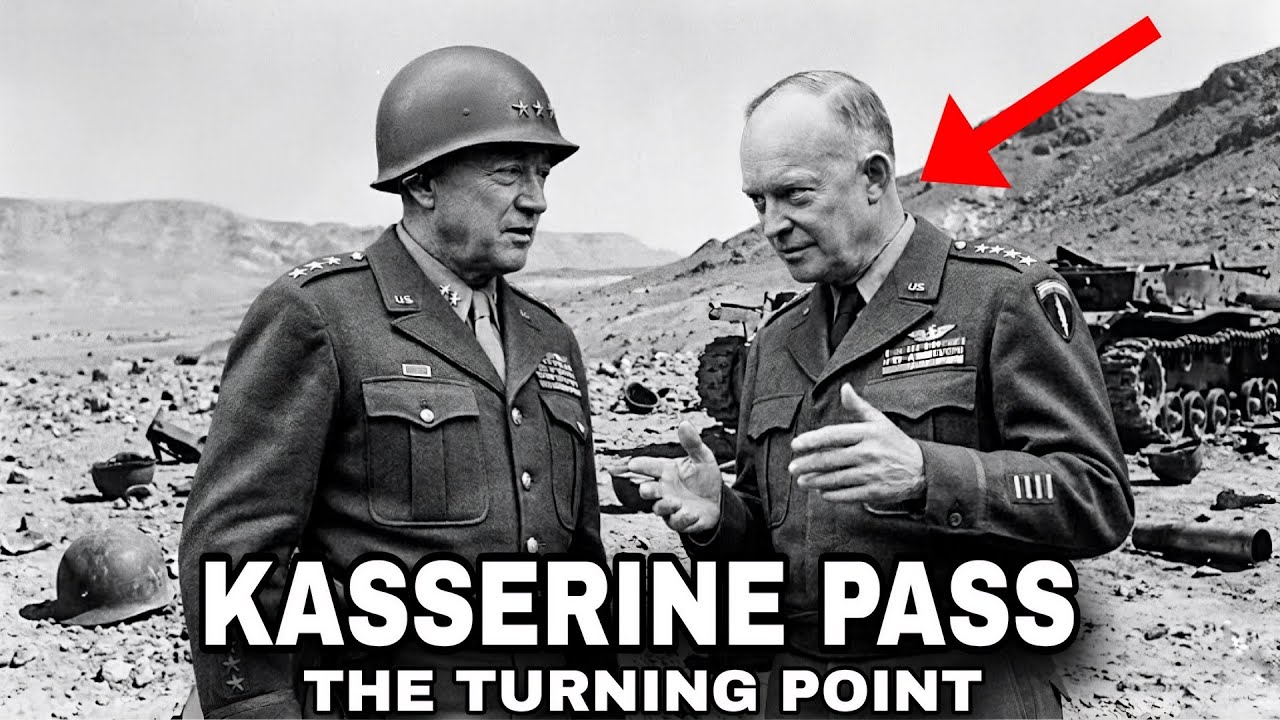
Declassified after-action reports, Bradley's memoir, and Eisenhower's own correspondence to Marshall revealed that the failure at Kasserine was not principally a failure of the American soldier. The soldiers fought. They retreated when their flanks collapsed because their flanks were exposed by poor command decisions. The collapse at Kasserine was, at its core, a leadership failure, not a fighting failure.
Eisenhower understood this, and his next move would prove it. British General Harold Alexander, the new commander of 18th Army Group overseeing all Allied ground forces in Tunisia, also made his position clear to Eisenhower. He wanted Fredendall removed. The British had watched the American performance with growing skepticism, and Alexander was not subtle about expressing it.
Eisenhower first offered the Second Corps command to Major General Ernest Harmon, who had helped stabilize the line during the final days of Kasserine. Harmon refused. His reasoning was straightforward in principle. He had written a critical report about the state of Second Corps, and it would be improper, he said, to benefit from his own negative assessment by taking command on its basis.
Eisenhower made his choice. On March 5, 1943, he personally flew to Tebessa to inform Fredendall that he was being relieved of command. Eisenhower handled the conversation carefully. He framed it as a standard reassignment rather than a dismissal, presenting it in a way that would protect Fredendall's professional reputation.
Fredendall, who had been largely isolated from the reality of his corps's condition, was escorted out of the theater. He would return to the United States and spend the rest of the war in a training role. By March 6, a very different kind of general was stepping into his place.
George S. Patton arrived at Djebel Kouif, the Second Corps headquarters in Algeria, on March 7, 1943. He was two stars when he boarded the plane. He carried his third star with him, conferred by Eisenhower as part of the authority being placed in his hands.
Before he even reviewed the battle maps, before he had studied the disposition of the battered units under his new command, Patton opened his diary that evening and wrote something that captured everything about how he approached the task ahead. "It is taking over rather a mess, but I will make a go of it," he wrote.
What Eisenhower said to Patton when he handed over command of Second Corps was not a dramatic speech. It was not recorded in a formal transcript, but the conversation is reconstructed from multiple overlapping historical accounts, most notably from Stephen Ambrose's research documented in The Supreme Commander, and from the American Heritage account of the Eisenhower-Patton relationship drawn from primary correspondence.
Eisenhower told Patton three things. He told him to restore the morale of a broken corps. He told him to raise the image of American fighting forces in the eyes of their British allies by winning a battle. And then, according to the historical record, Eisenhower added one sentence that revealed exactly how well these two men understood each other. He told Patton that he did not have to prove to him that he was courageous.
Think about the weight of that sentence for a moment. Eisenhower was not giving Patton confidence. He was releasing him from the obligation to prove something. After years of knowing each other, after watching Patton operate in Morocco during Operation Torch and fight through the political chaos of the North African campaign, Eisenhower was telling him, "I already know what you are. Now go and fix what is broken."
It was less an order than a cleared runway. Patton now had the authority, the rank, and the explicit trust of the Supreme Allied Commander. The question was what he would do with it in the next 48 hours.
The answer came almost immediately, and it shocked every officer in Second Corps headquarters. Patton issued a series of orders that most of the staff considered almost theatrical in their severity. Every enlisted man old enough to shave would shave every day. Officers would wear their neckties in the field. Steel helmets were mandatory. Violations carried fines.
One officer who was present recalled Patton walking up to within a foot of his face and stating the rules in terms that left no ambiguity. Decades later, General Omar Bradley, who became Patton's deputy commander in that assignment, wrote about the psychological mechanism behind it.

Each time a soldier knotted his necktie, threaded his leggings, and buckled on his heavy steel helmet, Bradley observed, he was forcibly reminded that the pre-Kasserine days had ended and that a tough new era had begun.
Was Patton's discipline campaign the right prescription for a corps that had just suffered a catastrophic defeat? Some officers thought it was petty. Some thought it was a distraction from the real problems of tactical coordination and inter-unit communication. But Bradley's account suggests something more sophisticated was at work.
Patton understood that an army's bearing and its belief in itself are not separate things. A soldier who looks like a defeated man will fight like one. Patton was not issuing uniform regulations. He was issuing a message. The identity of this corps had changed as of today. Whether every officer agreed with his method did not matter. Within days, the corps felt it.
One of the unresolved questions of this story is what would have happened to the North African campaign and to the broader Allied strategy if Eisenhower had chosen to leave Fredendall in command after Kasserine. The scenario is not hypothetical in any abstract sense.
Alexander had flagged Fredendall's performance. Bradley had confirmed it in direct conversation. Harmon had written his critical assessment before even being offered the command. And yet Eisenhower had the authority to protect Fredendall, to frame Kasserine as a collective intelligence failure rather than a command failure, and to give him another chance.
Had he done so, Second Corps would have entered the next phase of the Tunisian Campaign under a commander its division generals had unanimously lost confidence in. The Battle of El Guettar, the first significant American victory against a German armored force, would likely never have taken place in the form it did.
Ten days after Patton took command, US Second Corps launched offensive operations in southern Tunisia. The target was the town of Gafsa. The broader operation brought American forces into direct contact with German armored units at El Guettar.
On March 23, 1943, less than three weeks after Patton's arrival, the First Infantry Division and the First Armored Division's 601st Tank Destroyer Battalion repelled a major German armored assault by the 10th Panzer Division. It was, by any rigorous military measure, the first time American ground forces had decisively held the line against a major German armored attack in the entire war.
Eisenhower, watching from Algiers, wrote about the First Infantry Division specifically: "The Hun will soon learn to dislike that outfit."
Another unresolved question concerns what Eisenhower himself truly believed in those weeks between Kasserine and El Guettar. In his official report on the Tunisian operations, Eisenhower wrote language that historians have described as deliberately understated. He did not call Kasserine a crisis. He referred to the German offensive as having reached its flood tide without having breached the barriers. He described it as an ebb.
These were the words of a commander managing a coalition, carefully shaping the narrative for British, French, and American audiences simultaneously. But his private correspondence with Marshall told a more candid story. He described the lessons as learned. He did not make excuses. The gap between his public language and his private record is one of the most instructive things in his entire wartime documentation.
Leo Baron, author of Patton's First Victory, a detailed study of the El Guettar operation, assessed Eisenhower's decision to relieve Fredendall with a specific historical judgment. Eisenhower's replacement of Fredendall with Patton, Baron concluded, shows that Eisenhower was a decisive leader who could make the tough decisions.
That sentence deserves to be examined carefully. Baron was not saying Eisenhower was brilliant. He was saying Eisenhower was decisive at the right moment. Those are two different qualities, and in command, the second one often matters more than the first.
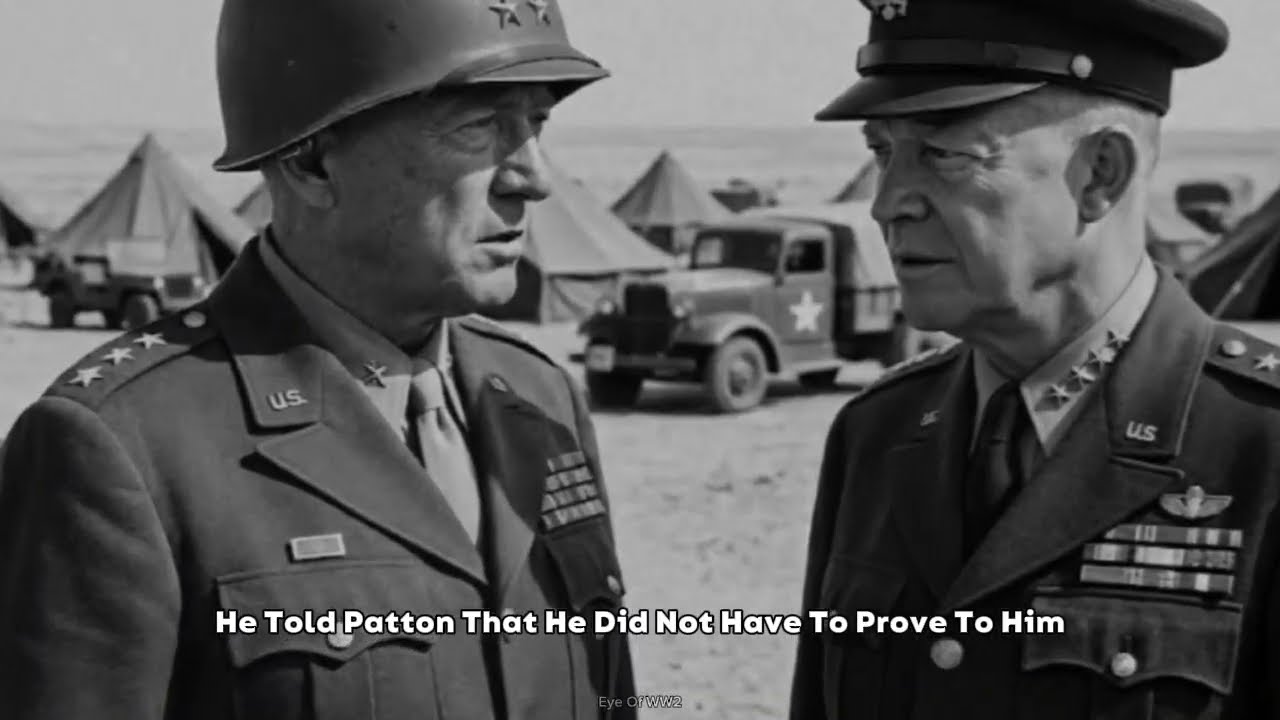
A third unresolved question connects everything that happened at Kasserine to the larger war. Patton had been assigned to Second Corps as a temporary measure. Eisenhower intended to move him to command the Seventh Army for the coming invasion of Sicily. The question was whether this brief, high-pressure assignment in Tunisia would prepare or exhaust him for that next mission.
Patton himself was aware of the temporary nature of his role. He knew Bradley would replace him when the Tunisian campaign reached its conclusion. This created a dynamic between the two men that was professionally tense and personally complex. Bradley, who admired Patton's tactical instincts, was also watching him with the measured eye of a man who would soon be expected to work alongside him at the same command level.
By May 13, 1943, the Axis forces in North Africa had surrendered. Nearly 250,000 German and Italian troops went into captivity in Tunisia. It was one of the largest surrenders in the entire war. And the Americans who had been routed at Kasserine Pass in February were among the forces that helped seal that outcome in May.
Three months. That was the distance between catastrophic defeat and strategic victory. In one of those three months, Patton had transformed Second Corps from a broken, demoralized formation into a unit that had held the line at El Guettar and advanced across Tunisia. The transformation was real. It was documented, and it began with a conversation in a headquarters somewhere between Algiers and the front lines.
Years later, in December 1944, during the Battle of the Bulge, Eisenhower and Patton shared a brief exchange as they concluded a command meeting at Verdun. Eisenhower, now wearing five stars, walked Patton to the door. With that dry Midwestern humor that surfaced whenever the pressure was highest, Eisenhower said something remarkable. "Funny thing, George, every time I get another star, I get attacked."
He was referring, among other moments, to his promotion to four stars just before Kasserine. Then Patton, without missing a beat, replied, "And every time you get attacked, Ike, I have to bail you out." It was not entirely a joke, and both men knew it.
The conversation that took place at the ruins of Kasserine Pass was not one conversation. It was a series of them, some formal, some brief, some written in letters that were never intended for public reading. Eisenhower's letter to Marshall, candid and accountable. Bradley's assessment at Tebessa, blunt and confirmed. Eisenhower's direct instruction to Patton, precise, personal, and trust-laden. Patton's entry in his diary, quiet and determined. Bradley's observation about the neckties, historically acute.
Each of these exchanges was a tile in a mosaic that, taken together, tells a story not about a defeat, but about what a military institution does when it confronts the distance between what it believed it was and what the evidence showed it to be.
Eisenhower would later write in his official assessment of the Tunisian campaign that for the specific task Patton had been given, he had no superior in the army. He added that Patton's buoyant leadership and strict insistence upon discipline rapidly rejuvenated the Second Corps and brought it up to fighting pitch.
These are calibrated words from a general who did not give praise lightly. They are also the words of a man who believed, from the moment he picked up the phone to call Patton, that this was the right decision. The record vindicates him.
One historian quoted a soldier present during the Kasserine period with a remark that has never been officially sourced but has been cited consistently across accounts of the era. Asked about the command structure under Fredendall, the unnamed soldier said, "Never were so few commanded by so many from so far away."
It was a soldier's assessment of a general who had placed himself 70 miles behind the front lines and issued cryptic orders through coded language that confused the men who most needed clarity. History has been more charitable to Fredendall than that soldier was, but it has not been more accurate.
The resolution to the questions left open at the beginning of this account is now visible. What would have happened had Eisenhower not removed Fredendall? The American contribution to the final Tunisian victory would have been far more limited, and Allied confidence in US forces would have taken months longer to recover, if it recovered at all before Sicily.
What did Eisenhower truly believe in those weeks? He believed the fault was structural and correctable, not fundamental. And what did the Kasserine assignment do to Patton? It confirmed him. It showed him, and showed Bradley, and showed Eisenhower exactly how he operated under the maximum possible pressure.
Three months after the United States Army's worst day in North Africa, that same army sealed the fate of a quarter of a million Axis troops on a peninsula in Tunisia. The story of Kasserine Pass does not end at the pass. It ends in the dust of a victory that Kasserine made possible.