History remembers her as the woman who saved the crown with nothing but charm. It is a comforting story, the kind that works well at a memorial service, but it does not hold up under close examination.
Long before she became Britain's beloved grandmother in pearls, long before a wartime legend turned her into a symbol of courage, she was simply a girl who had been given everything. From that early abundance she absorbed two lessons almost at once: that the world naturally arranged itself around her comfort, and that a smile could do more damage than a raised voice ever could.
She was born in 1900 as Elizabeth Bowes-Lyon, into the old Scottish aristocracy, the house of Strathmore and Kinghorn, a family with centuries of grandeur behind its name. Her childhood unfolded between two great estates, St. Paul's Walden Bury in the English countryside and Glamis Castle in Scotland, places steeped in ritual and inherited myth.
She was the ninth of ten children, a fact that might suggest a girl lost in the crowd, were it not for the peculiar habit of enormous aristocratic families of that era: they were excessively fond of the children who came last. Elizabeth and her younger brother David were the babies of the family, and they were treated exactly that way.
It was the kind of childhood that produces either humility or a sense of superiority, depending on the child, and Elizabeth developed the second. An army of servants kept the household running invisibly, and she absorbed, without ever having to think about it, the idea that comfort was simply how the world worked, not a privilege granted to her.
She was not the beauty of the family, not in the conventional sense. She lacked the cool, striking glamour some women are born with. What she had instead was a rarer and more effective charm that she could switch on at will, a sharp mind, and an unmatched talent for making people feel that her attention was a gift worth earning.
As a child she was theatrical, affectionate, and sharper than she let on, someone who could play the innocent while quietly setting the mood of an entire room. That is an unusual skill for a child to have already mastered, but she clearly possessed it early. The warmth came naturally. So did the willpower hidden beneath it.
Her upbringing taught her something else, something that would shape the rest of her life. The Bowes-Lyons were distinguished, but they were not of royal blood. They sat close enough to real power to understand its rhythms without ever being trapped by it, close enough to imagine stepping through the palace gates without already living behind them.
That particular vantage point breeds its own kind of hunger. Elizabeth grew up full of pride in her lineage, prepared and ready in case an opportunity to rise ever presented itself. Her education matched her expected future rather than any real intellectual ambition: French, music, dancing, the polished social skills that made a young woman excellent company and a capable hostess.
No one trained her to debate or think in public. She was educated to marry brilliantly, run a great house, and keep the machinery of high society running smoothly through charm alone. That training, whatever its limitations, taught her to read a room instantly, present herself with total control, and hide real effort behind an easy laugh. That last trick would become one of the defining skills of her entire life.
Then came the war, and it rewrote everything. She turned 14 on the day Britain entered the First World War, and Glamis Castle was almost immediately converted into a recovery home for wounded soldiers. The spoiled daughter of the elite suddenly walked corridors full of injury and fear.
She was too young to nurse officially, but she helped where she could: she visited patients, wrote letters home for men who could not do it themselves, and saw suffering up close for the first time in her life. The war did not make her a saint, but it did harden her; she learned to keep a calm face under pressure and to meet a crisis with the right posture and a clear voice.
It also cut straight through her own family. Her brother Fergus died in battle in 1915, and other brothers came home wounded or spent time as prisoners. In later decades she would use that wartime background to great public effect, as most royals of her generation eventually did. But for her it was not simply theater. She had genuinely learned something during those years.
She learned that sympathy, practiced often enough, becomes its own kind of authority, and that one can offer others real comfort while leaving one's own emotional core entirely untouched.
When peace finally came, society exploded back into pleasure with the desperate energy of people who had just crawled out of a shelter. Elizabeth entered that glittering postwar scene at exactly the right age to enjoy it to the fullest.
She was not one of the reckless "flappers" of the era, smoking in doorways and flouting convention for fun. She was something more dangerous than that. She looked entirely respectable while doing exactly as she pleased. She could flirt without seeming loose and laugh without seeming wild.
Men noticed her, and other women noticed that the men noticed her. The marriage market for aristocratic women was ruthless beneath its flowery surface, and Elizabeth understood the game completely; she mastered the art of seeming delightfully unaware of her own appeal while missing nothing.
It was in this atmosphere that Prince Albert, the second son of King George V, truly entered her sphere of influence. Everyone called him Bertie, and he was never the family favorite. That honor was reserved for his glamorous older brother, Edward, who was adored everywhere.
Bertie was shy, full of anxieties, and burdened by a stutter that made public life feel like a punishment. He had grown up in a family where discipline mattered more than affection, and it showed in every anxious, dutiful bone in his body.
Elizabeth read him flawlessly from the start, and that accuracy mattered enormously. She understood that he needed someone stable, and she also understood exactly what a marriage to him would actually cost her. Privacy, ease, and much of her own freedom. Exchanged for proximity to the throne and a permanent seat at the center of national ceremonies.
For a woman who had grown up in comfort her whole life, that trade was no small thing to consider. So when Bertie proposed, she said no. That refusal told him something important, and it told everyone watching something important too. She was not just an impressed young woman ready to throw herself into the arms of the first prince who came along.
He asked again. She hesitated again. That hesitation gave her power, and it gave her time to genuinely consider whether she could survive and thrive inside the gilded cage a royal marriage would mean. She had seen enough of that world from the outside to know its coldest edges: the rituals, the hierarchy, the near-total absence of ordinary freedom. She was not about to step into that cage without first deciding she could run it from within.
In 1923 she finally accepted him. The popular version of this story likes to frame it as pure romance, and love was certainly part of the equation, but it was not the whole story. Duty, ambition, and the unmistakable pull of a marriage into the royal family sat in the room alongside affection. She did not choose to disappear into anonymity. She chose the biggest stage available to her.
Her wedding at Westminster Abbey proved immediately that she understood the power of symbolism. On her way to the altar she laid her bridal bouquet on the grave of the unknown soldier, a tribute to her fallen brother and to every other family touched by the war. It was a gesture both sincere and perfectly theatrical, and the public loved her for it instantly.
As Duchess of York, she brought real warmth into a family that had always seemed carved from stone. She was lively where they were stiff, approachable where they were reserved, and this quickly became the core of her public legend: the woman who softened Bertie and gave the whole dynasty a more human face.
That legend contained a core of truth, but it was also enormously useful to her, because the more the public saw her as the warm heart of the family, the more quiet influence she gained over how everything actually ran.
Her marriage to Bertie was loving, but it was never simply a strong woman selflessly supporting a vulnerable man. His dependence on her was, from the very beginning, a source of her own power. He relied on her judgment and drew his confidence from hers, and she was far too intelligent not to notice exactly what that dependence gave her.
When the young couple began their public duties, she stood beside her stuttering husband like a shield: she coached him, reassured him, and helped arrange the speech therapy that gradually improved his speaking. It is often described in tender, sentimental terms, and there was real tenderness in it. But there was also a sharper management instinct underneath.
She was not only supporting her husband. She was building an instrument for her own future. Because if Bertie could not function in public, her own path would stay narrow; if he could, it would open wide. She understood that calculation perfectly, even if she never said it out loud.
Meanwhile the older brother Edward kept shining in public while unsettling everyone close to him in private, seeking excitement and admiration, and seizing every chance to dodge his duties. To a pragmatic woman like Elizabeth, he must have looked like a crisis waiting to break.
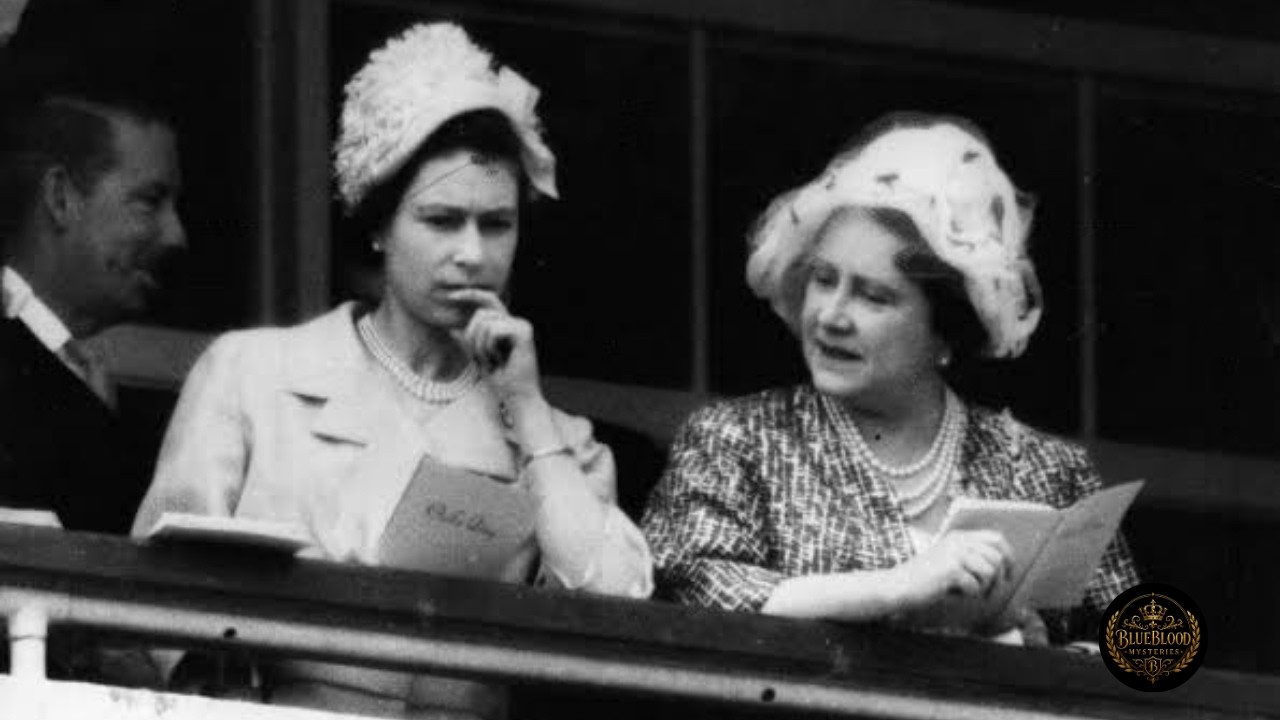
She was sharp enough to sense that the survival of the monarchy might not depend on the golden brother who dazzled the masses, but on the duller one who could be shaped to actually carry the job.
In 1926 she had her first daughter, Princess Elizabeth, and in 1930 a second, Margaret, born at Glamis, and suddenly the family portrait seemed complete. Two young princesses, a charismatic duchess, a household radiating exactly the calm and stability the wider royal family had always lacked.
That reputation became one of her greatest assets and also one of the great illusions of the century, because stability is a beautiful word that can conceal an enormous amount of quiet control.
By the early 1930s she was fully at home in royal life, not because she had surrendered to its demands, but because she had begun reshaping those demands to her own preferences. She loved beautiful things, flawless service, and the refinement of a perfectly run household, and she never for a moment saw herself as an ordinary woman.
She also had a good memory for slights, something that would prove enormously important later. She did not erupt in anger. Anger is crude and undignified. Her displeasure expressed itself coldly; she withdrew her warmth, remembered everything, and smiled a little less generously than before, and in a world built entirely on etiquette, that silent frostiness could be devastating.
Looking back, it is remarkable how early the future Queen Mother was already formed, long before a crown ever rested on her head. The need for comfort was there. The steel beneath the kindness was there. The gift for emotional theater was there.
She still looked light and young enough that most people saw only a charming aristocratic wife who had married well. But beneath the laughter she was already absorbing the most useful lesson a palace ever teaches. The person everyone underestimates is often the one quietly running the whole room.
By then the family was sitting on a secret so obvious it was barely a secret anymore. The Prince of Wales was a real problem, and not the kind older relatives could wave away with a meaningful sigh. Edward sought novelty, married women, and any excuse to escape his weekly duties.
His own father predicted more than once that the boy would destroy himself the moment the crown actually landed on his head. Elizabeth watched all of this closely. She had no particular affection for Edward, who was everything her own husband was not.
Restless and indulgent where Bertie was serious and burdened; to anyone who valued steadiness, Edward looked like trouble, impeccably dressed.
By the early 1930s the York household and the Wales household had effectively become two rival answers to the same pressing question. What did the monarchy actually need to survive the modern age? Edward offered glamour and risk. Bertie and Elizabeth offered discipline and the appearance of reliability, and that contrast grew more valuable with each passing year, because Britain, worn down by economic hardship and the slow decay of old certainties, wanted a monarchy that did not feel remote or unstable.
Elizabeth understood this instinctively. She had a genuine gift for making privilege seem inviting rather than distant, one of the most powerful tricks in public life, and she performed it beautifully.
Then Wallis Simpson entered the picture, and every previous royal headache suddenly seemed trivial by comparison. Wallis was American, sharp-witted, and already once divorced by the time she entered Edward's circle. And once he fixated on her, he stopped behaving like a prince entirely and started behaving like a man determined to prove that every warning he had ever received was beneath him.
Elizabeth's dislike of her was immediate, and it was mutual. That hostility was often framed purely as constitutional concern, and genuine constitutional concerns were certainly involved. But there was also a great deal of old-fashioned personal resentment underneath, sharpened by class, nationality, and pure rivalry.
Wallis had a talent for mockery that could come uncomfortably close to the truth. And a woman who had spent years polishing the monarchy's image does not simply forgive being treated as an easy target.
Elizabeth believed in the rules of this particular social game, because those rules worked in her favor. Wallis had never agreed to play by them.
Beneath the personal friction lay a real and serious question. Could a king actually marry a twice-divorced woman with two living ex-husbands? Could the government tolerate it? Could the church? The court's preferred strategy was delay, but delay changed nothing about how Edward felt. If anything, resistance only hardened his resolve, casting him as a romantic rebel being unfairly persecuted.
King George V died in January 1936, and the prince who had behaved like a perpetual disgrace for years suddenly became King Edward VIII. Becoming king changed nothing about him. That was precisely the problem.
Elizabeth understood immediately that this had shifted from a looming risk into an active emergency. In public she stayed calm. In private she could be sharp and fiercely protective of Bertie, watching as the growing uncertainty reopened every old wound and insecurity he carried, and something in her hardened into a fixed resolve.
Should disaster strike, she would not let him collapse, and she would not allow the institution to fail in front of the entire world.
In December 1936 Edward chose Wallis over the crown, freeing himself while saddling everyone else with consequences they had never asked for. Bertie would become king. Elizabeth would become queen. This looked nothing like the monarchy little girls dream of.
There was no clean, graceful ascent here, only a family wound laid out on every front page in the country. Edward had not died. He had simply walked away, forcing Bertie and Elizabeth to live the life he had refused to carry.
That alone would have permanently poisoned Elizabeth's feelings toward him. And permanent is exactly what happened. Some people forgive slowly. Others never forgive and only grow more elegant in their bitterness with age. Elizabeth belonged firmly to the second category.
From the moment of the abdication, her personal anger hardened into something cold and lasting, and she made a decision. If Bertie had to be king, he would become the absolute opposite of everything Edward stood for. Serious, dutiful, self-sacrificing, reliable; and she would stand beside him as living proof that duty could also radiate grace.
The new king and queen quickly set the emotional tone for their reign. Nothing about George VI came naturally, so every effort had to be hidden, reinforced, and wrapped in enough ceremony to mask the strain. Elizabeth understood this with almost professional precision: she managed the atmosphere in every room he entered and filled every silence his nerves left behind.
Meanwhile Edward, now demoted to Duke of Windsor, drifted into exile with Wallis, and simple dislike was never enough for Elizabeth. She wanted the couple banished to the farthest edge of royal life and fought bitterly over whether Wallis deserved the title Her Royal Highness.
George VI ultimately refused the title, and Elizabeth drew genuine, quiet satisfaction from that rejection; exactly the kind of cold, procedural punishment she valued most. She had a talent for packaging personal revenge as principle and making it look almost dignified, and for the rest of her life she showed no interest in reconsidering her position.
The coronation of 1937 gave her the chance to turn humiliation into spectacle, and she excelled at it, because she never confused genuine splendor with empty display. A crown could serve as mere ornament in one setting and pure reassurance in another; she understood exactly how visual grandeur works on the public imagination.
She looked that day as though she had been born entirely for the role, which may have been the most important impression she could have left.
At home another shift was underway. Princess Elizabeth was now the heir to the throne, and her mother, warm in her own formal way, never romanticized what lay ahead; she believed devoutly in preparing children for the burden of their rank rather than shielding them from it.

The elder Elizabeth was calm, cautious, and eager to please. Margaret was vivacious and far more open with her emotions. Courts have always rewarded calm over sparkle, and their mother, a woman made entirely of court instinct, noticed that difference early.
As Europe darkened further in the late 1930s, Edward's open sympathy for the German regime, including a widely noted 1937 visit in which he met Hitler personally, only deepened her contempt for him.
The queen also had a second task in these years: managing her husband's personal fear, because no crown cures a stutter and no ceremony erases a lifetime of feeling inadequate. Elizabeth converted that fear into discipline rather than letting it spill into confession.
She refused to let the public see him as second-rate and pulled him back toward his role whenever his confidence wavered, because she understood better than most people of royal blood that a monarchy survives by the grace of a performance.
By 1939 the transformation was complete. The laughing young Duchess of York had entirely disappeared. In her place stood a queen who had become something considerably more formidable than a mere helpmate. The polished public face of resistance itself.
When war finally broke out in September 1939, Elizabeth was no longer a sheltered girl watching a catastrophe from a safe distance. She was queen now, and the full meaning of her public role shifted overnight.
When sensible advisers suggested sending the princesses to Canada for their safety, she refused flatly with the statement that would define her wartime reputation: the children would not leave without her. She would not leave without the king, and the king would not leave under any circumstances.
In one sentence she united maternal devotion, marital loyalty, and national defiance into an unbreakable statement. The girls were moved to Windsor Castle instead, but the king and queen stayed in London. Because in wartime physical location becomes an emotional statement, and a royal family that fled abroad would look decorative and irrelevant at best, and cowardly at worst.
Then came the real attack. France fell in 1940, and once German bombers turned their full attention to British cities, London was no longer a theoretical target but a burning one.
This was the period of history that truly made Elizabeth famous. She visited bombed neighborhoods and hospitals, dressed practically without ever losing her elegance, and seemed tireless, because she understood instinctively that people enduring a collective trauma are not waiting for a sermon. They want to feel seen.
Yet beneath that warm wartime legend lay a hard core of steel. Because Elizabeth did not only want to offer comfort; she wanted the monarchy to remain essential rather than merely decorative. That is precisely why she and Winston Churchill, once he became prime minister, built such an effective working relationship. Both understood that wars are fought with symbols and morale as much as with weapons.
Then, in September 1940, Buckingham Palace itself was hit directly while the king and queen were inside. Neither was killed, but the damage was real and the shock genuine, and Elizabeth's response became one of the most quoted statements of the entire war. She said she was glad the palace had been hit, because now she could finally look the East End in the eye.
That remark captured a national sentiment instantly, suggested solidarity and shared sacrifice, and also revealed something very characteristic about her. She understood exactly how sympathy works as currency, and she saw immediately that the bombing had given her the moral standing to walk through devastated streets.
There were, of course, clear limits to the legend. She never lived anything remotely like the life of an ordinary Londoner enduring the Blitz. She still had staff, spacious rooms, and every comfort the war allowed. But she performed danger instead of avoiding it, and that performance carried enormous weight, because people genuinely saw that she stayed.
They saw her clothing dusted with the same soot that covered everyone else and concluded that she was brave in the truest sense, a quality the public can love almost as much as goodness itself.
The war hardened her hostility toward the exiled Windsors even further. The duke's conduct during the war raised suspicion, his earlier German sympathies still tainted his reputation, and eventually the couple was shipped off to the Bahamas, officially a diplomatic post, unofficially a paid exile.
Elizabeth objected to neither part of that arrangement. She did not trust Wallis an inch and trusted Edward even less. Whatever moral clarity the war gave some people, for her it eliminated any lingering chance that she would ever soften toward either of them.
Back home she became the keeper of tone and standard. Flowers still had to be arranged the right way. Order still had to be maintained. Manners mattered more than ever, because in her view civilization itself was under direct attack, and preserving these small elegant rituals was itself a form of resistance to barbarism; a conviction that, depending on who was watching, could seem genuinely admirable or faintly absurd.
By the middle war years, Queen Elizabeth had become one of the chief architects of royal wartime sentiment, turning a bombed palace into a national symbol and a marriage partly built on necessity into a public image of grace under pressure.
Few people stopped to consider how much effort it took to hold that smile, or how much she had come to enjoy finally being truly indispensable.
That kind of success carries its own quiet danger. Adoration easily turns into certainty, and Elizabeth increasingly came to believe that she and Bertie had earned something like moral superiority through their suffering. Britain owed them affection. History owed them rehabilitation. Edward, above all, owed them shame.
The Duke and Duchess of Windsor remained abroad, nursing their grievances at a distance; this stayed the one subject on which Elizabeth could never muster grace. She had a real talent for hiding resentment behind perfect manners, freezing a topic with a single sentence rather than raising her voice, and in her personal ledger actions always had consequences.
Both Edward and Wallis would keep paying in the currency she valued above all: exclusion.
The war in Europe ended in 1945 with much noise and relief, but peacetime proved considerably less flattering to the monarchy than wartime had. It invited criticism, questions about the budget, and increasingly blunt public demands to know why certain families still needed so many servants.
Elizabeth would never feel at home in that egalitarian postwar mood. Rather than distancing herself from visible grandeur, her instinct was to refine it, in the firm belief that a monarchy without beauty and radiance would decay into mere bureaucracy.
The problem was that beauty is expensive, and she had never had the temperament of someone who lives frugally. A fine setting, expert staff, and elegant rooms were never, in her view, superfluous luxury. They formed the very essence of what made a monarchy a monarchy.
This is exactly where her wartime halo and her lifelong taste for luxury met in the same person, sometimes grinding against each other like hidden knives. The woman publicly praised as brave and down-to-earth handled money in private with the breezy confidence of someone who had simply never believed the consequences would reach her.
And that wartime halo remained one of the greatest protective shields of her life, allowing her a lifestyle that would have seemed wildly inappropriate in anyone else the public loved less.
Her relationship with the new queen, once Elizabeth II took the throne, was warm but genuinely complicated. The daughter had always been beautiful and disciplined, while the mother had always been formidable, and building an identity as a sovereign while standing in the considerable shadow of a mother so professionally skilled at humanizing the monarchy cannot have been simple.
Then there was Princess Margaret, beautiful, magnetic, and far more willing than her sister to be led by feeling, whose romantic bond with the divorced group captain Peter Townsend became one of the first emotional crises of the new reign.

Townsend looked nothing like Wallis Simpson. He was respectable and genuinely admired. But he was divorced, and that single fact set off every alarm in a family still haunted by the events of 1936.
Elizabeth had spent years building a moral narrative in which her own household stood for duty while Edward and Wallis stood for pure self-interest, and she was not about to let her daughter blur that carefully drawn line.
She made no public scene. Instead she let the slow machinery of delay, institutional caution, and quiet pressure do the work for her, arranging for Townsend to be posted abroad in one of those elegant royal removals the palace had perfected. Officially a matter of duty, unofficially designed to smother the romance through distance.
In 1955 Margaret publicly announced that she would not marry him. A dignified and quietly devastating statement, exactly the ending the palace could live with comfortably, though hardly the kind of ending a young woman emerges from unscathed.
Margaret never fully forgave the forces that drove her to that decision, and her own mother stood among them; someone who had not personally broken her daughter's heart, but had loyally stood on the side of the system that did.
Meanwhile Elizabeth flourished in her widowhood in a way few people would dare admit out loud. As Queen Mother she gained freedom without losing relevance and grandeur without the full burden of constitutional duties, and she embraced the role immediately; she kept her own households running, entertained lavishly, and followed horse racing with genuine, expert enthusiasm.
With the same sharp attention to bloodlines and breeding she had once used to read a crowded room, she restored the Castle of Mey in the far north of Scotland as her own personal retreat; remote and picturesque, but never modest, because even her version of solitude came with staff, polished silver, and perfectly arranged views.
Her spending became the subject of hushed conversations and indulgent laughter in high society. Debts piled up. Bills had to be quietly smoothed over. The family absorbed much of what polite society preferred not to name directly as a problem, and the public let her wartime reputation blur the sharper edges of the truth.
Because a charming older lady with a drink in her hand looks very different from a woman living far beyond her means while the rest of the country modernizes around her. And for four decades Elizabeth managed to present the second reality as if it were simply the first, only with a prettier hat on.
She remained demanding and status-conscious for the rest of her life. Charming to anyone who could earn her approval, and cruelly dismissive in ways almost too elegant to quote directly toward anyone who could not.
Her feelings toward the Windsors never thawed. When the Duke of Windsor died in 1972, there were formal gestures of reconciliation and a frail, marked Wallis attended the funeral, but Elizabeth never became her friend. And there is no reason to pretend she made any real effort to.
The old grudge had simply smoldered too long, and whatever softer feelings she may have harbored in private, she kept them so well hidden that in practice they barely existed.
During these decades Britain changed around her at a dizzying pace. The Empire shrank into the Commonwealth, old deference eroded, and television pushed into every corner of a mystique that had always depended on distance to survive.
And every new royal generation was expected to be simultaneously magical and emotionally accessible, a demand the Queen Mother, entirely formed by an older code of reticent concealment, never truly understood.
When the marriage of Charles and Diana publicly fell apart in the 1980s and 1990s, Diana embodied a style of monarchy that deeply unsettled Elizabeth. A woman who replaced self-control with confessions rather than the other way around, and who was willing to show the public exactly what the palace had always instinctively buried.
That did not necessarily make the Queen Mother cruel toward her. It made her a product of a world in which survival and emotional concealment had become one and the same. She was genuinely unable to understand why a woman would seek public sympathy for wounds an older generation had hidden behind powder and stoic silence.
If a marriage became unhappy, you endured it. If a husband strayed, you kept your composure and said nothing.
Her grandson Charles, meanwhile, had always been close to her; he shared her love of history, ceremony, architecture, and the atmosphere of the old world in a way his own parents had never really offered him; and within the family she was often considerably more pleasant company for him than they had ever been.
As the years advanced, the losses piled up. Margaret's own health declined after a series of strokes and chronic illness; and the Queen Mother weathered her own falls and setbacks, but remained remarkably visible.
She appeared at commemorations and horse races, small and smiling, wrapped in bright colors, a woman who had permanently anchored herself in Britain's emotional fabric even as confidence in most other institutions around her collapsed.
Her hundredth birthday in the year 2000 was almost too perfect for a sentimental nation to resist. A living thread connecting the present to an England many suspected had never really existed except in her presence; born under Queen Victoria and still smiling in the age of mobile phones.
The celebrations were massive, the tributes endless, and her legend fossilized even further. Even though the private reality behind it remained far more complicated; she still spent enormous sums, still preferred luxury above all, still nursed old grudges, still expected the world to adjust to her, and remained entirely capable of a coldness sharp enough to crack glass.
Then, in February 2002, Princess Margaret died. A real blow at a moment when the Queen Mother herself was already fragile. Within weeks, on March 30, 2002, she died in her sleep at Royal Lodge, aged 101.
The nation responded with the kind of grief reserved for figures who are no longer ordinary people but have become national mythology.
But myths always gloss over what a real life leaves messy and unresolved. The popular story is simple enough. She was brave during the war. She supported an anxious king. She gave the monarchy a human face. And every part of that is true.
What is equally true is that she was spoiled from childhood and never really outgrew it. Her rank made her selfishness easy, and charm made it invisible, and she remained almost grandly unforgiving toward the one couple who had ever truly crossed her.
She made courage look effortless, precisely because she worked tirelessly at performing it. And that performance eventually turned into a sense of entitlement that was unique. She had suffered, and therefore she deserved.
In a less gifted woman, that selfishness would simply have been seen as selfishness. In Elizabeth it became a style. Her extravagance became continuity. Her lingering grievances became principles, wrapped in a particularly beautiful hat.
That was her particular genius, and quite possibly her greatest magic trick. She was not the saintly grandmother of nostalgic memory, and she was not the villain some later made of her. Cynical versions have tried to make her one or the other. She was something considerably more interesting than both.
A woman with real passion, real rank, and formidable emotional control, capable of comforting an entire bombed city and ignoring a family member in the same lifetime, without ever feeling a contradiction between those two acts.
She could defend the institution of the monarchy with true genius while quietly enjoying every privilege it gave her. Generous in her appearance and unforgiving in her judgment in the same breath.
The smile everyone remembers first was never the whole truth about her. It was the velvet over an iron frame, polished every day, arranged so that it seemed effortless, and not an inch of it moved without a fight. And the country that mourned her in 2002 ultimately mourned the velvet far more than it ever really understood the iron beneath.