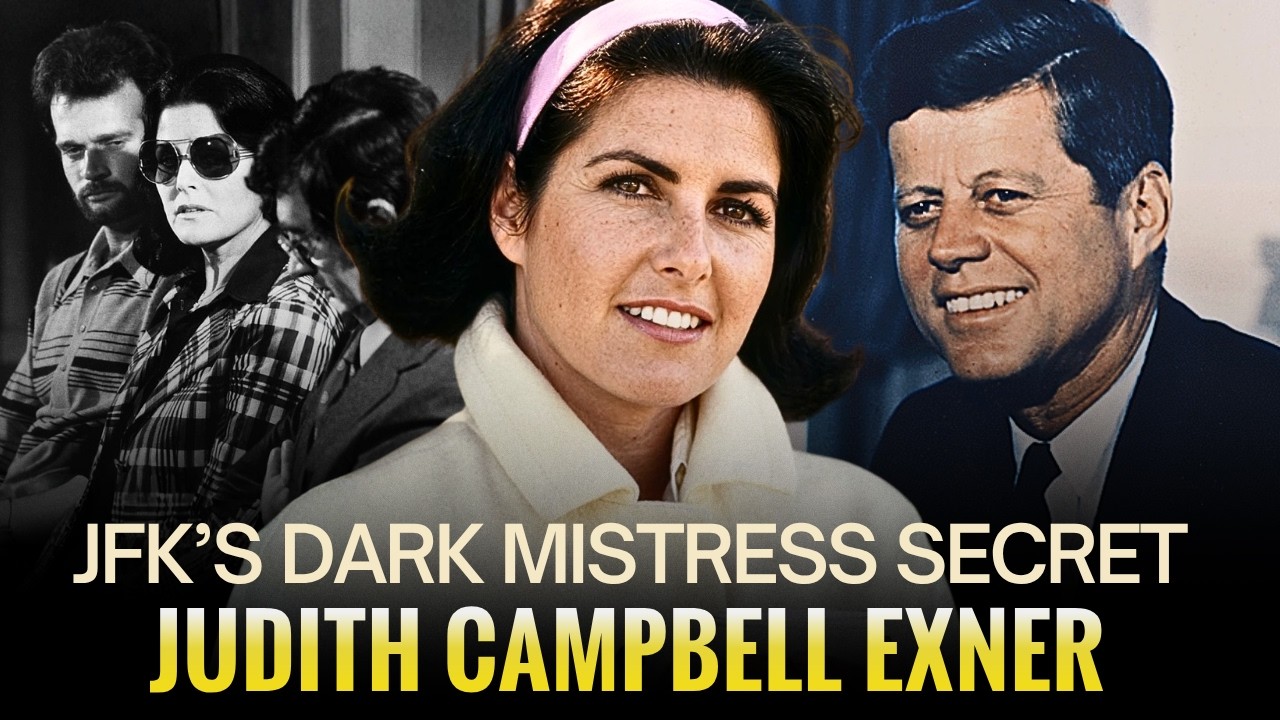
For nearly two years, Judith Exner lived at the center of a secret triangle connecting the president of the United States and the boss of the Chicago mafia. She shared a bed with John F. Kennedy and a life with Sam Giancana. She also carried sealed envelopes between them.
Her story remained buried for decades. When it finally surfaced, it exposed a side of American power that the public was never meant to see.
Judith Eileen Katherine Moore was born in 1934 into a world of strict rules and high expectations. Her family lived in Pacific Palisades, an exclusive wealthy enclave of Los Angeles. Her father was a prosperous architect who provided a life of immense privilege.
The household was rigid. Raised in a strict Catholic environment, Judith was taught early that appearances mattered above all else. People dressed impeccably, spoke with refined politeness, and kept private struggles hidden behind locked doors.
She possessed a striking, elegant beauty. In 1950s Los Angeles, that kind of beauty was valuable currency. At just 18 years old, in 1952, she married William Campbell, a working television and film actor.
Overnight, Judith traded the quiet wealth of the Palisades for the relentless glare of Hollywood. She became a regular at the most exclusive parties in Beverly Hills. But the marriage itself was hollow.
The constant pressure of the Hollywood lifestyle wore her down. By 1958, the marriage was over. At 24, Judith found herself single, highly connected, accustomed to extreme privilege, and untethered.
It was during this transitional period, in 1959, that she caught the eye of Frank Sinatra. Sinatra was the absolute center of gravity in the entertainment world. He collected people, politicians, actors, and business moguls, using social introductions to build his own capital.
Judith and Sinatra embarked on a brief romantic relationship. It lasted only a few months, but it fundamentally altered the rest of her life. Sinatra liked her because she understood the rules of the room. She did not ask probing questions and never spoke to the press.
When their romantic involvement faded, the friendship remained solid. She stayed firmly entrenched in his inner circle. That comfort led her to Las Vegas on the night of February 7, 1960.
Judith was staying at the Sands Hotel and Casino as Sinatra's guest. Sinatra was performing and holding court at his usual table. On this particular night, a highly prominent guest was in the audience.
John F. Kennedy, the senator from Massachusetts, was in the middle of a ruthless campaign for the presidency. When he walked over to Sinatra's table, Frank made the connection. He introduced the presidential hopeful to Judith.
The attraction was immediate. Kennedy was captivated by her elegance and her complete lack of intimidation. Unlike the young campaign volunteers who fawned over him, Judith was unimpressed by his fame.
She had been married to a Hollywood actor. She had dated Frank Sinatra. She looked at Kennedy directly, speaking to him not as a political icon, but as a man. That directness hooked him.
They spent the entire evening talking. By the end of the night, a silent agreement had been reached. The very next day, the phone rang. It was Kennedy.
Despite running a grueling national campaign, he called her every single day. He pursued her with aggressive focus. Judith was hesitant. She knew he was married and understood the complications of involvement with a man aiming for the Oval Office.
But the daily phone calls broke down her defenses. For exactly one month, the relationship existed purely through telephone wires and brief stolen moments on the campaign trail. The tension built until the first week of March.
Kennedy was scheduled to be in New York City. He arranged for Judith to fly out and meet him on March 7, 1960. They met privately in a suite at the Plaza Hotel. The physical affair officially began.
Judith stepped into the role of the hidden mistress. She believed she was managing the situation. What she did not know was that Frank Sinatra intended to introduce her to a second powerful man. The trap was only half set.
While Kennedy was meticulously building his political empire, Sinatra was operating a completely different kind of network. He functioned as a high-level facilitator, brokering relationships between men who operated in the light and men who operated in the shadows.
In the final week of March 1960, Judith traveled to Miami Beach. Sinatra was performing at the Fontainebleau Hotel, an opulent resort that served as the unofficial winter headquarters for the American underworld.
One afternoon, Sinatra brought Judith to a table at the Fontainebleau. He introduced her to two men. One was Johnny Roselli, a smooth, polished operative who served as the mob's primary liaison to Hollywood and Las Vegas.
The other was a quiet, intensely observant man whom Sinatra introduced simply as Sam Flood. Judith spent several days in their company. Sam Flood was polite, highly attentive, and treated her with traditional respect.
It was only later, through hushed conversations in Sinatra's orbit, that Judith learned the true identity of the man she was sitting with. Sam Flood was an alias. His real name was Sam Giancana.
Giancana was the undisputed boss of the Chicago Outfit, the most powerful and violent criminal syndicate in the United States. He controlled gambling, extortion, and labor unions across half the country.
Within a span of less than 60 days, Judith had become intimately involved with the Democratic nominee for president and was now forming a deep personal connection with the most powerful mobster in America.
The contrast between the two men dictated the nature of her dual life. Kennedy was a man in constant motion. His time was highly regimented by political aides. His interactions with Judith were intense but transactional.
He expected her to be available at a moment's notice, flying her into cities where he had a narrow window of free time between campaign rallies. He was entirely focused on his own needs.
Giancana operated differently. Despite running a massive criminal empire, he was patient. He did not rush her. He provided a sense of stability and protection that Kennedy could not offer. He treated her not as a hidden secret, but as a priority.
Throughout the summer of 1960, Judith navigated this impossible tightrope. She traveled to the Democratic National Convention in Los Angeles to be near Kennedy, slipping through back service elevators to avoid the press. Days later, she would meet Giancana for quiet dinners in private casino back rooms.
What makes this period historically staggering is the complete lack of compartmentalization. Judith did not hide the men from each other. Kennedy knew she was spending time with Giancana. Giancana knew she was spending time with Kennedy. Neither man demanded she stop.
For Kennedy, her connection to the Chicago mob was not a deal breaker. It was a highly intriguing asset. The political machinery of the 1960 election required leverage, and the Chicago Outfit controlled the unions and political wards that Kennedy needed to win Illinois.
In November 1960, John F. Kennedy won the presidency in one of the tightest margins in American history. The victory was secured in large part by a suspicious surge of votes in Giancana's territory of Cook County, Illinois.
When Kennedy moved into the White House in January 1961, the logistics of his relationship with Judith required a massive upgrade in operational security. Bringing a civilian with known ties to organized crime into the executive mansion required the complicity of the highest levels of White House staff.
The primary gatekeeper for this operation was Evelyn Lincoln, the president's personal secretary. Lincoln was fiercely loyal to Kennedy, functioning as a human firewall. She managed the private telephone logs and the back-channel schedules.
Over the next 18 months, Judith called the White House more than 70 times. These calls were not routed through the standard switchboard. They were directed through private lines heavily managed by Lincoln to ensure no official record linked the president to Giancana's associate.
When Judith visited the White House, she was often cleared outside the standard visitor logs. She was ushered through private corridors, bypassing the Secret Service detail that guarded the public perimeters. She was given direct access to the presidential living quarters.
But the White House Judith entered was not the polished, idealistic Camelot portrayed in the press. The reality of the executive mansion under Kennedy was a place of deep moral decay, extreme recklessness, and intense chemical dependency.
Kennedy viewed his executive power as a shield against consequences. The private quarters were frequently used for inappropriate gatherings. The president established a culture where the exploitation of staff was not only ignored but actively facilitated by his closest aides.
Young female interns, some just 19 years old, were brought into the administration and quickly maneuvered into highly compromising situations directly overseen by the president. Two White House secretaries, known by the nicknames Fiddle and Faddle, were frequently summoned to the White House pool for private parties during the workday.
Judith observed this culture firsthand. She found the environment deeply unsettling. Kennedy treated the women around him as disposable commodities.
Furthermore, the frantic pace of the presidency and Kennedy's relentless lifestyle were unsustainable without heavy medical intervention. Kennedy suffered from severe chronic pain, Addison's disease, and exhaustion.
To maintain his public image of youthful vigor, he relied on an illegal, highly dangerous chemical regimen. The architect of this regimen was Dr. Max Jacobson, known within elite circles as Dr. Feelgood.
Jacobson specialized in customized injections and was given unprecedented access to the White House, bypassing standard medical protocols. His treatments were potent cocktails consisting of massive doses of liquid methamphetamine, animal steroids, hormones, and placenta.
He injected the president directly, sometimes multiple times a day before debates, major speeches, and summits with foreign leaders. The side effects of this massive amphetamine abuse were severe. Kennedy exhibited extreme mood swings, hyperactivity, and periods of deep paranoia.
The drug use bled directly into his private life. He frequently encouraged his associates and the women he brought into the White House to partake in various chemical stimulants to enhance their private encounters.
The situation reached a terrifying breaking point in May 1962. During a stay at the Carlyle Hotel in New York City, the president suffered a massive adverse reaction to one of Jacobson's methamphetamine injections.
The leader of the free world experienced a severe psychotic break. He stripped off his clothing and began running frantically through the hallways of the hotel in a state of complete delirium. The Secret Service had to physically tackle him to the ground.
They dragged him back into his suite and locked the doors. The situation was so dire that standard medical staff were useless. They had to discreetly summon a prominent psychiatrist to sedate the president of the United States just to bring him back to reality.
Judith watched this erratic, dangerous behavior escalate. The man she had met in Las Vegas was disappearing into a chaotic cycle of pharmaceutical dependence and unrestrained power. She was increasingly alienated by his behavior, yet she remained trapped in the orbit.
By early 1961, as Kennedy settled into the Oval Office, he realized that Judith Exner was no longer just a beautiful companion. She was a tactical advantage. She was a civilian with no government clearance, no official intelligence payroll, and no formal political background.
To the Secret Service and the press, she was simply one of the many women who quietly slipped in and out of the president's private orbit. But to Kennedy, she was the perfect blind spot.
Because she was already intimately connected to Sam Giancana, she could move between the White House and the Chicago underworld without raising the alarms an official envoy would trigger. Kennedy needed a secure channel to the mafia.
The telephone was too risky, even with Evelyn Lincoln managing the switchboards. Written correspondence sent through traditional means could be intercepted. He needed a courier. He chose the woman who shared his bed.
The transition from mistress to accomplice began subtly. It started with a simple request to carry a sealed envelope on her next trip to Chicago to see Giancana. Kennedy did not explicitly detail the contents, but the weight of the request was clear.
Judith agreed. She was still under the spell of the presidency, still believing that she held a special protected place in Kennedy's life. Over the course of 18 months, she transported highly sensitive materials between the president and the boss of the Chicago Outfit.
She carried manila envelopes sealed with tape, heavy with cash and classified documents. She traveled by commercial trains and planes, a solitary woman carrying secrets that could have destroyed the American government.
Judith facilitated approximately 10 face-to-face meetings between Kennedy and Giancana. She coordinated the logistics, ensuring both men were in the same city, at the same hotel, at the exact right time, completely off the official record.
Initially, the envelopes contained payoffs. Kennedy was settling debts. The mafia had mobilized vast resources to buy votes in crucial districts in West Virginia and Illinois during the 1960 election, pushing Kennedy past Richard Nixon. The cash Judith carried was the return on that investment.
But soon, the stakes escalated from election fraud to international assassination. In the early 1960s, the United States government was obsessed with removing Fidel Castro from power in Cuba. Castro's communist regime was an unacceptable threat, sitting just 90 miles off the coast of Florida.
The government was not the only entity that wanted Castro gone. Before the revolution, the American mafia effectively owned Havana. They ran the casinos, hotels, and drug trade. Castro had kicked them out, costing the syndicates millions of dollars a day.
The CIA and the mafia found themselves with a mutual enemy. In one of the most bizarre and highly classified operations in American history, the intelligence community actively recruited the mob to assassinate a foreign leader.
Kennedy was deeply involved in the shadow war. Despite the public stance of plausible deniability, the president was using Judith to coordinate directly with Giancana regarding the Castro plot. The documents she carried were the blueprints for murder, passed from the Oval Office to the Chicago mob.
The sheer absurdity of her reality peaked during a scheduled meeting in a Chicago hotel. Kennedy was in town for a political event. Giancana was summoned to his suite. To maintain absolute secrecy, the president instructed Judith to hide.
While the leader of the free world and the boss of the American underworld sat in the bedroom discussing the logistics of assassinating a foreign dictator, Judith sat on the edge of a porcelain bathtub in the adjoining bathroom.
She sat there in silence, staring at the tile, listening to the muffled voices of her two lovers through the door. In that bathroom, the illusion of her life completely shattered. She realized the monumental danger she was in.
If anyone found out, she would be the first person thrown to the wolves. She was the ultimate disposable asset. This dangerous geopolitical game was playing out against a backdrop of deep hypocrisy.
While the president was secretly employing Giancana for state-sponsored murder, his brother, Attorney General Robert F. Kennedy, was launching a massive, highly publicized legal crusade to destroy the mafia. Robert Kennedy had set up a special task force dedicated entirely to putting Sam Giancana behind bars.
The mob was furious. They had bought the election for the Kennedys. They were doing the CIA's dirty work in Cuba. And in return, the president's brother was trying to lock them up. Judith was caught directly in the crossfire of this escalating war.
The pressure of this double life began to take a severe psychological toll. She was living in a state of constant low-level terror. But the final fracture in her relationship with Kennedy did not come from the espionage or the threat of the FBI.
It came from the sheer degrading reality of who John F. Kennedy was behind closed doors. By 1962, the president's behavior had become increasingly erratic and depraved. The chemical stimulants he was taking fueled a relentless appetite for sexual extremity.
He no longer viewed Judith as a partner. He viewed her as an instrument for his own gratification. The breaking point arrived on a quiet afternoon at the White House.
Judith arrived for what she assumed was a private meeting. She was ushered up to the presidential living quarters. When she walked into the bedroom, she froze. Kennedy was not alone. Another woman, a stranger, was standing in the room waiting.
Kennedy looked at Judith with a casual, empty confidence. He did not ask her permission. He simply expected her to comply. He told her not to be afraid, assuring her that she would enjoy it. He propositioned a threesome with the casual demeanor of a man ordering a drink.
For Judith, the moment was violently clarifying. She looked at the president, a man she had risked her life and her freedom for, a man she had genuinely cared for. She saw a void. There was no affection, no respect, no boundary he was not willing to cross for a fleeting thrill.
"My God, Jack," she replied, her voice thick with disgust. "How could you do this?" She turned and walked out of the room. That single ugly exchange killed whatever remaining affection she held for him.
It mirrored a similar degrading request Frank Sinatra had made years earlier, cementing her realization that to these men of immense power, she was entirely interchangeable. She was a toy.
But the physical entanglement with Kennedy had one final devastating consequence. Later in 1962, Judith missed her period. The reality set in with a crushing weight. She was pregnant. The father was the president of the United States.
In 1962, abortion was illegal, highly dangerous, and heavily stigmatized. For a single woman to seek one was to risk her life in back-alley clinics. For the mistress of a sitting Catholic president to seek one was a scenario of catastrophic political proportions.
When Judith informed Kennedy of the pregnancy, his reaction was exactly what one would expect from a ruthless politician managing a crisis. There was zero empathy. There was no comfort, no apology, and no emotional support.
He approached the unborn child purely as a liability that needed to be eliminated immediately. He arranged for the funds. He handed over the cash to pay for the procedure, washing his hands of the situation entirely.
He did not call to check on her. He did not ask if she was safe. He simply shut down the communication, treating her trauma as an inconvenience he had successfully paid to make go away.
Judith underwent the abortion in profound isolation. The physical pain was eclipsed only by the psychological devastation of being so entirely discarded by a man who had claimed to care for her. She was terrified, grieving, and completely alone.
In a bitter, striking twist of irony, the only person who offered her genuine humanity during the darkest moment of her life was the man who ordered murders for a living. When Sam Giancana learned of the situation, his reaction was the exact opposite of the president's.
The ruthless mafia boss, a man hunted by the federal government, dropped his defenses. He called her. He checked on her. He offered her a shoulder to lean on, providing the emotional shelter that the leader of the free world had coldly denied her.
Judith survived the abortion, but the woman who had walked into the Sands Hotel two years earlier was gone. She was exhausted, disillusioned, and carrying a burden of secrets that felt heavier by the day. She wanted out.
But stepping away from the president and the mafia is not a choice you get to make on your own terms. The machinery of Washington was already moving against her. Unknown to Judith, every time she picked up the phone, every time she carried an envelope, someone had been listening.
The director of the FBI had been building a file, and he was about to bring the entire operation crashing down. For nearly five decades, J. Edgar Hoover was the director of the Federal Bureau of Investigation. Presidents came and went, but Hoover remained.
He did not maintain this unprecedented run of power by simply enforcing the law. He maintained it by collecting leverage. Hoover kept highly confidential files on every major politician, activist, and celebrity in America.
If you had a vice, a hidden financial crisis, or a secret relationship, Hoover made it his business to know. He used this information as a silent, heavily guarded currency to ensure his own survival. Nobody dared challenge the director because everyone knew what was in the files.
Hoover deeply despised the Kennedy family. He viewed John F. Kennedy as a reckless, arrogant amateur who lacked the moral discipline required for the presidency. But Hoover's true hatred was reserved for the president's younger brother, Attorney General Robert F. Kennedy.
Robert Kennedy was technically Hoover's boss. He was young, aggressive, and entirely uninterested in Hoover's established way of doing things. More importantly, Robert had launched a massive, heavily publicized crusade against organized crime.
He formed a specialized unit specifically designed to dismantle the mafia, publicly hauling mob bosses into Senate hearings and tying up their operations with relentless federal indictments. This crusade put Hoover in a difficult position.
For years, Hoover had publicly minimized the existence of a national crime syndicate, preferring to focus FBI resources on easier targets. Robert Kennedy forced Hoover to pivot, demanding aggressive wiretaps and surveillance on the Italian mob.
It was a catastrophic miscalculation by the Kennedy administration. By ordering Hoover to intensely surveil the mafia, Robert Kennedy unknowingly directed the FBI's magnifying glass squarely onto his own brother's most dangerous secret.
The FBI began aggressively wiretapping the Chicago Outfit. They planted bugs in restaurants, tapped the private phone lines of mob associates, and monitored the movements of top enforcers. They were listening to Sam Giancana. They were listening to Johnny Roselli.
And because they were listening to the mob, they started hearing about Judith. At first, the FBI agents analyzing the wiretaps did not know who she was. She was simply a frequent female voice on the line, a woman Giancana and Roselli spoke to with familiarity.
But Hoover's agents were meticulous. They began tracking her movements. They traced her phone calls. They cross-referenced her travel records with Giancana's schedule. Then the agents auditing the phone logs made a discovery that sent shock waves all the way up to Hoover's private office.
They realized that the woman closely associated with the boss of the Chicago mafia was making direct phone calls to the White House. These were not calls to a public switchboard. The FBI traced the numbers and realized they were calling the private lines managed by Evelyn Lincoln.
They tracked Judith's movements to Washington, D.C., confirming that on the same day she was logged making these calls, she was entering the executive mansion. The pieces snapped together.
The president of the United States and the target of the attorney general's massive criminal investigation were sharing the same woman. Furthermore, this woman was traveling across the country carrying God knows what between the Oval Office and the Chicago underworld.
For J. Edgar Hoover, this was the ultimate prize. It was the absolute undeniable leverage he needed to permanently neutralize the Kennedy brothers. Hoover moved with calculating precision.
He did not immediately go to the press. Leaking the information would destroy the president, but it would also destroy the leverage. Hoover wanted the Kennedys in his pocket.
On February 27, 1962, Hoover made his first move. He drafted a highly classified, heavily redacted internal memo. He sent it directly to Attorney General Robert Kennedy and key White House aides.
The memo did not tell the whole story. It was a deliberate warning shot. It vaguely outlined that the FBI had uncovered a connection between the Chicago mafia, a woman named Judith, and the White House telephone logs.
The memo triggered absolute panic in the West Wing. Robert Kennedy realized immediately the catastrophic danger his brother was in. The very men he was trying to put in federal prison had a direct line to the Oval Office.
If the Republicans found out, it meant impeachment. If the public found out, it meant the end of the Kennedy dynasty. But Hoover wasn't finished. The memo was just the setup.
The final blow was delivered a few weeks later. At 10:30 in the morning on March 22, 1962, J. Edgar Hoover walked into the Oval Office. He had scheduled a private one-on-one lunch with President John F. Kennedy.
There are no official transcripts of what was said in that room, but the mechanics of Hoover's method were well known. Hoover sat down across from the president. He brought a dossier. He opened it. He laid out the facts.
He presented the telephone logs, the dates, the hotel records, and the surveillance reports on Sam Giancana and Johnny Roselli. He presented the undeniable proof that the FBI knew exactly who Judith Exner was, what she was doing, and who she was doing it for.
Hoover did not need to yell. He did not need to make a direct threat. In the brutal high-stakes game of Washington politics, the presentation of the file was the threat. The message was crystal clear.
I hold your political life, your legacy, and your freedom in my hands. The crusade against the mob stops now, and you will never attempt to fire me. Kennedy was cornered. For all his wealth, his charm, and his executive power, he was completely paralyzed.
The president of the United States had handed the keys to his presidency to the director of the FBI. The reaction of the Kennedy political machine was instantaneous and ruthless.
The moment Hoover walked out of the Oval Office, Kennedy shifted from a reckless man playing a dangerous game to a cold, calculating politician in pure survival mode. The cleanup operation began immediately. Every single tie to the underworld had to be severed that very afternoon.
A few hours after the lunch with Hoover, the phone rang in Judith's apartment. She picked it up. It was Kennedy. His voice was entirely different from the charming, confident man she had known. It was cold, clipped, and devoid of any affection.
He did not apologize for the trauma of the abortion. He did not ask how she was doing. He delivered a blunt, terrifying message. He told her that her telephone lines were being tapped by the FBI.
He told her that J. Edgar Hoover knew everything about her relationship with him and her relationship with Sam Giancana. He told her they could never speak again. Before she could fully process the magnitude of what he was saying, the line went dead. Kennedy hung up.
Just like that, a relationship that had spanned nearly two years, a relationship that had pulled her into the deepest, darkest quarters of American power, was erased. Kennedy never answered another call from her. He never reached out to see if she was safe.
To protect his crown, he threw her directly out of the moving vehicle, leaving her stranded in the crosshairs of the FBI and the mafia. But Judith was not the only one discarded that afternoon.
Frank Sinatra, the man who had brokered the entire arrangement, was next on the chopping block. Kennedy had been scheduled to stay at Sinatra's sprawling compound in Palm Springs later that month. Sinatra had spent massive amounts of money preparing for the presidential visit, building a helipad and upgrading security.

Following the Hoover meeting, the White House abruptly cancelled the trip. Kennedy's team informed Sinatra that the president would instead be staying at the nearby estate of Bing Crosby, a staunch Republican. It was a public, humiliating slap in the face.
Sinatra was devastated and enraged. He had used his vast network and personal capital to help Kennedy win the election. He had introduced Kennedy to the women he wanted and the mobsters he needed. Now, because of FBI pressure, Kennedy was treating him like a disease.
The consequences of this sudden, brutal pivot rippled outward, crashing directly into the Chicago underworld. Sam Giancana and Johnny Roselli realized exactly what had happened. They had rigged an election to put Kennedy in the White House.
They had risked their own lives and the stability of their organizations to coordinate with the CIA on the Castro assassination plots. They had kept the president's secrets. In return, the president's brother was trying to lock them in federal cages, and the president himself was abruptly cutting off all contact.
The mafia operates on a strict code of reciprocity. A deal is a deal. The Kennedys had broken the deal. The fury within the Chicago Outfit was intense and volatile. They did not just blame the Kennedys. They blamed the man who had vouched for them. They blamed Frank Sinatra.
Sinatra had guaranteed the mob that Kennedy would be a friend in the White House. Now the mob viewed Sinatra as a liability who had lured them into a trap. Sinatra's position in the underworld, once unshakable, became suddenly precarious.
He spent the next several years frantically trying to appease Sam Giancana, taking on massive financial losses in his casino businesses to smooth over the betrayal. But for Judith Exner, there were no casinos to leverage. There was no political machine to protect her.
She was a solitary woman holding the explosive truth about an administration that had just abandoned her and a criminal syndicate that was currently boiling with rage. She had witnessed the cash handoffs. She had sat in the hotel bathrooms while assassinations were planned.
She knew exactly what J. Edgar Hoover knew. She was completely isolated. The president of the United States had cut the cord. The FBI was listening to her every conversation. And the most violent men in America were realizing they had been double-crossed.
The glamour of the White House was gone. What remained was a terrifying reality. Judith was now a loose end. And in the world of high-stakes politics and organized crime, loose ends are rarely allowed to survive.
The silence that followed John F. Kennedy's final phone call was absolute. For nearly two years, Judith Exner's life had been dictated by the ringing of the telephone. She had lived on standby, waiting for the private lines of the White House to summon her or for the Chicago Outfit to coordinate a drop.
Now, the phone simply stopped ringing. But the silence did not mean she was alone. In fact, she was more closely watched than ever before. Hoover had successfully used Judith's existence to blackmail the president of the United States. He had forced Kennedy to stand down.
But Hoover did not close the file on Judith. In the paranoia-fueled ecosystem of the FBI in 1962, leverage was only valuable if you maintained absolute control over it. Hoover needed to ensure that Judith never spoke to the press, never contacted political rivals, and never revealed the extent of the FBI's surveillance operations.
To guarantee her silence, Hoover deployed a tactic he had perfected over decades: psychological warfare. Judith's life in Los Angeles quickly turned into a suffocating nightmare. The surveillance was no longer a secret. It was intentionally obvious. It was designed to induce terror.
She would walk out of her apartment to find unmarked sedans parked directly across the street. Men in dark suits would sit in the front seats, making no effort to hide their faces. When she drove to the grocery store, they followed her. When she went for a walk, they matched her pace from a distance.
Her phone lines clicked constantly. In the 1960s, wiretapping technology was not seamless. The distinct hollow echo on the line and the sudden drops in volume were clear indicators that government agents were recording every word she spoke.
Her mail arrived routinely delayed, the envelopes slightly wrinkled, the seals clearly tampered with and hastily glued back together. She was entirely isolated. She could not call her old friends in the Hollywood elite.
If she told them she was being stalked by the FBI because she had acted as a courier between the president and the mafia, they would think she had lost her mind. She could not contact Frank Sinatra. He had been brutally excommunicated by the Kennedy administration and was fighting for his own survival.
Her only remaining connection to the power structure was Sam Giancana. But that relationship was rapidly deteriorating. Giancana was fighting a two-front war. On one side, Attorney General Robert F. Kennedy was relentlessly pursuing him with federal indictments.
On the other side, the internal dynamics of the mafia were shifting. The Chicago Outfit was hemorrhaging money because of the Castro regime in Cuba. And the other syndicate bosses were furious that Giancana's massive investment in the Kennedy campaign had resulted in a federal crackdown rather than protection.
Giancana was angry, paranoid, and highly volatile. Judith realized that maintaining a connection to a mob boss who was actively being hunted by the Department of Justice was a death sentence. She quietly, carefully began to distance herself from him.
She stopped taking his calls. She moved apartments. She tried to disappear into the vast anonymous sprawl of Los Angeles. But disappearing is impossible when your own mind is turning against you.
The compounding trauma of the past two years began to tear her apart. She had survived a predatory Hollywood marriage. She had been used as a geopolitical courier. She had been subjected to a degrading proposition by the president. She had endured a deeply traumatic, isolated abortion. And now she was living under the constant heavy gaze of the federal government.
In late 1962, Judith fell into a severe, paralyzing depression. The woman who had once navigated the most exclusive rooms in the world could barely leave her bedroom. The paranoia became suffocating. She stopped eating. She suffered from chronic insomnia, pacing her apartment at night, waiting for the door to be kicked in by either federal agents or mob enforcers.
The pressure reached a breaking point. Unable to see a way out of the invisible cage Hoover had built around her, Judith attempted suicide. She survived, but the attempt left her mentally shattered, a hollow shell of the confident woman who had walked into the Sands Hotel in 1960.
She spent the next year trying to rebuild a semblance of a normal, quiet life, desperately hoping that the political machine in Washington would simply forget she existed. Then came the morning of November 22, 1963.
Judith was in Los Angeles when the news broke. Regular television programming was abruptly interrupted. A somber anchorman announced that shots had been fired at the presidential motorcade in Dallas, Texas. Minutes later, the confirmation was broadcast to the world. President John F. Kennedy was dead.
The United States plunged into a state of profound shock and mourning. The public wept for the young charismatic leader cut down in his prime. The media immediately began framing Kennedy as a martyr, a symbol of stolen potential. The narrative of Camelot was cemented into the American consciousness on that day.
Judith watched the television coverage in a state of absolute, freezing terror. She experienced a cognitive dissonance that almost nobody else in the country could understand. The public was mourning a saint. Judith knew the man behind the myth.
She knew about the drug cocktails, the reckless behavior, the casual cruelties, and the mafia alliances. But her fear was not rooted in the loss of her former lover. Her fear was rooted in sheer survival.
As she watched the chaotic aftermath unfold in Dallas, a horrifying realization washed over her. She knew exactly what John F. Kennedy had been doing in the shadows. She knew he had authorized the CIA to work with the mafia to assassinate Fidel Castro.
She knew he had accepted mafia money to win the election only to turn around and unleash his brother's Justice Department on the very men who had bought him the presidency. Kennedy had double-crossed the most dangerous men on the planet. And now he had been executed in broad daylight in the middle of an American city.
For Judith, the assassination was not just a national tragedy. It was a glaring, terrifying signal. If the mafia or rogue intelligence elements or a combination of both could successfully orchestrate the murder of the most heavily protected man on earth and get away with it, what could they do to a civilian from California?
She was a walking liability. She held the exact secrets that could connect the murdered president to the criminal underworld. In the weeks following the assassination, Washington went into lockdown.
J. Edgar Hoover took immediate control of the narrative, aggressively steering the investigation toward a lone gunman theory. The Warren Commission was established to provide the public with a definitive, cleanly packaged explanation for the murder.
Judith waited in agonizing suspense. She expected the FBI to arrive at her door any day. She expected a subpoena from the Warren Commission. She assumed she would be dragged into a windowless room and interrogated about her courier missions and the meetings she had arranged between the president and Sam Giancana.
The knock on the door never came. Hoover kept her name completely out of the official investigations. He buried the wiretaps. He sealed the files. His reasoning was entirely self-serving.
If Hoover exposed Judith Exner to the Warren Commission, it would expose the fact that the FBI had been blackmailing the president. It would expose the highly classified CIA assassination plots against Castro, violating massive national security protocols.
Hoover's priority was protecting the institution of the FBI and maintaining order. The simplest way to do that was to ensure Judith Exner officially did not exist. She was buried alive in the archives of the federal government.
The physical surveillance slowly dialed back, but the psychological damage was permanent. Judith spent the remainder of the 1960s living as a ghost. She was entirely adrift. Desperate for any anchor of normalcy, she entered into a brief, ill-advised relationship.
It was a catastrophe of a mistake driven by loneliness and trauma. She became pregnant again. This time there was no president to coldly hand over an envelope of cash. She was unmarried, financially unstable, and entirely broken mentally.
The paranoia still dictated her every move. She knew she could not provide a safe, secure environment for a child while she was constantly looking over her shoulder. In a heartbreaking decision that added another massive layer of grief to her life, Judith carried the baby to term and gave her newborn son up for adoption immediately after birth.
She signed the papers, walked out of the hospital, and returned to her empty apartment. The decade closed with Judith living in deep obscurity. She avoided the news. She avoided the political upheaval of the late 1960s.
When Robert F. Kennedy was assassinated in 1968, it only confirmed her darkest fears about the lethal consequences of power. She believed she had successfully hidden herself from history. She believed the secrets of Camelot and the Chicago Outfit would stay buried forever.
As the 1970s dawned, Judith was living quietly in California, completely detached from the political machine. She believed the past was permanently erased. But history rarely stays quiet. The past was simply waiting for the right moment to detonate.
The culture of Washington underwent a brutal transformation. The unquestioning loyalty that had defined the Kennedy era evaporated, replaced by deep systemic distrust. Two major events triggered this collapse.
First, in May 1972, J. Edgar Hoover died. For nearly half a century, Hoover had used his secret files to hold the government hostage. He had personally suppressed the truth about Kennedy, the mafia, and Judith Exner to protect his own leverage.
When Hoover died, his iron grip on the FBI's archives vanished. His highly classified dossiers, wiretapped transcripts, and surveillance logs were suddenly vulnerable. The secrets he had hoarded were left sitting in filing cabinets, waiting to be rediscovered.
Second, the Watergate scandal broke. The Nixon administration's brazen criminality and subsequent cover-up destroyed the public's faith in the executive branch. The press and the public stopped treating presidents like royalty. They demanded transparency.
This demand for truth forced the United States Senate to take unprecedented action. In 1975, they formed the Select Committee to Study Governmental Operations with Respect to Intelligence Activities. It became widely known as the Church Committee, named after its chairman, Senator Frank Church of Idaho.
The Church Committee had a specific, explosive mandate: investigate decades of illegal off-the-books operations conducted by the CIA and the FBI. They were not looking for Judith Exner. They were looking for evidence of rogue intelligence operations.
Specifically, they were investigating rumors that the CIA had attempted to assassinate foreign leaders. As Senate investigators dug through declassified CIA files and old FBI memos, they hit the jackpot.
They uncovered the paper trail detailing the government's alliance with the American mafia to eliminate Cuban leader Fidel Castro in the early 1960s. The investigators followed the money. They tracked the communications.
They pulled the White House visitor logs and telephone records from the Kennedy administration to see who was authorizing these operations. And right there, in the middle of highly classified documents linking the Oval Office to the Chicago Outfit, they found a glaring anomaly.
They found the name of a civilian woman from California. The Senate investigators saw that this woman, Judith Exner, had logged over 70 private phone calls to President Kennedy. They cross-referenced her name with FBI files from 1961 and 1962.
Hoover's old wiretap summaries confirmed that during the exact same time frame, this woman was closely associating with Sam Giancana and Johnny Roselli, the two specific mobsters the CIA had hired for the assassination plots.
The mathematical impossibility of a random civilian accidentally dating the president and the head of the Chicago mafia simultaneously was obvious. The Senate committee realized Judith was the missing link. She was the human bridge between Camelot and the underworld.
In California, Judith's quiet life shattered instantly. A federal subpoena was issued. Senate investigators tracked her down. They knocked on her door, armed with the authority of the United States government, demanding that she travel to Washington, D.C., to testify under oath about her relationship with John F. Kennedy and the Chicago Outfit.
The terror that had paralyzed her in 1962 came rushing back, amplified a thousand times. Judith knew exactly what was at stake. She was not being asked to gossip about a presidential affair.
She was being summoned to testify about a massive illegal conspiracy involving state-sponsored assassination, election fraud, and the highest levels of organized crime. She also knew that the men she was expected to testify about were not politicians who would simply hire lawyers. They were men who silenced witnesses permanently.

Her fears were entirely justified. As the Church Committee prepared its hearings in the summer of 1975, they also issued subpoenas to the top figures of the mafia involved in the Castro plots. They summoned Sam Giancana.
Giancana's life had spiraled significantly since the Kennedy years. After a stint in federal prison and years living in exile in Mexico to avoid further prosecution, he had been unceremoniously deported back to the United States in 1974. He was living under heavy FBI surveillance in Oak Park, Illinois.
His power within the mafia had diminished, but his knowledge of the syndicate's deepest secrets remained absolute. Giancana knew where all the bodies were buried. He knew about the stolen votes in 1960. He knew about the CIA cash. And he knew exactly what Judith Exner had carried in those sealed envelopes.
The Senate committee scheduled Giancana to testify. The mafia leadership, however, had a different plan. The syndicate operates on absolute risk management. A former boss angered by years of federal harassment, sitting in front of a live Senate microphone, was an unacceptable liability.
On the night of June 19, 1975, just days before he was scheduled to travel to Washington to testify before the Church Committee, Sam Giancana was cooking sausages in the basement kitchen of his Oak Park home.
Someone he trusted, someone who had bypassed his elaborate security system without forcing entry, walked up behind him. Giancana was shot in the back of the head. As he fell to the floor, the assailant stood over him and fired six more rounds directly into his face and neck.
The assassination was precise, brutal, and entirely calculated. It was not a robbery. It was a massive, undeniable message sent directly to anyone else who was thinking about talking to the United States Senate.
When the news of Giancana's execution broke on national television, Judith Exner went into a state of absolute psychological freefall. The man who had once protected her, the boss of the Chicago mafia, had been slaughtered in his own home to stop him from speaking.
She was now holding the exact same secrets he had died for, and the Senate committee was still demanding her testimony. Her life devolved into a constant state of siege. She barricaded herself inside her home.
She purchased a firearm and kept it under her pillow every single night. She acquired aggressive guard dogs. She refused to open the mail. She jumped at the sound of cars slowing down outside her window. She was entirely convinced that she was next on the hit list.
She tried to fight the subpoena. She begged the Senate investigators to leave her alone, citing the severe, immediate threat to her life. But the government was unrelenting. They needed a witness to corroborate the paper trail linking the White House to the mob.
Since Giancana was dead, Judith was their only remaining viable asset. Faced with the threat of federal contempt charges and potential imprisonment, Judith had no choice. She had to appear.
Her testimony before the Church Committee in 1975 was conducted behind closed doors. She walked into a secure room to face seasoned Senate investigators. She was terrified, exhausted, and operating purely on survival instincts.
Judith made a desperate, calculated decision. She chose to tell a half-truth. Under oath, she admitted to the affair with President Kennedy. She confirmed the timeline of their meetings and the frequency of the phone calls. She admitted to her friendships with Sam Giancana and Johnny Roselli.
But when the investigators pressed her on the espionage, when they asked if she had transported documents, if she had arranged private meetings between the president and the mob boss, if she had any knowledge of the Castro assassination plots, she flatly denied it.
She lied to the United States Senate to save her own life. She calculated that admitting to an affair would destroy her reputation, but admitting to being a courier for an international assassination conspiracy would get her killed.
She portrayed herself merely as a socialite who had accidentally found herself dating men in powerful positions, completely ignorant of their business dealings. The Senate investigators were skeptical. The FBI logs strongly suggested she was more than just a bystander.
But without Giancana alive to corroborate her deeper involvement, and with Judith sticking rigidly to her denials, the committee could not legally prove she was a courier. She survived the testimony, but the cost was immediate and devastating.
Despite the closed-door nature of her deposition, the government leaks in Washington were uncontrollable. Shortly after her appearance, her name was leaked to the press. The media explosion was catastrophic.
For 15 years, the American public had protected the myth of Camelot. Now, newspapers across the country were printing headlines about the president sharing a mistress with the head of the Chicago mafia. The political establishment, deeply invested in protecting the Kennedy legacy, launched a massive smear campaign against her.
Former White House aides went on television and flatly called her a liar. Evelyn Lincoln, the secretary who had personally managed Judith's 70 phone calls, publicly denied ever knowing who she was. The media painted her as an opportunistic, delusional woman seeking attention.
Judith was isolated, publicly humiliated, and still in mortal danger. The danger was violently confirmed a year later. In 1976, the Church Committee called Johnny Roselli to testify. Unlike Giancana, Roselli actually appeared.
He gave the committee limited but explosive details about the CIA-mafia plots. He confirmed the government's alliance with the underworld. Shortly after his testimony, Roselli vanished.
A few weeks later, a fisherman off the coast of Miami noticed a heavy 55-gallon steel drum floating in the bay. When authorities opened it, they found the remains of Johnny Roselli. He had been asphyxiated, his legs sawed off to fit inside the drum, and dumped into the ocean.
The triangle was gone. John F. Kennedy had been assassinated in Dallas. Sam Giancana had been executed in his basement. Johnny Roselli had been chopped up and thrown in the Atlantic. Judith Exner was the only one left alive.
She retreated completely from the world. She changed her name, moving quietly and constantly looking over her shoulder. She spent the late 1970s and the 1980s as a recluse, bearing the weight of a monumental historical secret that the public believed was a lie and the government knew was the truth.
She watched from the shadows as historians debated the Kennedy era, as books were written praising the administration, and as the men who had orchestrated the cover-up secured lucrative careers in Washington. She absorbed the insults, the accusations of perjury, and the complete destruction of her character in silence.
But silence has an expiration date. The trauma of carrying the truth eventually outweighs the terror of the consequences. As the years passed, the immediate threat from the mafia diminished. The older generation of mob bosses died off or went to federal prison.
Judith realized that if she died holding the secrets she had protected during the Church Committee hearings, history would permanently record her as a delusional footnote, a liar who had tried to smear an American president. She decided that she would not let them write her ending.
For over a decade, Judith Exner lived in a self-imposed exile. The 1970s bled into the 1980s, and the woman who had once navigated the inner sanctums of the White House and the Chicago mafia became a ghost. She attempted to construct a facade of normalcy.
In 1975, shortly after her bruising testimony before the Church Committee, she married a professional golfer named Dan Exner. They moved to Newport Beach, California. On paper, it looked like a quiet, respectable life.
She spent her days painting landscapes, avoiding the news, and staying entirely out of the public eye. But trauma of that magnitude does not simply vanish because you change your zip code. Judith was fundamentally broken by her experiences.
The profound betrayals by John F. Kennedy, the constant surveillance by J. Edgar Hoover, and the brutal assassinations of Sam Giancana and Johnny Roselli had hardwired her nervous system for panic. She suffered from severe depression.
Her marriage to Dan Exner buckled under the weight of her untreated PTSD and the inescapable shadow of her past. By 1988, they were separated. She was living alone, estranged from the world and holding the unvarnished truth about the American government in her head.
She had lied to the United States Senate to save her own life, denying her role as a courier. She assumed she would take the rest of the secrets to her grave. Then her body made the decision for her.
In the late 1980s, Judith received a devastating diagnosis: terminal breast cancer. The illness was aggressive. As she underwent grueling treatments, her perspective fundamentally shifted. For 20 years, her primary motivator had been the fear of being murdered by the mafia or destroyed by the federal government.
But terminal cancer operates as the ultimate truth serum. When an individual is confronted with the absolute certainty of exactly how and when their life is going to end, the ominous men in dark suits and the ruthless syndicate enforcers instantly lose all their psychological leverage.
Judith realized that the mob could no longer threaten her. The government could no longer ruin her. She was already dying. What terrified her now was not assassination. It was erasure.
She looked at how history was being written. Kennedy loyalists and White House aides had spent decades crafting a pristine, heroic narrative of the 35th president. In their books and television interviews, Judith was either entirely omitted or casually dismissed as a mentally unstable groupie who had exaggerated a brief fling.
She realized that if she died without speaking, the establishment would win. They would succeed in labeling her a liar, burying the reality of a presidency that was heavily compromised by organized crime and reckless abuse of power. Judith decided to take her name back.
The unraveling of the ultimate secret happened in stages. In 1988, facing her mortality, she granted an interview to People magazine. For the first time, she explicitly admitted what she had denied under oath to the Senate. She had been a courier.
She confessed to carrying the sealed envelopes between Kennedy and Giancana, detailing the cash and the classified documents regarding the Castro assassination plots. The political establishment reacted with predictable ferocity.
The guardians of the Kennedy legacy attacked her credibility instantly. Former Kennedy aides Arthur Schlesinger Jr. and Ted Sorensen scoffed at her claims. They called her assertions absurd, relying on the public's deep-seated desire to protect the image of Camelot.
They challenged her to provide proof, knowing full well that the cash handoffs and the secret meetings were specifically designed to leave no paper trail. But Judith did not retreat. The cancer was advancing, but so was her resolve.
She held back the most agonizing personal details for nearly another decade, waiting for the right investigative journalist to trust. In 1997, knowing she had very little time left, she sat down for a final, exhaustive series of interviews with Vanity Fair and renowned investigative reporter Liz Smith.
This time, she held nothing back. She laid bare the absolute, ugly reality of her time in Washington. She detailed the White House pool parties, the drug injections administered by Dr. Max Jacobson, and the degrading proposition by the president.
And finally, she revealed the deepest wound of all: the pregnancy in 1962 and the cold, entirely detached manner in which Kennedy had handed her cash for an illegal abortion before discarding her completely.
The 1997 revelation shocked the American public. It was no longer just a story about political espionage. It was a brutal indictment of Kennedy's humanity. The establishment tried to dismiss her one last time, but by the late 1990s, the shield protecting the Kennedy administration had severely cracked.
The Freedom of Information Act had forced the declassification of thousands of FBI and CIA documents. Investigative journalists, most notably Pulitzer Prize winner Seymour Hersh, began cross-referencing Judith's final confessions with the newly released government archives.
The vindication was absolute. Every single detail Judith provided matched the historical record. The date she claimed to have traveled to Chicago to meet Giancana perfectly aligned with the FBI surveillance logs of the mob boss. The dates she claimed to have been in the White House aligned with Evelyn Lincoln's private telephone records.
Even more damning, the people who had sworn to protect the president finally broke their silence. Retired Secret Service agents, the men who had stood outside the doors of the Oval Office, began speaking to reporters. They confirmed Judith's presence. They confirmed she was ushered in through private entrances.
They corroborated the reckless environment, the drug use, and the constant flow of illicit guests. The government insiders who had called her a liar for 20 years were systematically proven wrong by their own internal documents. Judith Exner did not make up a single detail.
The unbelievable triangle between the president, the mafia, and the young woman from California was a historical fact. She lived just long enough to see her truth validated. She spent her final months in a small hospital bed in Southern California, ravaged by cancer, but mentally unburdened.
The heavy, suffocating weight she had carried since 1960 was finally lifted. She had beaten the FBI. She had outlasted the mafia. And she had forced the American political machine to acknowledge her existence.
Judith Eileen Katherine Immoor Campbell Exner died on September 24, 1999. She was 65 years old. Her story is not simply a footnote in a presidential biography. It is a profound, chilling case study of how institutional power treats human beings.
Judith stepped into a world engineered entirely by men who operated without consequences. John F. Kennedy and Sam Giancana represented two seemingly opposite sides of the American spectrum: the absolute peak of legitimate authority and the absolute depths of the criminal underworld.
Yet to Judith, they were functionally identical. Both men used her as a tool, exploited her loyalty, and were perfectly willing to let her be destroyed to protect their own empires. For decades, the public was trained to view her as the villain, a scandalous woman who had tarnished a great presidency.
But the historical record reveals her true position. She was the collateral damage of a political system that was far darker, far more corrupt, and far more ruthless than the public was ever allowed to see.
In her final days, when asked to reflect on the entirety of her extraordinary, tragic life, Judith offered no grand political philosophies. Her conclusion was painfully intimate. The woman who had smuggled government secrets and stood between assassins and presidents stated simply that she had finally found peace by telling the truth.
Her life stands as a stark, enduring warning about the gravitational pull of extreme power. Her greatest tragedy was not that she knew the secrets of the nation, but that she made the very human mistake of seeking love in a world entirely built on leverage and lies.